
Your first day at a workshop where the boss and your co-workers speak Chinese: you walk through the door, everyone turns to look — and all you can manage is an awkward smile. Even the simplest greeting sticks in your throat. If that scene sounds familiar, this article was written for you.
This article brings together 100 Chinese sentences for workplace communication for newcomers: greetings, asking about your work schedule, reporting that you’ll be late, asking to swap shifts, asking about instructions again, talking in the warehouse and workshop, handing over your shift — each sentence comes with simplified Chinese characters, pinyin with tone marks and the meaning in English, ready to read aloud and use straight away. Read it all the way through once, pick out the 10 sentences you need most in your first week, then learn them by heart one by one. A week from now, you’ll find you no longer freeze when people ask you something.
How to get the most out of these 100 sentences
Every sentence in this article has 3 parts: the Chinese characters, the pinyin and the meaning in English. Read the pinyin aloud — don’t read silently with your eyes. Say it out loud; mistakes are fine, you’ll get more accurate as you go. The pinyin carries tone marks: tone 1 is flat, tone 2 rises, tone 3 dips down then rises, tone 4 falls sharply. Say a tone wrong and listeners can usually still guess from the work context, but say it right and they understand immediately, with no need to ask again.
One small tip every newcomer should know: at work, open with 请问 (qǐngwèn — excuse me, may I ask) or 不好意思 (bù hǎoyìsi — sorry to bother you) before asking anything. These two phrases are like a polite “can I just ask something” — gentle and courteous, and anyone who hears them is glad to help. And remember: workplace Chinese doesn’t need to be flowery. A short, clear sentence at the right moment is a good sentence.
Now let’s start. The ten groups below follow a single working day of yours, from walking in the door in the morning to leaving at the end of your shift.
100 Chinese sentences for workplace communication for newcomers
Group 1: Greeting co-workers — 10 sentences to open the working day
Greetings are the first thing in the morning, and your first impression too. Learn these 10 sentences by heart and you can greet the whole workshop.
- 1. 早上好!(zǎoshang hǎo) — Good morning!
- 2. 大家好!(dàjiā hǎo) — Hello, everyone!
- 3. 你好,我是新来的。(Nǐ hǎo, wǒ shì xīn lái de.) — Hello, I’m new here.
- 4. 很高兴认识你。(Hěn gāoxìng rènshi nǐ.) — Pleased to meet you.
- 5. 你叫什么名字?(Nǐ jiào shénme míngzi?) — What’s your name?
- 6. 我叫明英。(Wǒ jiào Míng Yīng.) — My name is Minh Anh.
- 7. 你是哪个部门的?(Nǐ shì nǎge bùmén de?) — Which department are you in?
- 8. 我在仓库工作。(Wǒ zài cāngkù gōngzuò.) — I work in the warehouse.
- 9. 请多多关照。(Qǐng duōduō guānzhào.) — Please look after me.
- 10. 谢谢大家。(Xièxie dàjiā.) — Thank you, everyone.
Group 2: Introducing yourself on day one — 10 sentences so people remember your name
On the first day, everyone asks who you are, where you work and where you’re from. Prepare these 10 sentences and you can answer smoothly, without having to think.
- 11. 我今天第一天上班。(Wǒ jīntiān dì yī tiān shàngbān.) — Today is my first day at work.
- 12. 我是越南人。(Wǒ shì Yuènán rén.) — I’m Vietnamese.
- 13. 我的中文不太好。(Wǒ de Zhōngwén bú tài hǎo.) — My Chinese isn’t very good yet.
- 14. 请说慢一点儿。(Qǐng shuō màn yìdiǎnr.) — Please speak a little more slowly.
- 15. 我会努力学习。(Wǒ huì nǔlì xuéxí.) — I’ll work hard at learning.
- 16. 我的工号是二零三。(Wǒ de gōnghào shì èr líng sān.) — My employee number is 203.
- 17. 我住在公司附近。(Wǒ zhù zài gōngsī fùjìn.) — I live near the company.
- 18. 我以前做过类似的工作。(Wǒ yǐqián zuòguo lèisì de gōngzuò.) — I’ve done similar work before.
- 19. 请问,我的座位在哪儿?(Qǐngwèn, wǒ de zuòwèi zài nǎr?) — Excuse me, where is my seat?
- 20. 请问,洗手间在哪儿?(Qǐngwèn, xǐshǒujiān zài nǎr?) — Excuse me, where is the toilet?
Group 3: Asking about your work schedule — 10 sentences so you never turn up for the wrong shift
Going to the wrong shift, at the wrong time, is the mistake every newcomer fears. Ask about the schedule clearly from the start and you won’t have to worry.
- 21. 今天几点上班?(Jīntiān jǐ diǎn shàngbān?) — What time do we start work today?
- 22. 几点下班?(Jǐ diǎn xiàbān?) — What time do we finish work?
- 23. 今天我上白班。(Jīntiān wǒ shàng báibān.) — I’m on the day shift today.
- 24. 明天我上夜班。(Míngtiān wǒ shàng yèbān.) — I’m on the night shift tomorrow.
- 25. 这个星期我休息哪天?(Zhège xīngqī wǒ xiūxi nǎ tiān?) — Which day do I have off this week?
- 26. 星期六要加班吗?(Xīngqīliù yào jiābān ma?) — Do we have to work overtime on Saturday?
- 27. 午休是几点到几点?(Wǔxiū shì jǐ diǎn dào jǐ diǎn?) — What time is the lunch break, from when to when?
- 28. 我几点可以吃饭?(Wǒ jǐ diǎn kěyǐ chīfàn?) — What time can I go and eat?
- 29. 下个星期排班表出来了吗?(Xià gè xīngqī páibān biǎo chūlái le ma?) — Is next week’s shift roster out yet?
- 30. 请问,今天谁是组长?(Qǐngwèn, jīntiān shéi shì zǔzhǎng?) — Excuse me, who is the team leader today?
Remember to tell apart the two most easily confused words in this group: 上班 (shàngbān) means starting work, and 下班 (xiàbān) means finishing work. Say these two the wrong way round and your team leader will roster you wrong on the spot.
Group 4: Reporting that you’ll be late, asking for leave — 10 sentences to rescue you on a bad day
Traffic jams, a broken vehicle, feeling unwell — it happens to everyone who works. If you can explain the reason clearly in Chinese, your boss will be understanding and your co-workers can arrange cover for you more easily.
- 31. 对不起,我今天要晚到。(Duìbuqǐ, wǒ jīntiān yào wǎn dào.) — Sorry, I’ll be late today.
- 32. 我大概晚十分钟。(Wǒ dàgài wǎn shí fēnzhōng.) — I’ll be about 10 minutes late.
- 33. 路上堵车了。(Lùshang dǔchē le.) — There’s a traffic jam on the way.
- 34. 我的车坏了。(Wǒ de chē huài le.) — My vehicle has broken down.
- 35. 不好意思,让你们久等了。(Bù hǎoyìsi, ràng nǐmen jiǔ děng le.) — Sorry to have kept you all waiting.
- 36. 我今天身体不舒服。(Wǒ jīntiān shēntǐ bù shūfu.) — I’m not feeling well today.
- 37. 我想请一天假。(Wǒ xiǎng qǐng yì tiān jià.) — I’d like to take one day off.
- 38. 明天我不能来上班。(Míngtiān wǒ bù néng lái shàngbān.) — I can’t come to work tomorrow.
- 39. 我家里有急事。(Wǒ jiālǐ yǒu jíshì.) — Something urgent has come up at home.
- 40. 谢谢你的理解。(Xièxie nǐ de lǐjiě.) — Thank you for understanding.
Group 5: Swapping shifts, asking for help — 10 sentences so you don’t have to struggle through on your own
A newcomer who carries everything alone ends up both slower and more mistake-prone. Asking for help once, swapping a shift once — that’s perfectly normal at work.
- 41. 可以跟你换班吗?(Kěyǐ gēn nǐ huànbān ma?) — Can I swap shifts with you?
- 42. 我星期五想换成白班。(Wǒ xīngqīwǔ xiǎng huàn chéng báibān.) — I’d like to swap to the day shift on Friday.
- 43. 麻烦你帮我一下。(Máfan nǐ bāng wǒ yíxià.) — Sorry to trouble you — could you help me?
- 44. 你能帮我搬一下这个箱子吗?(Nǐ néng bāng wǒ bān yíxià zhège xiāngzi ma?) — Can you help me move this box?
- 45. 这个怎么做?(Zhège zěnme zuò?) — How do I do this?
- 46. 请你教教我,好吗?(Qǐng nǐ jiāo jiāo wǒ, hǎo ma?) — Could you show me how, please?
- 47. 我一个人做不完。(Wǒ yí gè rén zuò bù wán.) — I can’t finish this on my own.
- 48. 我们一起做吧。(Wǒmen yìqǐ zuò ba.) — Let’s do it together.
- 49. 辛苦你了。(Xīnkǔ nǐ le.) — Thank you for your hard work.
- 50. 真的很感谢你。(Zhēn de hěn gǎnxiè nǐ.) — I really am grateful to you.
A small note for this group: when you ask someone for help, open with 麻烦你 (máfan nǐ — sorry to trouble you) and only then say what you need help with. It sounds much gentler than stating the request straight out.
Group 6: Checking instructions again, confirming the work — 10 sentences against doing things wrong
Doing a whole batch of goods wrong costs far more than asking one question. If you didn’t hear clearly, just ask — bosses prefer staff who ask clearly over staff who guess.
- 51. 不好意思,我不太明白。(Bù hǎoyìsi, wǒ bú tài míngbai.) — Sorry, I don’t quite understand.
- 52. 可以再说一遍吗?(Kěyǐ zài shuō yí biàn ma?) — Could you say that once more?
- 53. 请问,这是什么意思?(Qǐngwèn, zhè shì shénme yìsi?) — Excuse me, what does this mean?
- 54. 我再确认一下。(Wǒ zài quèrèn yíxià.) — Let me just double-check.
- 55. 是先做这个,对吗?(Shì xiān zuò zhège, duì ma?) — I do this one first, right?
- 56. 做完以后交给谁?(Zuò wán yǐhòu jiāo gěi shéi?) — Once it’s finished, who do I hand it to?
- 57. 今天的工作什么时候完成?(Jīntiān de gōngzuò shénme shíhou wánchéng?) — When does today’s work have to be finished?
- 58. 这个要做多少个?(Zhège yào zuò duōshao gè?) — How many of these do I need to make?
- 59. 我这样做对吗?(Wǒ zhèyàng zuò duì ma?) — Am I doing this right?
- 60. 明白了,我现在就去做。(Míngbai le, wǒ xiànzài jiù qù zuò.) — Got it — I’ll go and do it right now.
Have a listen to the sentences for asking for help and confirming instructions:
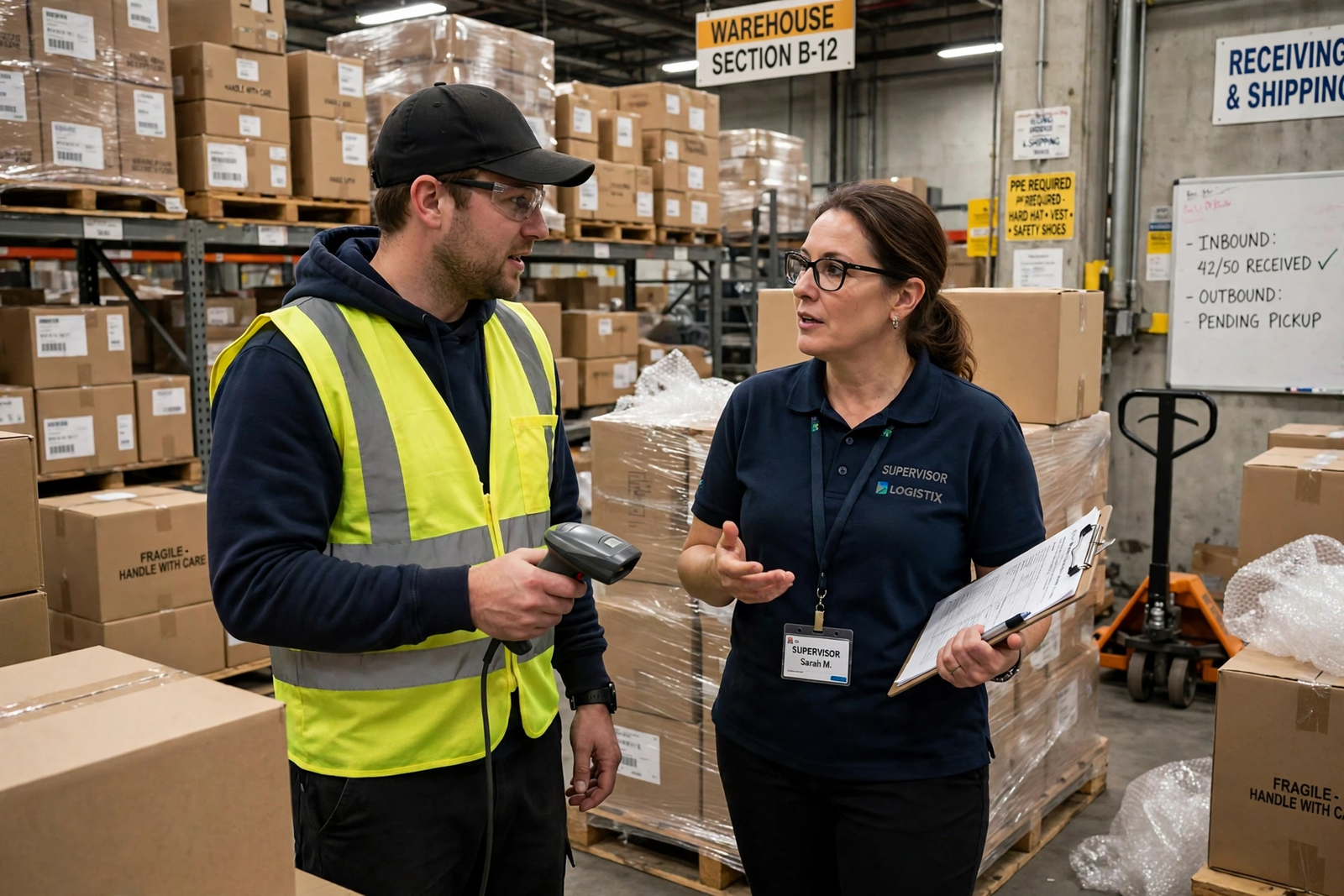
Group 7: Warehouse, workshop, checking goods — 10 sentences for warehouse workers
Many Vietnamese work in warehouses, workshops or delivery centres — places where every sentence is tied to boxes, parcels and quantities. This group is for you.
- 61. 请问,这个货放在哪儿?(Qǐngwèn, zhège huò fàng zài nǎr?) — Excuse me, where does this stock go?
- 62. 这个箱子有多少个?(Zhège xiāngzi yǒu duōshao gè?) — How many items are there in this box?
- 63. 请帮我数一下。(Qǐng bāng wǒ shǔ yíxià.) — Please help me count them.
- 64. 货到了吗?(Huò dào le ma?) — Has the stock arrived?
- 65. 还差五个。(Hái chà wǔ gè.) — We’re still five short.
- 66. 这个坏了,要换一个。(Zhège huài le, yào huàn yí gè.) — This one is damaged; it needs swapping for another one.
- 67. 请小心一点儿,里面是易碎品。(Qǐng xiǎoxīn yìdiǎnr, lǐmiàn shì yìsuìpǐn.) — Please be careful — the contents are fragile.
- 68. 贴标签了吗?(Tiē biāoqiān le ma?) — Have the labels been stuck on yet?
- 69. 包装好了,可以发货了。(Bāozhuāng hǎo le, kěyǐ fāhuò le.) — It’s packed — it can be shipped now.
- 70. 请把这个搬到二号仓库。(Qǐng bǎ zhège bān dào èr hào cāngkù.) — Please move this to warehouse number 2.
Group 8: Handing over your shift, reporting progress — 10 sentences to close your shift neatly
Finishing your shift doesn’t mean the job is over — the next shift still needs to know how far you’ve got. Hand over clearly and the person taking over doesn’t have to guess, and you can head home with a clear mind.
- 71. 今天的工作做完了。(Jīntiān de gōngzuò zuò wán le.) — Today’s work is done.
- 72. 我来交班。(Wǒ lái jiāobān.) — I’ve come to hand over my shift.
- 73. 上午的工作都完成了。(Shàngwǔ de gōngzuò dōu wánchéng le.) — All of the morning’s work is finished.
- 74. 下午请你继续做这个。(Xiàwǔ qǐng nǐ jìxù zuò zhège.) — Please carry on with this one in the afternoon.
- 75. 这个地方要注意一下。(Zhège dìfang yào zhùyì yíxià.) — This part needs a bit of attention.
- 76. 有三个箱子还没有贴标签。(Yǒu sān gè xiāngzi hái méiyǒu tiē biāoqiān.) — There are 3 boxes that haven’t had labels stuck on yet.
- 77. 机器出了一点儿问题。(Jīqì chū le yìdiǎnr wèntí.) — There’s a small problem with the machine.
- 78. 已经报告给组长了。(Yǐjīng bàogào gěi zǔzhǎng le.) — It’s already been reported to the team leader.
- 79. 明天早上八点开会。(Míngtiān zǎoshang bā diǎn kāihuì.) — There’s a meeting at 8 tomorrow morning.
- 80. 今天辛苦大家了。(Jīntiān xīnkǔ dàjiā le.) — Great work today, everyone.
Have a listen to the end-of-day shift handover dialogue:
Group 9: Lunch, breaks, small talk — 10 sentences to get closer to your co-workers
Workplace friendships often begin with one invitation to lunch. Chatting in Chinese is also the fastest way to practise speaking, because nobody is marking you during the break.
- 81. 一起去吃饭吧。(Yìqǐ qù chīfàn ba.) — Let’s go and eat together.
- 82. 食堂在哪儿?(Shítáng zài nǎr?) — Where is the canteen?
- 83. 你吃了吗?(Nǐ chī le ma?) — Have you eaten yet?
- 84. 我带了饭。(Wǒ dài le fàn.) — I brought my own food.
- 85. 休息一下吧。(Xiūxi yíxià ba.) — Let’s take a short break.
- 86. 你累吗?(Nǐ lèi ma?) — Are you tired?
- 87. 喝杯水吧。(Hē bēi shuǐ ba.) — Have a glass of water.
- 88. 今天天气真热。(Jīntiān tiānqì zhēn rè.) — It’s really hot today.
- 89. 你家住得远吗?(Nǐ jiā zhù de yuǎn ma?) — Do you live far away?
- 90. 周末你打算做什么?(Zhōumò nǐ dǎsuàn zuò shénme?) — What are you planning to do at the weekend?

Group 10: End of shift, goodbyes — 10 sentences to close a working day
The end-of-day goodbye sounds simple, but say it at the right moment and people remember you as the polite one. Don’t just slip away quietly.
- 91. 下班了,明天见。(Xiàbān le, míngtiān jiàn.) — Work’s done — see you tomorrow.
- 92. 今天谢谢你。(Jīntiān xièxie nǐ.) — Thank you for today.
- 93. 路上小心。(Lùshang xiǎoxīn.) — Take care on the way home.
- 94. 再见,明天见。(Zàijiàn, míngtiān jiàn.) — Goodbye, see you tomorrow.
- 95. 晚安,明天见。(Wǎn’ān, míngtiān jiàn.) — Good night, see you tomorrow.
- 96. 明天别迟到哦。(Míngtiān bié chídào ó.) — Don’t be late tomorrow!
- 97. 今天学到了很多。(Jīntiān xué dào le hěn duō.) — I learnt a lot today.
- 98. 明天我会早一点儿来。(Míngtiān wǒ huì zǎo yìdiǎnr lái.) — I’ll come a bit earlier tomorrow.
- 99. 辛苦了,大家再见。(Xīnkǔ le, dàjiā zàijiàn.) — Great work, everyone — goodbye.
- 100. 工作顺利,天天开心。(Gōngzuò shùnlì, tiāntiān kāixīn.) — May your work go smoothly and every day be a happy one.
2 model dialogues to practise speaking in real situations
Learning single sentences is one thing; stringing them into a dialogue is another. The two dialogues below are taken straight from the sentences above — read them turn by turn, swap roles with a study partner, and you can practise right away.
Dialogue 1: First day at work — greetings and introducing yourself
Minh Anh: 你好!我是新来的,我叫明英。(Nǐ hǎo! Wǒ shì xīn lái de, wǒ jiào Míng Yīng.) — Hello! I’m new here, my name is Minh Anh.
Xiao Li: 你好,明英!很高兴认识你。我叫小李。(Nǐ hǎo, Míng Yīng! Hěn gāoxìng rènshi nǐ. Wǒ jiào Xiǎo Lǐ.) — Hello, Minh Anh! Pleased to meet you. My name is Xiao Li.
Minh Anh: 你是哪个部门的?(Nǐ shì nǎge bùmén de?) — Which department are you in?
Xiao Li: 我在仓库工作。你呢?(Wǒ zài cāngkù gōngzuò. Nǐ ne?) — I work in the warehouse. What about you?
Minh Anh: 我也在仓库。请多多关照。(Wǒ yě zài cāngkù. Qǐng duōduō guānzhào.) — I’m in the warehouse too. Please look after me.
Xiao Li: 没问题。有什么不懂的,可以问我。(Méi wèntí. Yǒu shénme bù dǒng de, kěyǐ wèn wǒ.) — No problem. If there’s anything you don’t understand, you can ask me.
Listen to the first-day dialogue again:
Dialogue 2: Asking about the work schedule and reporting that you’ll be late
Minh Anh: 请问,今天几点上班?(Qǐngwèn, jīntiān jǐ diǎn shàngbān?) — Excuse me, what time do we start work today?
Xiao Li: 早上八点上班,下午五点下班。(Zǎoshang bā diǎn shàngbān, xiàwǔ wǔ diǎn xiàbān.) — We start work at 8 in the morning and finish at 5 in the afternoon.
Minh Anh: 对不起,我今天可能要晚到十分钟,路上堵车了。(Duìbuqǐ, wǒ jīntiān kěnéng yào wǎn dào shí fēnzhōng, lùshang dǔchē le.) — Sorry, I may be ten minutes late today — there’s a traffic jam on the way.
Xiao Li: 没关系,路上小心。你到了先找组长。(Méi guānxi, lùshang xiǎoxīn. Nǐ dào le xiān zhǎo zǔzhǎng.) — It’s fine, take care on the way. When you arrive, find the team leader first.
Minh Anh: 好的,谢谢你。(Hǎo de, xièxie nǐ.) — OK, thank you.
Listen to the dialogue about asking about the schedule and reporting lateness again:
You see — both dialogues only use sentences from the 100 above. Learn the single sentences by heart, string them together, and you can speak whole passages. Practise these 2 dialogues aloud 3 times today, and tomorrow at work you’ll find the words come out of your mouth far more naturally.
Summary table: 10 groups of sentences — which ones should you memorise first?
| Group | Situation | Sentence to memorise first |
|---|---|---|
| 1. Greetings | Walking through the door in the morning | 早上好!大家好! |
| 2. Introductions | First day at work | 我是新来的。请多多关照。 |
| 3. Work schedule | Asking about times, asking about shifts | 今天几点上班?几点下班? |
| 4. Arriving late, time off | Traffic jams, illness, urgent matters | 对不起,我今天要晚到。 |
| 5. Swapping shifts, asking for help | Swapping shifts, asking for things to be moved | 麻烦你帮我一下。 |
| 6. Checking instructions again | Not hearing clearly, afraid of doing it wrong | 可以再说一遍吗? |
| 7. Warehouse, workshop | Counting goods, labelling, moving stock between warehouses | 货到了吗?贴标签了吗? |
| 8. Shift handover | Ending the shift, reporting progress | 我来交班。今天的工作做完了。 |
| 9. Lunch, small talk | Break time, making friends | 一起去吃饭吧。 |
| 10. End of shift | Heading home at the end of the day | 下班了,明天见。 |
If you only have 5 minutes a day, learn 1 group a day and read its 10 sentences aloud 3 times. In 10 days you’ll have covered all 100 sentences. In the second week, review each group once more — that’s when the sentences really start to live in your head.
Quick exercises with answers
Exercise 1. You arrive at the company in the morning and want to greet the whole group — what do you say? — Answer: 大家好!(Dàjiā hǎo!) — Hello, everyone!
Exercise 2. You want to ask “What time do we finish work?” — which sentence do you say? — Answer: 几点下班?(Jǐ diǎn xiàbān?) Remember: 下班 means finishing work — don’t confuse it with 上班 (starting work).
Exercise 3. You’ve finished a task and want to ask whether you did it right — what do you say? — Answer: 我这样做对吗?(Wǒ zhèyàng zuò duì ma?) — Am I doing this right?
Exercise 4. At the end of your shift there are 3 boxes that haven’t been labelled, and you need to hand that over to the next shift — how do you say it? — Answer: 有三个箱子还没有贴标签。(Yǒu sān gè xiāngzi hái méiyǒu tiē biāoqiān.) — There are 3 boxes that haven’t been labelled yet.
Quick quiz: how many sentences do you remember?
Tap the answer you choose — right or wrong, you’ll know on the spot.
Your score: 0/5 — tap an answer to check right away.
Question 1. What does 请多多关照 (qǐng duōduō guānzhào) mean?
Question 2. What does 我今天要晚到 (wǒ jīntiān yào wǎn dào) mean?
Question 3. To ask “What time do we finish work?”, which sentence do you say?
Question 4. In which situation do you use the sentence 这个怎么做?(zhège zěnme zuò?)?
Question 5. What does 我来交班 (wǒ lái jiāobān) mean?
Frequently asked questions about Chinese for workplace communication
How many sentences should a beginner learn before starting work? You don't need to learn all 100 sentences before you can start work. Learn groups 1, 2 and 3 well first — about 30 sentences — and you can already greet people, introduce yourself and ask about times. Learn the remaining groups gradually over your first month: whenever a situation comes up, review that group.
If I get the tones wrong, will my co-workers still understand me? In a work context, most of the time yes, because they guess from the situation: standing in the warehouse asking "几点下班" nobody is going to take it as anything else. But get the tones right and they understand straight away, with no asking again — so keep practising reading aloud every day.
Do I need to learn to write Chinese characters to do the job? For the job, speaking and listening matter most. Recognising characters is useful when reading notice boards, goods slips and labels in the warehouse. Just learn to recognise characters alongside speaking — don't force yourself to write beautifully right from the start.
After learning these 100 sentences, can I talk with the boss yet? You'll be able to say the everyday work sentences: greetings, asking about times, reporting, handing over. For long conversations and presenting your views you'll need more specialist vocabulary from your own field — keep building it from real work every day and your stock of sentences will thicken up fast.
100 Chinese sentences for workplace communication for newcomers — you've read to the end, so now pick out the 10 sentences you need most tomorrow and read them aloud 3 times before you go to sleep. Which sentence do you think you'll use this very week? Tell me in the comments, and send this article to friends who are getting ready to work in a Chinese-speaking environment. Want to keep learning along a ready-made pathway? Start from LingoBubbo's Chinese page — every article there already has vocabulary, audio and a quiz ready. If you work as a driver or delivery rider, have a read of the article 60 Chinese sentences for drivers and delivery riders, and if you work in sales or customer care, drop by the article 80 Chinese sentences for sales and customer care — the same way of learning, just different situations.