
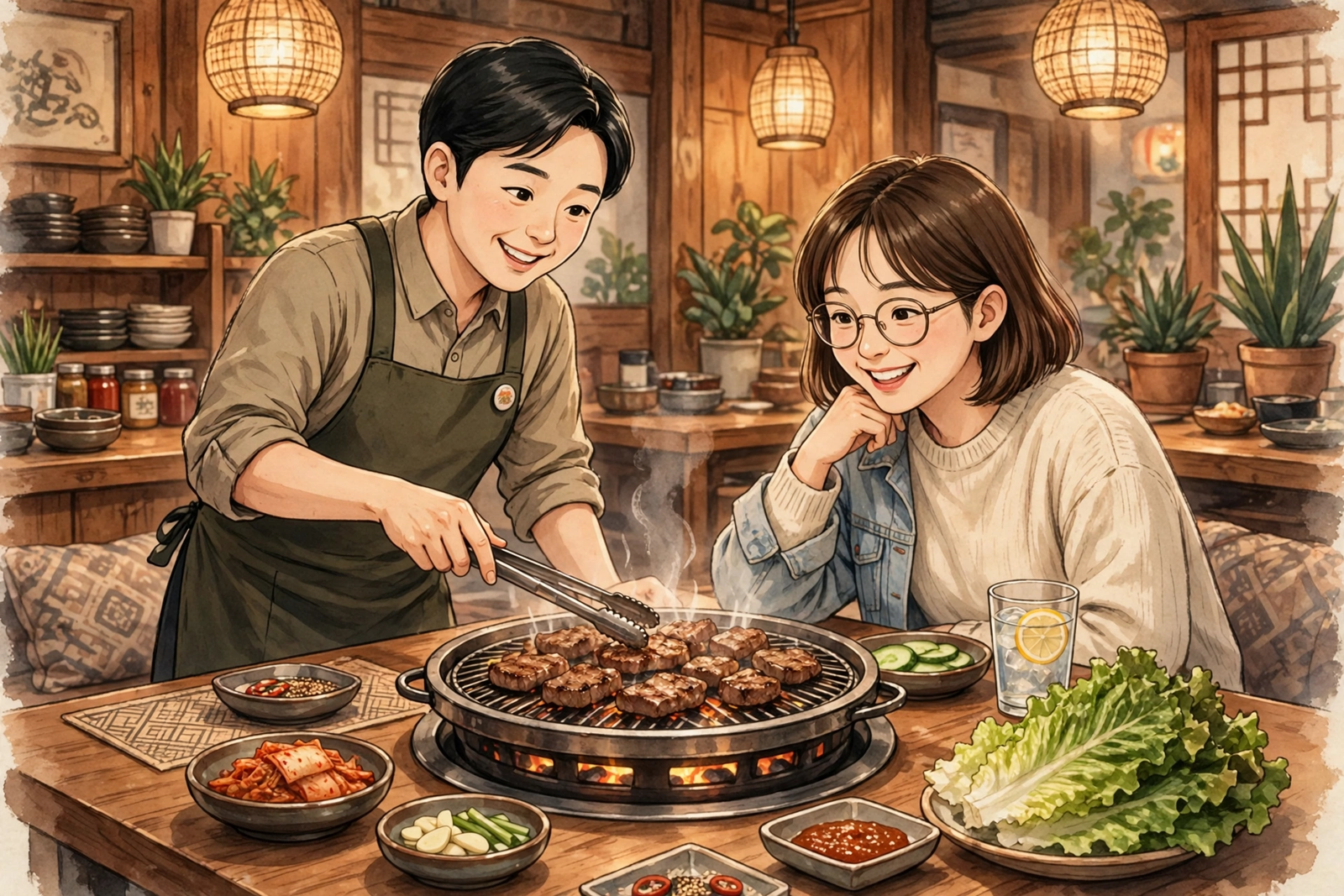
You walk into a barbecue restaurant in Seoul. The meat sizzles on the grill, smoke curls up into the air, and the table next to yours has just ordered two more portions of pork belly amid cheerful chatter. A staff member sets the grill down in the middle of your table and asks you something — and all you catch is the word “고기” (meat). So how do you order in a situation like this? With just these 20 Korean sentences for eating grilled meat, you can enjoy a BBQ meal in Seoul like a local: finding a restaurant, booking a table, ordering meat and side dishes, asking for help with the grilling or grilling it yourself, ordering more, and then settling the bill, neatly and calmly.
This article is written for people who are new to Korean, who don’t know much vocabulary yet but want to speak the moment they set foot in Seoul. Every sentence has the Korean, a read-along romanisation and the English meaning — read it aloud and you can use it straight away. Memorise the first 5 sentences and you can already order meat — the other 15 help you eat the proper Korean way, bit by bit, from ordering free extra side dishes right through to paying the bill.
Before the sentences: how a grilled-meat meal in Seoul unfolds
You walk in, the staff show you to a table and set the grill on the stove in the middle of it. You order meat by the portion (인분, inbun — a serving for one person); the raw meat is brought out, and either you or the staff grill it right at the table. While you wait for the meat to cook, you nibble on the little dishes called 반찬 (banchan — side dishes): kimchi, bean sprouts and lettuce leaves for wrapping the meat. Once the meat is cooked, it is cut into small pieces with scissors, wrapped with greens, dipped in sauce, and eaten with rice or cold noodles. At the end of the meal, you ask for the bill at the table — no need to go up to a counter.
The whole meal involves only a few short exchanges, and each exchange needs just one short sentence. You don’t have to speak in whole paragraphs — just say the right sentence at the right moment. One “magic word” you will use again and again all through this article: 주세요 (juseyo — please give me). Attach 주세요 to the end of any request and you are already polite enough. And remember: every sentence in this article uses the polite style 존댓말 (jondaenmal) — the endings -요 and -세요 — because you are talking to restaurant staff, to strangers, to people older than you or people you don’t know well. The casual style 반말 (banmal) is only for close friends — never use it with staff.
Group 1: Finding a restaurant, booking a table — 4 sentences that open the meal
You need to speak before you even get inside: ask which restaurant is good, ask whether there is a free table, book a table in advance. Get these four sentences done and you are seated comfortably in front of the grill.
- 1. 이 근처에 맛있는 고깃집 있어요? (I geuncheoe masinneun gogitjip isseoyo?) — Is there a good barbecue restaurant around here? 고깃집 (gogitjip) means “barbecue restaurant”. Asking a local this question is the fastest way to find a good place.
- 2. 두 명이요. 자리 있어요? (Du myeongiyo. Jari isseoyo?) — Two people, please. Do you have a table free? 두 명 (du myeong) means “two people” — just change the number to match how many of you there are: 세 명 (se myeong) is three people, 네 명 (ne myeong) is four people.
- 3. 제 이름으로 예약했어요. (Je ireumeuro yeyakhaesseoyo.) — I’ve booked a table under my name. Say this, then tell the staff your name so they can match it against the reservation book — done.
- 4. 창가 자리로 앉아도 돼요? (Changga jariro anjado dwaeyo?) — May I sit at a table by the window? The pattern ~해도 돼요? (~haedo dwaeyo? — may I ~?) can be used for all sorts of things: changing tables, borrowing a chair, opening a window.
One small note: good barbecue restaurants in Seoul are busy in the evenings, especially at weekends. If you are going with a group of 4 or more, booking ahead by phone — or asking your hotel reception to call for you — saves you the queue. If it is just the two of you at an off-peak time, walk straight in: sentence 2 is all you need.
Group 2: Ordering meat and side dishes in Korean at a barbecue place — the 6 most important sentences
This is the most important group in these 20 Korean sentences for eating grilled meat. Korean barbecue meat is ordered by the portion: 인분 (inbun) is a serving for one person. Two people order 2인분, three people order 3인분, and so on. The six sentences below are enough for one full round of ordering.
- 5. 삼겹살 2인분 주세요. (Samgyeopsal i-inbun juseyo.) — Two portions of pork belly, please. 삼겹살 (samgyeopsal) is pork belly, the national favourite of Korean barbecue — if it is your first time and you don’t know what to order, order this.
- 6. 목살도 1인분 주세요. (Moksaldo il-inbun juseyo.) — One portion of pork neck as well, please. 목살 (moksal) is pork neck, leaner than pork belly but still tender. The little word 도 (do — also, as well) at the end makes the sentence sound natural, just as a native speaker would say it.
- 7. 소고기 모둠으로 주세요. (Sogogi modumeuro juseyo.) — The mixed beef platter, please. 모둠 (modum) means “assorted, a bit of everything” — one tray with several different cuts of beef, ideal when you are in a big group and everyone wants to try a little of each.
- 8. 된장찌개 하나 주세요. (Doenjangjjigae hana juseyo.) — One soybean paste stew, please. 된장찌개 (doenjangjjigae) is soybean paste stew, a steaming-hot side dish that nearly every table orders alongside the barbecue.
- 9. 냉면 하나 주세요. (Naengmyeon hana juseyo.) — One bowl of cold noodles, please. 냉면 (naengmyeon) is buckwheat cold noodles, eaten at the end of the meal to “cut” the richness of the grilled meat — Koreans very often order this once the meat is finished.
- 10. 소주 한 병 주세요. (Soju han byeong juseyo.) — One bottle of soju, please. 한 병 (han byeong) means “one bottle”. Grilled meat and soju are a familiar pair in Korea, but if you don’t drink, just order a soft drink or a beer instead — nobody will push you.
About counting when you order: portions of meat use Sino-Korean numbers — 1인분 (il-inbun), 2인분 (i-inbun), 3인분 (sam-inbun). Bottles and bowls, though, use native Korean numbers: 한 병 (han byeong — one bottle), 두 병 (du byeong — two bottles), 하나 (hana — one). Mix the two number systems up and the staff will still understand you, but get them right and you sound like someone who has studied properly.
Group 3: Grilling the meat — 5 sentences around the grill
The meat is on the table, and now the most fun part begins: the grilling. In many Seoul barbecue restaurants, the staff grill for you from start to finish. In others, you grill it yourself. These five sentences cover both cases.
- 11. 고기 구워 주시겠어요? (Gogi guwo jusigesseoyo?) — Could you grill the meat for us, please? This is the most polite way to ask. If the staff member nods, all you have to do is sit back, watch and wait to eat.
- 12. 제가 직접 구울게요. (Jega jikjeop guulgeyo.) — I’ll grill it myself. Say this when you want the fun of grilling with your own hands. Hearing it, the staff will leave the tongs and scissors with you and won’t grill for you.
- 13. 이거 다 익었어요? (Igeo da igeosseoyo?) — Is this all cooked through? Ask this before you pick up a piece, especially with pork — pork has to be cooked thoroughly before you eat it, unlike beef, which can be eaten rare.
- 14. 불 좀 줄여 주세요. (Bul jom juryeo juseyo.) — Please turn the heat down a little for me. Say this straight away when the meat is about to catch and burn. The opposite — when you want the flame higher — say 불 좀 세게 해 주세요 (bul jom sege hae juseyo — please turn the flame up for me).
- 15. 이 고기는 어떻게 먹어요? (I gogineun eotteoke meogeoyo?) — How do you eat this meat? Ask this when the staff bring out a cut you have never eaten before — they will show you which greens to wrap it in, which sauce to dip it in, and whether it goes with kimchi or roasted garlic.
The standard Korean way to eat it: pick up a small-cut piece of meat, place it on a lettuce leaf (상추, sangchu), add a piece of kimchi and a slice of roasted garlic, dab on a little sauce (쌈장, ssamjang), roll it all into a small parcel and eat the whole parcel in one bite — this is called 쌈 (ssam). Eating a whole parcel in one bite like that is the proper way; don’t bite a ssam in half and put the rest back down.
Group 4: Ordering more and paying the bill — 5 sentences that close the meal
Nearly finished but still a little peckish? Order more. Full up? Ask for the bill. These last five sentences close the meal neatly, with no awkward fumbling.
- 16. 반찬 좀 더 주세요. (Banchan jom deo juseyo.) — A little more of the side dishes, please. At Korean barbecue restaurants, refills of the side dishes are usually free — when the kimchi or the lettuce wraps run out, just ask for more, quite comfortably, no need to feel shy.
- 17. 삼겹살 1인분 더 주세요. (Samgyeopsal il-inbun deo juseyo.) — One more portion of pork belly, please. The word 더 (deo — more) is the keyword of this group: whatever extra dish you want to order, just attach 더 주세요 (deo juseyo) to the end and you’re done.
- 18. 물 좀 주세요. (Mul jom juseyo.) — Some water, please. Filtered water in Korean restaurants is usually brought out in a jug; when it runs out, order more with this sentence.
- 19. 계산서 주세요. (Gyesanseo juseyo.) — The bill, please. Say this and the staff will bring the bill to your table — you don’t need to stand up and go to a counter. If you want to split the bill, say 따로따로 계산해 주세요 (ttarottaro gyesanhae juseyo — please bill each of us separately).
- 20. 카드로 계산할게요. (Kadeuro gyesanhalgeyo.) — I’ll pay by card. In Seoul, paying by card is the most common method of all — many places don’t even take cash any more. Say this, hand over your card, and you’re done.

One note about tipping, which many travellers wonder about: in Korea, tipping is not an obligatory custom. Menu prices usually include tax already, so you only need to pay exactly the amount on the bill. Nobody is waiting for you to leave extra money on the table, and leaving a tip can even fluster the staff — they may wonder whether you forgot your money. Just pay exactly what the bill says, and say one sentence, 잘 먹었습니다 (jal meogeotseumnida — I ate really well, thank you) as you leave, and that is the perfect finish.
3 mistakes beginners often make at a Seoul barbecue restaurant
Pouring soju for yourself. In Korean drinking etiquette, you pour for other people and other people pour back for you — you never pour your own. When you pour for someone older, hold the bottle with both hands. Remember this rule and you won’t “lose points” at the drinking table.
Ordering meat but forgetting the rice or noodles. Grilled meat tastes best eaten with plain rice, or with cold noodles at the end of the meal. Many beginners order only meat and are tired of the richness halfway through. Order one bowl of 냉면 (cold noodles) or one bowl of rice as well, and the meal balances out straight away.
Using 반말 with the staff. Saying 줘 (jwo — gimme) instead of 주세요 (juseyo — please give me) is rude with strangers. Every request in a restaurant uses the endings -요 and -세요, as in the 20 sentences above. The casual style is only for close friends; it is never used with serving staff.
Summary table: all 20 sentences — which ones should you memorise first?
| Group | Situation | Sentence to memorise first |
|---|---|---|
| 1. Finding a restaurant, booking a table | Before going into the restaurant | 두 명이요. 자리 있어요? |
| 2. Ordering meat and side dishes | Just sat down at the table | 삼겹살 2인분 주세요. |
| 3. Grilling the meat | Around the grill | 고기 구워 주시겠어요? |
| 4. Ordering more, paying the bill | End of the meal | 계산서 주세요. |
If you only have 10 minutes before you leave the hotel, learn groups 2 and 4 by heart — 11 Korean sentences for a grilled-meat meal are enough to order meat and pay the bill. Learn groups 1 and 3 gradually on the way; whichever situation comes up, review that group. And remember one thing: for Koreans, a barbecue meal means eating together and having fun together — don’t be afraid to speak up, don’t be afraid to ask; staff in every restaurant are used to foreign customers by now.
Quick Quiz
Test yourself on these 20 Korean sentences for a Seoul barbecue meal. Click an answer to see if you are right — your score is at the top.
Score: 0/5
1. What does 주세요 (juseyo) do at the end of a request?
2. For two people, how many portions of meat does the post say is usually enough?
3. 삼겹살 (samgyeopsal) is…
4. Refills of 반찬 (side dishes) at a Korean barbecue restaurant are usually…
5. In Korean drinking etiquette, how do you pour soju?
Frequently asked questions
For two people, how many portions of meat is enough? Usually 2–3 portions, depending on appetite. Start with 2 portions; if you have nearly finished and are still hungry, order 1 more portion using sentence 17 — you can order more at any time; there is no need to order everything in one go at the start.
Do barbecue restaurants in Seoul accept foreign cards? Most restaurants in tourist areas like Hongdae, Myeongdong and Itaewon accept international cards. But a small restaurant down an alley may only take cash or Korean cards, so carrying a little back-up cash is still the safer option.
I can’t eat spicy food — what should I order alongside the meat? Order 계란찜 (gyeranjjim — steamed eggs) or 된장찌개 (doenjangjjigae — soybean paste stew) — these two side dishes are not spicy and go very well with grilled meat. Kimchi is only mildly spicy; try one piece first before you order more.
Eating BBQ grilled meat in Seoul using Korean is not as hard as you think — these 20 sentences are enough for the whole meal. If you are out in Hongdae tonight, try ordering with one sentence in Korean and watch the staff smile and answer you straight away. Which sentence will you try first when you get to Seoul? Tell me in the comments — and send this article to the friend who is coming to Korea with you. If you want to learn Korean from the very beginning, start from LingoBubbo’s Korean hub page — the Hangul alphabet chart, your first conversation sentences and a study path towards TOPIK 1 are all ready there. And if you want to practise more Korean for travel situations, read the article 20 Korean sentences for shopping in Seoul: haggling, asking prices, trying clothes on — same way of learning, just a different situation. And if you love ordering at cafés, drop by the article Ordering at a café in Seoul in Korean: 20 sentences to order like a local to complete your set of Seoul sentences.