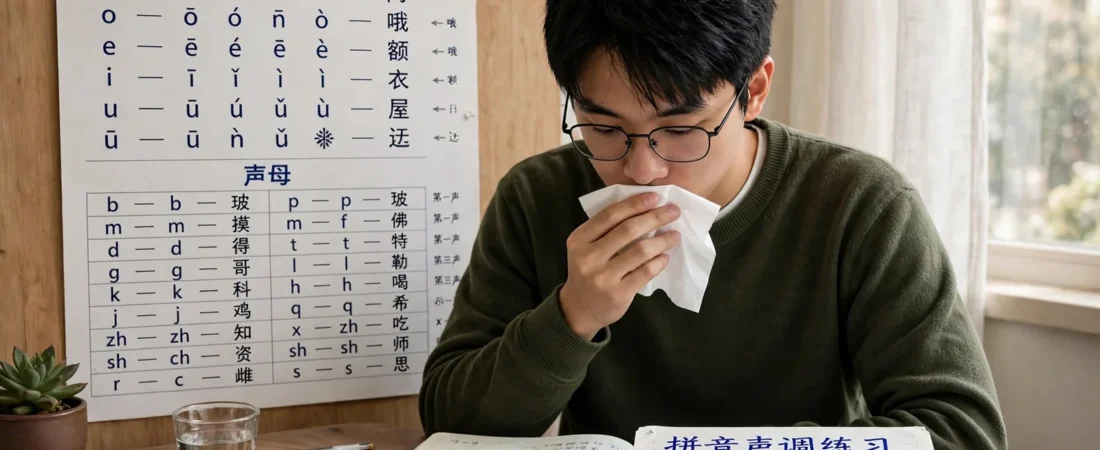
Say the word 爸 (bà, dad) to a Chinese speaker, and they smile. Say 怕 (pà, afraid) by mistake, and the smile turns into a puzzle. The difference between the two words is one small puff of air — and to an English ear, it is almost invisible. Nearly every beginner falls into this trap. The good news is that the trap has a pattern, and once you see it, it stops being a trap.
Pinyin pronunciation pairs are sounds English speakers hear as the same letter but Chinese hears as two different ones. The most important set is the aspirated pairs: b/p, d/t and g/k. Two more contrasts confuse beginners — j/q/x and zh/ch/sh — and the same fix works for all of them. Here is how each pair sounds, the minimal pairs that prove the difference matters, and a five-minute daily drill.
The one pinyin idea that explains b/p, d/t and g/k
English has two ways of making a “b” sound, and you already use both without noticing. Say “bat” and hold your hand in front of your mouth — you will feel a puff of air. Say “about” and listen to the b in the middle — almost no puff. Chinese takes that difference and turns it into two separate sounds. The unaspirated sound (b, d, g) is made with no puff of air. The aspirated sound (p, t, k) is made with a clear puff, like the start of an English word.
Test it in ten seconds. Hold a tissue in front of your lips. Say ba — the tissue should stay still. Say pa — the tissue should flutter. If it moves on both, you are puffing too much on the unaspirated sound. If it moves on neither, you are not puffing enough on the aspirated one. The tissue never lies.
The three pairs, with minimal pairs that matter
A minimal pair is two words that differ in exactly one sound — proof that the sound is real, because mixing them up changes the meaning. Learn these pairs out loud, in both orders:
| Pair | Unaspirated (no puff) | Aspirated (puff) |
|---|---|---|
| b / p | 爸 bà, dad | 怕 pà, afraid |
| b / p | 帮 bāng, to help | 旁 páng, beside |
| b / p | 杯 bēi, cup | 配 pèi, to match |
| d / t | 大 dà, big | 他 tā, he, him |
| d / t | 刀 dāo, knife | 逃 táo, to escape |
| d / t | 低 dī, low | 踢 tī, to kick |
| g / k | 高 gāo, tall | 考 kǎo, exam, to test |
| g / k | 狗 gǒu, dog | 口 kǒu, mouth |
| g / k | 该 gāi, should | 开 kāi, to open |
Read the table as a warning, not as a list. Saying dà when you mean tā turns “big” into “he”. Saying gǒu when you mean kǒu turns “dog” into “mouth”. Listeners will usually understand from context, but the wrong sound costs a beat of confusion every time.
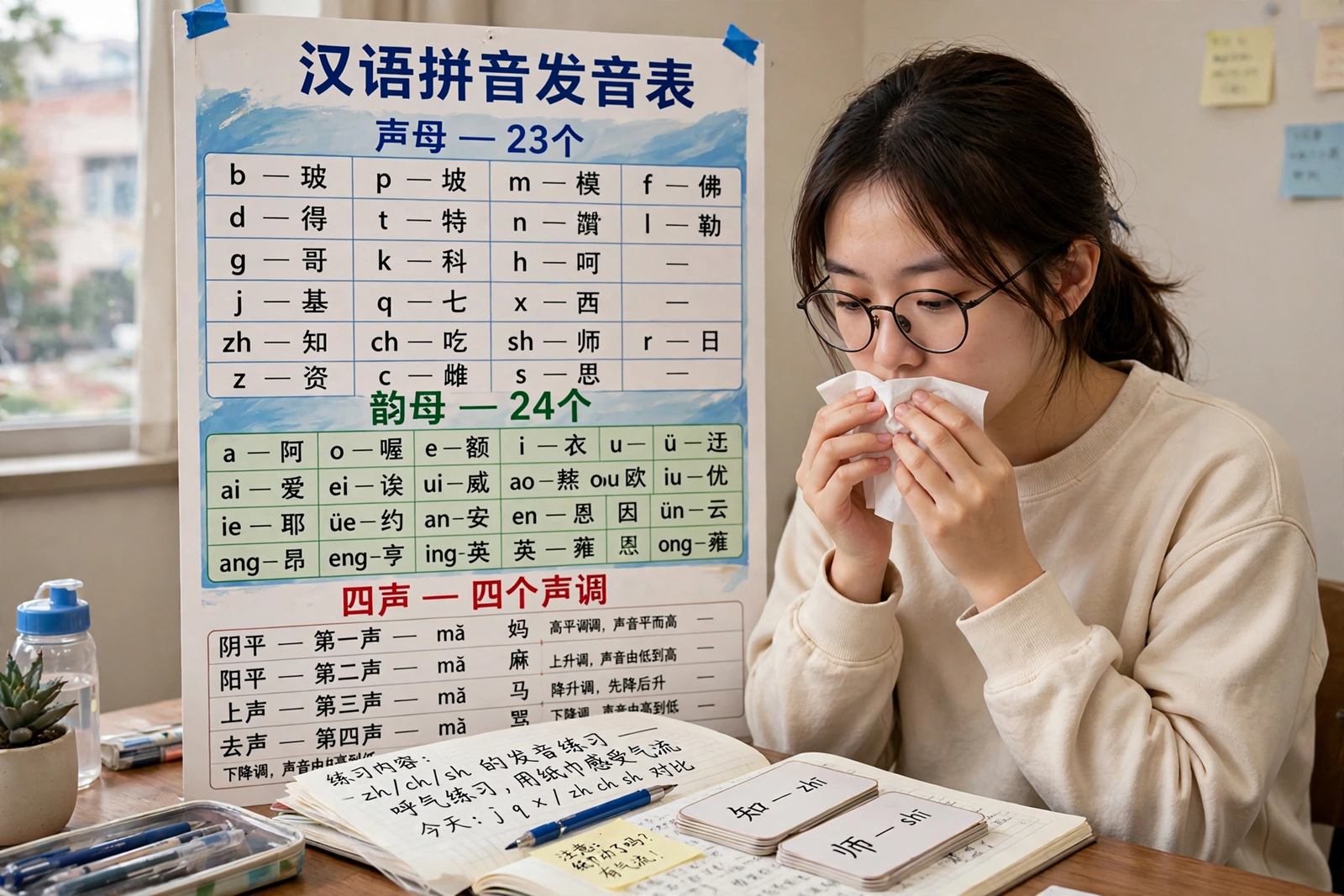
j, q and x — three sounds English does not have
After the aspirated pairs, the next trap is a trio: j, q and x. All three are made with the tongue in roughly the same place — tip behind the lower teeth, middle of the tongue raised — and English has no exact match for any of them. The difference is airflow: j is unaspirated and soft, q is j with a puff of air, and x is a steady hiss, like a quiet “sh” made further forward.
| Sound | How it feels | Example |
|---|---|---|
| j | Soft, no puff | 浇 jiāo, to water (plants) |
| q | j, with a puff of air | 敲 qiāo, to knock |
| x | A steady hiss | 小 xiǎo, small |
| j / q / x | All three together | 减 jiǎn, to reduce; 钱 qián, money; 先 xiān, first |
The classic mistake is turning x into an English “sh”. Say “shoe”: tongue pulled back, lips rounded. Now say xiǎo: the tongue stays flat and forward, the lips stay relaxed, and the hiss is thinner. It feels strange for a week, and then it feels normal.
zh, ch and sh — the tongue curls back
The last set is zh, ch and sh, the retroflex sounds. “Retroflex” simply means the tip of the tongue curls back towards the roof of the mouth. English has a rough cousin in the “r” of “red”, but never uses that tongue position for a “zh” or “ch” sound.
| Sound | How it feels | Example |
|---|---|---|
| zh | Curled back, no puff | 知 zhī, to know |
| ch | zh, with a puff of air | 吃 chī, to eat |
| sh | Curled back, steady hiss | 师 shī, teacher |
| zh / ch / sh | The trio | 长 zhǎng, to grow; 场 chǎng, place; 上 shàng, up, on |
知 (zhī, to know), 吃 (chī, to eat) and 师 (shī, teacher) are the same vowel with three different beginnings — the perfect trio to practise, because your tongue feels the difference before your ear does. Note the pattern repeating: zh and ch are another unaspirated/aspirated pair, exactly like b/p and d/t.
The five-minute daily drill
Pronunciation is a muscle skill: it needs short, daily practice, not one long session a week. Here is the drill, five minutes a day:
| Minute | Do this |
|---|---|
| 1 | Tissue test: ba–pa, da–ta, ga–ka, ten times each; the tissue moves only on the second word |
| 2 | Minimal pairs out loud, both orders: bà–pà, dà–tā, gāo–kǎo, dāo–táo |
| 3 | The trios: jiāo–qiāo–xiǎo, then zhī–chī–shī, slowly, feeling the tongue |
| 4 | Shadow one sentence from a recording, matching the speaker’s sounds |
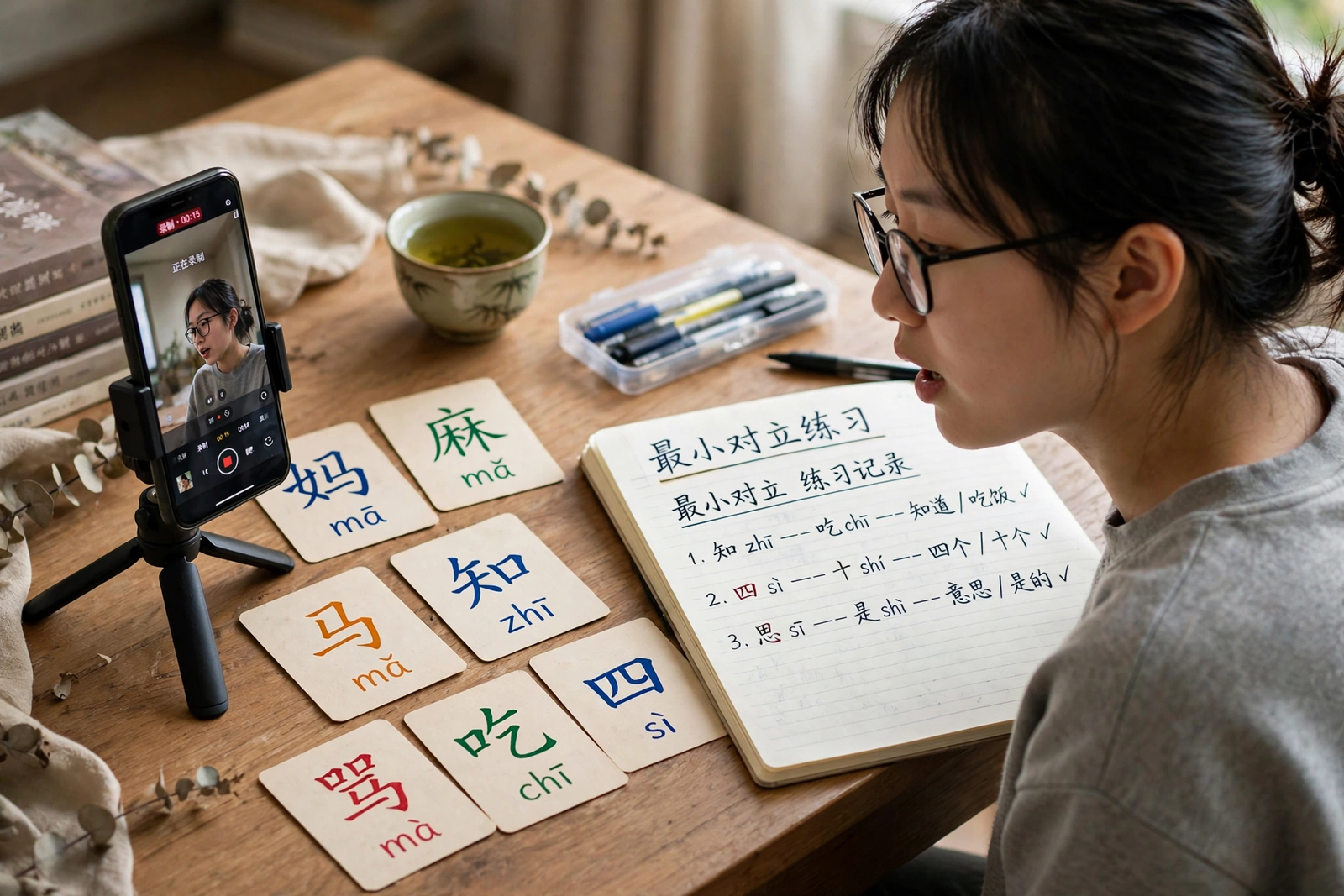
| 5 | Record the six pairs, play it back, and mark the ones that still sound alike |
Two rules make the drill work. First, exaggerate the puff for the first two weeks — make the aspirated sounds too strong on purpose, so your mouth learns the difference first. Second, record yourself from day one. A recording is the only honest mirror for your own speech.
Quick Quiz
Test yourself on the pinyin sound traps. Click an answer to see if you are right — your score is at the top.
Score: 0/5
1. What makes p, t and k different from b, d and g in pinyin?
2. 爸 (bà) means…
3. Which sound is a steady hiss made with the tongue flat and forward?
4. In the tissue test, when should the tissue flutter?
5. 知, 吃 and 师 (zhī, chī, shī) make a perfect practice trio because they share…
Quick answers
Is it really a problem if I mix up b and p?
People will usually understand you from context, so it is not a disaster. But it is one of the easiest things in Chinese to fix, and it is the difference between sounding clear and sounding hard to follow.
Why does my Chinese teacher say my “sh” is wrong?
Probably because you are saying the English “sh” (tongue back, lips rounded) where Chinese wants x (tongue flat and forward) or sh (tongue curled back). They are three different sounds.
How long until the pairs feel natural?
Most learners feel the difference within a week of daily drilling and stop thinking about it within a month. The sounds are not hard — they are just unfamiliar, and unfamiliar fades fast with practice.
The puff of air is small, but it carries the whole meaning of the word. Get it right and 爸 stays dad, 大 stays big, and 知 stays “to know” instead of “to eat”. Our free HSK 1 trial lessons drill these pairs with audio from the very first lesson. Five minutes a day, tissue in hand — start tonight.