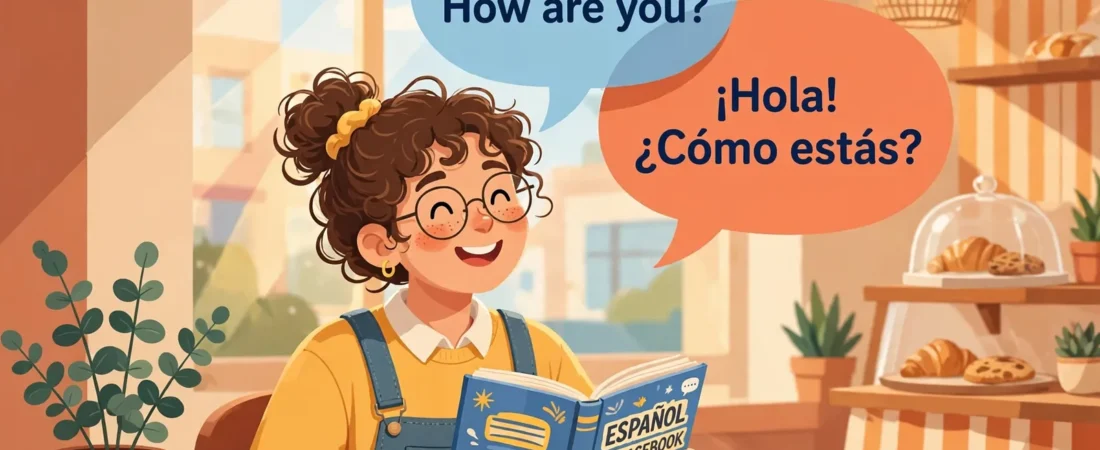
You already speak more Spanish than you think. Open a Spanish menu, a street sign, or a song lyric, and you will spot words you have never “studied” — hotel, taxi, radio, idea — sitting there in plain sight, meaning exactly what they mean in English. These are cognates: words that English and Spanish share because both languages borrowed them from Latin. Learn fifteen of them today and you will walk into your next Spanish conversation with a head start you did not know you had.
Here is the trick nobody tells beginners: you do not start Spanish from zero. English is full of Latin words, and Spanish kept most of them in a form you can still recognize. The fifteen words below are the easiest free vocabulary in the language — same meaning, nearly the same spelling, just a Spanish accent on top. Read them once, say them out loud, and try the little practice at the end. If you are just starting out, this pairs well with the Spanish learning hub on LingoBubbo and the first 50 Spanish words for beginners.
What is a cognate, and why does it feel like cheating?
A cognate is a word with the same origin in two languages. English and Spanish both inherited thousands of words from Latin, so the same word shows up in both languages wearing a slightly different outfit. Telephone became teléfono. Music became música. Family became familia. The meaning never changed — only the spelling and the accent did.
Why does this matter for you? Because every cognate you recognize is a word you do not have to memorize. A beginner who knows fifteen cognates can read a simple Spanish sign, follow a menu, or catch the topic of a conversation before they have learned a single verb conjugation. That early confidence is worth more than a perfect grammar chart. It is the difference between “I can’t speak Spanish” and “I understood that!” — and the second feeling is what keeps people learning.
One quick warning before the list: not every look-alike is a true friend. A few words look like English but mean something completely different — the “false friends.” They get their own section at the end, because knowing them will save you from at least one embarrassing moment. But first, the fifteen words that are exactly what they look like.
15 Spanish words you already know
Read each row, then say the Spanish word out loud. The pronunciation guide is a rough English-style hint, not perfect phonetics — the real rule is simpler than it looks: in Spanish, every letter is pronounced, and the stress usually falls where you would expect it. Words ending in a vowel, n, or s stress the second-to-last syllable; words ending in other consonants stress the last one. The one rebel in the list is teléfono, which is why it carries a written accent mark.
| # | Spanish | Pronunciation | English | Use it in a sentence |
|---|---|---|---|---|
| 1 | el teléfono | teh-LEH-foh-no | telephone | ¿Dónde está el teléfono? — Where is the telephone? |
| 2 | la idea | ee-DEH-ah | idea | ¡Buena idea! — Good idea! |
| 3 | la música | MOO-see-kah | music | Me gusta la música. — I like the music. |
| 4 | la familia | fah-MEE-lee-ah | family | Mi familia es grande. — My family is big. |
| 5 | el animal | ah-nee-MAHL | animal | El animal es grande. — The animal is big. |
| 6 | el hospital | ohs-pee-TAHL | hospital | ¿Dónde está el hospital? — Where is the hospital? |
| 7 | el doctor / la doctora | dohk-TOR | doctor | El doctor está aquí. — The doctor is here. |
| 8 | el taxi | TAHK-see | taxi | ¿Dónde hay un taxi? — Where is there a taxi? |
| 9 | el hotel | oh-TEHL | hotel | El hotel está cerca. — The hotel is nearby. |
| 10 | el mapa | MAH-pah | map | Tengo el mapa. — I have the map. |
| 11 | la radio | RAH-dee-oh | radio | Escucho la radio. — I listen to the radio. |
| 12 | el chocolate | choh-koh-LAH-teh | chocolate | Me gusta el chocolate. — I like chocolate. |
| 13 | central | sehn-TRAHL | central | La estación central. — The central station. |
| 14 | final | fee-NAHL | final | El examen final. — The final exam. |
| 15 | normal | nor-MAHL | normal | Es normal. — It is normal. |
Look at the last three for a second: central, final, normal. Same spelling, same meaning, just a Spanish accent. Words ending in -al are almost always cognates in Spanish — central, final, normal, total, local, natural, personal, original. Learn the pattern once and you can guess dozens of words you have never seen before. That is the real power of cognates: they are not fifteen words, they are fifteen keys that open hundreds of doors.
The patterns that let you guess hundreds more
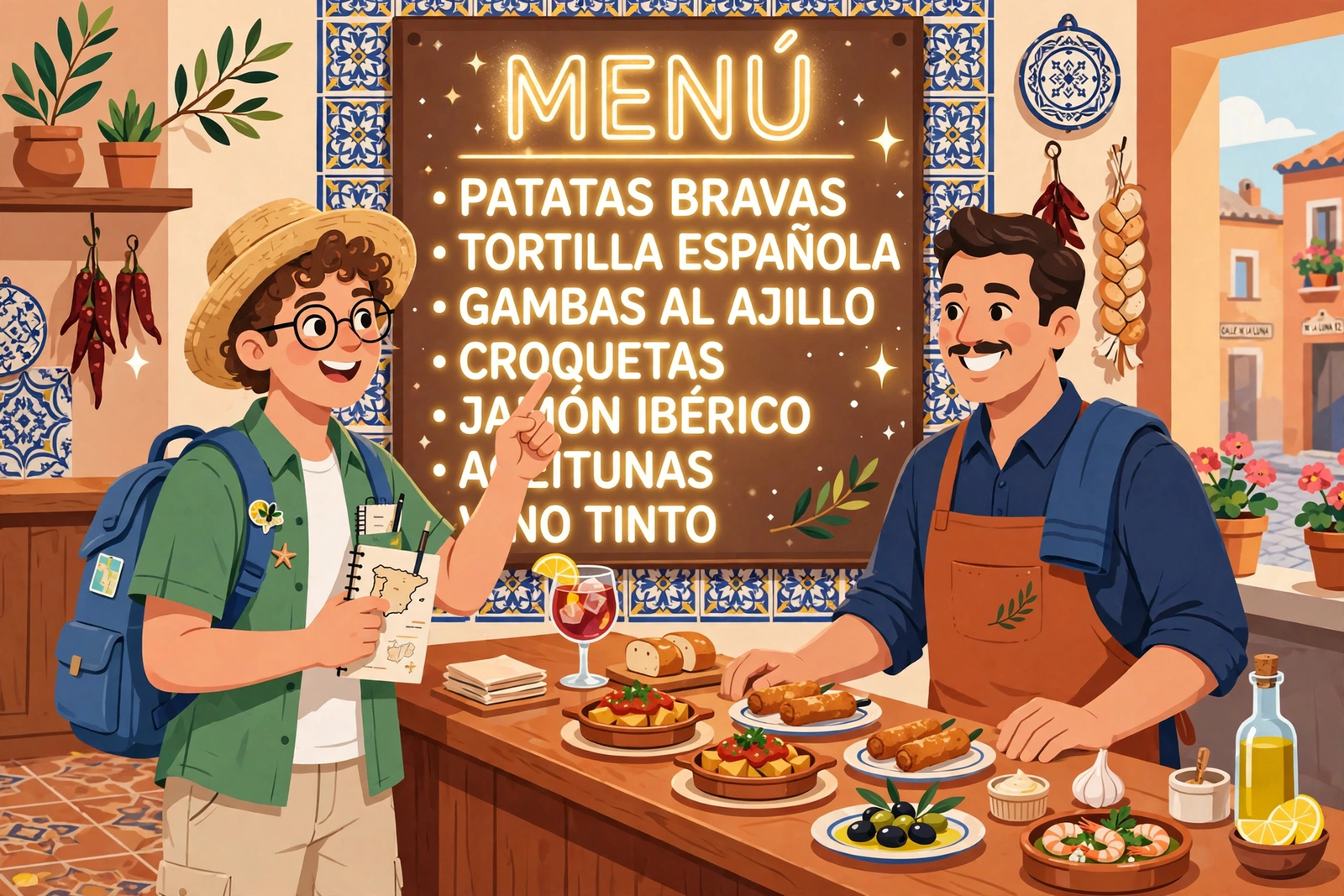
Fifteen words is a good start. The patterns below turn them into hundreds. Once you see the pattern, you will start spotting cognates everywhere — in song lyrics, on menus, in the news.
English -tion becomes Spanish -ción. Nation → nación. Station → estación. Information → información. Action → acción. If you know the English word, drop the -tion, add -ción, and you are right most of the time. This one pattern alone is worth more than a week of flashcards.
English -ty becomes Spanish -dad. University → universidad. City → ciudad. Activity → actividad. Community → comunidad. It looks different at first, but after five examples your brain starts doing it automatically.
English -ous becomes Spanish -oso. Famous → famoso. Curious → curioso. Delicious → delicioso. Generous → generoso. Say famoso out loud — it sounds like “famous” with a Spanish ending, because that is exactly what it is.
English -ic becomes Spanish -ico. Music → música (well, almost). Classic → clásico. Basic → básico. Fantastic → fantástico. And English -al stays -al: central, final, normal, total, local — the three words from the list above are just the beginning.
Try it right now. What do you think información means? What about universidad? If you guessed “information” and “university,” you just learned two words without studying. That is the cognate effect, and it works on real Spanish, not just textbook examples.
Watch out: 4 false friends that will trick you
Now the warning I promised. Some Spanish words look exactly like English words and mean something completely different. These are called false friends, and every learner meets them sooner or later. Meet these four now, in a blog post, instead of later, in front of a real person.
| Spanish word | It looks like… | It really means… | Example |
|---|---|---|---|
| embarazada | embarrassed | pregnant | Estoy embarazada. — I am pregnant. (Never use it to say you are embarrassed!) |
| actualmente | actually | currently, right now | Actualmente vivo en Madrid. — I currently live in Madrid. |
| la librería | library | bookstore | Compro libros en la librería. — I buy books at the bookstore. (A library is la biblioteca.) |
| sensible | sensible | sensitive | Es muy sensible. — He/she is very sensitive. (Sensible in the English sense is sensato.) |
The embarazada one is famous for a reason — it is probably the most common false-friend mistake in the history of Spanish learning. “Estoy embarazada” does not mean “I am embarrassed.” It means “I am pregnant.” If you remember only one row of this table, remember that one. The good news: false friends are rare. For every false friend, there are a hundred true cognates. Do not let four tricky words scare you away from the hundreds of honest ones.
A 10-minute practice you can do tonight
Knowing the words is step one. Using them is step two, and it only takes ten minutes.
Minutes 1–3: Say the fifteen. Cover the English column of the table and read the Spanish words out loud. Then cover the Spanish column and go the other way. Do it twice. Out loud, not in your head — your mouth needs to learn the sounds, not just your eyes.
Minutes 4–6: Build five sentences. Pick any five words from the list and make a sentence with each. Use the example sentences in the table as a model, then change one word. “Me gusta la música” becomes “Me gusta el chocolate.” “El hotel está cerca” becomes “El hospital está cerca.” Changing one word at a time is how sentences get built.
Minutes 7–10: Spot cognates in the wild. Open any Spanish text — a song, a menu, a news headline — and circle every word you recognize. You will be surprised how many you find. Write down three new ones and look them up. Congratulations: you just did your first real reading in Spanish.
Want a next step after the cognates? Learn to greet people properly — the 10 ways to greet someone in Spanish like a native speaker is the perfect follow-up, because now you can combine a greeting with a real word you already know. “¡Hola! ¿Dónde está el hotel?” is a complete, useful sentence, and you built it from one greeting and one cognate.

Quick Quiz
Test yourself on Spanish cognates. Click an answer to see if you are right — your score is at the top.
Score: 0/5
1. What is a cognate?
2. What does «embarazada» actually mean?
3. English -tion usually becomes which Spanish ending?
4. What does «la librería» mean?
5. Words ending in -al in English are usually…
Checklist: your first 15 Spanish words
Tick off every word you can say without looking. Fifteen out of fifteen means you already know fifteen Spanish words — and you knew them before you even started.
- ☐ el teléfono — telephone
- ☐ la idea — idea
- ☐ la música — music
- ☐ la familia — family
- ☐ el animal — animal
- ☐ el hospital — hospital
- ☐ el doctor — doctor
- ☐ el taxi — taxi
- ☐ el hotel — hotel
- ☐ el mapa — map
- ☐ la radio — radio
- ☐ el chocolate — chocolate
- ☐ central — central
- ☐ final — final
- ☐ normal — normal
- ☐ Bonus: I can spot the -ción, -dad, -oso, and -ico patterns in new words
- ☐ Bonus: I know why embarazada does NOT mean “embarrassed”
Share this list with a friend who says “I could never learn Spanish.” Fifteen words they already know is a hard argument to lose — and it might be the nudge that gets them started. Then tell us in the comments: which cognate surprised you most, and what is the first Spanish sentence you built with one? Keep going from the Spanish learning hub on LingoBubbo — the next fifteen words are waiting, and half of them you already know too.