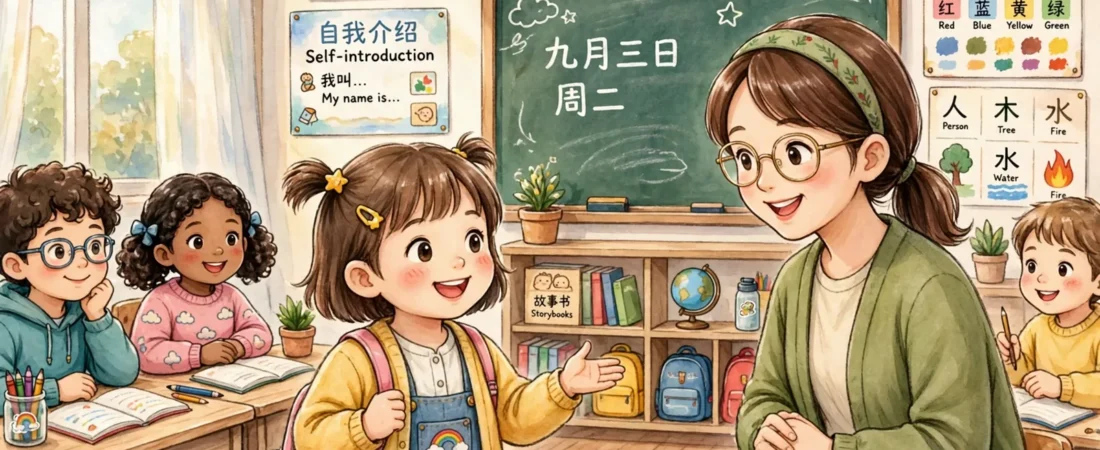
Picture this: your seven-year-old stands up in Chinese class, takes a breath, and says five clear sentences in Mandarin. The teacher beams. Your child beams harder.
Want to help your child write a 5-sentence self-introduction in Chinese — without tears, flashcard marathons, or a single boring drill? This step-by-step guide gives you a simple five-sentence frame, ten easy words, slow audio to copy, a five-minute practice game, and a parent cheat sheet, so kids ages 4 to 12 can introduce themselves in Mandarin with confidence and a smile.
## Why Five Sentences Is the Sweet Spot
Five sentences is short enough to memorize in one sitting and long enough to sound like a real introduction. One sentence is just a greeting. Ten sentences is a speech, and most kids will freeze halfway through. Five hits the middle: hello, name, age, one thing they like, and thank you. That is a complete little story about a person.
Teachers love this length too. It fits in a class sharing circle, a video homework clip, or the first page of a language portfolio. And for parents, five sentences means five small wins. Your child can master one sentence at a time, and every sentence they finish feels like progress.
So if your child has never spoken a full sentence in Chinese before, this is the perfect place to start.
## Goals by Age: What “Good” Looks Like at 4, 7, and 11
Not every age needs the same result. A four-year-old who says two sentences with a big smile has done wonderfully. An eleven-year-old can aim higher. Match the goal to your child and the whole activity stays fun.
### Ages 4–6: Say it, smile, and be heard
At this age, the goal is sound and courage, not perfect characters. Your child should be able to say the greeting and their name sentence out loud, slowly and clearly. Reading characters is a bonus, not a requirement. Let them point at pictures while they speak. If they remember three of the five sentences, celebrate that. Memory at this age comes from hearing and repeating, so play the audio clips below several times and let your child echo them like a game of parrot.
### Ages 7–9: Five sentences, in order, on their own
This is the sweet spot for the full five-sentence introduction. Kids this age can hold the order in their head: greeting, name, age, favorite thing, thank you. They can also start matching the spoken words to the characters, even if they cannot write them yet. Expect a few wobbles on tones. That is normal. Correct gently by saying the sentence yourself and letting them copy you, instead of stopping them mid-sentence.
### Ages 10–12: Make it their own
Older kids can swap in their own details. Maybe they like soccer instead of drawing, or their favorite animal is a dog instead of a cat. The frame stays the same, but the content becomes personal. They can also write the five sentences by hand and read them back without help. If your child is up for it, ask them to add a sixth sentence of their own — but only after the five are solid. The five come first.
## How to Write a 5-Sentence Self-Introduction in Chinese: The Frame
Here is the frame. Every sentence has one job, and together they make a complete introduction. Read the model paragraph first, then build your child’s own version sentence by sentence.
Here is a finished example using a made-up name, so your child can see what the whole thing sounds like:
大家好!我叫小明。我六岁。我喜欢画画。我喜欢红色。谢谢大家!
*Dàjiā hǎo! Wǒ jiào Xiǎomíng. Wǒ liù suì. Wǒ xǐhuān huàhuà. Wǒ xǐhuān hóngsè. Xièxie dàjiā!*
Hello, everyone! My name is Xiao Ming. I am six years old. I like drawing. I like the color red. Thank you, everyone!
Now, one sentence at a time:
| # | Job of the sentence | Chinese | Pinyin | English |
|—|—|—|—|—|
| 1 | Greet everyone | 大家好! | Dàjiā hǎo! | Hello, everyone! |
| 2 | Say your name | 我叫小明。 | Wǒ jiào Xiǎomíng. | My name is Xiao Ming. |
| 3 | Say your age | 我六岁。 | Wǒ liù suì. | I am six years old. |
| 4 | Say one thing you like | 我喜欢画画。 | Wǒ xǐhuān huàhuà. | I like drawing. |
| 5 | Say thank you | 谢谢大家! | Xièxie dàjiā! | Thank you, everyone! |
A quick note on the name: 小明 (Xiǎomíng) is a made-up example name, the way English textbooks use “Tom” or “Anna.” When your child practices at home, they can use their own name, a nickname, or a fun made-up name. And one safety rule that matters: never ask your child to share their real name, age, school, or any personal details online or with strangers. Practice at home, in class, or in a video that only family sees.
### Sentence 1: The greeting
大家好 (Dàjiā hǎo) means “Hello, everyone!” It is warmer than a plain 你好 (Nǐ hǎo, “Hello”) because it speaks to a whole group at once — a class, a family gathering, a video audience. Teach this one first. It is the easiest win, and starting with a word your child already knows how to say builds instant confidence.
### Sentence 2: The name
我叫… (Wǒ jiào…) means “My name is…” or, more literally, “I am called…” Your child just fills in the blank. If they are shy about their real name, let them pick a Chinese nickname for practice. The pattern is what matters, not the name itself. Once they can say 我叫小明, they can say 我叫 anything.
### Sentence 3: The age
我六岁 (Wǒ liù suì) means “I am six years old.” The pattern is 我 + number + 岁 (suì). Seven is 七 (qī), so “I am seven” is 我七岁 (Wǒ qī suì). Ten is 十 (shí): 我十岁 (Wǒ shí suì). Let your child plug in their own number. Kids love this sentence because it changes every birthday, which makes it feel like theirs.
### Sentence 4: One thing you like
我喜欢画画 (Wǒ xǐhuān huàhuà) means “I like drawing.” The pattern is 我喜欢 + activity. This is the sentence with the most room to play. Drawing is just the example. Your child might like soccer — 我喜欢踢足球 (Wǒ xǐhuān tī zúqiú) — or their favorite animal might be a cat, which is 我最喜欢的动物是猫 (Wǒ zuì xǐhuān de dòngwù shì māo, “My favorite animal is a cat”). Let them choose. A sentence they chose themselves is a sentence they will remember.
### Sentence 5: The thank-you
谢谢大家 (Xièxie dàjiā) means “Thank you, everyone!” It closes the introduction the way a little bow closes a gift. Kids sometimes rush this last line or skip it entirely, so practice it as its own moment. A clear ending tells the listener, “I am done, and I did it.”
## 10 Key Words and Sentences to Learn First
You do not need a big vocabulary list for this. Ten building blocks cover the whole introduction, and each one appears in the five sentences above. Learn the words, and the sentences almost build themselves.
| Chinese | Pinyin | English |
|—|—|—|
| 你好 | Nǐ hǎo | Hello |
| 大家 | Dàjiā | Everyone |
| 叫 | Jiào | To be called |
| 岁 | Suì | Years old |
| 喜欢 | Xǐhuān | To like |
| 画画 | Huàhuà | To draw / drawing |
| 红色 | Hóngsè | The color red |
| 谢谢 | Xièxie | Thank you |
| 学生 | Xuésheng | Student |
| 猫 | Māo | Cat |
Two bonus swaps for sentence 4: 狗 (Gǒu, dog) and 足球 (Zúqiú, soccer). If your child likes dogs or soccer more than drawing or cats, swap them straight in — the sentence pattern does not change at all.
## A 5–10 Minute Activity: Build-Your-Five
Here is the whole practice session, start to finish. Set a timer for ten minutes. Short and fun beats long and tired, every single time.
**Minute 0–2: Listen.** Play the full introduction audio once. Just listen. Then play it again, and this time your child echoes each sentence right after they hear it. No reading, no writing yet — ears first.
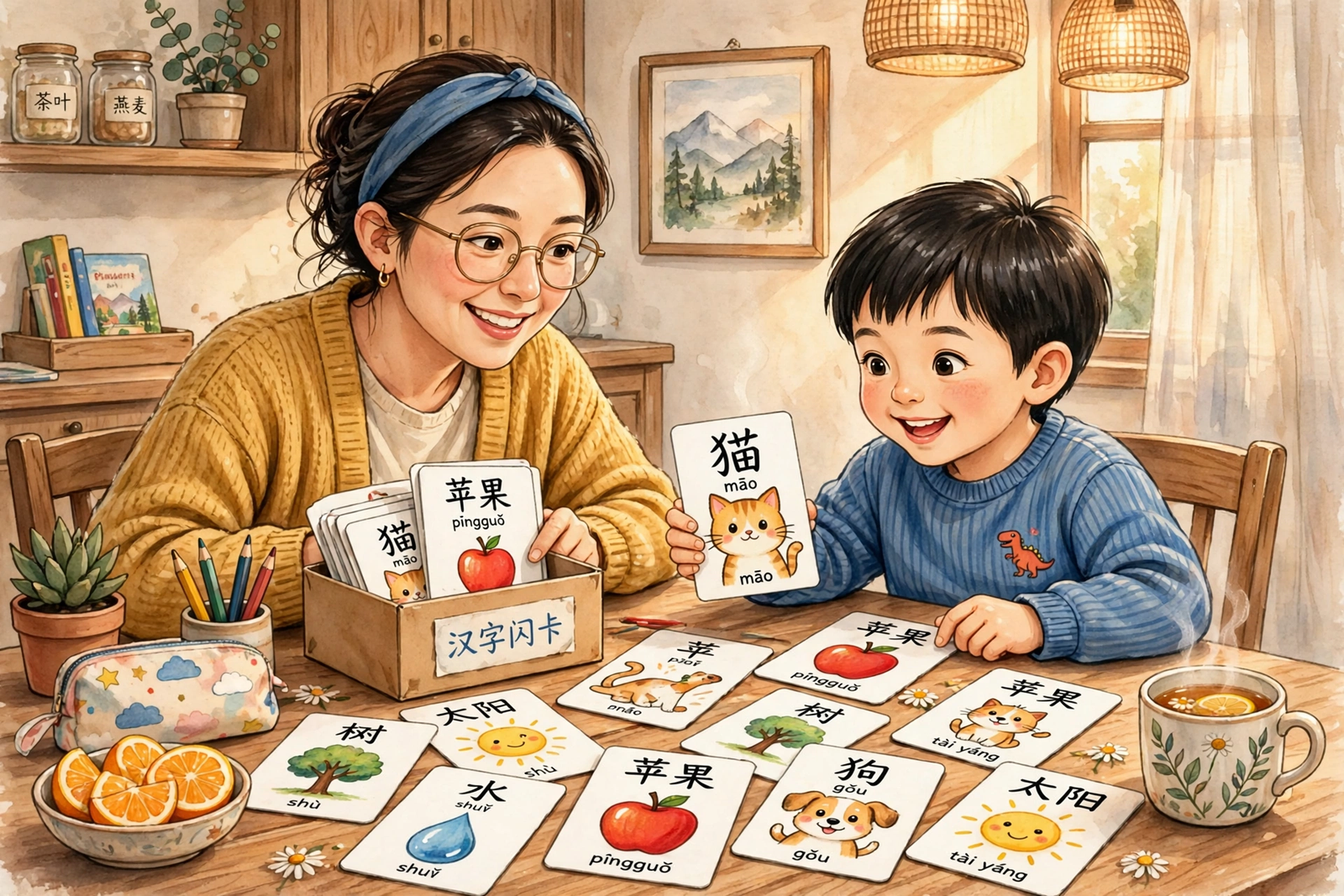
**Minute 2–5: Build the cards.** Write each of the five sentences on its own small card or sticky note — Chinese on one side, English on the back. Shuffle them. Can your child put them back in the right order? For younger kids, lay the cards out in order and let them point to each one as they say it.
**Minute 5–8: Swap one thing.** Change one detail. A different age, a different favorite color, a different hobby. Say the whole introduction again with the swap. This is the moment kids realize they are not reciting — they are actually speaking Chinese.
**Minute 8–10: Perform.** Your child stands up and says all five sentences, start to finish, to an audience of one very impressed parent. Clap. Mean it. Then ask: which sentence was the easiest? Which one needs one more practice round tomorrow?
That is it. Ten minutes, five sentences, one proud kid. Do it three days in a row and most children can say the whole thing without the cards.
## Parent Guidance: How to Help Without Taking Over
You do not need to speak Chinese to help your child with this. You need patience, a playful voice, and a few small habits.
**Model, don’t correct.** When your child says a tone wrong, just say the sentence correctly yourself and let them copy you. “Good try — listen: 我喜欢画画. Now you!” works far better than “No, that’s wrong.” Kids shut down when they feel tested. They open up when they feel like they are playing.
**One sentence per day is enough.** If five sentences in one sitting feels like too much, stretch it across the week. Monday is the greeting. Tuesday adds the name. By Friday, the whole introduction is there, and nobody cried. Slow progress that sticks beats fast progress that falls apart.
**Use pictures, not just characters.** Draw a little red crayon next to 红色. Sketch a cat next to 猫. A picture gives a young child something to hold onto while the sound is still new. For more playful practice ideas, try the [Chinese word games demo](https://lingobubbo.com/chinese-word-games-demo/) together — games turn review into something kids actually ask for.
**Keep practice private and safe.** Practice at home or in class, and keep any recordings inside the family. Never post a video of your child saying their name and age where strangers can see it, and never ask your child to share personal details to join an activity. Their safety comes before any homework.
**Celebrate the trying, not just the perfect.** A child who says all five sentences with wobbly tones has still spoken five sentences in Chinese. That deserves a high five. Perfection can come later. Confidence has to come first.
If your child wants more speaking practice after this, our guide on [how to help your child practise Chinese speaking](https://lingobubbo.com/help-child-practise-chinese-speaking/) has everyday routines that fit into breakfast, the school run, and bedtime.
## The Check-Up Game: Echo and Swap
How do you know the five sentences actually stuck? Play Echo and Swap. It takes two minutes and kids treat it like a game, not a test.
You say a sentence. Your child echoes it. Then your child changes one word — a different number, a different color, a different animal — and you have to echo the new version. Take turns. The moment your child catches you making a “mistake” on purpose (say 我七岁 when they said 我六岁), you will see their face light up. Catching the teacher is the best review there is.
Three rounds of Echo and Swap tells you everything a quiz could. If your child can change the age and the hobby without help, the pattern has landed. If they get stuck on one sentence, that is the sentence to practice tomorrow — just that one, for two minutes, and then stop while it is still fun.
## Mistakes Kids Make (and the Easy Fix for Each)
Every child makes the same few mistakes with this introduction. None of them are a big deal, and each one has a one-line fix.
**Forgetting the greeting.** Kids jump straight to their name because that is the exciting part. Fix: make the greeting a wave. Hand up, big smile, 大家好 — the wave reminds them to start at the start.
**Mixing up the order.** Age before name, or thank-you in the middle. Fix: the cards from the activity above. Order is a memory problem, and cards solve memory problems.
**Saying every sentence in the same flat voice.** Fix: give each sentence a job. The greeting is loud and happy. The name is proud. The thank-you is warm and slow. A little acting goes a long way.
**Rushing the last sentence.** Fix: practice the thank-you on its own, three times, before the full run-through. Endings deserve rehearsal too.
## Your Shareable Checklist
Save this, screenshot it, or send it to another parent who is starting Chinese with their child. Five checks, and you are done.
| Check | Done? |
|—|—|
| My child can say 大家好 (Hello, everyone!) clearly | ☐ |
| My child can say 我叫… (My name is…) with their name or nickname | ☐ |
| My child can say 我…岁 (I am … years old) with the right number | ☐ |
| My child can say 我喜欢… (I like…) with their own favorite thing | ☐ |
| My child can finish with 谢谢大家 (Thank you, everyone!) | ☐ |
Five ticks means five sentences. That is a real self-introduction in Chinese, built by your child, in about ten minutes a day.
## Frequently Asked Questions
**How long does it take a child to learn a 5-sentence self-introduction in Chinese?**
Most kids can say all five sentences after three short practice sessions of five to ten minutes each. Younger children may take a week, and that is completely fine. Short daily practice works better than one long weekend session.
**Does my child need to read Chinese characters to do this?**
No. Listening and speaking come first. Your child can learn the whole introduction by ear with the audio clips in this post. Characters can wait until the sounds feel easy.
**What if my child is shy about speaking?**
Let them practice to a toy, a pet, or a mirror first. An audience of one stuffed animal is much less scary than a whole class. The sentences are the same either way, and the confidence builds quietly.
**Can my child use their real name and age in the introduction?**
At home or in class, yes. Online, no — use a nickname or a made-up name, and never share personal details like a real name, age, or school on the internet. The practice works exactly the same with a pretend name.
## Quick Quiz
Test what you practiced! Click an answer to see if you are right. Your score is at the top.
Score: 0/5
1. How do you say “Hello, everyone!” in Chinese?
2. What does “我六岁” mean?
3. Which sentence means “I like drawing”?
4. What does 谢谢 mean?
5. Which sentence is the best way to END a 5-sentence self-introduction?
## Keep Going
Your child just learned how to write a 5-sentence self-introduction in Chinese. That is a real skill, and it took about ten minutes. Tomorrow, play Echo and Swap once more, then let them perform the whole thing for someone new — a grandparent, a sibling, or the family dog. New audience, same five sentences, bigger smile.
When they are ready for the next step, explore the [Chinese lessons on LingoBubbo](https://lingobubbo.com/tieng-trung/) and the [full self-introduction script for older learners](https://lingobubbo.com/introduce-yourself-in-chinese-script/). And if this guide helped your family, share it with another parent who is starting Chinese with their child — or leave a comment telling us which sentence your child liked best. We read every one.