You are sitting in the HSK 1 listening test. The recording plays one short sentence: 我的弟弟今年五岁. The question asks how old the younger brother is. You have about ten seconds. Did you catch it — five, not fifteen? If family words still blur together for you — 哥哥 and 弟弟, 爷爷 and 奶奶, 七十 and 十七 — this practice set is built for exactly that moment. Fifteen short listening questions, all about family, all at HSK 1 level, each with a transcript and a plain-English explanation. Listen, answer, check, and by the end you will hear family sentences the way you hear your own name: instantly.
This practice follows the HSK 3.0 syllabus — the current version of the HSK exam. If you learned from HSK 2.0 materials, the family vocabulary here is the same; the syllabus version matters mostly for the word lists, and this post flags the one place where the two versions differ. Everything is HSK 1 level: short sentences, everyday words, no grammar you have not met yet. If you want a second listening set on a different everyday topic, try the HSK 1 listening practice on greetings — same format, fifteen more questions — or the dates and months practice from yesterday.
How to Do This Practice (Read This First)
Do not read the questions before you listen. That is the whole point of a listening test — your ears do the work, not your eyes. Here is the routine:
Step 1: Listen once, eyes off the page. Play the audio clip for the group. Listen to all three sentences. Just listen — do not try to write anything down.
Step 2: Listen again and answer. Play the clip a second time. This time, answer each question as you hear its sentence. Pick an answer before you read the options below — say it out loud if you can.
Step 3: Check with the transcript. Read the transcript and the explanation for each question. If you got it wrong, listen to that one sentence a third time and read along. The sentence that beats you once is the sentence you will remember.
Score yourself out of 15. Twelve or more and your family words are in good shape — move on to the next topic. Under twelve, replay the groups you missed and read the “family words in one table” section below before trying again tomorrow. And if you are new to HSK entirely, start with the 60-day plan from zero to HSK 1 to see where this practice fits.
Family Words in One Table: Learn This Before You Listen
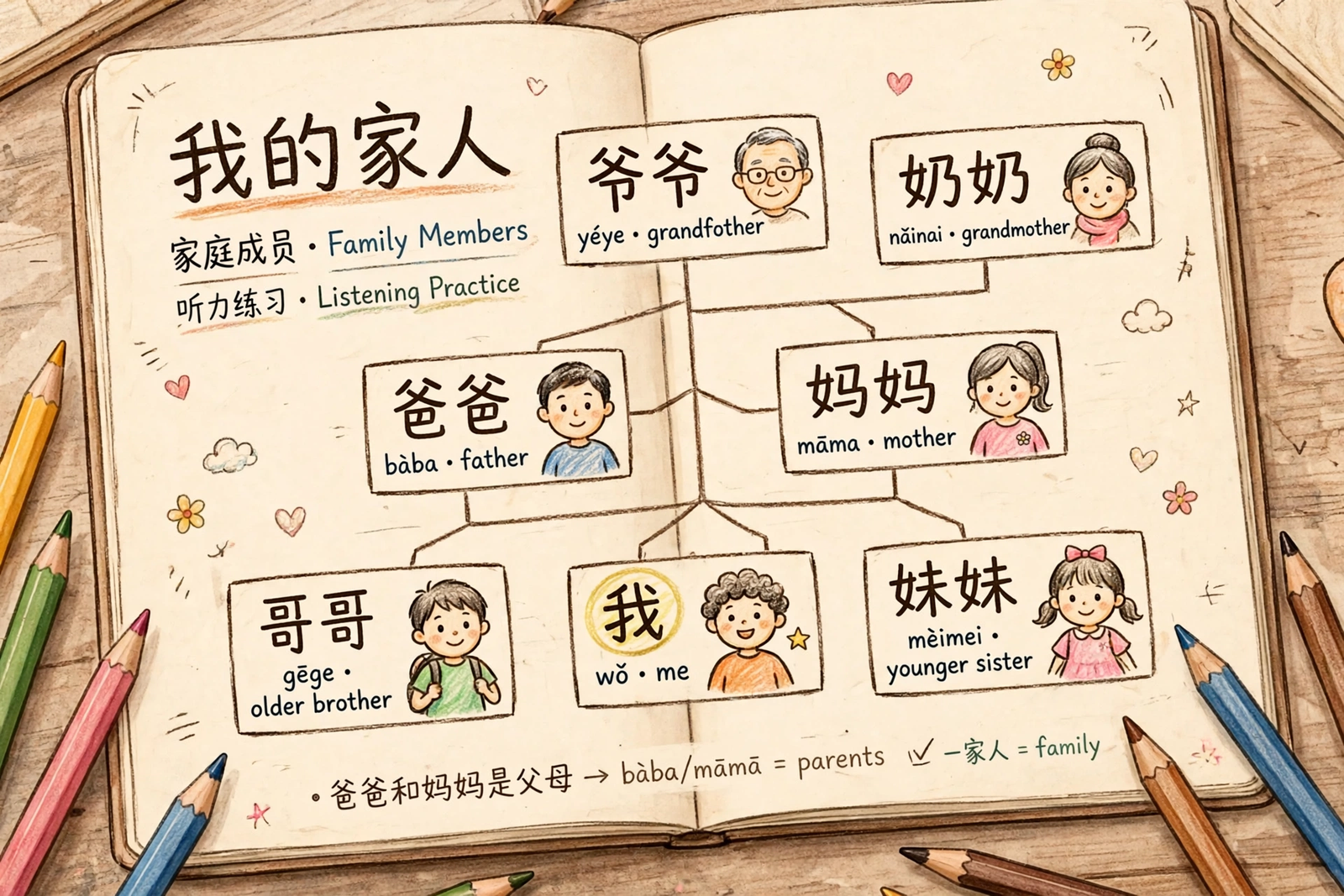
If any of these words are new, learn them now — the fifteen questions use nothing else. Chinese family words are wonderfully precise: there is a different word for older brother and younger brother, for father’s father and mother’s father. Learn them as pairs, and the listening test gets much easier.
| English | Chinese | Pinyin | English | Chinese | Pinyin |
|---|---|---|---|---|---|
| Dad | 爸爸 | bàba | Mom | 妈妈 | māma |
| Older brother | 哥哥 | gēge | Younger brother | 弟弟 | dìdi |
| Older sister | 姐姐 | jiějie | Younger sister | 妹妹 | mèimei |
| Grandpa (dad’s side) | 爷爷 | yéye | Grandma (dad’s side) | 奶奶 | nǎinai |
| Son | 儿子 | érzi | Daughter | 女儿 | nǚ’ér |
| Family | 家人 | jiārén | Home / family | 家 | jiā |
Three more building blocks, and you have the whole system. 今年 (jīnnián — this year), 岁 (suì — years old), and 几口人 (jǐ kǒu rén — how many people, for a family). Ages work like this: number + 岁 — 五岁 (wǔ suì — five years old), 七十岁 (qīshí suì — seventy years old). And when Chinese asks how big a family is, it counts 口 (kǒu — mouths): 我家有四口人 (wǒ jiā yǒu sì kǒu rén — my family has four people). That one measure word is worth more in the listening test than any single family word.
A quick note on two words in this practice: 爷爷 (yéye — grandpa) and 奶奶 (nǎinai — grandma) sit right at the edge of the official HSK 1 list, and 公园 (gōngyuán — park) too — but every HSK 1 course teaches them early. Grandparents are the whole reason learners talk about family, and parks are where family weekends happen — so they belong in a family practice, and you will meet them again in the real exam’s everyday topics.
Questions 1–3: Mom, Dad, and Loving Your Family
Question 1. 这是我的爸爸。(Zhè shì wǒ de bàba.) — Who is this?
(a) My dad (b) My mom (c) My older brother — Answer: (a) My dad. 爸爸 (bàba) is Dad. The sentence is 这是我的爸爸: this is my dad.
Question 2. 这是我的妈妈。(Zhè shì wǒ de māma.) — Who is this?
(a) My grandma (b) My mom (c) My teacher — Answer: (b) My mom. 妈妈 (māma) is Mom. Watch out for (a): 奶奶 (nǎinai) is grandma — it sounds a little like 妈妈, but it is a different person entirely.
Question 3. 我爱我的家人。(Wǒ ài wǒ de jiārén.) — What does the speaker say?
(a) I love my family (b) I love my teacher (c) I miss my family — Answer: (a) I love my family. 爱 (ài) means “to love” and 家人 (jiārén) means “family”. The trap in (c): “to miss” would be 想念 (xiǎngniàn), a word that is nowhere in this sentence.
Questions 4–6: How Many Brothers, and How Old?
Question 4. 你有几个哥哥?(Nǐ yǒu jǐ gè gēge?) — What is the speaker asking?
(a) How many older brothers do you have? (b) How old is your brother? (c) Do you like your brother? — Answer: (a) How many older brothers do you have? 几 (jǐ) means “how many” for small numbers, and 个 (gè) is the measure word for people. 哥哥 is specifically older brother — not just “brother”.
Question 5. 我有一个哥哥。(Wǒ yǒu yí gè gēge.) — How many older brothers does the speaker have?
(a) Two (b) One (c) None — Answer: (b) One. 一个 (yí gè) is one. This is the direct answer to question 4 — in the real listening test, questions often come in pairs like this, and the second one rewards you for hearing the first.
Question 6. 我的弟弟今年五岁。(Wǒ de dìdi jīnnián wǔ suì.) — How old is the younger brother?
(a) Five (b) Four (c) Fifteen — Answer: (a) Five. 五岁 is five years old. The trap in (c): 十五岁 (shíwǔ suì) is fifteen — one extra syllable, 十, changes the whole answer. Slow down on the number, not the family word.
Questions 7–9: What Do Mom and Dad Do, and How Old Is Grandpa?
Question 7. 爸爸是医生。(Bàba shì yīshēng.) — What is Dad’s job?
(a) Teacher (b) Doctor (c) Student — Answer: (b) Doctor. 医生 (yīshēng) is doctor. The trap in (a): 老师 (lǎoshī — teacher) is Mom’s job in the very next sentence — the test loves putting the two answers side by side.
Question 8. 妈妈是老师。(Māma shì lǎoshī.) — What is Mom’s job?
(a) Doctor (b) Student (c) Teacher — Answer: (c) Teacher. 老师 is teacher. If you heard 医生 here, you were remembering question 7 — each sentence stands on its own, so answer what you hear, not what you expect.
Question 9. 爷爷今年七十岁。(Yéye jīnnián qīshí suì.) — How old is Grandpa?
(a) Seventeen (b) Seventy (c) Seven — Answer: (b) Seventy. 七十岁 (qīshí suì) is seventy years old. The trap in (a): 十七岁 (shíqī suì) is seventeen — the same two sounds, swapped. 七十 is seven-ten; 十七 is ten-seven. In Chinese the bigger number comes first when you mean seventy.
Questions 10–12: How Big Is the Family, and What Does Grandma Like?
Question 10. 你家有几口人?(Nǐ jiā yǒu jǐ kǒu rén?) — What is the speaker asking?
(a) How many people are in your family? (b) How old is your family? (c) Where is your family? — Answer: (a) How many people are in your family? 几口人 asks for the number of people — 口 (kǒu) is the measure word used for counting family members. It is the single most useful family question in Chinese — learn it by heart.
Question 11. 我家有四口人。(Wǒ jiā yǒu sì kǒu rén.) — How many people are in the speaker’s family?
(a) Three (b) Four (c) Five — Answer: (b) Four. 四口人 is four people. The trap in (c): 五口人 would be five — and 五 sounds nothing like 四, so if you got this one wrong, replay the clip and listen for the number, not the family word.
Question 12. 我的奶奶喜欢喝茶。(Wǒ de nǎinai xǐhuan hē chá.) — What does Grandma like?
(a) Drinking tea (b) Going to the park (c) Eating rice — Answer: (a) Drinking tea. 喜欢喝茶 (xǐhuan hē chá) is “likes to drink tea”. The trap in (b): 公园 (gōngyuán — park) appears in question 15, not here — the test counts on you mixing up the sentences. Trust the one you just heard.
Questions 13–15: Big Sister, a Student, and a Family Trip
Question 13. 这是我姐姐。(Zhè shì wǒ de jiějie.) — Who is this?
(a) My younger sister (b) My older sister (c) My mom — Answer: (b) My older sister. 姐姐 (jiějie) is older sister; younger sister is 妹妹 (mèimei). In Chinese the age order is built into the word — there is no plain word for “sister” without saying older or younger.
Question 14. 她是学生。(Tā shì xuésheng.) — What is she?
(a) A teacher (b) A doctor (c) A student — Answer: (c) A student. 学生 (xuésheng) is student. The trap in (a): 老师 (teacher) is the word this sentence is most often confused with, because teachers and students always appear together in textbooks.
Question 15. 我们一家人去公园。(Wǒmen yī jiā rén qù gōngyuán.) — What are they doing?
(a) Going to the park (b) Going to school (c) Going home — Answer: (a) Going to the park. 一家人 (yī jiā rén) means “the whole family”, 去 (qù) means “to go”, and 公园 (gōngyuán) is the park. The trap in (b): 学校 (xuéxiào — school) sounds nothing like 公园, but test-takers who expect a school sentence sometimes hear one anyway. Trust your ears: if you heard 公园, it is the park.
Five Family Mistakes HSK 1 Learners Make
These five errors show up in almost every beginner’s listening test. The questions above were built around them on purpose.
Mixing up older and younger siblings. 哥哥 is older brother, 弟弟 is younger brother, 姐姐 is older sister, 妹妹 is younger sister. English has one word for each; Chinese has two. The first syllable tells you the age: gē- and jiě- are older, dì- and mèi- are younger. Learn them as pairs and the problem disappears.
Swapping 七十 and 十七. Seventy is 七十 (seven-ten), seventeen is 十七 (ten-seven). Same two sounds, opposite order — and the listening test loves this pair. When you hear a number with 七 and 十, ask yourself which one came first. First sound wins.
Hearing 五岁 as 十五岁. Five is 五岁, fifteen is 十五岁 — one extra syllable, 十, changes the answer by ten years. The month-and-day traps in the dates practice work the same way. Slow down on the number, not the family word.
Forgetting that 口 counts people. 你家有几口人? is not asking about mouths — 口 is the measure word for family members. If you translate it literally, the question makes no sense; if you know the pattern, it is the easiest question in the test.
Mixing up 奶奶 and 妈妈. Both end in a soft -ma sound, and both are women in the family — but 妈妈 is Mom and 奶奶 is Grandma. The first syllable is everything: mā- is Mom, nǎi- is Grandma. In fast speech, that first syllable is exactly what beginners miss.
Your Score and What to Do Next
Add up your correct answers from the fifteen questions above.
| Score | What it means | Next step |
|---|---|---|
| 13–15 | Your family words are solid | Move to the next listening topic — the greetings practice is the same level and format |
| 10–12 | Good, with a weak spot | Replay the groups you missed, then read the mistakes section once more |
| 7–9 | The words are there, the speed is not | Listen to each clip three times before answering, for one week |
| Under 7 | Learn the table first | Memorize the family words table above, then redo the fifteen questions tomorrow |
One more thing about the real exam: in the HSK 1 listening section, every question is short — one or two sentences, just like these fifteen. You hear each recording twice, and the questions come in the same order as the recordings. That is why this practice plays each clip as a group of three: it trains the exact skill the exam tests, which is hearing a short sentence once and holding the family word in your head long enough to answer. If you want to understand how the new syllabus differs from the old one, the HSK 3.0 changes explained post walks through it in plain language.
Quick Quiz: Family Words in Five Questions
Click the answer you choose — you will know right away whether it is right.
Your score: 0/5 — click an answer to check it right away.
Question 1. How do you say ‘older brother’ in Chinese?
Question 2. What does 我家有四口人 mean?
Question 3. 爷爷今年七十岁 means Grandpa is…
Question 4. Your friend says: 我的奶奶喜欢喝茶。 What does Grandma like?
Question 5. Which sentence means ‘This is my older sister’?
Frequently Asked Questions About HSK 1 Listening: Family
Does this practice follow HSK 2.0 or HSK 3.0? HSK 3.0 — the current syllabus. The family words are the same in both versions, so if you studied from HSK 2.0 books, everything here still applies. The main difference between the versions is the size of the word lists, not the family vocabulary. The HSK 3.0 changes explained post has the full comparison.
What is the difference between 哥哥 and 弟弟? 哥哥 (gēge) is an older brother and 弟弟 (dìdi) is a younger brother — Chinese always says which one. The same rule holds for sisters: 姐姐 is older, 妹妹 is younger. There is no plain word for "brother" or "sister" without the age built in.
Why does the family question use 口? 口 (kǒu) literally means "mouth", and it is the measure word Chinese uses to count people in a family — 我家有四口人 is "my family has four mouths", meaning four people. It is the standard way to ask and answer "how big is your family?"
How many times can I hear each recording in the real HSK 1 test? Twice. That is why this practice asks you to listen once with your eyes closed and once while answering — it copies the real exam's rhythm. If you need three listens now, that is fine; work down to two as the words get familiar.
What should I practice after family? Numbers and ages — the 五岁 versus 十五岁 trap in this set shows up everywhere in the exam, and the dates and months practice trains the same ear for numbers. The HSK 1 reading practice with fifteen short passages uses the same vocabulary in reading form, which locks the words in from a second direction.
Fifteen questions, one table, and a handful of traps you now know by name. Do this set once today and once more tomorrow, and the next time you hear 你家有几口人? you will not translate it — you will just know. Tell me in the comments how many of the fifteen you got right, and which question caught you. Then keep going on the Chinese page on LingoBubbo — every lesson there comes with vocabulary, audio, and a quiz, just like this one.