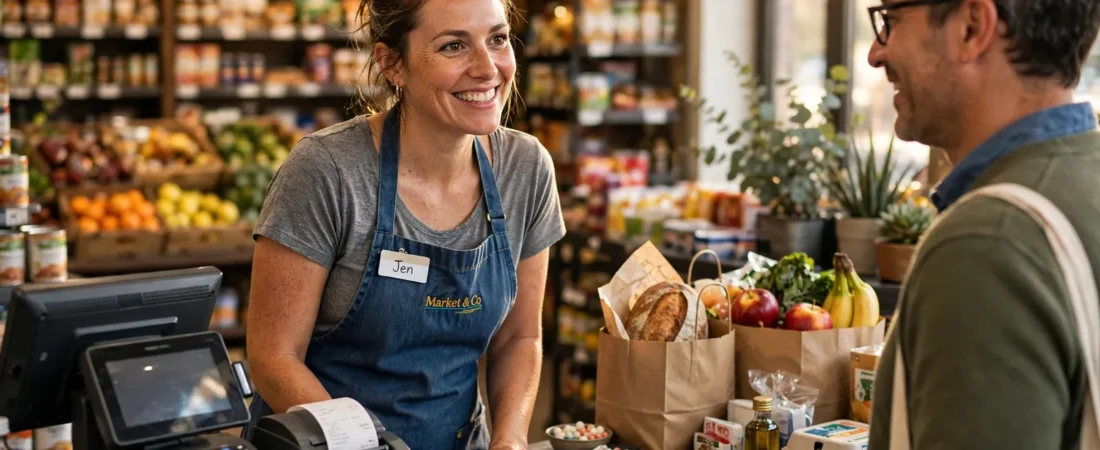
A customer walks up to your register, sets down their basket, and looks at you. You have about three seconds. In those three seconds, one friendly sentence in English can turn a nervous transaction into an easy one. This guide shows you how to greet customers at the checkout counter in English with the exact phrases real American cashiers use every day, plus what customers say back, how to pronounce it all naturally, two full role-play dialogues, and a quick quiz to lock it in. If you work as a cashier in a grocery store, a clothing shop, a pharmacy, or any retail store in the US, these are the words for your shift.
## Why the first five seconds at the register matter
Think about the last time you stood in line at a store. The cashier looked up, smiled, and said something warm. How did that feel? Probably like a small relief. Now think about the opposite: a cashier who says nothing, scans your items in silence, and holds out a hand for payment. Same store, same groceries, completely different feeling.
That feeling is your job at the register. Learning how to greet customers at the checkout counter in English is not about memorizing a script. It is about knowing which short sentence fits each moment, and saying it like you mean it. The greeting is not decoration. It tells the customer three things in one breath: I see you, I am happy to help, and this will be quick and easy. A customer who feels welcome is more patient when the card reader is slow, more forgiving when you need a price check, and more likely to come back to your store. And here is the good news: you do not need perfect English to do this well. You need about ten short sentences, said with a smile, in the right order. That is the whole skill, and this post teaches it.
## 16 phrases to greet customers at the checkout counter in English
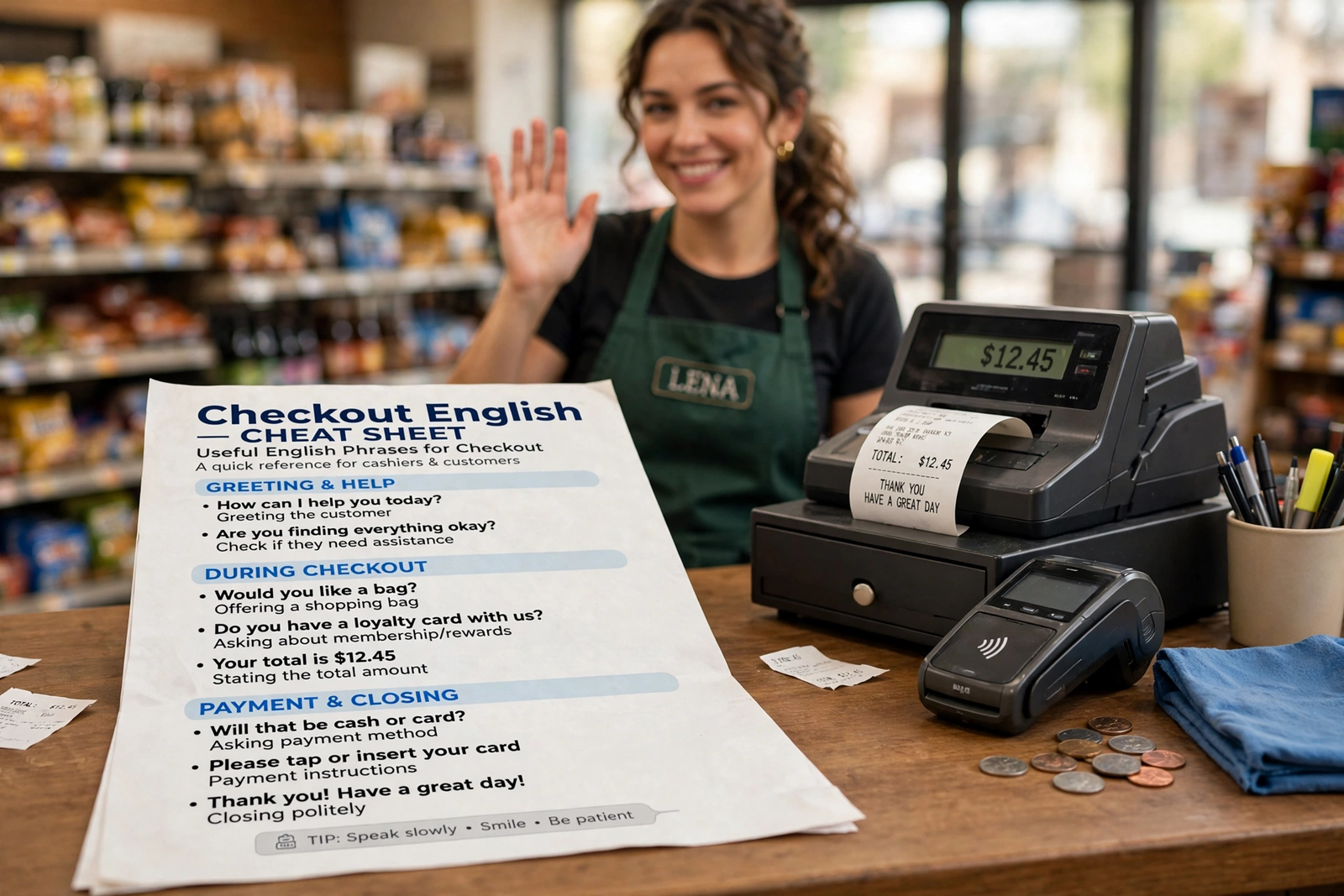
Learn these sixteen first. They cover the whole visit: the greeting, the check-in, the payment, the bag, and the goodbye. Read each one out loud as you go. The middle column tells you exactly when to say it, so you never have to guess.
| English phrase | When to say it | Plain-English meaning |
|—|—|—|
| Hi, how’s it going? | The moment the customer reaches your register | A friendly hello; you are not really asking for details |
| Hi there! | Same moment, a little shorter and warmer | Hello |
| Did you find everything okay? | After the greeting, before you start scanning | Did you find what you were looking for? |
| Let me know if you need any help. | When a customer is still deciding or browsing near the register | Tell me if you need something |
| Take your time. | When a customer is not ready yet | No rush |
| I’ll be right here if you need anything. | After offering help, as you step back | I am nearby, just ask |
| That’ll be twelve fifty. | When you state the total (say the real amount) | The total is $12.50 |
| Cash or card? | Right after the total | How will you pay? |
| Go ahead and tap when you’re ready. | For a card payment | Tap your card now |
| Go ahead and insert your card. | When tapping does not work | Put your card in the reader |
| Would you like a receipt? | After the payment goes through | Do you want the paper receipt? |
| Would you like a bag? | Before or after payment | Do you want a shopping bag? |
| Here’s your change. | Handing back cash | This is the money back from your payment |
| Have a great day! | The goodbye, with a smile | Enjoy the rest of your day |
| You’re welcome. | After a customer says thank you | Happy to help |
| Thanks for coming in. | A warm extra goodbye | Thank you for shopping here |
A few notes on the ones people get wrong. “Hi, how’s it going?” is not a real question about the customer’s life. The expected answer is a short “Good, thanks” or “Pretty good.” Nobody stands at the register and tells you about their week. And “Did you find everything okay?” is the standard American check-in at the register. It sounds caring, and it gives the customer a chance to say “Actually, I couldn’t find the oat milk,” before they pay and leave unhappy.
## Pronunciation tips that make you sound natural
You can know every phrase in the table and still sound stiff if the rhythm is off. American cashiers do not speak word by word. They link words together and soften small words. Here is how to copy that sound.
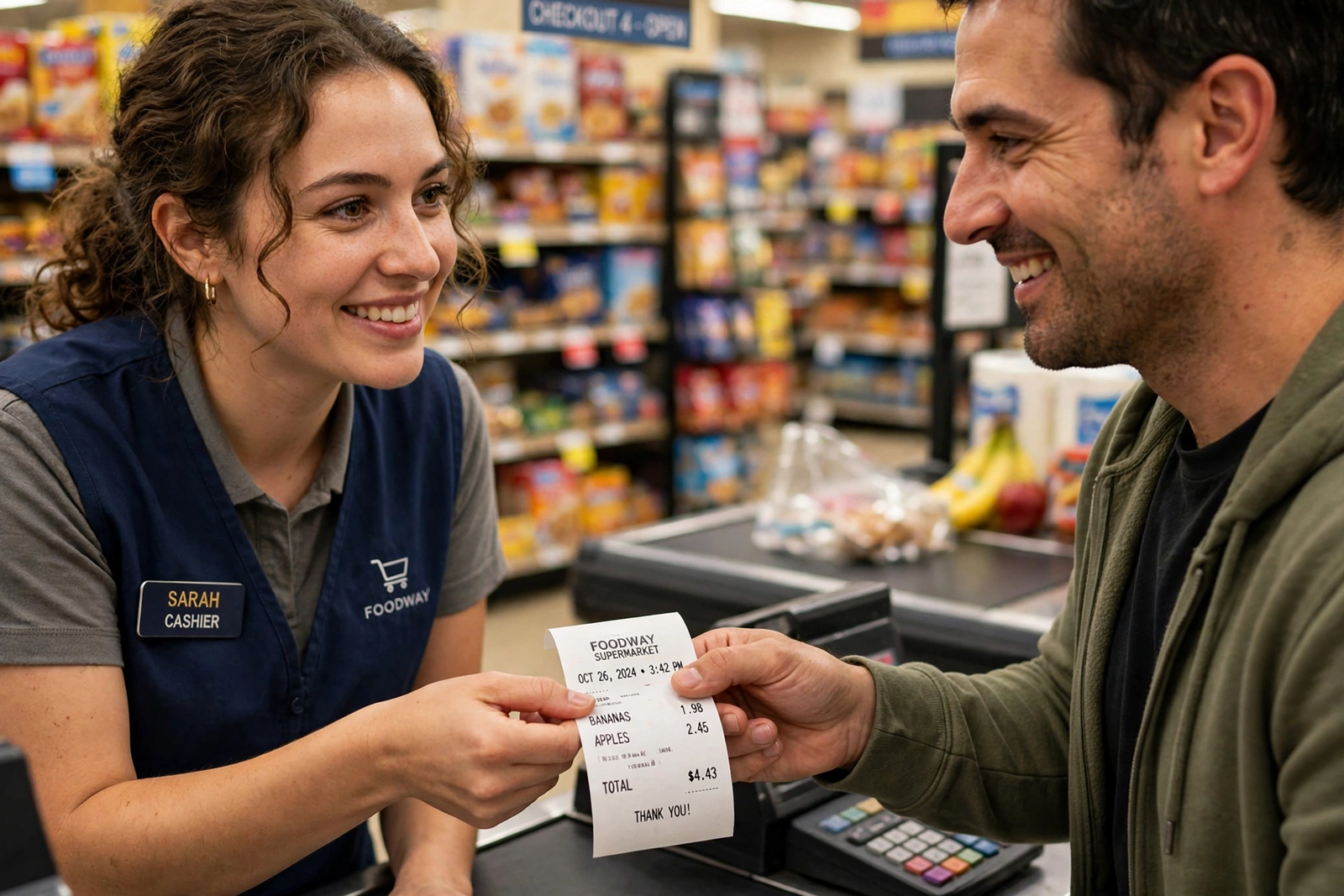
First, “How’s it going?” sounds like “howz it GOH-in.” The “how’s” squeezes into one quick syllable, and “going” loses its hard “g” at the end. Say it fast and relaxed, not “How. Is. It. Going?” Second, “Did you find everything okay?” in real speech often sounds like “didja find everything okay?” The “did you” melts together into “didja.” You do not have to say it that way, but you should recognize it when a coworker says it. Third, “Cash or card?” is short and flat, with a tiny rise at the end, like a friendly question, not an order. Fourth, “receipt” is pronounced “ruh-SEET,” with the stress on the second syllable. Many learners say “REH-seet,” which is understandable but sounds off. And “Would you like a bag?” softens into “woodja like a bag?” in fast speech. Again, clear and slow is always fine. Nobody at the register minds clear and slow. What sounds strange is a long pause followed by a perfect textbook sentence delivered like a robot.
One more tip: smile before you speak. It sounds like strange advice for a pronunciation section, but a smile changes your voice. It lifts the sound, softens it, and makes even a simple “Hi there!” feel warm. Customers hear the smile before they hear the words.
## What the customer says, and what you say back
Half the fear at the register is not knowing what the customer will say. So here is the other side of the conversation. These are the lines customers actually say, with the reply you give.
| Customer says | It means | You reply |
|—|—|—|
| Hi! | Hello | Hi, how’s it going? |
| I’m just looking. | I am browsing, not buying yet | No problem. Take your time. |
| I couldn’t find the oat milk. | They need help finding something | Let me check for you. One moment. |
| Can I pay with a card? | They want to pay by card | Of course. Go ahead and tap when you’re ready. |
| Do you take Apple Pay? | They want to pay by phone | Yes, you can tap your phone right here. |
| Can I get a bag? | They want a shopping bag | Sure thing. Here you go. |
| I don’t need a receipt. | They do not want the paper | No problem. Have a great day! |
| Can I get cash back? | They want extra cash from their card | Sure. How much would you like? |
| Thank you! | Thanks | You’re welcome. Have a great day! |
| Keep the change. | You can keep the extra coins | Thank you so much! |
Listen to these greeting phrases, read slowly, and repeat each one right after the speaker.
Read that table twice. The first time, read the customer column out loud. The second time, cover the reply column and say the reply from memory. That small exercise is worth more than reading the list ten times, because at the register you will hear the customer’s line first, and your reply has to come out without thinking.
A quick note on “Do you take Apple Pay?” and “Can I get cash back?” You do not need to promise anything about your store. Every store has its own rules about phone payments and cash back, and those rules can change. If you are not sure your store offers something, the safe answer is “Let me check” or “I can ask my manager.” Never guess about store policy. A friendly “Let me check for you” is always correct, and customers respect it.
## Role-play dialogue 1: A smooth card payment
Here is a whole checkout in one short conversation. The cashier is A, the customer is B. Read it out loud, playing both parts. Listen to the audio first, then read along.
A: Hi, how’s it going? Did you find everything okay?
B: Hi! Yes, I found everything. Thanks.
A: Great. That’ll be twenty-three forty. Cash or card?
B: Card, please.
A: Go ahead and tap when you’re ready. Would you like a receipt?
B: Yes, please.
A: Here you go. Have a great day!
B: You too, thanks!
That is a complete checkout in about thirty seconds. Notice how short every sentence is. Real register English is short. Nobody gives a speech at the checkout counter. Learn this dialogue by heart, and you can handle a real customer on your first day. Try it three times: once reading both parts, once as the cashier only, and once as the customer only. Each round takes less than a minute.
## Role-play dialogue 2: Cash, change, and a bag
This one covers the trickier case: a customer paying cash, which means you have to give change. Listen first, then practice.
A: Hi there! Let me know if you need any help.
B: Thanks, I’m just looking.
A: No problem. Take your time.
B: Actually, I’ll take this one.
A: Sure thing. That’ll be twelve fifty. Cash or card?
B: Cash. Here’s twenty.
A: And seven fifty is your change. Would you like a bag?
B: Yes, please. Thank you!
A: You’re welcome. Have a nice day!
The math in this dialogue is worth practicing on its own. The total is $12.50, the customer hands you $20.00, and the change is $7.50. Twenty minus twelve fifty is seven fifty. Say it out loud with the money: “And seven fifty is your change.” Customers love hearing the amount as you hand it over, because it tells them you counted it. If you ever feel unsure about the change, say the numbers out loud while you count the bills back. It is normal, it is professional, and it keeps everyone honest.
Now listen to the payment and goodbye phrases, read slowly, and repeat them.
## 5 mistakes that make you sound robotic
**Greeting too late, or not at all.** The greeting belongs the moment the customer reaches your register, in the first three seconds. A customer who has already put their basket down and waited in silence already feels invisible.
**Asking “What do you want?”** That is what you say to a friend, not a customer. At the register, use “Did you find everything okay?” or “Let me know if you need any help.” The words are longer, but the feeling is completely different.
**Skipping the check-in and jumping to the total.** “That’ll be twenty-three forty” as your first sentence sounds like a machine. One greeting first, then the total. The order matters more than the words.
**Mumbling the total.** The total is the one number the customer must hear clearly. Say it slowly and clearly, every time. “That’ll be twelve fifty” is not a sentence to rush.
**Forgetting the goodbye.** “Have a great day!” costs two seconds and it is the last thing the customer remembers. A checkout with a warm greeting and no goodbye feels unfinished, like a phone call that just ends without a word.
## Your 7-day practice plan
– **Day 1:** Memorize “Hi, how’s it going?” and “Did you find everything okay?” Say each one 20 times, out loud, with a smile.
– **Day 2:** Add “Cash or card?” and “Would you like a receipt?” Practice the greeting plus the payment question as one flow.
– **Day 3:** Read dialogue 1 out loud, playing both parts, three times. Listen to the audio and copy the rhythm.
– **Day 4:** Read dialogue 2 out loud three times. Practice counting change out loud: twenty minus twelve fifty is seven fifty.
– **Day 5:** Listen to all four audio clips and repeat each line right after the speaker, without looking at the text.
– **Day 6:** Role-play with a friend or family member. One of you is the cashier, one is the customer. Swap roles, then swap again.
– **Day 7:** Say the whole greeting-to-goodbye flow from memory, out loud, without looking at this post. If you can do it, you are ready for your next shift.
## Quick Quiz
Test yourself on greeting customers at the checkout counter in English. Click an answer to see if you are right. Your score is at the top.
Score: 0/5
1. A customer walks up to your register. What is the best greeting?
2. What does “Did you find everything okay?” mean?
3. A customer says “I’m just looking.” What is the best reply?
4. The customer says “Card, please.” What do you say next?
5. The total is $12.50 and the customer hands you $20. How much change do you give back?
## FAQ
**Do I have to greet every single customer?**
Yes, every one, with a smile. It takes three seconds, and it is the single most expected thing at an American checkout counter. Customers notice when it is missing, even if they do not say so.
**What if the customer does not answer my greeting?**
That is normal. Some people are tired, in a hurry, or thinking about something else. Smile, move on to “Did you find everything okay?” or straight to the total, and do not take it personally.
**What should I say if I do not understand the customer?**
Say “Sorry, could you say that again?” with a smile. It is polite, it is honest, and it works every time. Never pretend you understood. Guessing wrong about a payment or a bag causes real problems.
**Is “Hi, how’s it going?” too casual for work?**
No. It is the standard greeting in American retail, from grocery stores to clothing shops. It is friendly, not rude, and customers expect it. Save the formal “Good morning” for very formal settings, and use “Hi, how’s it going?” everywhere else.
**How do I practice if I work alone and have no one to role-play with?**
Record yourself reading both dialogues on your phone and play them back. Even better, say the greeting to yourself in the mirror before your shift, with a smile, three times. The 7-day plan above works alone or with a partner.
## Your turn: greet your next customer in English
You now have sixteen phrases, two full dialogues, four audio clips to copy, and a practice plan for the week. You do not need all of them tomorrow. You need one: “Hi, how’s it going?” Say it to your next customer, with a smile, and watch what happens. Then add “Did you find everything okay?” the day after, and “Cash or card?” the day after that. In a week, the whole flow will feel natural, and the register will feel less like a test and more like a conversation. That is what it means to greet customers at the checkout counter in English with confidence: not perfect grammar, just the right words at the right moment.
Keep learning with the [English lessons on LingoBubbo](https://lingobubbo.com/tieng-anh/), where work phrases like these appear in short dialogues you can practice every day. If this guide helped you, send it to a friend who works in a shop or is learning English for work in the US. A good greeting is the easiest skill in the language, and it pays off on the very first customer. And tell us in the comments: which phrase do you use most at your register, and which one still feels tricky to say?