
It is 11:40 at night. A guest walks through the door, dragging a suitcase with a broken wheel, hair damp from the rain. They have been driving for five hours. The first words out of your mouth will decide whether they relax or stay tense for the rest of the night.
That is the whole job of a hotel front desk greeting: make a tired stranger feel welcome in about ten seconds, in clear, professional English. This guide shows you how to greet hotel guests at check-in with 15 phrases that work in real American hotels, with simple pronunciation help, the replies guests actually give you, a full role-play you can practice, and the mistakes to avoid. Whether you work the front desk in a small motel or a big city hotel, these lines will carry you through any check-in.
## The first 30 seconds: what a tired guest really needs
Picture the guest again. They do not know your name. They do not know where the elevator is, what time breakfast starts, or whether the Wi-Fi needs a password. They are standing at your desk with a suitcase, a phone at 4 percent battery, and a long day behind them.
What they need from you in the first 30 seconds is simple: a warm hello, your name, and the feeling that someone is in charge. That matters more than perfect grammar. A receptionist who smiles and says, “Good evening! Welcome to the Grand Plaza Hotel. How may I help you today?” beats a receptionist with perfect English and a tired face, every single time.
Think of check-in as three small steps. First, greet the guest. Second, find the reservation and confirm the details. Third, hand over the key and point them in the right direction. If you can do those three steps with a smile, you can do this job in English.
## 15 phrases to greet hotel guests at check-in
Here are the 15 phrases, grouped by the moment you need them. Each one comes with a simple pronunciation hint. Read each phrase out loud twice. The hints use easy sounds, not phonetic symbols.
### The warm welcome
**1. “Good evening! Welcome to the Grand Plaza Hotel.”**
Pronunciation: “Good EEV-ning! WEL-kum too the Grand PLAH-zuh hoh-TEL.”
Use it: the moment a guest reaches your desk. Swap in your own hotel name, and swap “evening” for “morning” or “afternoon” to match the time of day.
**2. “How may I help you today?”**
Pronunciation: “How may I help yoo tuh-DAY?”
Use it: right after the welcome. It is the most professional way to ask what the guest needs. “How can I help you?” works too, but “may I” sounds a touch more polished at a hotel desk.
**3. “Welcome! Did you have a good trip in?”**
Pronunciation: “WEL-kum! Did yoo hav a good trip in?”
Use it: when a guest looks tired from travel. It is a small human touch, and guests love it. If they start telling you about traffic, just smile and say, “I’m glad you made it here safely.”
**4. “Good morning! Welcome back. It is great to see you again.”**
Pronunciation: “Good MOR-ning! WEL-kum bak. It is grait too see yoo uh-GEN.”
Use it: for a returning guest. Regular guests remember when you remember them. If you recognize a face but not the name, a warm “Welcome back!” on its own is enough.
**5. “Hi there! Are you checking in?”**
Pronunciation: “Hi thair! Ar yoo CHEK-ing in?”
Use it: when a guest walks up and you are not sure what they need. It is friendly, short, and it gets the conversation moving.
### The reservation and the details
**6. “May I have your name for the reservation, please?”**
Pronunciation: “May I hav yor naim for the rez-er-VAY-shun, pleez?”
Use it: to find the booking. Say the guest’s name back once you find it: “Thank you, Ms. Nguyen.” Guests relax the moment they hear their own name.
**7. “Could you spell your last name for me, please?”**
Pronunciation: “Could yoo spel yor last naim for mee, pleez?”
Use it: when you cannot find the reservation, or when a name has an unusual spelling. Asking someone to spell their name is normal in American hotels. Nobody is offended by it.
**8. “Could I see a photo ID and the credit card used for the booking?”**
Pronunciation: “Could I see a FOH-toh I-DEE and the KRED-it kard yoozd for the BOOK-ing?”
Use it: before you hand over a key. Say it with a smile and the word “please” at the end if you like. At many hotels, the card on file is checked at check-in, and guests expect this question.
**9. “How many nights will you be staying with us?”**
Pronunciation: “How MEN-ee naits will yoo bee STAY-ing with us?”
Use it: to confirm the length of the stay. It also catches mistakes early: if the guest says three nights and the system says two, you can fix it now instead of at check-out.
**10. “Would you like a room on a higher floor or a lower floor?”**
Pronunciation: “Wood yoo laik a room on a HY-er flor or a LOH-er flor?”
Use it: when you have a choice to offer. Some guests want a view from a high floor. Others, like parents with small kids, prefer a lower floor. One question shows you care.
### The room, the key, and the goodbye
**11. “Your room is on the fifth floor. The elevator is just to your right.”**
Pronunciation: “Yor room is on the fifth flor. The EL-uh-vay-ter is just too yor rait.”
Use it: while you hand over the key. Always point as you say it. A guest who is tired will remember a gesture far better than a sentence.
**12. “Here is your key card. Your room number is 512.”**
Pronunciation: “Heer is yor kee kard. Yor room NUM-ber is five-one-two.”
Use it: say the room number slowly, digit by digit: “five-one-two,” not “five hundred twelve.” And say it quietly. Room numbers are private. Never call a room number across a busy lobby.
**13. “Breakfast is served from 6:30 to 10:00 in the restaurant on the ground floor.”**
Pronunciation: “BREK-fust is servd from six-THIR-tee too ten in the RES-tront on the grownd flor.”
Use it: before the guest asks. It is the question almost every guest asks first, so answer it before they have to. At many hotels, breakfast hours and locations vary, so always confirm your own hotel’s times.
**14. “Check-out is at 11 a.m. Would you like a late check-out?”**
Pronunciation: “Chek-owt is at uh-LEV-en ay-em. Wood yoo laik a lait chek-owt?”
Use it: at the end of check-in, so there is no surprise on the last morning. If late check-out is available at your hotel, offering it now is a small kindness guests remember.
**15. “Please let me know if you need anything during your stay. Have a wonderful stay!”**
Pronunciation: “Pleez let mee noh if yoo need EN-ee-thing DUR-ing yor stay. Hav a WUN-der-ful stay!”
Use it: as your closing line. It is warm, professional, and it tells the guest the desk is there for them all night.
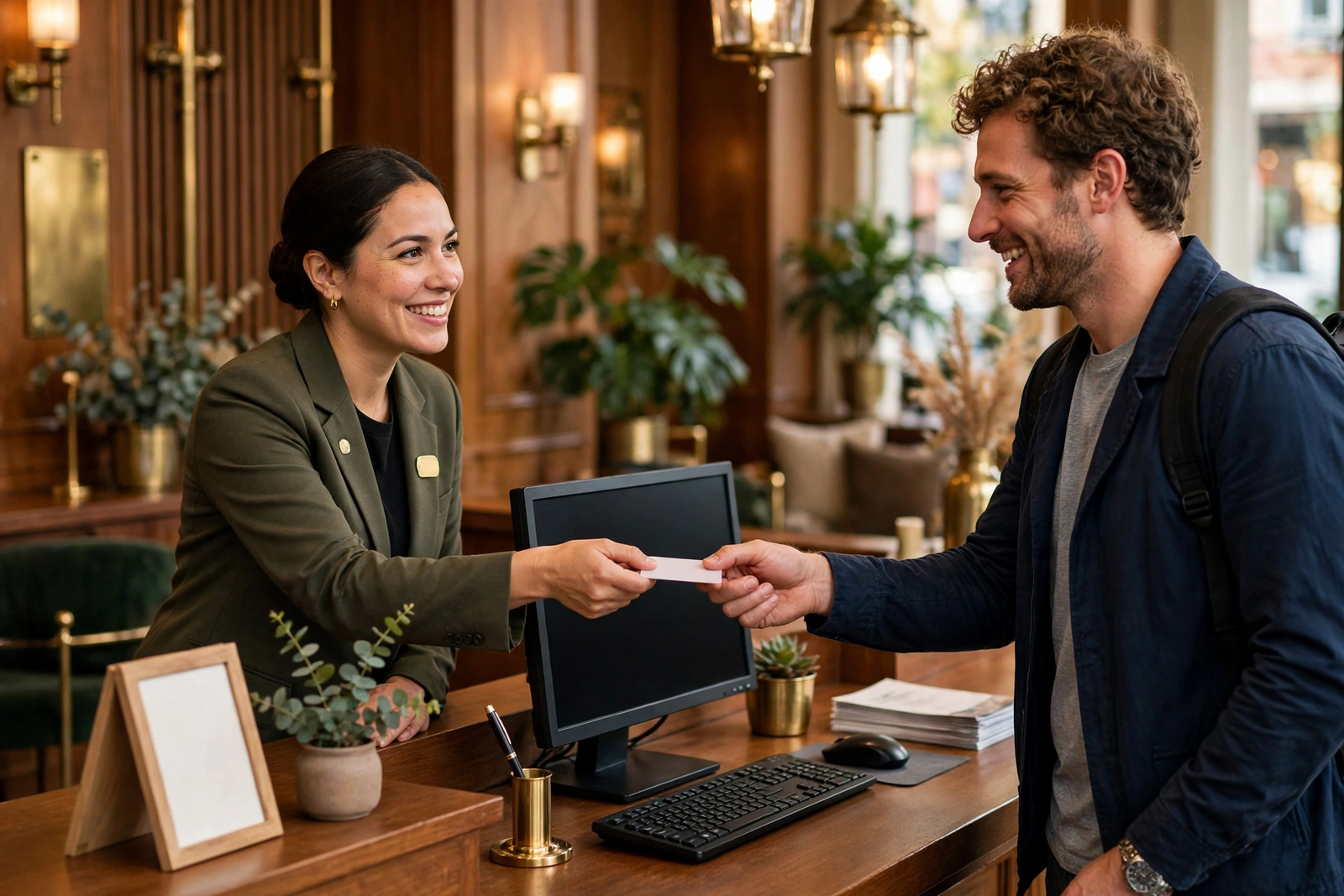
Listen to all 15 phrases, read slowly, and repeat each line right after you hear it:
## What guests say back, and what to answer
Guests do not always answer the way the textbook says they will. Here are the lines you will hear most often at an American front desk, and the short reply that keeps things moving. Every hotel is a little different, so treat the details below as examples. The phrases are what matter.
| Guest says | What it means | Your short answer |
|—|—|—|
| “I have a reservation under Nguyen.” | I booked a room. My last name is Nguyen. | “Thank you. May I have your first name, please?” |
| “Do you have a room for tonight?” | I did not book ahead. Is anything free? | “Let me check availability for you.” |
| “Can I get a room on a lower floor?” | I prefer a low floor. | “Of course. Let me see what we have.” |
| “What time is breakfast?” | When and where can I eat in the morning? | “Breakfast is served from 6:30 to 10:00 in the restaurant on the ground floor.” |
| “Where do I park?” | Where do I leave my car? | “Parking is just behind the hotel. I will show you on the map.” |
| “Can I check out late?” | I want to leave later than the normal time. | “Let me check what late check-out times we have today.” |
Listen for the key words: reservation, room, floor, breakfast, park, late. Even if you miss the rest of the sentence, those words tell you what the guest needs. And if you truly do not understand, it is perfectly professional to say, “I am sorry, could you say that once more, please?” Guests would rather repeat a sentence than watch you guess.
Listen to the guest lines and the staff replies, and notice how short each exchange is:
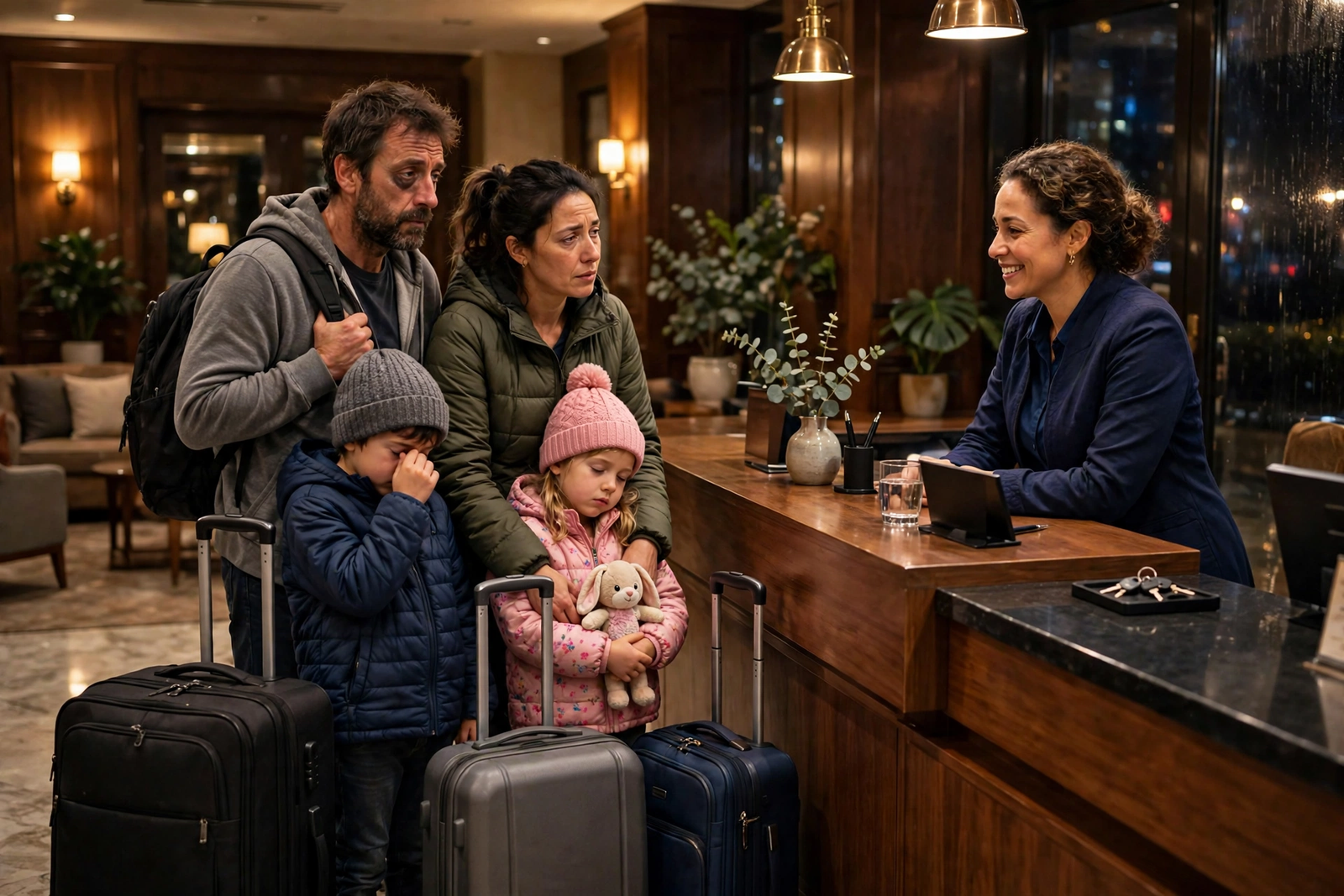
## Role-play: a family checks in late at night
Read this out loud with a friend, or read both parts yourself. Play the receptionist first, then switch and play the guest. Say it twice. The second time, try it without looking at the page.
**Receptionist:** Good evening, and welcome to the Grand Plaza Hotel! How may I help you today?
**Guest:** Hi! We have a reservation for two nights, under the name Tran. We just drove in from Los Angeles, and the kids are exhausted.
**Receptionist:** Welcome! Let me find your reservation. Could I have your first name, please?
**Guest:** It is Minh Tran.
**Receptionist:** Thank you, Mr. Tran. I found it: a family room for two nights. Could I see a photo ID and the credit card used for the booking?
**Guest:** Here you go. Is there any chance we could get a room on a lower floor? The kids are afraid of heights.
**Receptionist:** Of course. Let me check. Yes, I can move you to a room on the second floor. Your room number is 214. The elevator is just to your right.
**Guest:** That is wonderful. What time is breakfast?
**Receptionist:** Breakfast is served from 6:30 to 10:00 in the restaurant on the ground floor. Check-out is at 11 a.m. Would you like a late check-out?
**Guest:** No, eleven is fine. Thank you so much!
**Receptionist:** My pleasure. If you need extra towels or anything at all, just call the front desk. Have a wonderful stay with us!
Notice the pattern. The receptionist asks one question at a time, waits for the answer, and never rushes the family. She repeats the important details: the room number, the floor, breakfast, check-out. That is the whole job in the first five minutes. Listen to the full exchange here:
## 5 mistakes front desk staff make at check-in, and how to fix them
**Skipping the greeting and jumping straight to “Name?”** The guest feels like a number, not a person. Fix it: say hello first, then ask for the name. Two seconds of warmth change the whole check-in.
**Asking for ID before saying hello.** “ID and credit card, please” as your first sentence sounds like a border checkpoint. Fix it: greet, ask the name, find the reservation, and then ask for the ID. Order matters.
**Mumbling the room number and rushing the directions.** A tired guest will walk to the wrong floor and have to come back. Fix it: say the room number slowly, digit by digit, point to the elevator, and ask, “Would you like me to repeat that?” Most guests will say yes, and they will be grateful.
**Giving three directions at once.** “Elevator on the right, breakfast on the ground floor, pool on the second floor, gym closes at ten.” Nobody remembers all of that. Fix it: give one direction at a time, and put the rest on the key card holder or a small welcome card.
**Forgetting to mention check-out time and breakfast.** The guest has to call the desk at midnight to ask. Fix it: end every check-in with the two facts guests always want: breakfast hours and check-out time. Then your closing line.
## Polite recovery phrases for tricky moments
Sometimes check-in does not go smoothly. The room is not ready. The reservation is under a different name. The guest is upset. These phrases buy you time and keep your voice calm.
– “I am sorry for the wait. Thank you for your patience.”
– “Let me check that for you right away.”
– “I am afraid that room is not available, but I can offer you a similar room on the third floor.”
– “I understand the frustration, and I will do my best to help.”
– “Could you give me just a moment to confirm that with my manager?”
– “Thank you for letting me know. I will make a note of that right away.”
– “I apologize for the inconvenience. Here is what I can do for you.”
The magic phrase is “Here is what I can do for you.” It turns a problem into a solution, and it works even when the answer is not what the guest hoped for. Listen to the recovery phrases and repeat each one after you hear it:
## Your pocket cheat sheet
Save this table on your phone and read it once before every shift this week.
| Moment | Say this |
|—|—|
| Guest arrives | “Good evening! Welcome to the Grand Plaza Hotel. How may I help you today?” |
| Finding the booking | “May I have your name for the reservation, please?” |
| Asking for ID | “Could I see a photo ID and the credit card used for the booking?” |
| Offering a choice | “Would you like a room on a higher floor or a lower floor?” |
| Giving the key | “Here is your key card. Your room number is 512. The elevator is just to your right.” |
| Before they ask | “Breakfast is served from 6:30 to 10:00 in the restaurant on the ground floor.” |
| Closing | “Check-out is at 11 a.m. Please let me know if you need anything. Have a wonderful stay!” |
## Quick Quiz
Test yourself on the check-in phrases. Click an answer to see if you are right. Your score is at the top.
Score: 0/5
1. What is the best first sentence when a guest reaches your desk?
2. A guest asks “Do you have a room for tonight?” and you are fully booked. What is the most professional reply?
3. Which sentence asks for ID in the most polite way?
4. A guest asks “What time is breakfast?” What is the best answer?
5. Why should you repeat the room number and floor clearly?
## FAQ
**What if I do not understand the guest’s accent?**
Do not guess. Smile and say, “I am sorry, could you say that once more, please?” If you still miss it, ask the guest to spell the key word, or point to it on the screen. Guests would much rather repeat a sentence than watch you guess wrong.
**What if the guest has no reservation?**
Stay calm and check anyway. “Let me check availability for you” is the perfect line. If a room is free, check them in the same way. If nothing is free, apologize briefly and offer to help them find another hotel nearby.
**Should I call guests “sir” or “ma’am”?**
In many American hotels, “sir” and “ma’am” are polite and welcome, especially in the South. A safer choice that works everywhere is the guest’s name: “Thank you, Ms. Nguyen.” Once you know their name, use it.
**What if a guest is upset about the room?**
Listen first, then use a recovery phrase: “I understand the frustration, and I will do my best to help.” Offer what you can do, not what you cannot: “Here is what I can do for you.” If the problem is bigger than your desk can fix, call your manager. That is what managers are for.
**How do I greet a returning guest?**
A simple “Good morning! Welcome back. It is great to see you again” makes a regular guest’s day. If you remember their name or their usual room, use it. Returning guests are the best guests a hotel can have, and they notice when you notice them.
## Your turn: practice before your next shift
You do not need to memorize all 15 phrases tonight. You need three things ready: your greeting with your name, one question about the reservation, and your closing line with breakfast and check-out. Practice the role-play above out loud once before your next shift, and listen to the audio clips one more time on the way to work. By the second guest, the words will come on their own.
Keep learning with the [English lessons on LingoBubbo](https://lingobubbo.com/tieng-anh/), where you will find more work English for hotel staff, restaurant workers, and drivers. If you are preparing for a restaurant job interview, read our guide on [how to introduce yourself at a restaurant job interview in English](https://lingobubbo.com/cach-tu-gioi-thieu-khi-phong-van-viec-nha-hang-bang-tieng-anh/), and if you greet passengers as a driver, our [Uber driver greeting phrases](https://lingobubbo.com/tai-xe-uber-chao-khach-va-xac-nhan-ten-bang-tieng-anh-the-nao/) use the same warm, professional style. If this guide helped you, send it to a coworker who is starting their first front desk job. And tell us in the comments: what is the first sentence you say when a guest reaches your desk?