
You have studied the grammar and done the flashcards. Now you are sitting across from a real person, trying to say something in their language, and your mind has gone blank. That is the moment most learners realise what they are missing: a language exchange partner — someone who wants to learn your language as much as you want to learn theirs. This guide shows you where to find one, what to say first, and how to keep it fair, fun, and going for months.
The best part? A language exchange costs nothing. You trade time, not money — thirty minutes in your language, thirty minutes in theirs.
Where to find a language exchange partner
There are more places to find a partner than most learners realise. Start with the easiest ones.
Language exchange apps. Tandem, HelloTalk, and Speaky connect you with native speakers around the world in minutes. Set up a profile, say what you are learning and what you can offer, and start with text chat before moving to voice. The apps have built-in corrections and translations — use them.
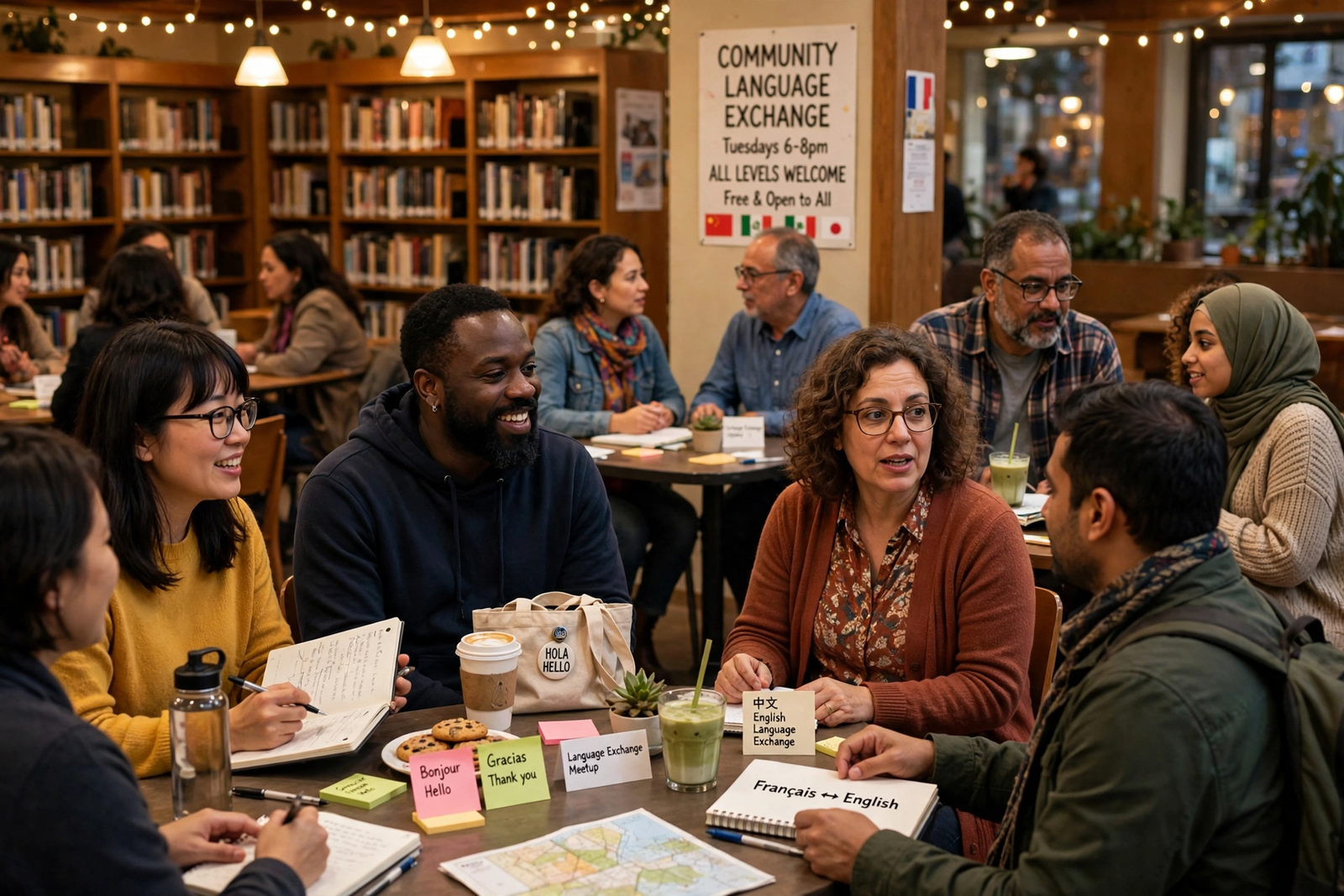
Local meetups and conversation groups. Search for language exchanges in your city — libraries, cafés, universities, and community centres host them every week. Meeting in person builds confidence faster than any app. If your city has a large community of speakers of your target language, there is almost certainly a group.
University language centres and cultural institutes. The Alliance Française, the Goethe-Institut, the Instituto Cervantes, and Confucius Institutes all run conversation programmes. You do not need to be a student — most welcome anyone who wants to practise.
Your own community. Neighbours, colleagues, parents at the school gate — someone near you speaks the language you are learning. The best exchange partner is often the person you already know.
Social media and forums. Reddit’s language exchange communities, Facebook groups, and Discord servers are full of people looking for partners. Post an introduction, say what you offer and need, and be specific about times and time zones.
What to say first: the first message that gets a reply
Most first messages fail because they are too vague. “Hi, I want to practise Spanish” tells a stranger nothing. This is what works instead.
“Hi, I’m Sara, I’m learning Spanish and I speak English.” Name, language, what you offer — that is all a stranger needs.
Say your level honestly. “I’m a beginner — I can have a simple conversation, but I make a lot of mistakes.” Nobody expects perfection, and pretending to be advanced wastes everyone’s time.
Suggest a structure. “Would you like to do 30 minutes in English and 30 minutes in Spanish, once a week?”
Suggest a first topic. “We could talk about food, travel, or our jobs — whatever you like.” A topic removes the awkward silence of the first meeting.
Be warm and specific about why you chose them. “I saw you like cooking, and I love cooking too” beats “Hi” every time. People reply to people who noticed something about them.
The rules that keep a language exchange fair
Most exchanges fail for one reason: they drift. One person talks, the other listens, and after a month only one of them has improved.
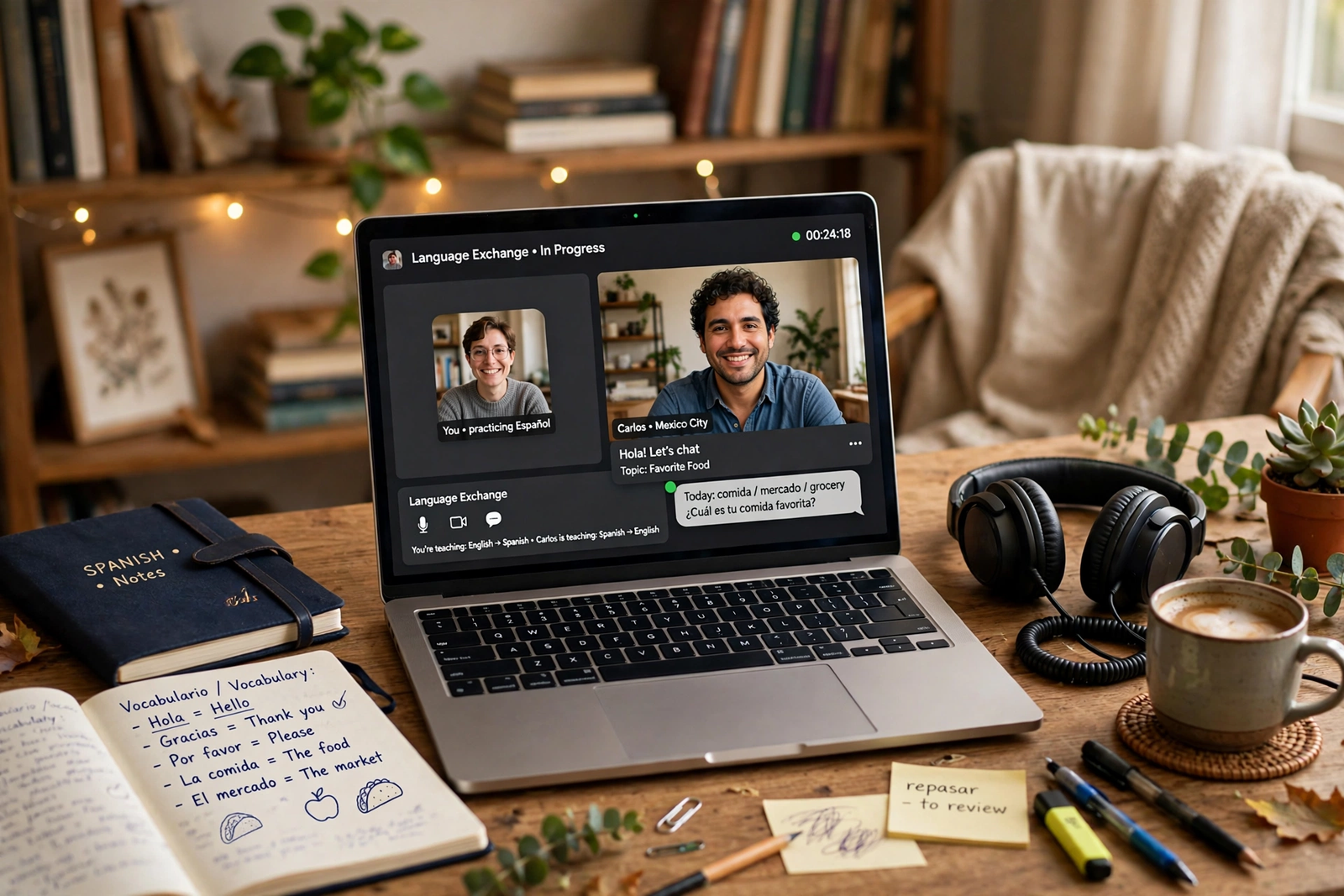
Split the time equally — and time it. Thirty minutes in each language, with a timer. When it goes off, switch, even mid-sentence. It feels strict at first — and it is the reason exchanges last.
Correct gently, and ask how. Some people want every mistake corrected; others want to flow. Ask your partner: “Do you want me to correct you as we go, or at the end?” Then do what they asked.
Prepare one thing each week. A short article, three questions, a story from your week. Preparation turns a chat into a lesson — and means you never sit wondering what to say.
Meet at the same time each week. Same day, same hour, same place or same link. Put it in the calendar like any other appointment.
Speak the target language, even badly. The temptation is to fall back into the language you both speak well. Resist it — mistakes are the point.
What to talk about: topics that never run dry
Running out of things to say is the second reason exchanges fail. Keep this list handy.
Your week. What you did, what you ate, what surprised you. Everyday life is the best conversation material there is.
Food and recipes. Describe a dish from your country, then ask your partner to describe one of theirs.
News and opinions. “What do you think about…?” turns a chat into a real conversation. Start with light topics — a film, a match, a festival — and let it grow.
Your goals. Why are you learning this language? What do you want to do with it?
Correct each other’s homework. Bring a short text you wrote. Your partner is the best proofreader you will ever have — and proofreading their English teaches you your own language too.
Your first-week exchange checklist
Start this week — do not wait until you feel ready, because you never will:
☐ Write a one-paragraph profile: who you are, what you are learning, what you offer
☐ Send three first messages today — to different people, on one platform
☐ Suggest a structure in your first message: 30 minutes each, once a week
☐ Prepare three questions for your first session, so you never run dry
☐ After the first session, agree the next time before you say goodbye
☐ Keep a notebook of new words from each session, and review them before the next one
Three messages, one session, and you are a language exchanger. The rest is just showing up.
Quick Quiz
Test yourself on finding a language exchange partner. Click an answer to see if you are right — your score is at the top.
Score: 0/5
1. A language exchange works by trading…
2. Which first message is most likely to get a reply?
3. The rule that keeps a language exchange fair is…
4. How should you end an exchange that is not working?
5. Where does the post say the best exchange partner is often found?
Quick answers about finding a language exchange partner
Is a language exchange free?
Yes — that is the point. You trade time, not money, and both partners teach and learn. If someone asks you to pay for a “language exchange”, it is a lesson, not an exchange.
What if my partner is much better than me?
That is normal. A stronger partner can explain things a textbook cannot. The exchange still works as long as time is split equally and both of you are patient. If the gap is huge, keep topics simple for the first month.
How do I end an exchange that is not working?
Politely and early: “Thank you so much — my schedule has changed and I need to pause for now.” Then find a new partner and try again.
Is it safe to meet a language exchange partner in person?
Meet in public — a café, a library, a group meetup — and tell someone where you are going. The same common sense that applies to any new acquaintance applies here.
A language exchange partner is the closest thing to a shortcut language learning has. Find one this week, send the message, and let the conversation do the teaching. If you want a guided path with audio, real dialogues and practice built in, explore our English programme and our Chinese programme for learners who love the same everyday, speak-first method.