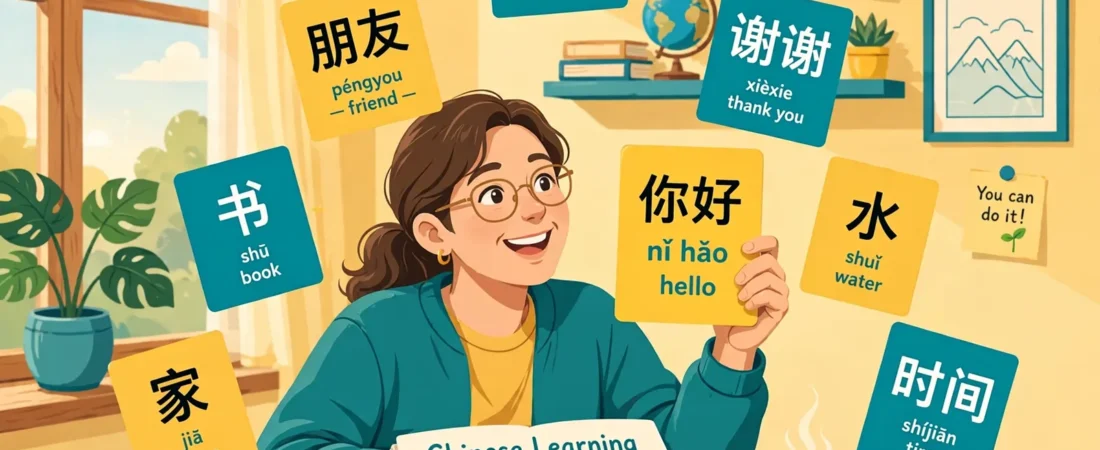
You do not need 3,000 words to talk to your neighbor. You do not need a dictionary in your head, and you do not need to wait a year before opening your mouth. Here is the number most beginners actually need to hear: 150 words will get you through your first real conversation, and 600 words will carry you through most of an ordinary day. The rest is practice, not vocabulary. If you have been collecting word lists like stamps and still cannot say more than hello, this post is for you. We will look at the real numbers, level by level, and then at the small set of words that does most of the work — so you can stop counting words and start using them.
## The short answer: 150 to start, 600 to chat
Think of it like packing for a trip. You do not bring your whole house. You bring the bag that fits the trip you are actually taking. A basic conversation is a short trip: greetings, introductions, food, shopping, directions, small talk about the weather. That trip needs about 150 words.
With 150 words you can say hello, tell someone your name, ask how much something costs, order food, say thank you, apologize, and ask someone to speak more slowly. That is not a trick or a shortcut. That is exactly what the HSK 2.0 Level 1 list contains — 150 words chosen because they cover the simplest real exchanges. This post follows the HSK 2.0 Level 1 list for its examples.
With 600 words — the HSK 2.0 Level 3 list — you can do much more: talk about your family, your job, your plans for the weekend, what you like and do not like, and ask follow-up questions when you do not understand. Six hundred words sounds like a lot until you realize you already know some of them, and the rest come in small groups: numbers, family words, food words, time words. Most learners reach 600 words in three to six months of steady study, and the day they cross that line, conversations stop feeling like tests and start feeling like talking.
## The HSK ladder, in plain English
The HSK exam organizes Chinese vocabulary into levels, and the ladder is the most honest answer to “how many words do I need?” that exists. Here it is under HSK 2.0, the standard this post follows:
| HSK 2.0 level | Words to know | What you can do with them |
|—|—|—|
| Level 1 | 150 | Greet people, introduce yourself, buy things, say the simplest sentences. |
| Level 2 | 300 | Handle everyday situations: shopping, eating out, asking directions. |
| Level 3 | 600 | Hold a basic conversation about daily life, work, family, and plans. |
| Level 4 | 1,200 | Talk about a wide range of topics and follow most conversations. |
| Level 5 | 2,500 | Read newspapers and discuss complex topics with some effort. |
| Level 6 | 5,000+ | Understand almost everything you hear or read. |
Under the newer HSK 3.0 standard, Level 1 grew from 150 words to 300 words, and the ladder was stretched to nine levels. The numbers moved, but the idea stayed the same: each level adds the words for the next kind of conversation you want to have.
Look at that table and notice something. The jump from Level 1 to Level 3 — 150 to 600 words — is where the magic happens. That is the stretch from “I can say hello” to “I can actually talk to someone.” Everything after Level 3 is depth and polish. Everything before it is the foundation. If you are a beginner, your whole job right now is that 150-to-600 stretch, and nothing else deserves your worry.
## What 150 words actually get you
Numbers are abstract. Sentences are not. Here is what the first 150 words sound like when you put them together. Listen to this short introduction — it uses only words from the HSK 2.0 Level 1 list.
你好!我叫李明,我是中国人。你呢?
(Nǐ hǎo! Wǒ jiào Lǐ Míng, wǒ shì Zhōngguó rén. Nǐ ne?)
Hello! My name is Li Ming, I am Chinese. And you?
Three short sentences, and you have greeted someone, given your name, said where you are from, and asked the question back. That is a conversation. It is not a long conversation, but it is a real one, and it started with about fifteen words.
Now look at the twenty words below. They are the hardest-working words in the whole Level 1 list. If you learn only twenty words this week, learn these.
| Chinese | Pinyin | English meaning |
|—|—|—|
| 你好 | nǐ hǎo | hello |
| 谢谢 | xièxie | thank you |
| 请 | qǐng | please |
| 对不起 | duìbuqǐ | sorry / excuse me |
| 没关系 | méi guānxi | it’s okay / no problem |
| 我 | wǒ | I / me |
| 你 | nǐ | you |
| 他 | tā | he / him |
| 是 | shì | to be |
| 有 | yǒu | to have |
| 在 | zài | at / in / to be at |
| 好 | hǎo | good |
| 吃 | chī | to eat |
| 喝 | hē | to drink |
| 买 | mǎi | to buy |
| 去 | qù | to go |
| 来 | lái | to come |
| 说 | shuō | to speak / to say |
| 听 | tīng | to listen |
| 看 | kàn | to see / to watch |
Count how many sentences you can build from just this table. 我要买水。(Wǒ yào mǎi shuǐ. I want to buy water.) 你好,我是中国人。(Nǐ hǎo, wǒ shì Zhōngguó rén. Hello, I am Chinese.) 你在看什么?(Nǐ zài kàn shénme? What are you looking at?) Twenty words, and you are already making sentences. That is the point the word-count question misses: a conversation is not a pile of words. It is a small set of words, combined in new ways, over and over.
## The 600-word sweet spot
So why 600, and not 300 or 1,200? Because 600 is where the pieces click together. At 150 words, you can answer questions. At 300, you can manage situations. At 600, you can steer a conversation yourself: ask a follow-up, change the subject, tell a short story, explain what you want and why.
Here is what a 600-word conversation sounds like. It is about likes and food — the two topics every beginner conversation visits sooner or later.
我喜欢喝茶,也喜欢吃米饭。
(Wǒ xǐhuan hē chá, yě xǐhuan chī mǐfàn.)
I like drinking tea, and I also like eating rice.
One sentence, two new verbs — 喜欢 (xǐhuan, to like) and 也 (yě, also) — and suddenly you can talk about every preference you have. 我喜欢喝咖啡。(Wǒ xǐhuan hē kāfēi. I like drinking coffee.) 我也喜欢看书。(Wǒ yě xǐhuan kàn shū. I also like reading books.) The word 喜欢 is a key that opens a hundred sentences, and it sits in the Level 1 list. Most of the words you need work like that: small words, huge leverage.

## Five short exercises you can do today
The bank row for this topic asks for five short exercises, so here they are. Each one takes less than five minutes, and each one turns a counted word into a used word.
**1. The twenty-word sprint.** Say all twenty words from the table above out loud, with their English meanings, twice through. Then cover the table and say as many as you can from memory. Whatever you miss, say three more times. Twenty words is a small enough number to win at.
**2. Copy the likes sentence.** Listen to audio clip 2 again and say 我喜欢喝茶,也喜欢吃米饭 after the speaker, three times. Then swap in your own likes: coffee, books, music, running. One pattern, your life in it.
**3. Build five sentences from the table.** Use only the twenty words above plus one noun you already know — water, tea, rice, book, friend. Write them down, then say them out loud. If a sentence feels wrong, it is still a win: you are practicing, and the correction will stick because you made the sentence yourself.
**4. Listen and walk.** Play this clip and repeat it while you walk around the room. Moving while you speak sounds silly, and it works: your brain remembers sentences your body was doing something during.
今天天气很好,我们去公园走走吧。
(Jīntiān tiānqì hěn hǎo, wǒmen qù gōngyuán zǒuzou ba.)
The weather is nice today, let’s go for a walk in the park.
**5. Answer out loud.** Listen to the question below and answer it before the next sentence finishes — in Chinese if you can, with gestures and a smile if you cannot. Speed is the skill here, not perfection.
你会说中文吗?我会说一点儿,但是不太好。
(Nǐ huì shuō Zhōngwén ma? Wǒ huì shuō yìdiǎnr, dànshì bú tài hǎo.)
Can you speak Chinese? I can speak a little, but not very well.
That last answer — 我会说一点儿,但是不太好 — is the most honest sentence a beginner can learn. Say it with a smile and people will slow down, help you, and keep talking. It is worth more than a hundred words you never say.
Want to check the pinyin of any word in this post before you practice it? The [Pinyin chart tool on LingoBubbo](https://lingobubbo.com/bang-pinyin/) lets you look up the sounds and tones for every word here.
## Four mistakes that keep the number scary
**Collecting words instead of using them.** A word list with 1,000 entries and zero spoken sentences is not progress. It is a collection. Ten words you have said out loud ten times beat a hundred words you have only read.
**Learning rare words before common ones.** If you can say “photosynthesis” but not “I want water,” your vocabulary is upside down. The HSK list exists precisely to stop this: it orders words by how often real life needs them. Trust the order.
**Counting words you half-know.** “I know about 500 words” usually means 200 you can use, 200 you recognize when you read them, and 100 you have seen once. Only the first group counts for conversation. Be honest about which group a word is in, and move words from group two to group one by saying them.
**Waiting for a big number before speaking.** Nobody needs 600 words to say hello. You needed about fifteen, and you already have them. The learners who reach 600 words fastest are the ones who started talking at 150, because every conversation teaches the next words for free.
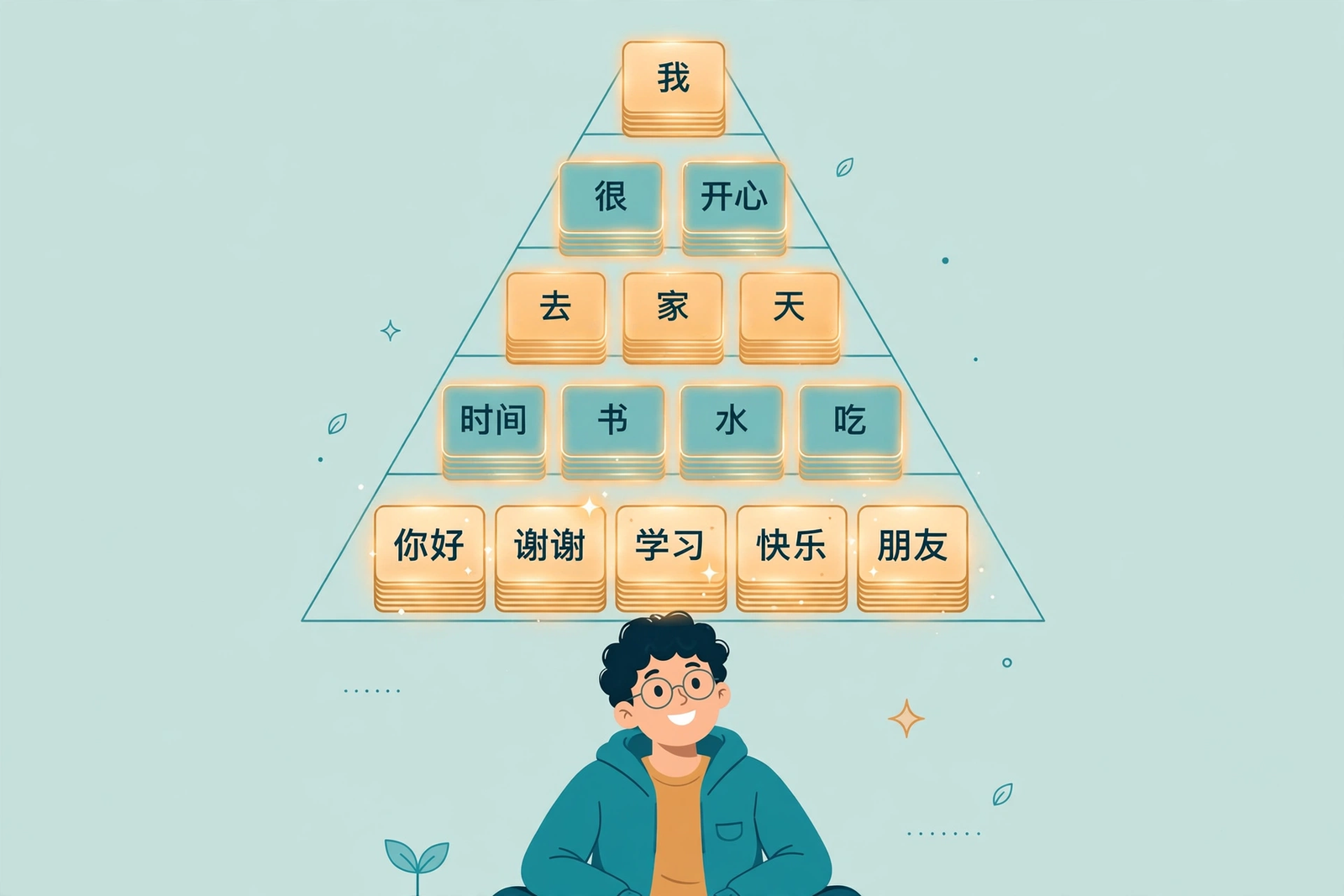
## Your word-count road map — the shareable summary
| Your level | Words | What you can do | Your next step |
|—|—|—|—|
| Just starting | 0–50 | Greet people, say thank you | Learn the 20 power words in this post |
| First conversations | 150 (HSK 2.0 L1) | Introduce yourself, buy things, ask for help | Practice the 5 exercises above, out loud |
| Everyday situations | 300 (HSK 2.0 L2) | Shop, eat out, ask directions | Add numbers, time words, and family words |
| Real back-and-forth | 600 (HSK 2.0 L3) | Talk about your day, your plans, your likes | Find a conversation partner, even once a week |
| Comfortable | 1,200 (HSK 2.0 L4) | Follow most conversations, discuss many topics | Read short articles and retell them |
| Fluent | 2,500+ (HSK 2.0 L5+) | Read, debate, and work in Chinese | Keep going — you are already there |
Send this table to a friend who keeps saying “I need to learn more words first.” They probably do not. They probably need to use the words they already have.
## Quick Quiz
Test yourself on Chinese word counts and the core vocabulary. Click an answer to see if you are right — your score is at the top.
Score: 0/5
1. How many words does HSK 2.0 Level 1 have?
2. What does 谢谢 mean?
3. Which sentence asks “Can you speak Chinese?”
4. How many words does HSK 2.0 Level 3 have?
5. What does 我喜欢喝茶 mean?
## FAQ
**Is 150 words really enough for a conversation?**
For the simplest conversations, yes. Greetings, introductions, buying things, asking for help — all of that fits in the HSK 2.0 Level 1 list of 150 words. You will not discuss politics with 150 words, but nobody expects you to. Start small, start real.
**How long does it take to learn 600 words?**
Most steady learners reach 600 words in three to six months, studying 20–30 minutes a day. The fastest way is to learn words in sentences, not alone: every new word goes straight into a sentence you say out loud the same day.
**Should I learn the HSK 2.0 or HSK 3.0 word list?**
Learn the HSK 2.0 Level 1 words first — they are the core of the new Level 1 too. Then read our guide on [what is new in HSK 3.0](https://lingobubbo.com/hsk-30-moi-co-gi-khac/) to see how the levels changed before you plan past Level 2.
**What if I know 600 words but still cannot talk?**
Then the words are in your eyes, not in your mouth. Add 15 minutes a day of speaking practice — shadowing audio, answering questions out loud, talking to a partner. Our companion guide on [learning Chinese to speak versus learning to pass the HSK](https://lingobubbo.com/hoc-tieng-trung-de-giao-tiep-khac-gi-hoc-de-thi-hsk/) explains why recognition and production are two different skills, and how to train both.
**What is the best first step after this post?**
Say the twenty power words out loud, then do the five exercises above. If you want a day-by-day plan, the [30-day self-study road map for absolute beginners](https://lingobubbo.com/lo-trinh-tu-hoc-tieng-trung-30-ngay-cho-nguoi-moi-bat-dau/) takes you from zero to your first real conversations in a month.
## Your turn: use your 150 words today
You now know the honest numbers: 150 words to start talking, 600 to hold a real conversation, and a road map for everything after. You also have the twenty hardest-working words, four audio clips to copy, and five short exercises. You do not need one more word list. You need one real sentence, said out loud, to a real person, today. Say 你好. Ask 你会说中文吗? Tell someone 我会说一点儿中文. That is how 150 words become a conversation — and how a conversation becomes 600 words without you even noticing.
Keep learning with the [Chinese lessons on LingoBubbo](https://lingobubbo.com/tieng-trung/), where short dialogues like the ones in this post appear in every lesson. If this guide helped you, send it to a friend who keeps collecting word lists and never speaks — the number they are waiting for is smaller than they think. And tell us in the comments: how many Chinese words do you know right now, and which one did you use most recently?