
What animal does your child love most? A dog? A cat? A rabbit with long ears? Now imagine your child pointing at that animal and naming it in Chinese — 狗 (gǒu), 猫 (māo), 兔子 (tùzi) — with a big smile. That is exactly what this post does. In about ten minutes a day, your child will learn 10 animal names in Chinese through sound, pictures, and three little games, and you will learn them right along with them.
Animals are the best first words in any language. Children already know what a dog is. They already love the sound a cat makes. So when they hear 狗 (gǒu) and 猫 (māo), the new words have somewhere to land. No memorizing, no drilling, no tears. Just listening, copying the sounds, and playing.
This post is built for parents and children ages 4 to 8, and it works even if you do not speak a word of Chinese yourself. Every word comes with pinyin (the roman letters that show you how to pronounce it), a slow audio clip you can play as many times as you like, and a game to try right after. You do not teach. You play along.
## How to use this post with your child
Keep it short. Five to ten minutes is enough. Sit together, play the audio, and repeat the words out loud with your child. Point at the picture, say the word, and let your child say it back. If your child wants to roar like a lion or hop like a rabbit, let them. The sillier it feels, the better it sticks.
Here is the rhythm that works best. First, listen to the audio clip together. Second, say each word out loud three times, slowly. Third, play one of the games below. Fourth, stop while your child is still having fun. You can always come back tomorrow. A short happy session beats a long tired one every single time.
One more thing before you start: praise the trying, not the perfect sound. Tones in Chinese take time. If your child says “gou” and it comes out a little flat, that is fine. Say it back the right way, smile, and move on. They will get closer every day.
If your child loves animal words, our [15 wild animals in Chinese with pictures for kids](https://lingobubbo.com/15-dong-vat-hoang-da-bang-tieng-trung-kem-tranh/) is the perfect next step after this one, and the [Chinese word games page](https://lingobubbo.com/chinese-word-games-demo/) has more games you can play together. For older kids who want to say more than single words, [teach your child to introduce themselves in Chinese in 30 seconds](https://lingobubbo.com/day-be-tu-gioi-thieu-bang-tieng-trung-trong-30-giay/) builds on the same sounds.
## The 10 animals: listen and repeat
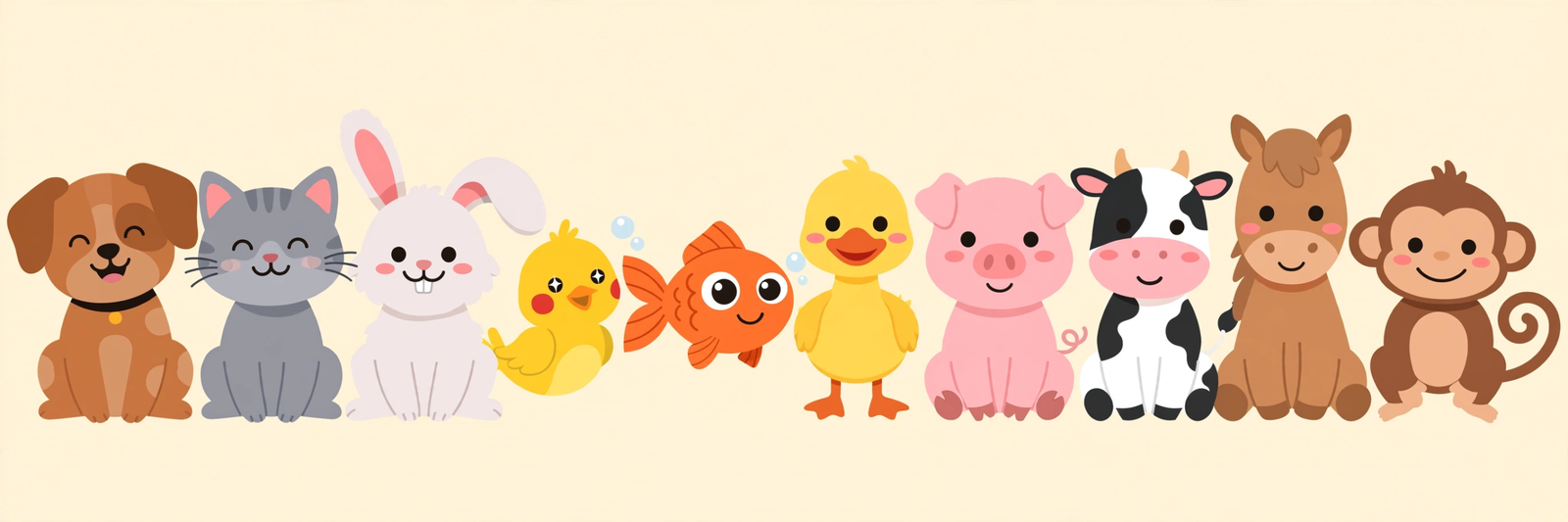
Here are the ten animals. Five live in most homes and gardens, and five live on the farm or in the forest. Learn the first five today and the next five tomorrow, or learn all ten if your child is excited. There is no rush.
| Chinese | Pinyin | English | Animal sound |
|—|—|—|—|
| 狗 | gǒu | dog | 汪汪汪 (wāng wāng wāng) |
| 猫 | māo | cat | 喵喵喵 (miāo miāo miāo) |
| 鸟 | niǎo | bird | 啾啾 (jiū jiū) |
| 鱼 | yú | fish | — (fish are quiet!) |
| 兔子 | tùzi | rabbit | — (rabbits wiggle their noses) |
| 鸭子 | yāzi | duck | 嘎嘎嘎 (gā gā gā) |
| 猪 | zhū | pig | 哼哼 (hēng hēng) |
| 牛 | niú | cow | 哞哞 (mōu mōu) |
| 马 | mǎ | horse | 嘶嘶 (sī sī) |
| 猴子 | hóuzi | monkey | 吱吱 (zhī zhī) |
Two things to notice. First, some animals have two characters: 兔子 (tùzi, rabbit), 鸭子 (yāzi, duck), 猴子 (hóuzi, monkey). The second character, 子 (zi), is light and quick — almost like a whisper at the end of the word. Second, the tones matter, but do not worry about them today. Listen to the audio, copy what you hear, and the tones will come.
## Listen: the first five animals
Press play and listen together. The clip says each animal slowly, then says a short sentence with it. Repeat each word right after you hear it.
狗,猫,鸟,鱼,兔子。这是狗,这是猫,这是鸟,这是鱼,这是兔子。
(Gǒu, māo, niǎo, yú, tùzi. Zhè shì gǒu, zhè shì māo, zhè shì niǎo, zhè shì yú, zhè shì tùzi.)
Dog, cat, bird, fish, rabbit. This is a dog, this is a cat, this is a bird, this is a fish, this is a rabbit.
Listen to it three times. The first time, just listen and point at each animal. The second time, repeat the word after the speaker. The third time, try to say the whole sentence together: 这是狗 (zhè shì gǒu, this is a dog). If your child can say one sentence today, that is a wonderful day.
这是 (zhè shì) means “this is.” It is one of the most useful little phrases in Chinese. Once your child can say 这是狗, they can say 这是猫, 这是鸟, 这是鱼 — just swap the animal. Five words, one pattern, and suddenly your child is making real sentences.
## Listen: the next five animals
Ready for five more? These are the farm animals and the monkey. Same game: listen, point, repeat.
鸭子,猪,牛,马,猴子。这是鸭子,这是猪,这是牛,这是马,这是猴子。
(Yāzi, zhū, niú, mǎ, hóuzi. Zhè shì yāzi, zhè shì zhū, zhè shì niú, zhè shì mǎ, zhè shì hóuzi.)
Duck, pig, cow, horse, monkey. This is a duck, this is a pig, this is a cow, this is a horse, this is a monkey.
Which one is your child’s favorite so far? Ask them. If they say 猴子 (hóuzi, monkey), ask them to show you a monkey face. If they say 马 (mǎ, horse), let them gallop around the room. When a word comes with a movement, children remember it twice as fast.
A quick tip for the grown-ups: 猪 (zhū, pig) and 牛 (niú, cow) sound a little alike to new ears, because both start with a buzzing sound. Play the clip again and listen for the difference. 猪 starts with “zh” and 牛 starts with “n.” Your child will hear it before you do — children are wonderful listeners.
## The animal sounds game: guess who is talking
This is the game children ask to play again and again. You make the animal sound, and your child guesses the animal in Chinese. No pictures, no pointing, just ears.
这是什么?这是狗。狗,狗,汪汪汪。这是什么?这是猫。猫,猫,喵喵喵。
(Zhè shì shénme? Zhè shì gǒu. Gǒu, gǒu, wāng wāng wāng. Zhè shì shénme? Zhè shì māo. Māo, māo, miāo miāo miāo.)
What is this? This is a dog. Dog, dog, woof woof woof. What is this? This is a cat. Cat, cat, meow meow meow.
这是什么? (zhè shì shénme?) means “What is this?” It is the question that turns every walk, every book, and every toy into a Chinese lesson. You can ask it about anything: a ball, a cup, a shoe. Today it is animals. Tomorrow it can be anything your child points at.
How to play at home:
– **Round 1:** You make the sound, your child names the animal in Chinese. Bark three times — 汪汪汪 — and your child says 狗 (gǒu).
– **Round 2:** Swap roles. Your child makes the sound, and you guess. Let them catch you getting one wrong on purpose. Children love correcting a grown-up.
– **Round 3:** Add a twist. Make the sound of one animal and the movement of another — moo like a cow while hopping like a rabbit. Your child has to say both words: 牛 (niú) and 兔子 (tùzi).

## A little conversation: mom and child
Here is a tiny conversation you can act out together. One of you is the mom, the other is the child. Then swap roles and do it again.
妈妈说:宝贝,这是什么?孩子说:这是兔子!妈妈说:对了!兔子,兔子,真棒!孩子说:我喜欢兔子!
(Māma shuō: Bǎobèi, zhè shì shénme? Háizi shuō: Zhè shì tùzi! Māma shuō: Duì le! Tùzi, tùzi, zhēn bàng! Háizi shuō: Wǒ xǐhuan tùzi!)
Mom says: Sweetheart, what is this? Child says: This is a rabbit! Mom says: That’s right! Rabbit, rabbit, wonderful! Child says: I like rabbits!
宝贝 (bǎobèi) means “sweetheart” or “baby” — the word parents use for their little ones. 对了 (duì le) means “that’s right!” and 真棒 (zhēn bàng) means “wonderful!” or “great job!” These three little phrases turn practice into praise, and praise is what keeps a child coming back tomorrow.
我喜欢兔子 (wǒ xǐhuan tùzi) means “I like rabbits.” 喜欢 (xǐhuan) means “to like,” and it works with everything: 我喜欢狗 (wǒ xǐhuan gǒu, I like dogs), 我喜欢猫 (wǒ xǐhuan māo, I like cats). Ask your child: 你喜欢什么? (nǐ xǐhuan shénme? What do you like?) and see what animal they pick.
## Three 5-minute games to play this week
**Game 1: The sound detective.** Hide a toy animal behind your back. Make its sound. Your child guesses in Chinese. Five rounds, then swap. This game takes five minutes and works in the car, at the dinner table, anywhere at all.
**Game 2: The flashcard race.** Draw the ten animals on ten small cards — stick figures are perfect, your child can help draw them. Spread the cards on the floor. Say an animal in Chinese, and your child runs to touch the right card. Then your child says one, and you run. The running is the point. Moving bodies remember words.
**Game 3: What is missing?** Lay out three toy animals. Your child closes their eyes. Take one away. Your child opens their eyes and says what is missing in Chinese: 猫不见了! (Māo bú jiàn le! The cat is gone!) Start with three animals, then try four, then five.
Play one game a day. By the end of the week, most children can name all ten animals without looking at the pictures. That is not a small thing. That is ten real words in a new language, learned through play.
## 4 mistakes to avoid with young learners
**Teaching too many words at once.** Ten words is a lot for a four-year-old. If your child is tired after five, stop at five. The other five will still be here tomorrow. Pushing past the fun is how children decide they do not like Chinese.
**Correcting every tone.** Tones matter in Chinese, but a child who is corrected every sentence stops talking. Model the right sound, praise the effort, and let the tones settle over weeks, not minutes.
**Turning it into a test.** “What is this? What is this? What is this?” feels like a quiz after the third time. Mix questions with games, songs, and silly voices. A child who is laughing is a child who is learning.
**Skipping the audio.** The clips in this post are slow and clear on purpose. Play them every time, even when you think you know the words. Your child needs to hear a real Chinese voice, not just a parent guessing at the sounds. That is what the audio is for.
## Your 7-day animal plan
– **Day 1:** Listen to audio clip 1. Learn 狗, 猫, 鸟, 鱼, 兔子. Play the sound detective with these five.
– **Day 2:** Listen to audio clip 2. Learn 鸭子, 猪, 牛, 马, 猴子. Review yesterday’s five too.
– **Day 3:** Play the animal sounds game with audio clip 3. Practice 这是什么? together.
– **Day 4:** Act out the mom-and-child dialogue with audio clip 4. Swap roles twice.
– **Day 5:** Play the flashcard race with all ten animals. Time yourselves and try to beat yesterday.
– **Day 6:** Play “what is missing?” with toy animals. Add 我喜欢… (wǒ xǐhuan…, I like…) to every answer.
– **Day 7:** Ask your child to name all ten animals from memory, in any order. Celebrate every single one, even the wobbly ones. Then pick a new favorite animal to learn next week.
## Quick Quiz
Test what you and your child learned. Click an answer to see if you are right — your score is at the top.
Score: 0/5
1. How do you say “dog” in Chinese?
2. What does 兔子 (tùzi) mean?
3. What does 这是什么? mean?
4. Which animal says 汪汪汪 (wāng wāng wāng)?
5. How do you say “This is a cat” in Chinese?
## FAQ
**What age is this post for?**
It is built for children ages 4 to 8, with a parent playing along. Four-year-olds can learn the five pet animals and the sounds. Older kids can learn all ten and the little dialogue too. Adjust the pace to your child, not to the calendar.
**My child cannot read Chinese characters yet. Is that okay?**
Yes, completely. At this age, listening and speaking come first. The characters are here so you can see them, and your child can look at the pictures. Reading can wait. Sound is the whole lesson.
**How long should we practice each day?**
Five to ten minutes is enough. Short and happy beats long and tired. If your child wants more, play another round of the sound game. If they are done, stop and come back tomorrow.
**Do I need to speak Chinese to help my child?**
No. The audio clips do the teaching. Your job is to press play, repeat along, and play the games. Learning together is the best part — your child loves it when you try too.
**What should we learn after animals?**
Try colors, numbers, or family words next. Our [15 wild animals in Chinese with pictures for kids](https://lingobubbo.com/15-dong-vat-hoang-da-bang-tieng-trung-kem-tranh/) adds bigger animals, and the [Chinese word games page](https://lingobubbo.com/chinese-word-games-demo/) has more games to keep the fun going.
## Your turn: name one animal in Chinese today
You do not need all ten words today. You need one. Pick your child’s favorite animal, play the audio, and say it together three times: 狗, 猫, 兔子 — whichever one makes your child smile. Then ask 这是什么? and let them answer. That one little exchange is a real conversation in Chinese, and it took less than a minute.
Keep learning with the [Chinese lessons on LingoBubbo](https://lingobubbo.com/tieng-trung/), where short dialogues and games like these appear every day. If this post helped your family, send it to another parent whose child loves animals — ten words, four audio clips, and three games are an easy gift to pass along. And tell us in the comments: which animal did your child learn first?