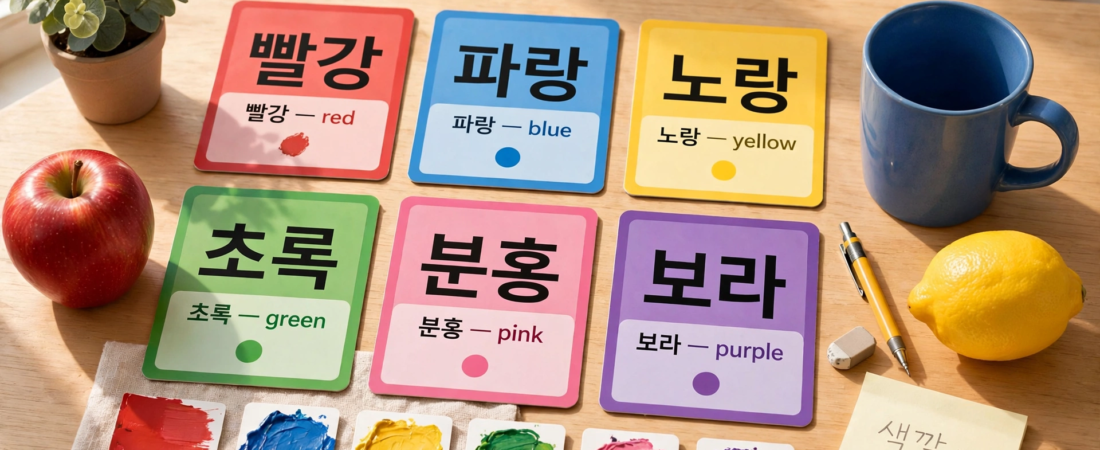
You are standing in a Seoul market, pointing at a sweater, and the only word that comes out is “this one.” Sound familiar? Korean color words and adjectives fix that in one afternoon, because describing things is what you do all day: the red apple, the big house, the hot coffee, the pretty dress.
This guide gives you 20 words that cover most of daily describing: 10 colors and 10 adjectives, each with its Hangul spelling, its pronunciation, and a real sentence you can say today. If you searched for Korean color words adjectives, this is the list to learn first. Master these 20, and suddenly you can talk about almost everything in front of you.
The 10 Korean color words you will use every day
Every Korean color word ends in 색 (saek), which means “color.” So 빨간색 (ppalgan-saek) is literally “red color,” and 파란색 (paran-saek) is “blue color.” Learn the first part and the ending takes care of itself.
| Korean | Romanization | English | Think of… |
|---|---|---|---|
| 빨간색 | ppalgan-saek | red | a ripe apple |
| 파란색 | paran-saek | blue | the sea on a clear day |
| 노란색 | noran-saek | yellow | a lemon |
| 초록색 | chorok-saek | green | fresh leaves |
| 검은색 | geomeun-saek | black | a night sky |
| 하얀색 | hayan-saek | white | fresh snow |
| 보라색 | bora-saek | purple | grapes |
| 주황색 | juhwang-saek | orange | a carrot |
| 분홍색 | bunhong-saek | pink | cherry blossoms |
| 갈색 | gal-saek | brown | coffee |
One trick that saves you at the market: in everyday speech Koreans often drop the 색 and say just 빨강 (ppalgang) or 파랑 (parang) for the color itself. You will hear both forms, so learn to recognise them together.
How to say “this is red” in Korean
The pattern is simple, and it works for every color on the list. Say the thing, add 는 or 은, then the color with 이에요 at the end.
이 사과는 빨간색이에요. 저 바다는 파란색이에요. 제 가방은 검은색이에요.
I sagwaneun ppalgan-saegieyo. Jeo badaneun paran-saegieyo. Je gabangeun geomeun-saegieyo.
“This apple is red. That sea is blue. My bag is black.”
Three sentences, this apple is red, that sea is blue, my bag is black
Try it with your own things right now. Your phone, your shoes, your coffee cup. Point, name the color, say the sentence. Three rounds of that and the pattern sticks.

10 describing adjectives for size, feeling, and taste
Colors tell you what something looks like. These 10 adjectives tell you the rest: how big it is, how it feels, how it tastes, how fast it moves. They are the words that turn a list into a conversation.
| Korean | Romanization | English | Opposite |
|---|---|---|---|
| 크다 | keuda | big | 작다 (jakda, small) |
| 작다 | jakda | small | 크다 (keuda, big) |
| 길다 | gilda | long | 짧다 (jjalda, short) |
| 짧다 | jjalda | short | 길다 (gilda, long) |
| 예쁘다 | yeppeuda | pretty | — |
| 귀엽다 | gwiyeopda | cute | — |
| 맛있다 | masitda | delicious | 맛없다 (madeopda, tasteless) |
| 뜨겁다 | tteugeopda | hot | 차갑다 (chagapda, cold) |
| 차갑다 | chagapda | cold | 뜨겁다 (tteugeopda, hot) |
| 빠르다 | ppareuda | fast | 느리다 (neurida, slow) |
Learn these in opposite pairs. Big and small, long and short, hot and cold. Pairs are twice as easy to remember as single words, because each one reminds you of the other.
Putting Korean color words and adjectives together
Real describing mixes the two lists. A big red apple. A small cute puppy. A hot delicious soup. Korean does this the same way English does: stack the describing words in front of the thing.
이 집은 커요. 저 강아지는 작고 귀여워요.
I jibeun keoyo. Jeo gangajineun jakgo gwiyeowoyo.
“This house is big. That puppy is small and cute.”
Two sentences, this house is big, that puppy is small and cute
Food is the best place to practise, because you describe it three times a day anyway. Hot coffee, cold water, delicious kimchi: three words you will say in Korea before lunch.
커피는 뜨거워요. 물은 차가워요. 김치는 맛있어요.
Keopineun tteugeowoyo. Mureun chagawoyo. Gimchineun masisseoyo.
“The coffee is hot. The water is cold. The kimchi is delicious.”
Three sentences, the coffee is hot, the water is cold, the kimchi is delicious
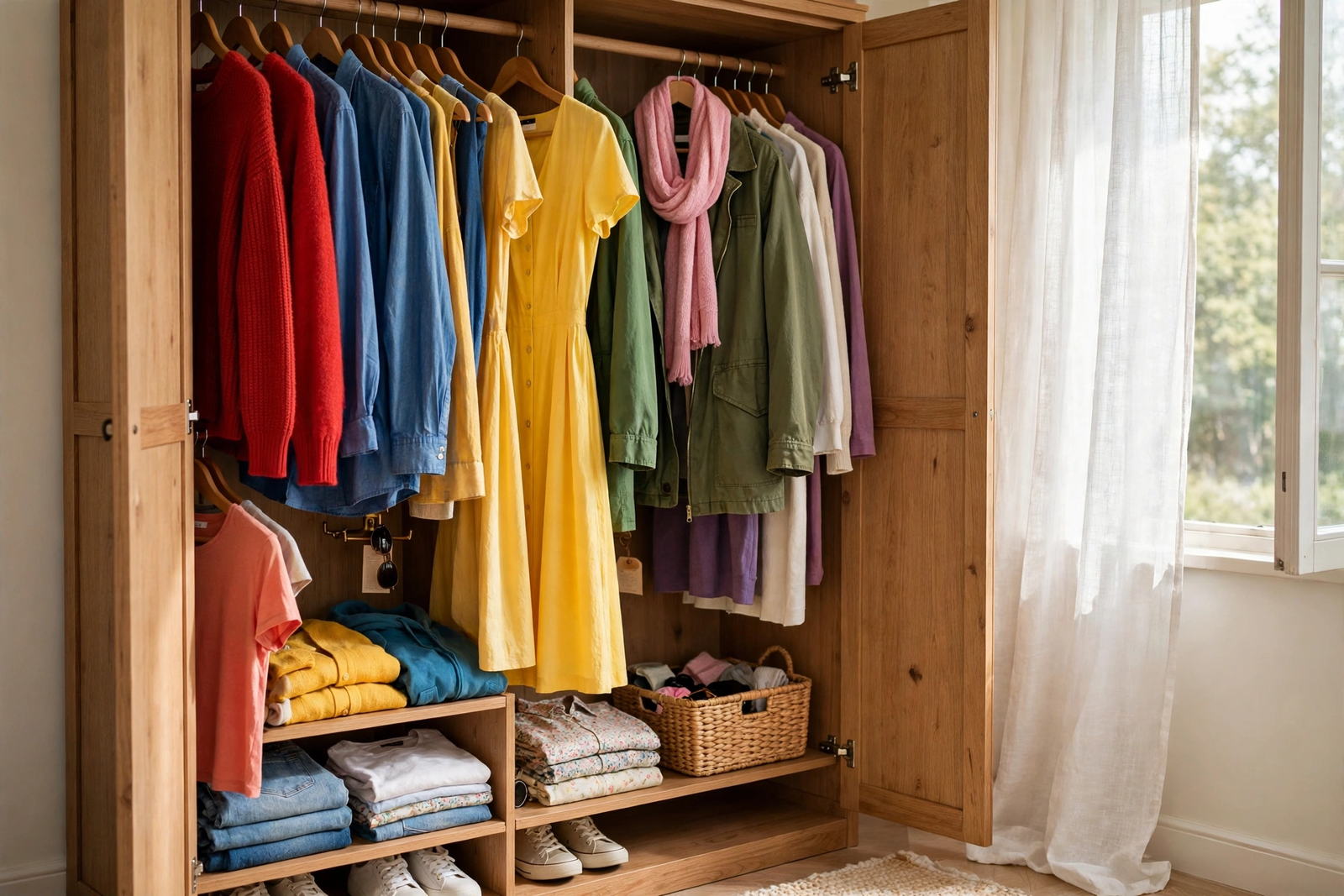
And clothes are the other daily stage. Open your wardrobe tomorrow morning and describe what you see, out loud, in Korean. Pretty dress. Fast car on the street below. It takes thirty seconds and it works.
이 옷은 예뻐요. 저 차는 빨라요.
I oseun yeppeoyo. Jeo chaneun ppallayo.
“These clothes are pretty. That car is fast.”
Two sentences, these clothes are pretty, that car is fast
Your one-week color challenge
Twenty words is a lot to hold at once. Spread them over a week, five minutes a day, and they will stay.
☐ Day 1: Learn the 10 colors from the table, then name the colors of 5 things in your room
☐ Day 2: Learn 크다, 작다, 길다, 짧다, and describe 3 things by size
☐ Day 3: Learn 예쁘다 and 귀엽다, and compliment something or someone in Korean
☐ Day 4: Learn 맛있다, 뜨겁다, 차갑다 at your next meal, out loud
☐ Day 5: Learn 빠르다 and 느리다, and describe the traffic or the train
☐ Day 6: Mix the lists, say 10 full sentences about things you can see
☐ Day 7: Retell the whole list from memory, then listen to the four audio clips again
Five minutes a day, one week, and the next time you point at a sweater in Seoul you will have the words for it.
Quick answers about Korean color words and adjectives
Do I say 빨간색 or 빨강?
Both are correct. 빨간색 (ppalgan-saek) is the full form, “red color,” and 빨강 (ppalgang) is the shorter everyday form. Use the full form while you are learning, and you will understand the short form when you hear it.
Why do some adjectives change shape in sentences?
Korean adjectives change their ending when they become a sentence. 크다 (keuda, big) becomes 커요 (keoyo) and 예쁘다 (yeppeuda, pretty) becomes 예뻐요 (yeppeoyo). Learn the sentence form with the dictionary form, and speaking gets much easier.
How do I describe two things at once?
Join adjectives with 고, which works like “and.” 작고 귀여워요 (jakgo gwiyeowoyo) means “small and cute.” It is the simplest connector in Korean, and you will use it constantly.
Which 5 words should I learn first?
Start with 빨간색 (red), 파란색 (blue), 크다 (big), 작다 (small), and 맛있다 (delicious). Those five cover shopping, directions, food, and compliments, which is most of a traveller’s day.
Quick quiz: Korean colors and describing things
Tap the answer you choose. You will know right away if it is correct.
Question 1. What does 빨간색 (ppalgan-saek) mean?
Question 2. Which word means “small”?
Question 3. What does “커피는 뜨거워요” mean?
Question 4. Which is the Korean word for “pretty”?
Question 5. How do you say “This apple is red”?
Twenty words, and the world around you just got describable. Start with the colors on your desk and the adjectives at your next meal, and these words will be yours by the weekend. For a guided path with audio lessons and practice built in, explore our Korean programme or try our English programme for learners who love the same everyday, speak-first method.