
Ten seconds. That is about how long you get when the waiter in a tapas bar turns to you, pen hovering, and asks, “¿Qué van a tomar?” — what are you having? Spanish food words ordering is the skill that turns that moment from a panic into a pleasure. You need the food words, five ordering phrases, and the confidence to say them.
Spanish menus are friendlier than they look. Most dishes are just a noun and an adjective — pollo asado is roast chicken, ensalada verde is a green salad. Learn fifteen words and you can read half the menu in any Spanish-speaking country.
The food words on every Spanish menu
These words show up on menus from Madrid to Mexico City. Know them, and you are never guessing blind.
| Spanish | Sounds like | Means |
|---|---|---|
| el pan | el pahn | bread |
| el queso | el KAY-so | cheese |
| el jamón | el hah-MOHN | ham |
| la ensalada | lah en-sah-LAH-dah | salad |
| el pollo | el POH-yoh | chicken |
| el pescado | el pes-KAH-doh | fish |
| la carne | lah KAR-nay | meat |
| el arroz | el ah-ROHS | rice |
| las patatas | lahs pah-TAH-tahs | potatoes (Spain; papas in Latin America) |
| la tortilla | lah tor-TEE-yah | omelette (Spain) / flatbread (Mexico) |
| el postre | el POHS-tray | dessert |
| el vino | el VEE-noh | wine |
| la cerveza | lah sair-VAY-sah | beer |
| el agua | el AH-gwah | water |
| la cuenta | lah KWEN-tah | the bill |
Notice el agua: feminine, but it takes el in the singular — el agua fría, cold water — to avoid two “a” sounds colliding.
How to order without pointing and hoping
Pointing works, but it keeps you quiet. These five patterns let you order like a person who eats out in Spanish, not like a tourist reading a phrasebook under the table.
Quisiera… — “I would like…” The softest way to order: Quisiera una mesa para dos, por favor. “I would like a table for two, please.”
Para mí,… — “For me…” The classic: Para mí, una tortilla española y un gazpacho. “For me, a Spanish omelette and a gazpacho.”
¿Me pones…? — “Can I have…?” Literally “will you put me…?”, completely normal in Spain: ¿Me pones una cerveza, por favor? “Can I have a beer, please?”
¿Qué me recomienda? — “What do you recommend?” Use it when the menu is long and your Spanish is short.
La cuenta, por favor. — “The bill, please.” In Spain and much of Latin America, the waiter will not bring the bill until you ask — not rudeness, just good manners. Nobody rushes you out of a restaurant.
Listen: ordering at a restaurant — a table for two, a Spanish omelette, a gazpacho and a beer
Tapas in Spain, tacos in Mexico: do not mix them up
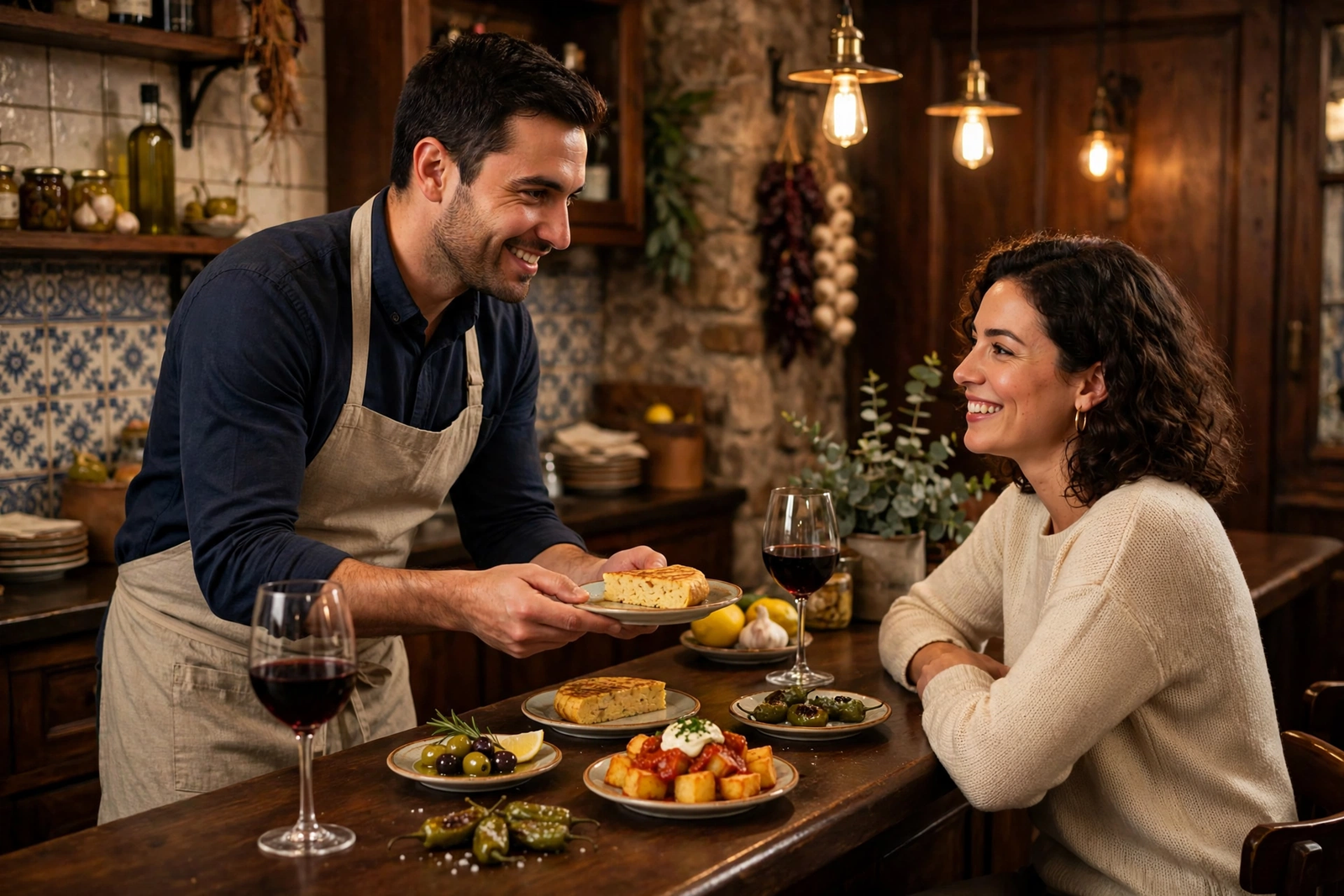
In Spain, las tapas are small plates meant for sharing: a few olives here, some patatas bravas (fried potatoes in a spicy sauce) there, a slice of tortilla española. You order several, and the table becomes a small feast. The verb you need is pedir, to order: Vamos a pedir unas tapas. “Let’s order some tapas.”
In Mexico, los tacos are folded tortillas filled with meat, fish or vegetables, eaten by hand. The question to ask is ¿Pica mucho? — “Is it very spicy?” Sometimes the answer is yes, and you will be glad you asked.
And la tortilla changes meaning at the border: a thick potato omelette in Spain, the flatbread that holds your taco in Mexico. Same word, two different dinners. Order una tortilla in Madrid expecting a wrap and you will get an omelette — a delicious one, but an omelette.
Spanish food words ordering: five phrases that work anywhere
Keep this short list in your pocket — it covers the whole meal:
☐ Una mesa para dos, por favor. — A table for two, please.
☐ Quisiera… / Para mí,… — I would like… / For me…
☐ ¿Qué me recomienda? — What do you recommend?
☐ Para llevar, por favor. — To take away, please.
☐ La cuenta, por favor. — The bill, please.
Para llevar is worth learning even if you always eat in: street food, bakeries, coffee to go. And ¿Aceptan tarjeta? — “Do you accept cards?” — saves you a walk to the nearest cash machine.
Listen: five phrases for any restaurant — a table, a recommendation, takeaway and the bill
A tiny dialogue to steal
Here is a whole exchange you can use tonight. Four lines, and you have ordered dinner.
A: Buenas tardes. ¿Qué van a tomar? “Good afternoon. What are you having?”
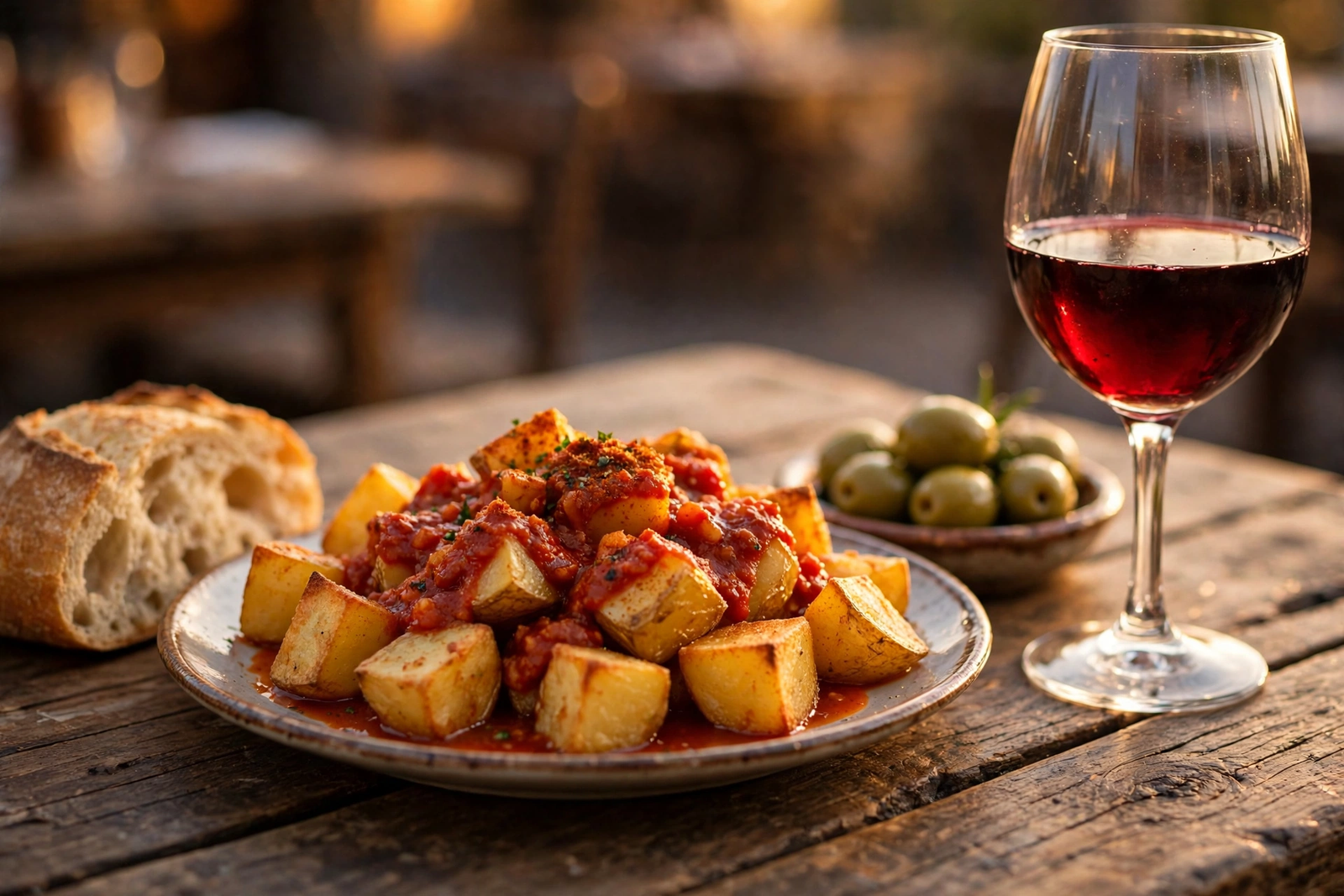
B: Para mí, unas patatas bravas y un vino tinto. “For me, some patatas bravas and a red wine.”
A: ¿Algo más? “Anything else?”
B: No, eso es todo. “No, that is everything.”
A: Son doce euros. “That is twelve euros.”
Two things to steal. Un vino tinto is red wine — tinto, not rojo, because wine has its own colour word. And eso es todo is the elegant way to say “that’s all”.
Listen: a short restaurant dialogue — ordering patatas bravas and a red wine, then paying twelve euros
Three mistakes that make waiters smile (politely)
| Mistake | Why it sounds off | Say this instead |
|---|---|---|
| Estoy embarazada for “I am embarrassed” | It means “I am pregnant” — a classic false friend | Me da vergüenza — “I am embarrassed” |
| Estoy caliente for “I am hot” | It means “I am aroused” — the waiter will not know where to look | Tengo calor — “I am hot”, literally “I have heat” |
| Preguntar for ordering | Preguntar means to ask a question; pedir means to order or request | Quiero pedir la sopa — “I want to order the soup” |
The first two are mistakes you only make once — and they make a great story afterwards. The third is the useful one: pedir is the verb of restaurants, shops and requests of every kind.
Listen: getting it right — el agua, una ensalada, el jamón and asking for the bill
Quick answers about Spanish food words and ordering
What is the difference between tapas and tacos?
Tapas are small shared plates from Spain, ordered several at a time. Tacos are folded tortillas with a filling, from Mexico, eaten by hand.
How do I ask for the bill in Spanish?
Say La cuenta, por favor. Waiters wait for you to ask. Add ¿Aceptan tarjeta? if you want to pay by card.
What does “para llevar” mean?
It means “to take away”. Use it at bakeries, coffee stands and street food stalls when you want food wrapped up instead of served at a table.
Food is the fastest way into a language, because everybody eats three times a day. Learn these words, practise the five phrases out loud tonight, and order your next meal in Spanish — even if it is only a coffee. When you are ready for the next step, our Spanish programme builds on exactly this speak-first method, one small conversation at a time.
Quick quiz: can you order food in Spanish?
Tap an answer and see right away if you have got it.
Question 1. What does “La cuenta, por favor” mean?
Question 2. Which word means “cheese”?
Question 3. What are tapas?
Question 4. How do you say “I am hot” (about the weather or the room) in Spanish?
Question 5. What does “para llevar” mean?