
Look at 山. Three peaks, rising in the middle. That is not a coincidence: it is a drawing of a mountain, and once you see it, you will never forget how to write shān. Chinese characters are full of pictures like this, and chinese character stories meanings are the easiest memory trick in the language: learn the story, and the character remembers itself.
Twelve characters are enough to prove the point: nature, people, trees, feelings and home, every one carrying its meaning in its shape. Walk through them once, and you will carry them for years.
Mountains, rivers, sun and moon
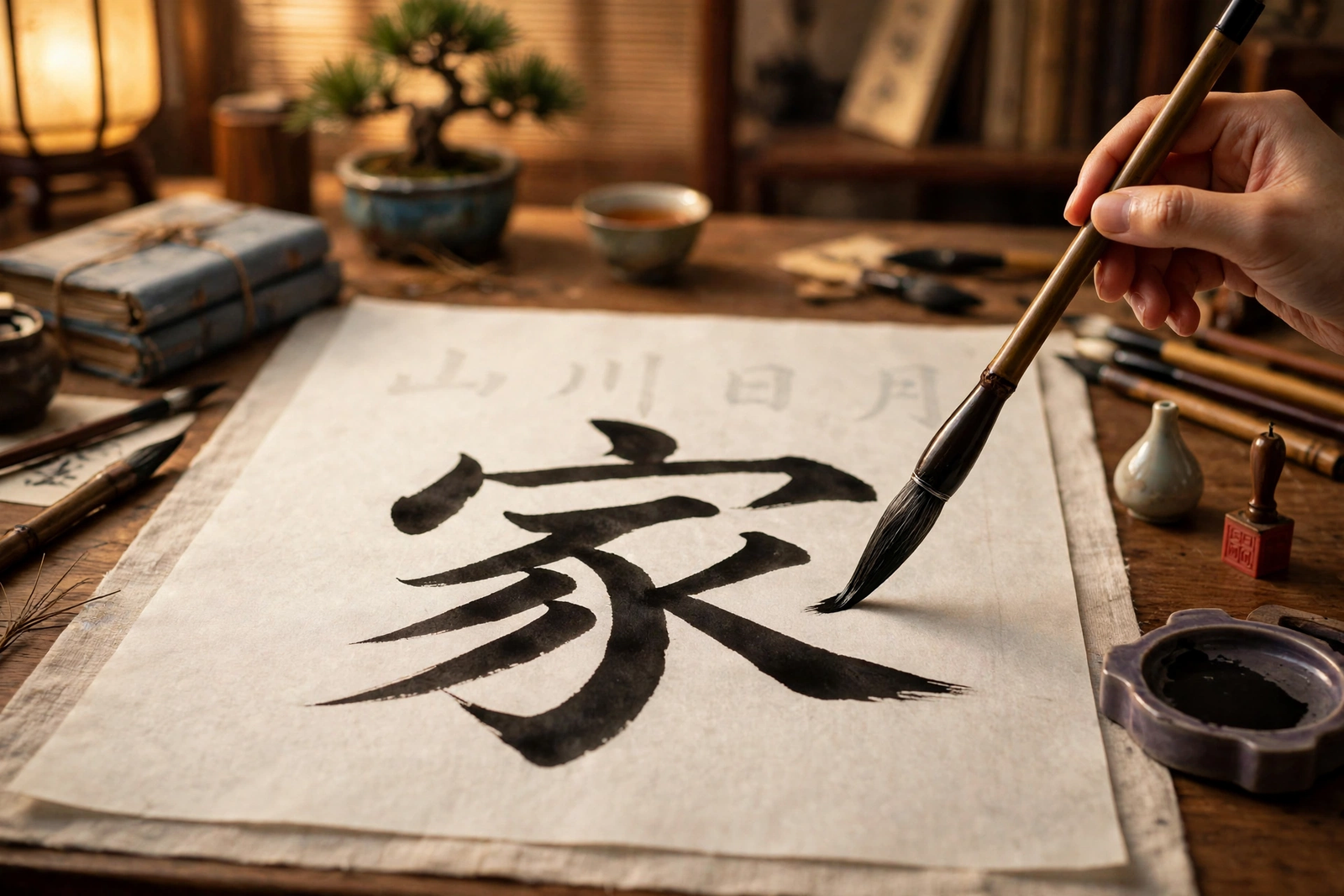
Start with the four characters that are still pictures. 山 (shān) is a mountain: three peaks, the middle one tallest. 川 (chuān) is a river: three lines of flowing water, running side by side. 日 (rì) is the sun: a circle with a dot in the middle, squared off over thousands of years. 月 (yuè) is the moon: a crescent, with two strokes inside marking its curve.
Say them out loud: 山川日月. Mountain, river, sun, moon. Four characters, four pictures, and you have just learned the oldest trick in Chinese.
| Character | Pinyin | Meaning | The story in the shape |
|---|---|---|---|
| 山 | shān | mountain | Three peaks, the middle one tallest |
| 川 | chuān | river | Three lines of flowing water |
| 日 | rì | sun | A circle with a dot inside, squared off |
| 月 | yuè | moon | A crescent moon |
| 人 | rén | person | A person walking, two legs |
| 木 | mù | tree | Trunk, branches above, roots below |
| 林 | lín | forest | Two trees standing side by side |
| 森 | sēn | dense forest | Three trees, a thick forest |
| 休 | xiū | rest | A person leaning against a tree |
| 好 | hǎo | good | A woman holding a child |
| 明 | míng | bright | The sun and the moon together |
| 家 | jiā | home, family | A roof over a pig |
Twelve rows, and you can already read them. That is the power of a character that tells its own story: you do not memorise a random shape, you recognise a picture.
Listen: mountain, river, sun and moon — the four picture characters
People and trees: small pictures that combine
人 (rén) is a person: two strokes, like two legs walking. Add a tree and the pictures start combining. 木 (mù) is a tree: the vertical stroke is the trunk, the strokes at the top are branches, and the strokes at the bottom are roots. Two trees together make 林 (lín), a forest. Three make 森 (sēn), a dense, dark forest. One tree, two trees, three trees: the meaning grows with the number.
Then comes the most human character of all. 休 (xiū) is a person leaning against a tree, 人 plus 木, and it means to rest. After a long walk, you lean on a tree and rest. When you write 休, draw the person first, then the tree, and imagine yourself leaning on it. That image is worth a hundred repetitions.
These combinations are the real secret of Chinese: a few hundred small pictures combining into new meanings, like bricks into a house.

Good, bright and home: feelings you can see
好 (hǎo) means good, and it is made of a woman and a child: 女 (nǚ) plus 子 (zǐ). A mother holding her child. What could be more good than that? Whenever you write 好, think of the two of them together, and the character writes itself.
明 (míng) means bright, and it puts the two brightest things in the sky side by side: 日 (the sun) plus 月 (the moon). It is also the character in 明天 (míngtiān, tomorrow), because every tomorrow starts with a bright morning.
家 (jiā) means home or family, and the traditional explanation is a roof over a pig: 宀 (the roof) plus 豕 (a pig). In ancient China, a family that kept a pig under its roof was a family that could feed itself. Today nobody keeps a pig in the living room, but the character still carries the old picture: a roof, and everything precious beneath it.
Listen: he is tired, so he rests leaning against a big tree
Why chinese character stories meanings stick in your memory
Your brain forgets shapes. It remembers stories. A student who learns 山 as “three random strokes” forgets it by Friday, while one who learns it as “three peaks” remembers it for years. The story gives the strokes a reason to be where they are.
Use the same trick on every new character. Ask three questions: what picture is hiding in it? Which smaller characters is it made of? What would it look like if you drew it yourself? The question alone forces you to look at it properly, and looking properly is half of remembering.
Listen: tomorrow is a good day, let’s go home
Your character-stories checklist for this week
Tick each one off as you finish it:
☐ Write 山, 川, 日 and 月 from memory, picturing each one
☐ Build 林 from two 木 and 森 from three 木
☐ Draw 休 and imagine yourself leaning on the tree
☐ Write 好 and remember the woman and the child
☐ Write 明 and name the sun and the moon inside it
☐ Write 家 and picture the roof over everything precious
☐ Teach one character story to a friend
☐ Pick one new character this week and find its story before you memorise it
Eight boxes, twelve characters, and a method you can use on the next hundred.
Quick answers about Chinese character stories
Do all Chinese characters tell a story like this?
No, only some. The picture characters, called pictographs, and the combined characters, called compounds, tell stories, while many others carry a sound clue instead. But they are the best place to start, because they teach you to look at characters instead of just copying them.
Is the pig in 家 really a pig?
That is the traditional explanation, and the one Chinese schoolchildren learn: a roof over a pig meant a family that could feed itself. Scholars debate the details, but the picture is a wonderful way to remember the character.
Should beginners learn characters by their stories?
Yes, for the first hundred or so. Stories make the shapes memorable, and memorable shapes build confidence. Later, add sound clues and common combinations. Stories open the door; practice keeps it open.
Twelve characters, twelve little stories, now yours. The next time a character looks like a wall of random strokes, stop and ask what picture is hiding inside it. When you are ready for more, our Chinese programme teaches characters the same way: story first, writing second, real sentences from day one.
Listen: there are many trees in the forest, and the sunshine is very bright
Quick quiz: can you read the stories in the characters?
Tap an answer and see right away if you have got it.
Question 1. What does 山 show?
Question 2. Which character means “dense forest”?
Question 3. What does 休 picture?
Question 4. 明 is bright because it combines which two characters?
Question 5. What does 家 traditionally show?