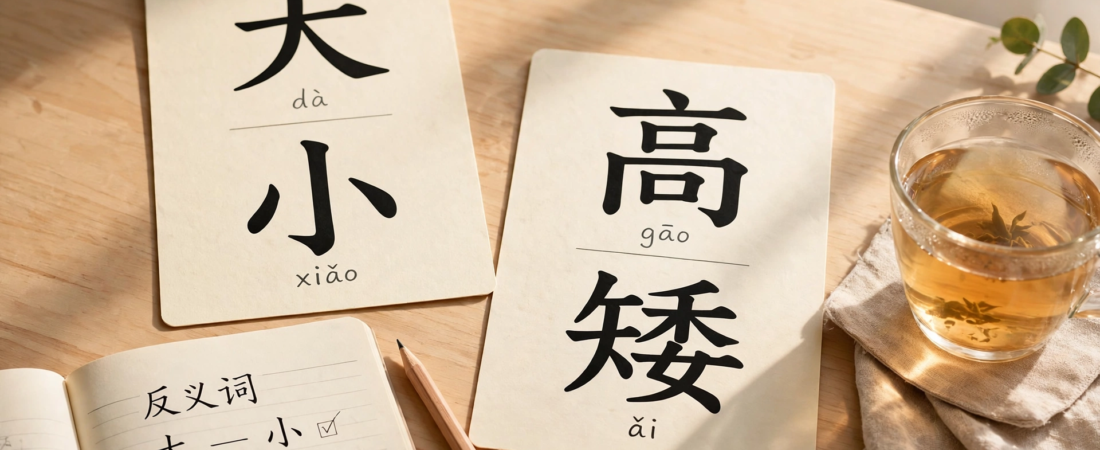
Twenty pairs, forty words, one evening of practice — and you can describe almost anything around you: the weather, the price tag, the road ahead, how you feel. That is the quiet magic of chinese opposites antonyms: learn them two at a time, and every word brings a partner along for free.
Why opposites double your vocabulary
Most beginners learn words one by one, like collecting single socks. You learn 大 (dà, big) on Monday and forget it by Friday, because it has nothing to hold on to. Pair it with its opposite, 小 (xiǎo, small), and something clicks: your brain loves contrast. Big only makes sense next to small; hot only makes sense next to cold.
There is a practical bonus too. Forget how to say “cheap”? Say 不贵 (bú guì, not expensive) and you will be understood. Opposites give you an escape route in every conversation, which is exactly what a beginner needs.
The 20 Chinese opposite pairs to learn first
Read each pair out loud, then cover one side and try to recall it. That little test is where the learning happens.
| Chinese | Pinyin | Meaning | Chinese | Pinyin | Meaning |
|---|---|---|---|---|---|
| 大 | dà | big | 小 | xiǎo | small |
| 高 | gāo | tall | 矮 | ǎi | short |
| 长 | cháng | long | 短 | duǎn | short |
| 快 | kuài | fast | 慢 | màn | slow |
| 好 | hǎo | good | 坏 | huài | bad |
| 新 | xīn | new | 旧 | jiù | old |
| 热 | rè | hot | 冷 | lěng | cold |
| 多 | duō | many | 少 | shǎo | few |
| 贵 | guì | expensive | 便宜 | piányi | cheap |
| 难 | nán | difficult | 容易 | róngyì | easy |
| 开 | kāi | open | 关 | guān | close |
| 来 | lái | come | 去 | qù | go |
| 左 | zuǒ | left | 右 | yòu | right |
| 前 | qián | front | 后 | hòu | back |
| 远 | yuǎn | far | 近 | jìn | near |
| 忙 | máng | busy | 闲 | xián | free, leisure |
| 亮 | liàng | bright | 暗 | àn | dark |
| 强 | qiáng | strong | 弱 | ruò | weak |
| 对 | duì | correct | 错 | cuò | wrong |
| 开心 | kāixīn | happy | 难过 | nánguò | sad |
Listen: this book is big — he is tall, she is short

How to use them in real sentences
Words only stick when you use them, so say each sentence out loud before you read the translation.
Size and length. 这本书很大。Zhè běn shū hěn dà. “This book is big.” 他很高,她很矮。Tā hěn gāo, tā hěn ǎi. “He is tall, she is short.” 这条路很长,那条路很短。Zhè tiáo lù hěn cháng, nà tiáo lù hěn duǎn. “This road is long, that road is short.”
Speed and time. 请你快一点!Qǐng nǐ kuài yìdiǎn! “Please hurry up a bit!” 请你慢一点。Qǐng nǐ màn yìdiǎn. “Please slow down a bit.” 今天很忙。Jīntiān hěn máng. “Today is busy.”
Shopping and the weather. 这件衣服很贵。Zhè jiàn yīfu hěn guì. “This piece of clothing is expensive.” 这件衣服很便宜。Zhè jiàn yīfu hěn piányi. “This piece of clothing is cheap.” 今天很热。Jīntiān hěn rè. “Today is hot.” 昨天很冷。Zuótiān hěn lěng. “Yesterday was cold.”
Directions. 左边是学校,右边是商店。Zuǒbiān shì xuéxiào, yòubiān shì shāngdiàn. “On the left is the school, on the right is the shop.” 前面是学校,后面是公园。Qiánmiàn shì xuéxiào, hòumiàn shì gōngyuán. “In front is the school, behind is the park.” 我的家很远。Wǒ de jiā hěn yuǎn. “My home is far away.”
Feelings and answers. 今天我很开心。Jīntiān wǒ hěn kāixīn. “Today I am very happy.” 他很难过。Tā hěn nánguò. “He is very sad.” 你的答案是对的。Nǐ de dá’àn shì duì de. “Your answer is correct.”
Listen: this one is expensive, that one is cheap
Three mistakes that trip up beginners
1. Mixing up 高 and 长. Both can translate as “long” in English, but they are not interchangeable: 高 (gāo) is tall for people and buildings, 长 (cháng) is long for roads, hair, and time. A tall man is 很高, never 很长.
2. Forgetting that 开 and 关 are a team. 开 (kāi) opens things and 关 (guān) closes them: 开门 (kāi mén, open the door), 关门 (guān mén, close the door). Learn them as one switch, not two verbs.
3. Saying 便宜 with the wrong tone. 便宜 (piányi, cheap) is pronounced pián-yi, with a rising second tone on 便 — get the tone wrong and the word muddles. Listen to the audio clip above and copy the rise.
Listen: today is hot, yesterday was cold — the school is on the left, the shop is on the right
The pair trick: how to remember all 20
Here is the memory trick that makes this list stick: never learn a single word on its own. Learn it as a pair, tied to something in your own life.
Take 快 and 慢: running for the morning bus (快!), walking home slowly in the evening (慢). Take 热 and 冷: tea, hot when it arrives, cold when you forget it on the desk. One small scene per pair, and the words have a home.
Stick labels around the house — 大 on the big sofa, 小 on the small chair, 开 on the door, 关 on the light switch — and say the pair out loud every time you walk past. After a week, the labels can come down. The words will stay up.
Finally, quiz yourself backwards. If you can say the opposite of each word without peeking, you know it; if you can only go one way, that pair needs one more day.

Listen: today I am very happy, he is very sad — your answer is correct
Your 7-day opposites checklist
Tick each one off as you finish it:
☐ Read all 20 pairs out loud, both words each time
☐ Cover one side of the table and recall all 20 opposites
☐ Say five sentences from this post out loud without reading them
☐ Label two things at home with a pair: 大 and 小, or 开 and 关
☐ Use 贵 and 便宜 in a real or imagined shopping sentence
☐ Give directions with 左, 右, 前 and 后
☐ Play the four audio clips and repeat each one after listening
Quick answers about Chinese opposites
What is the opposite of 好 in Chinese?
坏 (huài, bad). But in everyday speech people usually say 不好 (bù hǎo, not good) instead: 这个电影很好 (zhège diànyǐng hěn hǎo, this film is very good).
How do you say “left” and “right” in Chinese?
左 (zuǒ, left) and 右 (yòu, right). Add 边 (biān, side): 左边 (zuǒbiān, on the left), 右边 (yòubiān, on the right).
Are Chinese antonyms enough to start speaking?
They are a strong start, not the whole journey. Twenty pairs give you forty words for size, speed, price, weather, feelings and directions — enough for many everyday situations. Add a few verbs and you can build full sentences fast.
Forty words, twenty pairs, one week of saying them out loud — that is all it takes. Pick your five favourite pairs tonight and use them before bed. When you are ready for the next step, our Chinese programme builds on exactly this pair-by-pair method, one small conversation at a time.
Quick quiz: do you know your opposites?
Tap an answer and see right away if you have got it.
Question 1. What is the opposite of 大 (dà, big)?
Question 2. How do you say “cheap” in Chinese?
Question 3. What does 慢 (màn) mean?
Question 4. Which pair means “open” and “close”?
Question 5. What is the opposite of 开心 (kāixīn, happy)?