
You are halfway to the airport, the brake lights ahead stretch as far as you can see, and the passenger in the back seat leans forward: “Are we going to make it on time?” Or worse — your navigation suddenly reroutes you around a closed road, and the passenger asks, “Why are we turning here?” These are the moments that separate a nervous driver from a confident one. The good news is that you do not need perfect English for them. You need about fifteen short sentences, said calmly, in the right order. Here they are: what to say about traffic, what to say about a closed road, a full role-play you can practice, and the mistakes that make a delay feel worse than it is.
A note before the phrases: nothing in this post is legal advice or a promise about Uber’s policies or fares. The sentences here are about language — how to explain a delay clearly and kindly in English. For anything about fares, cancellations, or app rules, follow what the Uber app itself tells you in the moment.
First, the golden rule: tell them before they ask
Here is the single most important idea in this whole post. A passenger who hears about a delay from you stays calm. A passenger who discovers the delay themselves — watching the clock, watching the map, watching the same gas station go by twice — gets nervous, and then annoyed. So say it first. Say it early. Say it in one short sentence, and then add the plan.
The formula is simple: what is happening + how long it might take + what you are doing about it. “There’s heavy traffic ahead — it looks like about ten extra minutes. I’m taking the side streets to get around it.” Three pieces, one breath, and the passenger can relax. Compare that with silence. Silence is where passengers imagine the worst: a wrong turn, a lost driver, a missed flight. Your voice is the fix.
Listen to the first audio clip: a driver tells the passenger about traffic before the passenger has to ask, using exactly this formula.
Nghe audio: Driver and passenger dialogue — the driver explains heavy traffic ahead and the plan to take side streets
What to say about a traffic jam
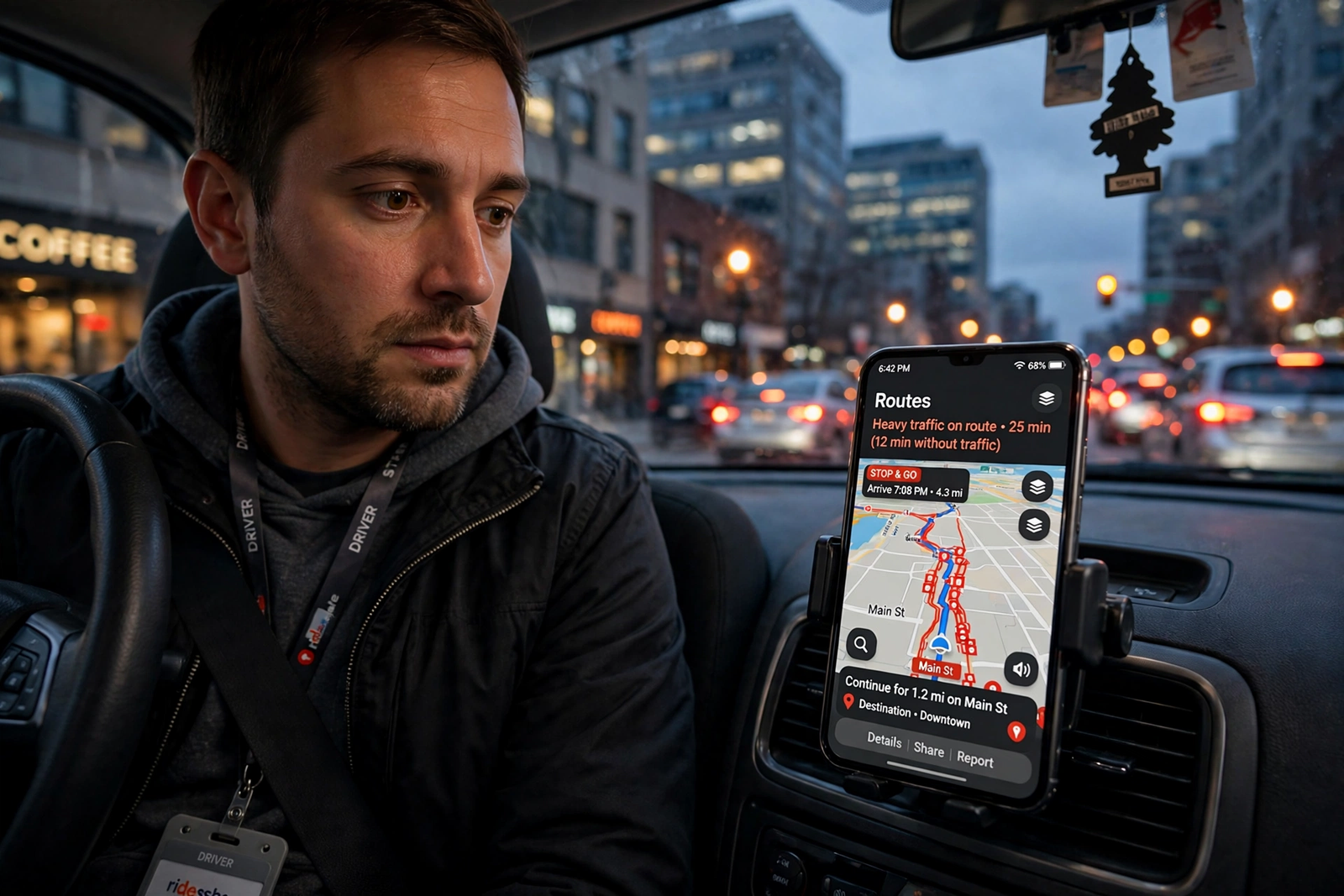
Traffic is the most common delay, so start here. The key words to know are “traffic jam,” “heavy traffic,” “bumper to bumper,” and “rush hour.” A traffic jam is the whole situation. Heavy traffic is how you describe it. Bumper to bumper means the cars are packed so tightly they are almost touching — Americans use this phrase all the time. Rush hour is the busy time, usually morning and evening, when everyone is on the road at once.
Here are the driver lines worth memorizing. Say them out loud as you read — your mouth needs the practice, not just your eyes.
Announcing the delay: “There’s heavy traffic ahead.” “We’re stuck in a traffic jam.” “Traffic is really bad right now.” “It’s rush hour, so it’s moving slowly.”
Giving a time estimate: “It looks like about ten extra minutes.” “We should be there in about twenty minutes.” “The app says we’ll arrive around 6:30.” Notice the soft words: “about,” “around,” “it looks like.” Never promise an exact minute. Traffic changes, and a soft estimate you beat feels much better than a firm promise you miss.
Explaining what you are doing: “I’m taking the side streets to get around it.” “The app is finding a faster route.” “Let me try a different way.” The passenger does not need a geography lesson. They need to hear that you have a plan.
Reassuring the passenger: “Don’t worry, we’ll still make it.” “We have plenty of time.” “I’ll get you there as fast as I safely can.” That last sentence is the one to memorize word for word. “As fast as I safely can” says two things at once: I am hurrying, and I am not doing anything dangerous. Passengers love hearing it.
Listen to the second clip for these driver lines, and repeat each one right after you hear it.
Nghe audio: Driver key phrases — announcing a traffic jam, giving a time estimate, and reassuring the passenger
What to say when a road is closed
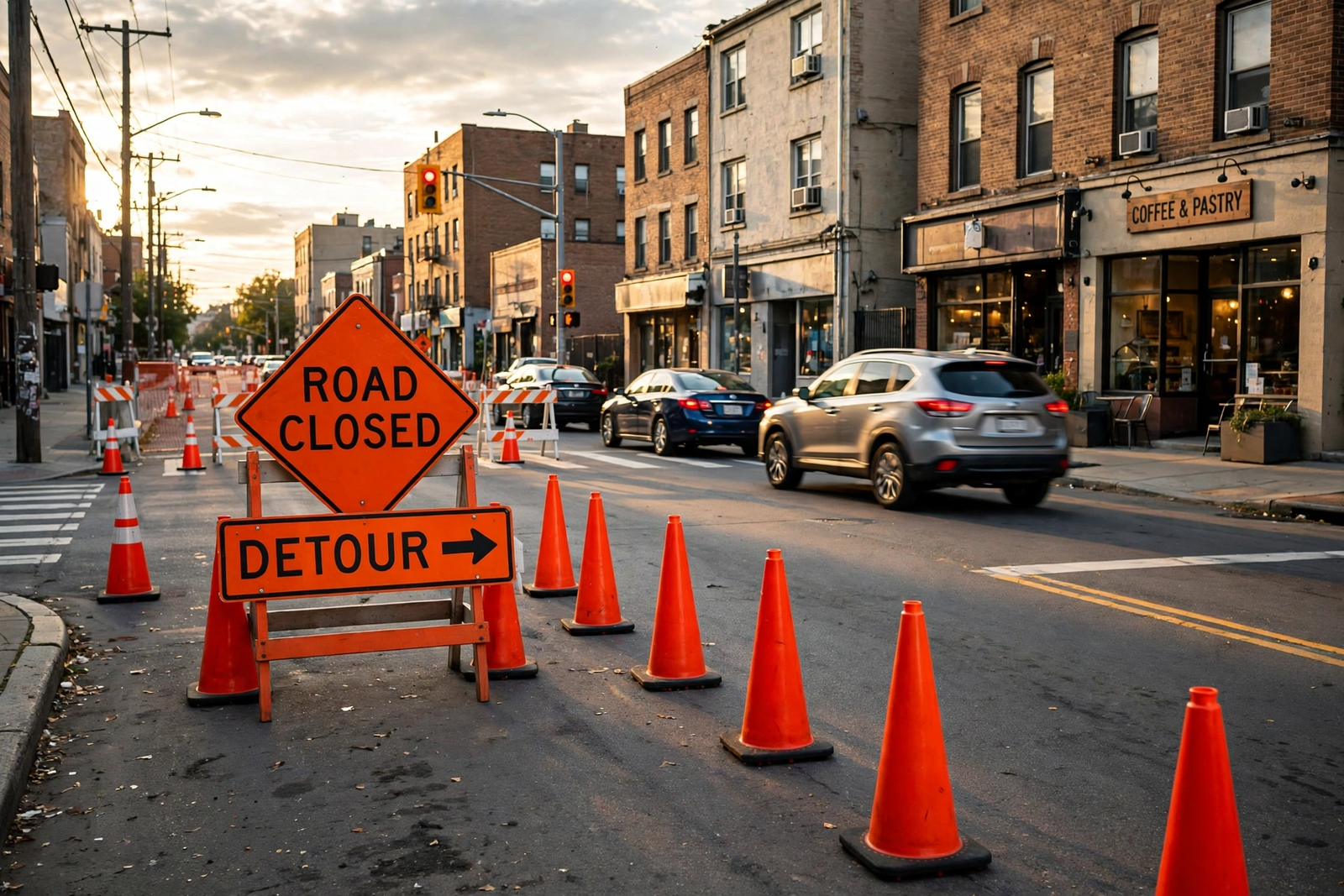
A closed road is different from a traffic jam, and passengers react differently to it. A traffic jam is slow but familiar. A closed road means a detour — a different route than the one the app showed — and the passenger’s first thought is usually “Is this driver lost?” Your job is to answer that thought before it grows. Name the reason, name the detour, and keep it short.
The key words are “closed,” “detour,” “roadwork” (or “construction”), and “blocked.” A road is closed when nobody can drive on it. A detour is the alternative route you take instead. Roadwork means workers are fixing the road. Blocked means something is in the way — an accident, a fallen tree, a parade.
Announcing the closure: “This road is closed ahead.” “There’s roadwork up ahead, so we need to take a detour.” “The street is blocked, so I’ll go around the other way.” Short, factual, calm.
Explaining the detour: “We’ll take the next street over — it adds about five minutes.” “The app is rerouting us now.” “We’ll go around the block and come back to the main road.” The time estimate matters more than the street names. Passengers do not know the streets. They know minutes.
When the passenger worries: “Don’t worry — the detour is normal here.” “This happens a lot with the roadwork downtown.” “We’re still heading the right way, just on a different street.” That last line is gold. “We’re still heading the right way” answers the fear directly, in plain words.
What the passenger says — and how to answer
So far we have covered your lines. But a real conversation has two sides, and the passenger will ask questions. Here are the ones you will hear most, with a calm answer for each.
| Passenger asks | You can answer |
|---|---|
| Are we going to make it on time? | We should make it — it’s about ten extra minutes. |
| Why are we turning here? | The road ahead is closed, so we’re taking a detour. |
| How much longer will it take? | About ten more minutes, give or take. |
| Is there a faster way? | Let me check the app — I’ll take the fastest route it shows. |
| Can you hurry, please? I have a flight. | Of course — I’ll get you there as fast as I safely can. |
| Are we lost? | No, we’re still heading the right way, just on a different street. |
Listen to the third clip for these passenger questions and the driver answers. Notice how short the answers are. In a car, at a busy intersection, short wins.
Nghe audio: Passenger questions about the delay and the driver’s calm answers
Full role-play: the closed road on the way to the airport
Now let us put it all together. Read this role-play out loud with a friend, or read both parts yourself, switching voices. It is the whole situation, start to finish, in under a minute.
Driver: Just so you know, there’s heavy traffic ahead, and the main road is closed for roadwork. We’ll take a detour — it adds about ten minutes.
Passenger: Oh no — are we going to make my flight? It leaves at seven.
Driver: Don’t worry, we have plenty of time. The app says we’ll arrive around 6:15. I’ll get you there as fast as I safely can.
Passenger: Okay, good. Is there a faster way?
Driver: Let me check the app — it’s already finding the fastest route. We’re still heading the right way, just on a different street.
Passenger: Thanks for letting me know. I feel better now.
Driver: Of course. I’ll keep you updated if anything changes.
Notice what the driver does right in that exchange. He tells the passenger before being asked. He gives a time, not a guess. He answers the flight worry directly instead of brushing it off. And he ends with a promise to keep the passenger updated — “I’ll keep you updated if anything changes” — which is the sentence that turns a nervous passenger into a trusting one. Listen to the full role-play in the fourth clip, then try it yourself without looking at the text.
Nghe audio: Full role-play — the closed road on the way to the airport, from the announcement to the reassurance
Five mistakes that make a delay feel worse
Mistake 1: Saying nothing. Silence is the worst response to a delay. The passenger fills the silence with worry. One short sentence — “There’s heavy traffic ahead” — fixes it before it starts.
Mistake 2: Promising an exact time. “We’ll be there in exactly seven minutes” is a promise traffic will break. Use “about,” “around,” and “give or take.” A soft estimate you beat is a small victory. A firm promise you miss is a complaint.
Mistake 3: Blaming the city, the app, or other drivers. “This city is the worst” or “These drivers are crazy” might feel honest, but it makes the passenger nervous. Stay factual and calm: “There’s roadwork ahead, so we’re taking a detour.” Facts calm people down. Complaints wind them up.
Mistake 4: Driving faster to make up time. Never trade safety for minutes. “I’ll get you there as fast as I safely can” is the line — and the word “safely” is doing real work there. Passengers would rather arrive five minutes late than feel unsafe for five minutes.
Mistake 5: Using long, complicated sentences. “Due to unforeseen infrastructural maintenance, we will be required to utilize an alternative thoroughfare” is correct English and terrible car English. Short wins: “The road is closed, so we’re taking a detour.” Save the long sentences for emails.
Quick Quiz: stuck in traffic or a closed road
Click the answer you choose — right or wrong, you will know immediately.
Score: 0/5 — click an answer to check it right away.
Question 1. What does “bumper to bumper” mean?
Question 2. The road ahead is closed for roadwork. What is the best thing to say first?
Question 3. A passenger asks, “Are we going to make it on time?” What is the best reply?
Question 4. What is a “detour”?
Question 5. A passenger says, “Can you hurry, please? I have a flight.” What is the best reply?
Frequently asked questions about traffic jams and closed roads
Should I tell the passenger about traffic before they ask? Yes. Always say it first, in one short sentence, with a time estimate and a plan. A passenger who hears it from you stays calm. A passenger who discovers it alone gets nervous.
What if I honestly do not know how long the delay will be? Say so, softly: "It looks like about ten extra minutes, give or take — I'll keep you updated if anything changes." Honesty plus a promise to update is better than a made-up number.
What if the passenger gets angry about the delay? Stay calm and keep your sentences short. "I'm sorry about the delay. I'm taking the fastest route the app shows." You cannot control their mood, but you can keep the moment small.
Do I need perfect English to drive for Uber? No. The sentences in this post are short on purpose — announce the delay, give a soft time, explain the plan. Clear and polite beats perfect every time.
What if the detour takes us far from the route on the passenger's phone? Say it before they notice: "We're still heading the right way, just on a different street — the main road is closed." One sentence answers the worry before it forms.
Your turn: practice the three-piece formula before your next shift
Before your next ride, say the formula out loud three times: what is happening, how long, what you are doing. "There's heavy traffic ahead — about ten extra minutes. I'm taking the side streets to get around it." Then play the role-play audio in this post and answer as the driver. When the lines come out without thinking, you are ready for the next rush hour.
Want to keep building your work English? The LingoBubbo English page has the full English-for-work path, with vocabulary, audio, and a quiz in every lesson. Two related reads: Polite English Phrases to Ask a Passenger to Fasten Their Seatbelt and How to Announce ETA in English. Tell us in the comments: what is the worst traffic jam you have ever driven through — and what did you say to your passenger? Share this post with a driver friend. The whole road gets friendlier one calm sentence at a time.