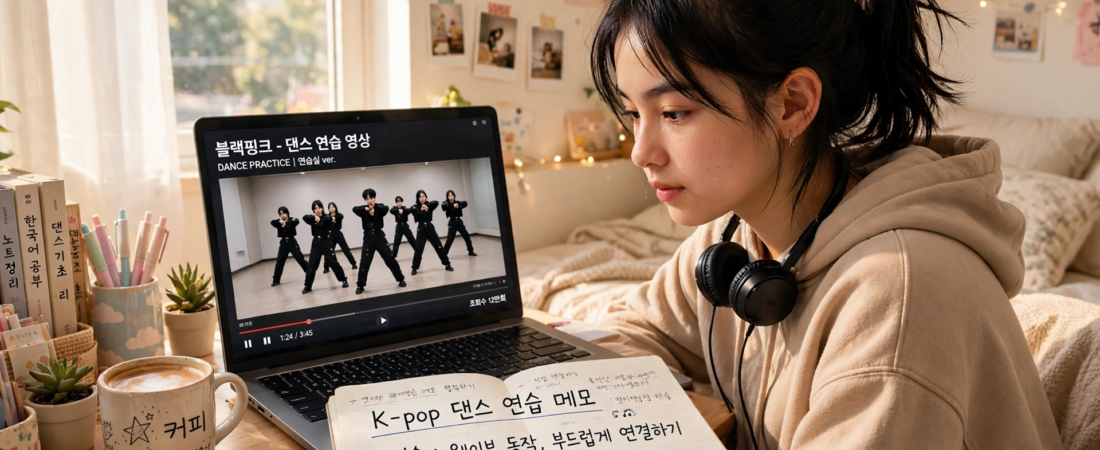
Your favourite K-pop group just dropped a new dance practice video. You hit play, the beat drops, and before the first chorus the dancers count in: 하나, 둘, 셋, 넷. One, two, three, four. You have just understood your first four Korean words, and you have not opened a textbook yet. If you want to learn Korean from K-pop dance practice videos, the practice room is the best classroom you own.
Why the practice room beats the music video
A music video cuts to a new shot every two seconds. A dance practice video does the opposite: one fixed camera, one clean room, the whole group in frame from start to finish. You can see every step and hear the same words again and again — exactly what a beginner needs.
Dance practice videos are also honest. The idols stop, laugh, and start again. A coach calls out a word, the group repeats the move, and you hear it five times in a minute. Nobody is performing for a camera — they are working, out loud, in Korean.
The 10 words you will hear in every dance practice video
Start with these ten. They show up in almost every practice video, no matter the group or the song:
| Korean | Romanization | Meaning |
|---|---|---|
| 시작 | sijak | start |
| 준비 | junbi | preparation, “ready” |
| 연습 | yeonseup | practice |
| 안무 | anmu | choreography |
| 다시 한 번 | dasi han beon | one more time |
| 천천히 | cheoncheonhi | slowly |
| 반복 | banbok | repeat, repetition |
| 박자 | bakja | beat, rhythm |
| 포인트 안무 | pointeu anmu | the signature move of a song |
| 힘내요 | himnaeyo | cheer up, you’ve got this |
Most of them are verbs and instructions, not nouns. Practice-room Korean is the language of doing things: start, repeat, go slowly, try again. Try saying 따라 해 봐요 (“try following along”) and 준비됐어요? 시작해요 (“Are you ready? Let’s start.”) out loud.
Listen: "one more time, try it slowly"
Count to eight: the beat of every chorus
K-pop choreography is counted in eights. Every move lands on a number, and the dancers count out loud while they learn:
| Number | Korean | Romanization |
|---|---|---|
| 1 | 하나 | hana |
| 2 | 둘 | dul |
| 3 | 셋 | set |
| 4 | 넷 | net |
| 5 | 다섯 | daseot |
| 6 | 여섯 | yeoseot |
| 7 | 일곱 | ilgop |
| 8 | 여덟 | yeodeol |
Say them with the video and you get the numbers and the rhythm of Korean at once. After a week of counting along, you will just know one to eight.
Listen: counting in to start: one, two, three, four
Learn body words from the moves
Choreography is a body-word lesson in disguise: every move names a body part you can see as you hear it:
| Korean | Romanization | Meaning |
|---|---|---|
| 머리 | meori | head |
| 어깨 | eokkae | shoulder |
| 팔 | pal | arm |
| 손 | son | hand |
| 다리 | dari | leg |
| 발 | bal | foot |
| 동작 | dongjak | movement, motion |
When a dancer points to their 머리, or throws their 팔 out to the side, the word and the picture lock together. Say the word out loud as you copy the move.

How to learn Korean from K-pop dance practice videos in 15 minutes
Pick one video and one chorus, not the whole song. Fifteen minutes, three rounds:
1. Watch once, hands off. Just enjoy it. Notice which words you hear more than once.
2. Watch again with Korean subtitles on. Pause when you spot a word from the table above and write it down, Hangul and meaning side by side. Five words is a good haul for one session.
3. Play one 8-count on loop. Copy the move, count out loud in Korean, and say the word that goes with it. Slow is fine: 천천히 is the whole point.
Three rounds, one chorus, fifteen minutes. Do that four days in a row.
Listen: "Are you ready? Let’s start."
Three mistakes that slow you down
1. Learning from the music video instead of the practice video. The music video is a fireworks show. The practice video is the rehearsal. If you want words you can actually catch, watch the rehearsal.
2. Starting with the lyrics. Song lyrics are poetry — beautiful, but full of unusual words and flipped word order. The words the dancers shout in the practice room are the everyday ones. Learn those first.
3. Trying to learn the whole dance in one night. One 8-count a day beats one frustrated evening. The dancers learned it in pieces, repeating each one until it was automatic. Copy their method, not just their moves.
Your 5-minute daily checklist
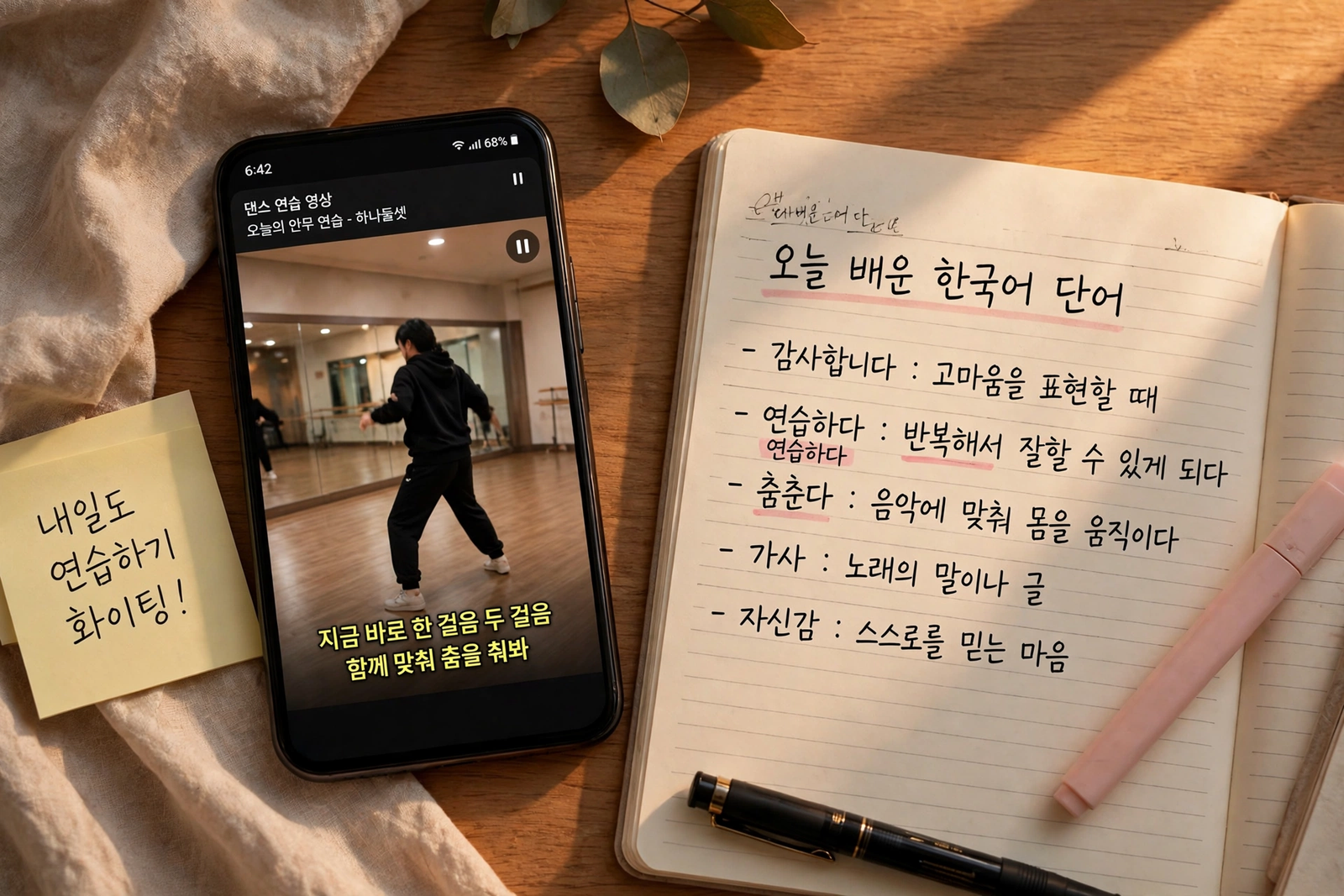
Tick it off after every practice session:
☐ Counted one to eight out loud in Korean
☐ Spotted one word from the ten-word table in the video
☐ Copied one 8-count, slowly, saying the count as I moved
☐ Said one practice-room sentence out loud — 다시 한 번, 천천히 해 봐요
☐ Wrote one new word in my notebook with its meaning
☐ Played the four audio clips and repeated each one
Listen: "Try following along. Cheer up!"
Quick answers about learning Korean from K-pop dance practice videos
Do I need to know Hangul before I start?
It helps a lot, and it takes less time than you think. Hangul was designed to be simple — most learners can read it within a few days — and dance videos give you a reason to read it right away, because the words on screen match the words you hear. If you cannot read Hangul yet, start with the counting.
How much Korean can I really learn from dance videos?
Enough to build a real foundation: numbers, body words, directions like 왼쪽 (oenjjok, left) and 오른쪽 (oreunjjok, right), and the everyday instructions people use when they work together. You will not learn grammar from dance videos alone, but you will arrive at your first grammar lesson already knowing fifty useful words.
Which videos should I start with?
Pick a song you already love and search for its dance practice video — the studio version with the fixed camera, not the music video. Slower songs are kinder for a first try.
Ready to turn those first words into real Korean? Our Korean programme takes you from 시작, 연습, 안무 all the way to full conversations, one small step at a time. Bring your favourite dance video with you.
Quick quiz: can you learn Korean from K-pop dance practice?
Tap an answer and see right away if you have got it.
Question 1. What does 다시 한 번 (dasi han beon) mean?
Question 2. What does 안무 (anmu) mean?
Question 3. How do you count “one, two, three, four” in Korean?
Question 4. What does 천천히 (cheoncheonhi) mean?
Question 5. What does 힘내요 (himnaeyo) mean?