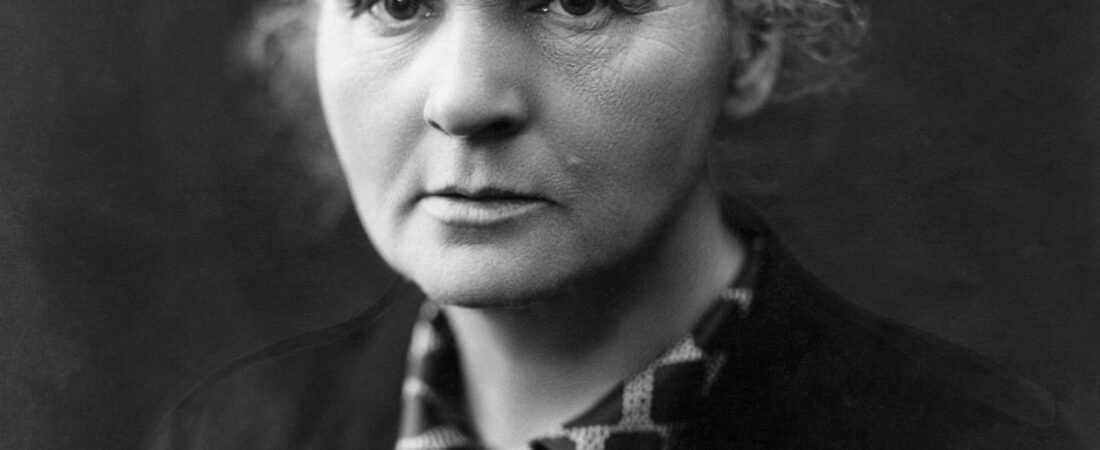
Reading passages in English exams can feel dry as dust. So let us try a different way to practise: a true story. This Marie Curie story in simple English is the first episode of Great Lives in Simple English — one great life per lesson, told slowly and clearly, with audio to listen to and an IELTS-style quiz at the end. Ready? Step into her shoes.
The Marie Curie story in simple English
Warsaw, 1867. You are a young girl named Maria, and you love books more than anything. But your country, Poland, is ruled by Russia, and girls are not allowed to go to university. So you learn in secret classes, in rooms where students must hide their books if a soldier knocks on the door. You make a promise to yourself: one day, I will study science — really study it.
For years you work as a teacher for rich families, and you save every coin. Then, in 1891, you take a train to Paris. At the Sorbonne university you study physics and maths. You are poor, your room is cold, and some days you eat only bread and tea. But your name is at the top of the exam lists. In Paris you also meet Pierre Curie, a quiet scientist who loves the same questions you love. In 1895 you marry him, and you become Marie Curie.
Listen to part 1: Warsaw, 1867 — a girl who loves books, in a country where girls cannot go to university.
The shed, 1898. Your laboratory is not beautiful. It is an old shed with a leaking roof, hot in summer and freezing in winter. There, you and Pierre study a strange metal called uranium. Uranium gives off invisible rays, like a quiet light nobody can see. Then you test a black rock called pitchblende — the ore that uranium comes from. The result makes no sense: the ore gives off stronger rays than pure uranium. You look at Pierre and say the words that change your life: something new is hiding in this rock.
Listen to part 2: Paris, and the cold little shed where the ore gave off stronger rays than uranium itself.
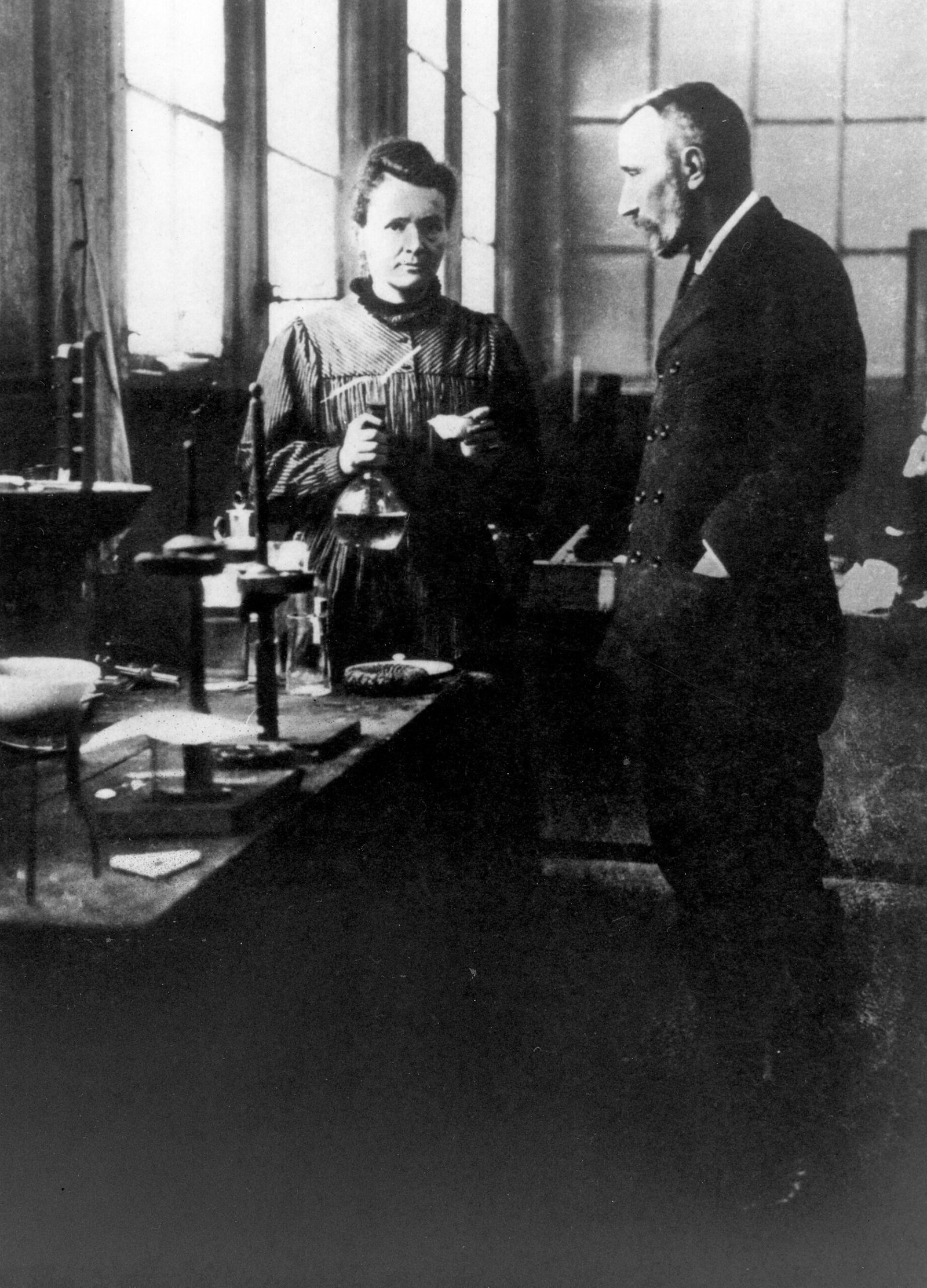
Four years of fire and water. To find the hidden thing, you must boil and clean tonnes of black ore, pot after pot, day after day. Your hands crack. Your back aches. But slowly, the work pays. In 1898 you and Pierre announce two new elements. You name one polonium, for your home country, Poland. The other you call radium, because it gives off such strong rays — and in the dark, it glows with a soft blue light. By 1902 you hold one tenth of a gram of pure radium, won from tonnes of rock. In 1903, you win the Nobel Prize in Physics. You are the first woman in the world to receive it.
Listen to part 3: four years of boiling black rock, two new elements, and the first Nobel Prize.
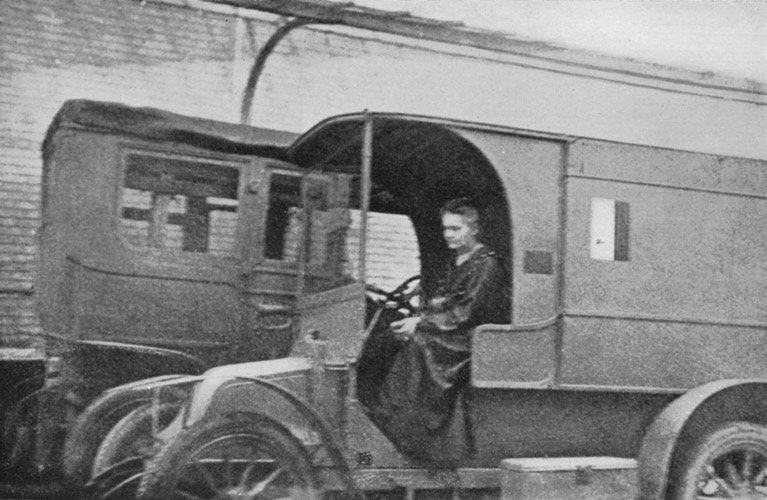
Loss, and a second prize. In 1906, on a rainy Paris street, Pierre is hit by a horse-drawn carriage and killed. Your heart is broken, but you do not stop. You take his teaching place at the Sorbonne — the first woman to teach there. In 1911 you win a second Nobel Prize, this time in Chemistry. Nobody in history has won Nobel Prizes in two different sciences. Then war comes in 1914, and you build X-ray machines into small cars — soldiers call them “petites Curies”, little Curies — and drive them to the hospitals near the front, so doctors can find bullets inside wounded men.
1934. The rays you discovered were a gift to science, but they were also a slow poison. After years of working with them, they made your blood sick, and in 1934 you die. Even today, your notebooks are still dangerous to touch. They sleep in lead boxes in Paris, still quietly giving off their rays — like your ideas, which have never stopped working.
Listen to part 4: a second Nobel Prize, the X-ray cars of the war, and notebooks that are still radioactive today.
Words to know
| Word | What it means |
|---|---|
| ray | An invisible line of energy that travels through the air, like light you cannot see. |
| ore | Rock that has metal or other useful material inside it. |
| element | One of the pure materials that everything in the world is made of, like gold or oxygen. |
| glow | To shine with a soft, warm light. |
| shed | A small, simple building, often made of wood. |
| carriage | A vehicle pulled by horses, used before cars. |
| honour (verb) | To show great respect for someone or something. |
Your turn
Tell the story back in three sentences: one about the girl in Warsaw, one about the shed in Paris, and one about the two Nobel Prizes. Say them out loud — your voice is part of the lesson. Then try the quiz below. It works like a mini IELTS Reading test: for the True / False / Not Given questions, remember that “Not Given” means the story simply does not say it.
Want more English like this? Our English programme builds your reading step by step, and Episode 2 of Great Lives — Isaac Newton and the falling apple — is coming soon.
Quick quiz: Marie Curie
Tap an answer and see right away if you have got it. Score: 0 / 5
Question 1. True, False or Not Given? Marie Curie was born in Paris.
Question 2. Why was the black ore, pitchblende, special?
Question 3. True, False or Not Given? Marie Curie was the youngest of five children.
Question 4. Why did Marie name one new element polonium?
Question 5. In the story, what is a “shed”?