
Is your child into K-pop and Korean dramas, and starting to call everyone “oppa”? Hold on — in Korean, addressing an older brother or sister isn’t free choice: use the wrong word for the wrong person and it’s not only incorrect, it can even come across as rude. Luckily, there is just one rule: the speaker’s age + gender decides the word.
This post teaches parents and children the 4 Korean forms of address for an older brother or sister — oppa, hyung, unnie, noona — when to use them, when to never use them, and how to speak to strangers politely. By the end, your child will know exactly what to call the person in front of them — and parents get a 5-minute daily game to make it stick.
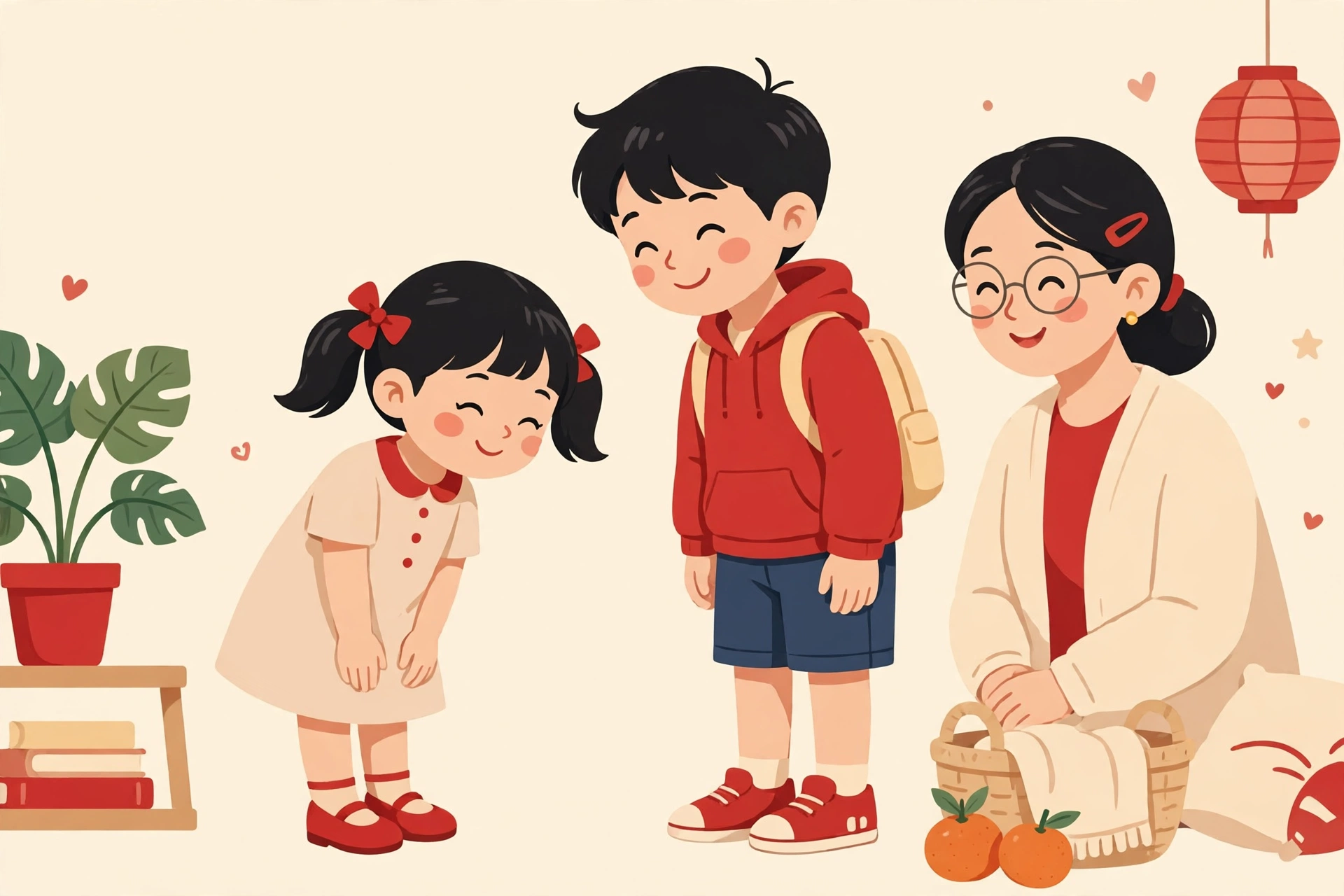
The golden rule: who is speaking decides the word
The same older brother is called one thing by a girl and another by a boy. This table is all you need:
- 오빠 (oppa) — what a girl / woman calls her older brother, or an older male she is close to. Example: a younger sister calls her older brother 오빠.
- 형 (hyeong, pronounced roughly “hyung”) — what a boy / man calls his older brother, or an older male he is close to.
- 언니 (eonni, pronounced roughly “unnie”) — what a girl / woman calls her older sister, or an older female she is close to.
- 누나 (nuna, pronounced roughly “noona”) — what a boy / man calls his older sister, or an older female he is close to.
A memory trick for kids: “girls call him oppa, boys call him hyung; girls call her unnie, boys call her noona”. Learn this one sentence and they’ll never mix them up.
Listen to the 4 forms of address: press play and read along slowly with your child.
An example from two families
In Lan’s family there is a 12-year-old older sister and an 8-year-old younger brother. The sister calls her brother 동생 (dongsaeng — younger sibling), while the brother calls his sister 누나 (noona), because he is a boy addressing an older sister. In Minh’s family it is the other way round: an 11-year-old older brother and a 7-year-old younger sister — the sister calls her brother 오빠 (oppa), and the brother calls her 동생. The very same “older brother” or “older sister” takes a different word depending on who is speaking — and that is the biggest difference between Korean and Vietnamese forms of address: in Vietnamese we go by the role of the person being addressed, while Korean also depends on the role of the speaker.
One small note for parents: Koreans also use oppa and unnie for older cousins and close older neighbours, not just their own siblings. As long as the person is older and the relationship is close, your child can use these words. But “close” here means genuinely close — someone they know well and play with often — not someone they met once at the park.
How do you know who is older?
The rule is easy, but to get it right your child has to know whether the other person is older or younger than them. Koreans ask about age very naturally — it isn’t considered nosy the way it might be in our culture. The sentence your child can learn by heart is 몇 살이에요? (myeot sarieyo? — how old are you?). This is a polite question, fine to use with older children. The other way round, if your child is the older one, they will hear a younger child ask them this — they answer with their age, and then both sides know what to call each other.

At home, you can practise with an “age staircase”: line up photos of the family from oldest to youngest, then quiz your child on what they would call each person. If your child still hesitates between oppa and hyung, just go back to the magic sentence above. Practise a few times and their responses get faster — and most importantly, they understand why the word is what it is, instead of learning by rote.
3 cases where you must NOT use oppa/unnie
1. Strangers. Oppa, unnie, hyung and noona are only for people you are close to. With an older stranger, address them politely as 아주머니 (ajumeoni — ma’am) or 아저씨 (ajeossi — sir), or simply say 저기요 (jeogiyo — excuse me) to start a conversation. Calling a stranger oppa can make them uncomfortable, because it feels far too familiar.
Listen to polite ways to address strangers: 저기요 opens the question, and 잘했어요! is the praise parents use when their child gets it right.
2. People much older than you. For teachers and respected elders, use 선생님 (seonsaengnim — teacher), or add 님 (-nim) after a title to show respect. Never call a male teacher hyung, even if he is only a few years older than you.
3. People younger than you, or the same age. With friends the same age, use their name + 아/야 (-a/-ya) when you are close, or name + 씨 (-ssi) to be polite: for example 지민 씨 (Jimin-ssi). Calling a same-age friend oppa or unnie breaks the age rule.
Mistakes K-pop fans often make
Children who love K-pop easily make these three mistakes. First, calling idols oppa or noona on social media. An idol is not a close older brother or sister, so the correct, polite way to refer to a celebrity is their name with -ssi — for example, “Jimin-ssi”. Second, copying drama characters who call each other oppa/unnie without noticing whether the character is male or female — and ending up with the word the wrong way round. Third, calling their Korean teacher hyung because the teacher looks young. A teacher is still a teacher — always 선생님.
That doesn’t mean your child can’t use oppa/unnie outside the family. A close friend one or two years older, an older cousin who often comes over to play, the older boy next door who plays football with them — calling them oppa, unnie, hyung or noona is perfectly correct, and it makes the bond warmer. The line is drawn by two questions: are you genuinely close, and is the person older than your child? If both answers are yes, go ahead and use the words naturally.
4 more Korean forms of address your child should know
- 동생 (dongsaeng) — younger brother / younger sister (a younger sibling; one word used for both genders).
- 선배 (seonbae) — a senior: someone ahead of you at school or at work.
- 후배 (hubae) — a junior: someone behind you at school or at work.
- 잘했어요! (jalhaesseoyo!) — Well done! A polite praise phrase parents can use when their child gets it right: praise them straight away in Korean so it sticks.
Besides the 4 words above, your child should learn this greeting by heart 안녕하세요 (annyeonghaseyo — hello). Use the right form of address and add a greeting — 안녕하세요, 오빠! — and it sounds both polite and natural, completely different from just blurting out “oppa!” and leaving it at that. Press play and practise the greeting with your child.
Listen to a greeting for an older brother or sister in Korean:
How to teach your child in 5 minutes a day
- Play “Who is who”: point at family photos and ask your child: “What do you call this person? Oppa or hyung? Unnie or noona?” — when they answer correctly, praise them with 잘했어요!
- Watch Korean dramas with your child: every time a character says oppa or unnie, pause and ask: “Is this character a girl or a boy? So why do they say oppa?”
- Remind them of the stranger rule: tell your child to use oppa/unnie only with people they know well — with strangers, use 저기요.

To make it stick even longer, make a set of flashcards: the Korean word (오빠, 형, 언니, 누나) on one side, “who calls whom” on the other. Each evening, draw a card and give your child 10 seconds to answer. Three correct answers in a row and they “level up”. Children remember far more through games than through staring at a chart — and you don’t need anything fancy, just a few slips of paper are enough to play.
A summary table for the fridge door
Print this table or copy it out and stick it where your child will see it often — they’ll know it within a week:
| If the speaker is… | An older brother is called… | An older sister is called… |
|---|---|---|
| A girl / female |
오빠 (oppa)
 |
언니 (unnie)
 |
| A boy / male |
형 (hyung)
 |
누나 (noona)
 |
Three golden rules to go with the table: only use these words with people you are close to, never with strangers; teachers are always 선생님; and for someone the same age, use their name + -ssi. Send this table to another parent whose child is learning Korean — it might save another child some confusion in their very first lesson.
Frequently asked questions
Can a girl call an older boy hyung?
No. A girl calls an older boy oppa; hyung is only for a boy addressing an older boy or man. Mixing these two up is the most common mistake.
Is it a problem to call a stranger oppa?
Yes — the other person may find it too familiar and feel uncomfortable. With an older stranger, your child should open with 저기요, or address them politely as 아주머니 / 아저씨.
What do two children the same age call each other?
Name + -ssi to be polite (Jimin-ssi), or name + -a/-ya once they are close. No oppa/unnie, because neither of them is older.
To wrap up
Forms of address aren’t “dry grammar” — they are how Koreans show respect through language. Teach your child the right words from a young age and they gain vocabulary, and, more importantly, they learn a culture of respect for their elders — and that is what truly makes a child “good at Korean”.
If your child loves Korean culture and wants to learn more vocabulary through topics they enjoy, read the post Learn Korean through food names: 15 Korean dishes every child loves on LingoBubbo — because learning through what a child loves is always faster than learning from a textbook. For children who want a steady daily study routine, see also The 20-minutes-of-Korean-a-day system for your child. To start from the alphabet, visit LingoBubbo’s Korean learning page to pick the right lessons for your child.
How many words did your child get right today? Tell me in the comments — and if this post helped your child feel less confused, share it with another parent whose child is learning Korean!
Quiz nhanh
Play these 5 questions with your child and see how many they remember! Score: 0/5
Question 1: What does a girl call her older brother?
Question 2: What does a boy call his older sister?
Question 3: Meeting an older stranger, what should your child say to start a conversation politely?
Question 4: Two friends the same age who are close — what do they call each other?
Question 5: What do you call your Korean teacher?
📷 Photo credits: real photos from the open libraries Openverse / Wikimedia Commons / Flickr (licences CC0, CC BY, CC BY-SA) — one real-life photo for every word, no AI images.