You have just downloaded a long HSK 1 vocabulary list, new words stare at you from every line, and one question pops up straight away: which words should I learn first? Trying to learn a hundred words scattered all at once is the fastest way to give up. Learning by group is how beginners actually get far.
This post gathers the whole HSK 1 vocabulary under the new standard into 10 familiar groups, each with the Chinese characters, pinyin, the meaning in English and an example sentence you can use right away. At the end there is a small exercise set and a quiz so you can check how much you have learned.
One thing to state clearly first: which standard does this post follow?
This post follows the HSK 3.0 standard — the new Chinese proficiency standard with 9 levels, issued in 2021 and gradually replacing the old HSK 2.0 standard (6 levels). This is exactly the point beginners get most confused about, so let’s be upfront about it from the start.
A quick distinction to remember: the old HSK 2.0 standard had 6 levels, and HSK 1 had only about 150 words. The new HSK 3.0 standard has 3 bands and 9 levels, and the vocabulary at each level has expanded considerably. As LingoBubbo’s analysis What’s new in HSK 3.0? pointed out, HSK 1 alone has grown from 150 to about 300 words. The good news: the word groups are still the familiar ones below — each group simply has a few more new words in it.
One date worth memorising: according to LingoBubbo’s Chinese learning page, the current lessons still follow the HSK 2.0 standard, while the HSK 3.0 standard applies to the exam from 13/12/2026. That means if you sit the exam after that date, revise using the word-group list in this post. And if you are only learning to communicate, any group order works — basic communication vocabulary doesn’t change, it just has wider coverage.
How to read the examples in this post: each word has 3 parts — the simplified Chinese characters, the pinyin with tone marks, and the meaning in English. Read the pinyin out loud; don’t just read silently with your eyes. Say it loudly — getting it wrong is fine, you will polish it gradually.
The 10 HSK 1 vocabulary groups under the new standard
Group 1: Greetings and forms of address — the first group to learn
This is the group you meet in your very first lesson, and the one you will use most in daily life. Learn this group by heart and you can already greet people, introduce yourself and say thank you in Chinese.
- 你好 (nǐ hǎo) — Hello
- 谢谢 (xièxie) — Thank you
- 再见 (zàijiàn) — Goodbye
- 对不起 (duìbuqǐ) — Sorry
- 没关系 (méi guānxi) — It’s all right / No problem
- 请 (qǐng) — Please
- 我 (wǒ) — I, 我叫 (wǒ jiào) — My name is
- 你 (nǐ) — You, 您 (nín) — You (polite)
- 他 (tā) — He, 她 (tā) — She
- 名字 (míngzi) — Name
Example: 你好!我叫小明。你叫什么名字?(Nǐ hǎo! Wǒ jiào Xiǎo Míng. Nǐ jiào shénme míngzi?) — Hello! My name is Xiao Ming. What is your name?
Have a listen to this basic greeting:
A small tip: the character 您 (nín) is used when speaking to older people or in formal situations. With friends your own age, 你 (nǐ) is friendly enough.
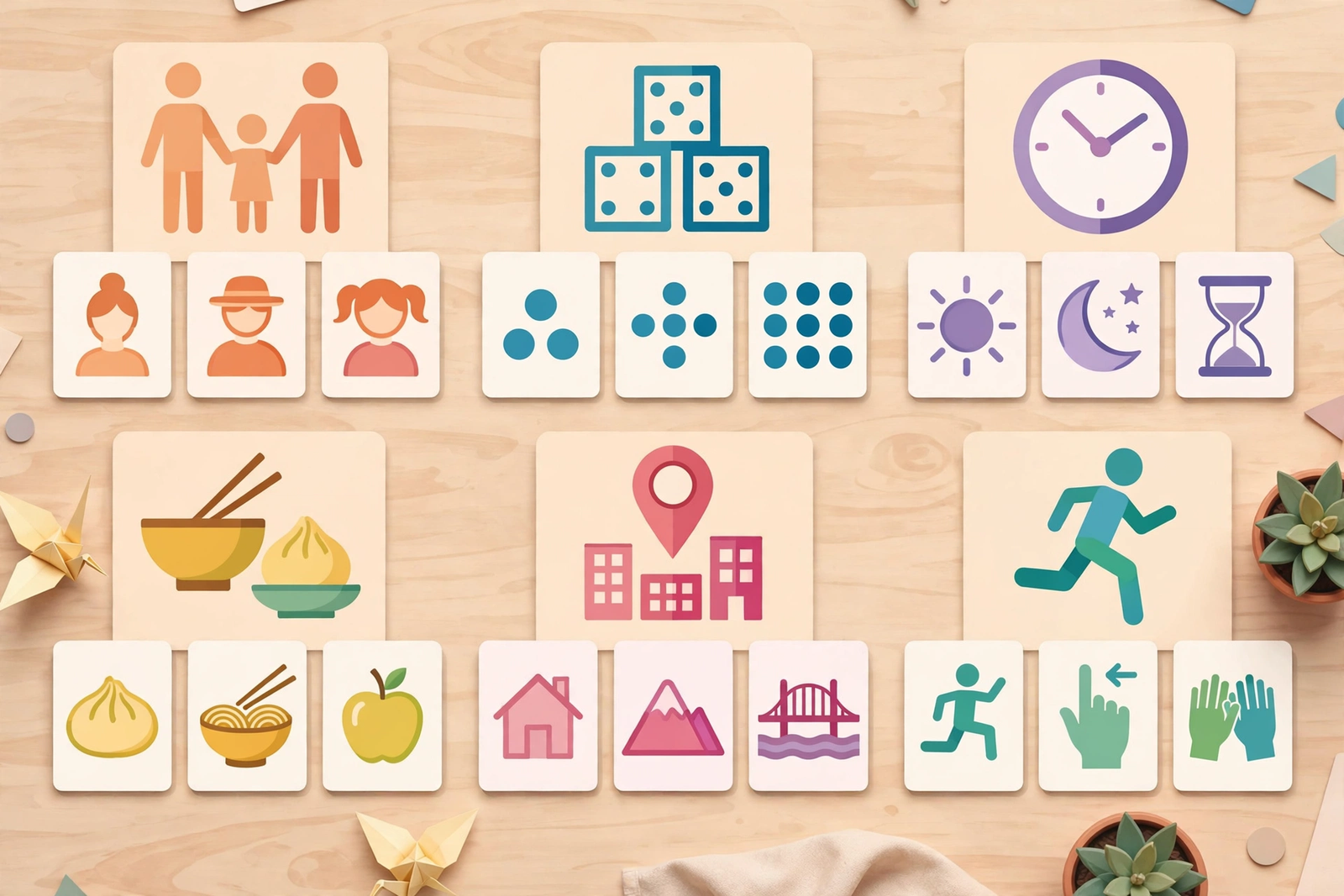
Group 2: Numbers and time — the group you “need wherever you go”
Without numbers you can’t bargain, can’t ask the time, can’t make an appointment. That is why this group comes second, right after greetings.
- 一 (yī) 1, 二 (èr) 2, 三 (sān) 3, 四 (sì) 4, 五 (wǔ) 5
- 六 (liù) 6, 七 (qī) 7, 八 (bā) 8, 九 (jiǔ) 9, 十 (shí) 10, 百 (bǎi) 100
- 块 (kuài) — yuan, the money unit used when stating prices
- 点 (diǎn) — o’clock, 分 (fēn) — minute, 半 (bàn) — half past
- 今天 (jīntiān) — today, 明天 (míngtiān) — tomorrow, 昨天 (zuótiān) — yesterday
- 现在 (xiànzài) — now, 早上 (zǎoshang) — morning, 晚上 (wǎnshang) — evening / night
- 星期 (xīngqī) — week, 月 (yuè) — month, 年 (nián) — year, 号 (hào) — day (of the month)
Example: 现在几点?现在三点半。(Xiànzài jǐ diǎn? Xiànzài sān diǎn bàn.) — What time is it now? It’s half past three now. And: 我每天七点起床。(Wǒ měitiān qī diǎn qǐchuáng.) — I get up at 7 o’clock every day.
Have a listen to asking the time and talking about routine times:
Vietnamese learners often mix up 点 (diǎn) and 分 (fēn): 点 comes before the hour number, 分 comes before the minute number. Saying “三点半” means half past three, while “三点三十分” is also correct but longer, and native speakers rarely use the long form in quick conversation.
Group 3: Family and people
This group helps you introduce your family and ask about other people’s families — the opening topic of almost every social conversation.
- 爸爸 (bàba) — dad, 妈妈 (māma) — mum
- 哥哥 (gēge) — older brother, 姐姐 (jiějie) — older sister
- 弟弟 (dìdi) — younger brother, 妹妹 (mèimei) — younger sister
- 朋友 (péngyou) — friend, 老师 (lǎoshī) — teacher, 学生 (xuésheng) — student
- 孩子 (háizi) — child, 人 (rén) — person
- 男人 (nánrén) — man, 女人 (nǚrén) — woman
- 中国 (Zhōngguó) — China, 越南 (Yuènán) — Vietnam
Example: 她是我的汉语老师。(Tā shì wǒ de Hànyǔ lǎoshī.) — She is my Chinese teacher. And: 我是越南人。(Wǒ shì Yuènán rén.) — I am Vietnamese.
Group 4: Food and drink
Going out to eat is the most real communication situation for a beginner. Learn this group and you can order food, praise the taste and pay right away.
- 吃 (chī) — to eat, 喝 (hē) — to drink
- 米饭 (mǐfàn) — cooked rice, 面条 (miàntiáo) — noodles
- 水 (shuǐ) — water, 茶 (chá) — tea, 咖啡 (kāfēi) — coffee
- 苹果 (píngguǒ) — apple, 好吃 (hǎochī) — delicious
- 饭馆 (fànguǎn) — restaurant
Example: 我要一杯水,谢谢。(Wǒ yào yì bēi shuǐ, xièxie.) — I would like a glass of water, please. And: 这个多少钱?三十块。(Zhège duōshao qián? Sānshí kuài.) — How much is this? 30 yuan.
Have a listen to ordering a drink and asking the price:
Group 5: Travel and places
This group goes with group 2: know the numbers, know the time, then you need to know the way too before you can go anywhere.
- 去 (qù) — to go, 来 (lái) — to come
- 学校 (xuéxiào) — school, 家 (jiā) — home, 公司 (gōngsī) — company
- 医院 (yīyuàn) — hospital, 商店 (shāngdiàn) — shop
- 前面 (qiánmiàn) — in front, 后面 (hòumiàn) — behind
- 左边 (zuǒbian) — left side, 右边 (yòubian) — right side
- 远 (yuǎn) — far, 近 (jìn) — near
- 出租车 (chūzūchē) — taxi, 飞机 (fēijī) — aeroplane, 火车 (huǒchē) — train
Example: 请问,学校在哪儿?前面左转就到了。(Qǐngwèn, xuéxiào zài nǎr? Qiánmiàn zuǒ zhuǎn jiù dào le.) — Excuse me, where is the school? Go straight ahead and turn left, and you’re there.
Have a listen to asking for directions:
Group 6: Studying
Your own group: talking about your studies, asking about lessons, saying whether you know something or not yet.
- 学 (xué) — to learn / to study, 汉语 (Hànyǔ) — Chinese (language)
- 书 (shū) — book, 字 (zì) — character, 课 (kè) — lesson
- 考试 (kǎoshì) — exam, 会 (huì) — to know how to (do something)
- 说 (shuō) — to speak, 读 (dú) — to read, 写 (xiě) — to write, 听 (tīng) — to listen
Example: 我会说汉语。(Wǒ huì shuō Hànyǔ.) — I can speak Chinese. The first time you say this sentence, it always makes you feel “I can actually do this”, even if your pronunciation isn’t perfect yet.
Group 7: Shopping and money
This group connects with group 2 (numbers) and group 4 (asking prices) to make a complete market-going trio.
- 买 (mǎi) — to buy, 卖 (mài) — to sell (these two characters differ only in tone — read the tone wrong and the meaning flips!)
- 钱 (qián) — money, 贵 (guì) — expensive, 便宜 (piányi) — cheap
- 多少 (duōshao) — how much / how many, 衣服 (yīfu) — clothes, 鞋 (xié) — shoe
Example: 这件衣服多少钱?(Zhè jiàn yīfu duōshao qián?) — How much is this piece of clothing? Remember to tell apart 买 (mǎi, tone 3), which means to buy, and 卖 (mài, tone 4), which means to sell — say the wrong tone and the seller understands the opposite.
Group 8: Weather
- 天气 (tiānqì) — weather, 热 (rè) — hot, 冷 (lěng) — cold
- 下雨 (xià yǔ) — to rain, 晴天 (qíngtiān) — sunny day, 风 (fēng) — wind, 雪 (xuě) — snow
Example: 今天天气怎么样?今天很热。(Jīntiān tiānqì zěnmeyàng? Jīntiān hěn rè.) — How is the weather today? It’s very hot today. The weather question is the most common conversation-opening small talk after greetings.
Group 9: Feelings and descriptions
- 高兴 (gāoxìng) — happy, 累 (lèi) — tired, 忙 (máng) — busy
- 好 (hǎo) — good, 大 (dà) — big, 小 (xiǎo) — small
- 多 (duō) — many / much, 少 (shǎo) — few / little, 快 (kuài) — fast, 慢 (màn) — slow
Example: 我很高兴认识你。(Wǒ hěn gāoxìng rènshi nǐ.) — I am very pleased to meet you. This sentence combines group 1 (认识) and group 9 (高兴) — you see: learn by group, then join the pieces together and you can say long sentences.
Group 10: Everyday activity verbs
The “backbone” group of the sentence: without verbs, there is no sentence.
- 起床 (qǐchuáng) — to get up, 睡觉 (shuìjiào) — to sleep
- 工作 (gōngzuò) — to work, 做 (zuò) — to do / to make
- 看 (kàn) — to watch / to look, 爱 (ài) — to love, 喜欢 (xǐhuan) — to like
- 想 (xiǎng) — to want / to think, 住 (zhù) — to live (somewhere), 坐 (zuò) — to sit
Example: 我喜欢喝茶。(Wǒ xǐhuan hē chá.) — I like drinking tea. If you want to dig deeper into this verb group, read the post the HSK 1 verb list organised by everyday action on LingoBubbo.
Summary table: the 10 groups, and what each is for
| Group | What you can do once you’ve learned it | Starter words to learn by heart |
|---|---|---|
| 1. Greetings and forms of address | Greet, introduce yourself, say thank you | 你好, 谢谢, 我叫 |
| 2. Numbers and time | Ask the time, make appointments, say prices | 一, 点, 今天, 明天 |
| 3. Family and people | Introduce your family, ask after others | 爸爸, 妈妈, 朋友 |
| 4. Food and drink | Order food, ask prices, praise the taste | 吃, 水, 好吃 |
| 5. Travel and places | Ask for directions, take transport, find places | 去, 学校, 左边 |
| 6. Studying | Talk about your own studies | 学, 汉语, 会 |
| 7. Shopping and money | Buy things, bargain | 买, 钱, 便宜 |
| 8. Weather | Small talk to open a conversation | 天气, 热, 下雨 |
| 9. Feelings and descriptions | Express feelings, praise and criticise | 高兴, 累, 好 |
| 10. Everyday activity verbs | Tell your day in long sentences | 起床, 工作, 喜欢 |
A suggested 4-week roadmap for beginners
Week 1: groups 1 and 2. Ten words a day, read out loud, introduce yourself and ask the time out loud. By the end of the week, being able to say “My name is…, what day of the week is it today, what time is it now” means you’ve made it.
Week 2: groups 3, 4 and 5. Build sentences: introduce your family, order food, ask for directions. You will see the number of sentences you can say shoot up, because the new words slot into old sentence frames.
Week 3: groups 6, 7 and 8. By now you can talk about your studies, shopping and the weather — the three most common social topics.
Week 4: groups 9 and 10, then review everything with flashcards. The HSK 3.0 standard adds more words to each group, so this week you can also load in 5–10 extra new words per group if you still have the energy. Don’t try to cram all 300 words into one month and then quit — learn a steady 10 words a day, and in a month you will have reached the 300-word mark before you know it.

Quick exercises with answers
Exercise 1. Translate into Chinese: “Hello! My name is Lan. What is your name?” — Answer: 你好!我叫兰。你叫什么名字?(Nǐ hǎo! Wǒ jiào Lán. Nǐ jiào shénme míngzi?) Note: Vietnamese personal names, when spoken in Chinese, are usually read with the closest Sino-Vietnamese sound — Lan is read as Lán.
Exercise 2. How do you say “It’s half past three now”? — Answer: 现在三点半。(Xiànzài sān diǎn bàn.) Remember: 半 (bàn) comes after 点 (diǎn) and the hour number, and means “half past”.
Exercise 3. Tell 买 and 卖 apart: in the sentence “I want to buy this shirt”, which character is used? — Answer: 买 (mǎi, tone 3). Using 卖 (mài, tone 4) would make it “I want to sell” — the complete opposite.
Exercise 4. Asking for directions to the school: — Answer: 请问,学校在哪儿?(Qǐngwèn, xuéxiào zài nǎr?) Don’t forget 请问 (qǐngwèn) at the start of the sentence — it is the polite opener for every question you ask a stranger.
Quick quiz: how many HSK 1 word groups have you learned so far?
Tap the answer you choose — right or wrong, you will know on the spot.
Your score: 0/5 — click an answer to check it right away.
Question 1. What does 你好 (nǐ hǎo) mean?
Question 2. Which word means “tomorrow”?
Question 3. What does 现在三点半 mean?
Question 4. What is the sentence 请问,学校在哪儿? used for?
Question 5. According to LingoBubbo’s Chinese learning page, from when does the HSK 3.0 standard apply to the exam?
Frequently asked questions about HSK 1 under the new standard
HSK 2.0 and HSK 3.0 — which standard should I revise for? If you sit the exam from 13/12/2026 onwards, revise for HSK 3.0. If you are only learning to communicate, both standards work, because basic communication vocabulary is almost identical — the new standard simply covers more.
How many words are in the new-standard HSK 1? According to LingoBubbo's HSK 3.0 analysis, HSK 1 has grown from about 150 words (old standard) to about 300 words (new standard). Learn the 10 groups in this post and you will have covered the main framework, then add more words group by group, gradually.
Which group should I learn first? Greetings, then numbers and time. These two groups unlock the most situations with the fewest words.
Do I need to learn to write Chinese characters right from the start? You should learn to recognise characters alongside speaking, but don't force yourself to write beautifully straight away. Listen and speak first, read and write after — the characters will sink in more naturally.
How long does it take to learn all 10 groups? With 10 words a day and a review at the weekend, in about a month you will be able to use most of these words in simple sentences. Knowing them is one thing; producing them in a sentence when you need them is another — just keep speaking out loud every day.
Which group are you on now? Tell me in the comments, and send this post to friends who are clutching a vocabulary list and don't know where to start. If you want to follow a ready-made roadmap, start from LingoBubbo's Chinese page with lesson 1 你好, then go lesson by lesson — every lesson already comes with illustrated vocabulary, audio and a quiz.