
“Is it spicy?” A guest asks, you freeze for half a second, and the whole table is watching. You know the dish. You know the chili. What you need is the English sentence that comes out fast, warm, and right. This post gives you exactly that: 20 English phrases for when guests ask if a dish is spicy, with plain pronunciation help, the guest’s side of the exchange, and a short role-play you can practice before your next shift. No long grammar lesson. Just the words that work at a real table.
Why this question comes up at every table
Spicy is personal. One guest’s “a little kick” is another guest’s five-alarm fire, and Americans ask about it constantly, before they order and after the first bite. They are not testing you. They are trying to enjoy their dinner without a surprise. A clear answer in the first five seconds builds trust for the whole meal: the guest relaxes, orders with confidence, and remembers the server who took care of them.
The good news? You do not need perfect English for this. You need about twenty short sentences, said with a smile. Most of them follow the same shape: a little heat, a little choice, a little care. Learn them once, and the question stops being scary.
The four heat levels every server should know
Guests in the US usually think in four levels. Say the level, then the sentence. That is the whole system.
| Level | What it means | Say it like this |
|---|---|---|
| Mild | Just a little heat, easy for everyone | “This one is mild.” |
| Medium | A warm, comfortable spice | “It has a nice kick, but it is not too hot.” |
| Spicy | Real heat, you will feel it | “That one is pretty spicy.” |
| Extra spicy | Very hot, for people who love heat | “It is our spiciest dish, so take your time.” |
Listen to the four levels and say them after the speaker. The rhythm matters as much as the words: slow down on “mild” and “spicy” so the guest hears the level clearly.
Pronunciation help: spicy sounds like SPY-see, mild sounds like MY-uld, medium sounds like MEE-dee-um, chili sounds like CHIL-ee, sauce sounds like SAWS. Say each one out loud twice before you read on. Your mouth needs the practice more than your eyes do.
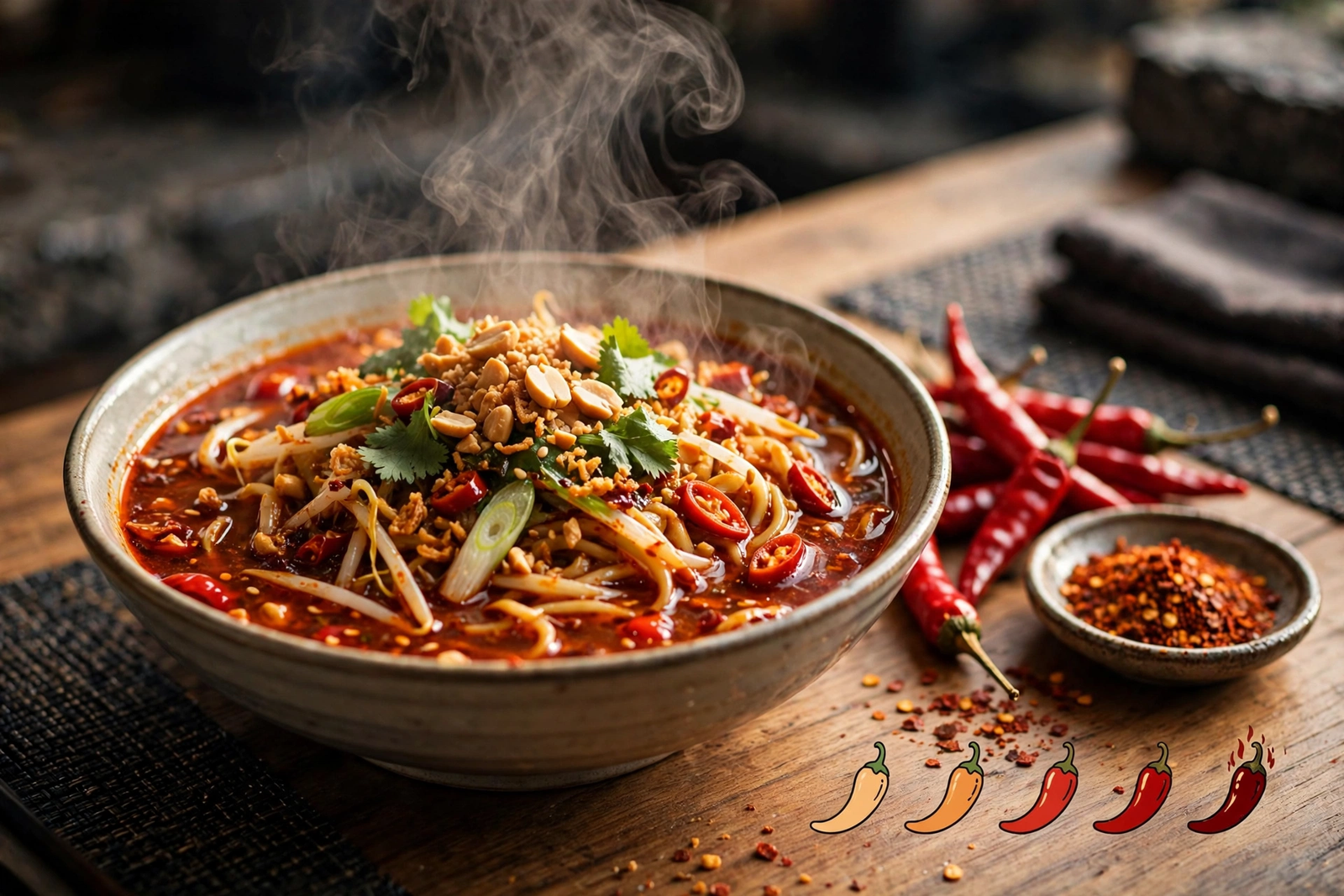
The 20 English phrases for “Is it spicy?”, in the order you will actually use them
Answering “Is it spicy?” (1 to 5)
1. “Yes, a little.”
Short, honest, friendly. Your safest answer when the heat is light. Add a smile and the guest is already at ease.
2. “It has a little heat, but it’s not too hot.”
The most useful sentence in this whole post. It answers the question and calms the worry in the same breath.
3. “This one is mild.”
Use it when you want to point a nervous guest toward a safe choice. Point at the dish on the menu as you say it.
4. “That one is pretty spicy.”
“Pretty” here means “quite” or “fairly.” A natural warning that does not sound like a lecture.
5. “It’s the spiciest dish we have, so take your time.”
For the hottest item on the menu. “Take your time” tells the guest you respect their pace, and it usually makes them smile.
Describing the heat (6 to 10)
6. “It’s mild, medium, or spicy, your choice.”
Three levels in one sentence, and the guest picks. This line ends a lot of back-and-forth before it starts.
7. “The sauce has chili in it.”
Simple and clear. Guests with a chili allergy or a low tolerance need this fact, not a long description.
8. “It will warm you up, but it won’t burn.”
A warm, playful way to describe medium heat. Guests remember this line, and they repeat it to their friends.
9. “Most guests find it comfortable.”
When you are not sure about a guest’s tolerance, this is your honest middle ground. It is true, and it does not overpromise.
10. “It builds slowly, it doesn’t hit you all at once.”
Some dishes start gentle and get hotter as you eat. Warn the guest once, and they will thank you at the end of the meal.
Offering to adjust the heat (11 to 15)
11. “Would you like it mild, medium, or spicy?”
Ask before the guest has to ask you. It shows care, and it takes five seconds.
12. “I can ask the kitchen to go light on the chili.”
Notice the wording: “I can ask.” You are offering to try, not making a promise for the kitchen. That keeps you honest and the guest happy.
13. “I can make it less spicy for you.”
Short and direct. Use it when a guest looks worried but still wants the dish.
14. “Would you like some rice to go with it? It helps with the heat.”
Rice, bread, a glass of milk: these are the server’s quiet tools. Offer one before the guest needs to ask.
15. “I can bring extra water, no problem.”
“No problem” is the magic phrase here. It tells the guest their request is easy, not a bother.
When it is already too spicy (16 to 20)
16. “I’m sorry about that. Let me bring you some water.”
Act first, apologize once, and move. Guests forgive fast when they see you solving the problem.
17. “Would you like me to make you a milder dish?”
Offer a fix, not an excuse. One sentence, and the guest feels looked after.
18. “Here is some rice and a glass of milk, they help.”
Say it as you set the rice down. Action plus words beats words alone every time.
19. “Take your time, there’s no rush.”
The guest is red-faced and embarrassed. This line gives them room to breathe, and it costs you nothing.
20. “Next time, try the mild version, it’s just as tasty.”
A goodbye line that turns a too-spicy dinner into a return visit. The guest leaves with a plan, not a complaint.
What the guest says, and what you say back
Here is the other half of the conversation: the guest’s lines, so you recognize them the second you hear them, and the server’s answer that fits.
| The guest says | You say |
|---|---|
| “Is this dish spicy?” | “It has a little heat, but it’s not too hot.” |
| “How spicy is it?” | “It is medium. A nice kick, but comfortable.” |
| “Can I have it less spicy, please?” | “Of course. I can ask the kitchen to go light on the chili.” |
| “Is there chili in this?” | “Yes, the sauce has chili in it. Would you like a milder one?” |
| “That’s too spicy for me!” | “I’m sorry about that. Let me bring you some water.” |
Listen to the guest’s questions first, then the server’s answers. Hearing the question before the answer is how your ear learns to catch it at a noisy table.
A full role-play you can practice before your shift
Read it out loud with a coworker or a friend. One of you is the guest, one is the server. Swap roles and do it twice. The second time always sounds better than the first.
Guest: Hi, is the spicy chicken very spicy?
Server: It has a nice kick, but it is not too hot for most people. Would you like it mild, medium, or extra spicy?
Guest: Medium sounds good. Can you make it a little less spicy?
Server: Of course. I will ask the kitchen to go light on the chili. Would you like some rice with that?
Guest: Yes, please. And a glass of water, too.
Server: Coming right up.
Did you notice what the server did? She answered the question, offered a choice, and added rice and water before the guest had to ask. That is the whole job in six lines. Try the role-play again tomorrow before your shift, and the words will be there when a real guest asks.

Five mistakes to avoid
Saying “no” when the dish is a little spicy. “No, it’s not spicy” feels helpful, but if the guest feels heat, they stop trusting you. Say “a little” instead. Honesty keeps the tip.
Saying “yes, very spicy” to everything. Guests hear a warning and order something else, or nothing at all. Describe the level: mild, medium, or spicy. A level is information; “very spicy” is a scare.
Promising what the kitchen cannot do. “I will make it not spicy at all” is a promise you may not be able to keep. Say “I can ask the kitchen” and you stay honest.
Freezing when you do not understand. If a guest’s question comes too fast, say “Sorry, could you say that again?” Nobody minds. Everybody minds a wrong answer.
Forgetting the follow-up. After the first bite, walk past and ask “How is the spice level?” One question turns a good meal into great service, and it takes three seconds.
Your quick-reference cheat sheet
Copy this table to your phone or print it for the break room. It is the whole post on one screen.
| Situation | Say this |
|---|---|
| Guest asks if it is spicy | “It has a little heat, but it’s not too hot.” |
| Guest wants to choose the level | “Would you like it mild, medium, or spicy?” |
| Guest wants it milder | “I can ask the kitchen to go light on the chili.” |
| Guest says it is too spicy | “I’m sorry about that. Let me bring you some water.” |
| Guest finishes and smiles | “Next time, try the mild version, it’s just as tasty.” |
Send this cheat sheet to a coworker who is starting their first restaurant job in the US. Five lines, and their hardest question of the night is already answered.
Quick Quiz
Test yourself on the spicy-food phrases. Click an answer to see if you are right, your score is at the top.
Score: 0/5
1. A guest asks, “Is it spicy?” What is the best answer?
2. A guest says, “Can you make it less spicy, please?” What do they want?
3. Which word means the lowest heat level?
4. What does “This dish is mild” mean?
5. A guest says, “That is too spicy for me!” What is the best reply?
FAQ
What should I say if I do not know how spicy a dish is?
Say so, and offer to check: “I am not sure about this one. Let me ask the kitchen for you.” Guests trust an honest check far more than a confident guess.
What is the difference between “spicy” and “hot”?
In US restaurant talk they often mean the same thing, the chili heat. If a guest says “hot,” they usually mean spicy, not temperature. When in doubt, answer about the spice: “It is a little spicy, but not too hot.”
How do I ask a guest about their spice level without sounding pushy?
One short question is enough: “Would you like it mild, medium, or spicy?” Ask it once, with a smile, and let the guest choose. No follow-up needed.
What if a guest is allergic to chili?
Take it seriously right away. Say “Thank you for telling me,” write it on the order, and let the kitchen know. Never guess about allergies: if you are unsure whether a dish has chili, ask the kitchen.
Can I practice these phrases if I work alone?
Yes. Say the role-play out loud before your shift, both parts, twice. Your mouth remembers what it has said, and the words will come out faster at a real table.
Your turn: try one phrase tonight
You now have 20 English phrases for when guests ask if a dish is spicy, a four-level heat scale, the guest’s side of the exchange, and a role-play to practice. Pick one phrase tonight, the one you will use most, and say it out loud three times before your next shift. “It has a little heat, but it’s not too hot” is a good place to start.
Keep learning with the English lessons on LingoBubbo, where workplace dialogues like this one appear in every lesson. If this guide helped you, send it to a coworker who is starting their first restaurant job in the US. And if you want more table-side English, read 100 English phrases for restaurant staff, from greeting a table to the bill and 20 English phrases for taking orders at the counter. Then tell us in the comments: which phrase from this post will you try first, and what is the spiciest dish on your menu?