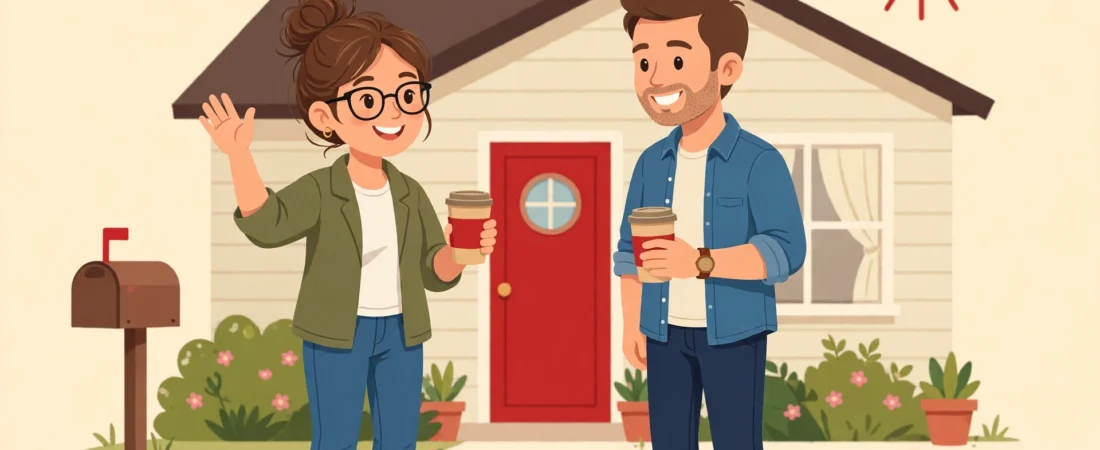
Have you ever heard an American say a line that sounds so familiar — you understand every word, yet you’re still not sure you’d use it correctly? Take “What’s up?” — everyone hears it every day, but not everyone feels confident about how to answer naturally. This post rounds up exactly 20 everyday American English sentences like that: ordinary, polite, not slang, usable by absolutely anyone — at the office, in a shop, or when you bump into friends on the street.
Here are 20 such sentences, each with a short dialogue and a note on what it means. Learn this group by heart and you’ll follow what Americans say much faster — because you hear these lines everywhere. At the end of the post there’s audio so you can listen and shadow along, plus a quick quiz to check how many sentences you remember.
Listen first: what do American greetings sound like?
Before you read the list, listen to this short dialogue. Two friends meet on the street and use exactly 5 sentences from the greetings group below. Listen once to get your ear used to them, then read on for the explanation of each sentence.
🎧 Listen to the dialogue: Meeting on the street
Did you notice? The whole dialogue is made up of short sentences — not one of them is longer than 6 words. That’s the common thread running through all 20 sentences in this post — short, easy to remember, and Americans use them almost by reflex.
Greetings and asking how someone is
- “What’s up?” — What’s new? / How have you been lately? For example: A: “Hey, what’s up?” B: “Not much, just working. You?”
- “Long time no see!” — Long time no see! For example: A: “Sarah! Long time no see!” B: “I know! How have you been?”
- “I’m good, thanks.” — I’m well, thanks. For example: A: “How are you?” B: “I’m good, thanks. And you?”
- “Let’s catch up.” — Let’s meet up for a proper chat. For example: A: “We should get coffee soon.” B: “Yes, let’s catch up this weekend.”
- “Take care.” — Take care / Look after yourself. For example: A: “See you next week!” B: “You too. Take care!”
A handy tip: when Americans ask “What’s up?”, they usually aren’t waiting for a long answer. “Not much.” or “I’m good, thanks.” is plenty; then ask “You?” back so the conversation keeps going. And “Long time no see!” is only for when you really haven’t met for a long time — say it when you only met yesterday and it sounds a bit odd.

Agreeing, thanking and understanding
- “Sounds good.” — Sounds all right / That’s fine. For example: A: “Let’s meet at 3.” B: “Sounds good.”
- “That works for me.” — That works for me / I’m OK with that plan. For example: A: “Can we move it to Friday?” B: “That works for me.”
- “I appreciate it.” — I really appreciate it / Thank you so much. For example: A: “I sent you the file.” B: “Thanks, I appreciate it.”
- “That makes sense.” — That makes sense / I see. For example: A: “We need more time because the test is long.” B: “Yeah, that makes sense.”
- “Fair enough.” — Fair point / That’s reasonable. For example: A: “I can’t come, I’m too tired.” B: “Fair enough. Rest up.”
- “Of course.” — Of course / Certainly. For example: A: “Can you help me?” B: “Of course!”
You’ll come across this group a lot at work. “Sounds good” and “That works for me” are two polite ways to agree without being long-winded. And “I appreciate it” is warmer than a flat “Thanks” — use it when someone has genuinely helped you with something, for example a colleague who sends you a document just when you need it. If you’re working in the US and want to speak English more naturally at work, read the post on English for communicating at work in the US for beginners.
Asking someone to wait, apologising and asking for help
- “Hang on a second.” — Wait a moment, please. For example: A: “Are you ready?” B: “Hang on a second, I need my keys.”
- “Take your time.” — Take your time, there’s no rush. For example: A: “Sorry, I’m slow today.” B: “No problem, take your time.”
- “My bad.” — My fault / I got it wrong. For example: A: “You took my pen!” B: “Oh sorry, my bad!”
- “No worries.” — It’s fine / Don’t worry about it. For example: A: “Sorry I’m late!” B: “No worries.”
- “Let me know.” — Let me know / Keep me posted. For example: A: “I’ll check my schedule.” B: “Okay, let me know.”
Listen to this group of sentences in an office situation: asking to move a meeting, thanking a colleague, then asking for a small favour. Every one of them is a sentence you’ll use this very week if you live and work in the US.
🎧 Listen to the dialogue: At the office
Notice how “My bad” and “No worries” make such a natural pair: one person owns up lightly, the other brushes it off straight away. And “Take your time” is what you say when you want the other person not to hurry — it sounds very kind, especially when you’re talking to an older person or to someone who’s flustered.
Encouraging, surprise and connection
- “You got this.” — You can do it / Keep going. For example: A: “I’m so nervous about the test.” B: “You got this!”
- “I’m on my way.” — I’m on my way there. For example: A: “Where are you?” B: “I’m on my way, five minutes!”
- “No way!” — I can’t believe it! / Really? For example: A: “I won the prize!” B: “No way! Congratulations!”
- “You know what I mean?” — You know what I mean, right? For example: A: “It’s just so busy, you know what I mean?” B: “Yeah, totally.”

“This group sounds simple, but use it in the wrong context and it easily comes across as over the top. “No way!” is only for when you’re genuinely surprised — winning a prize, meeting an old friend again after many years — not for replying to ordinary news. And “You know what I mean?” is a line Americans add to the end of sentences very often, almost as a habit, to make sure the listener is keeping up with them.
Practise speaking the 20 sentences Americans say every day: listen and shadow
This last audio clip goes through the remaining sentences on the list: asking someone to wait a moment, apologising, asking for help, then encouragement and passing on news. Listen to each section, press pause, then say it back out loud in the same tone as the audio — fast or slow doesn’t matter; what matters is saying it out loud.
🎧 Listen and practise speaking: Everyday sentences
One very effective way to practise: each day, choose 3 sentences from this post, say them out loud following the model dialogue, then think up a situation of your own to use each one in. For example, today you text a friend “Sounds good” instead of just “Ok” — you’ve just used real English, not textbook English.
How to learn these 20 sentences so they really stick
Don’t try to memorise the whole list in one sitting. Each day, choose 3 sentences, say them out loud following the model dialogue, then think up a situation of your own to use each one in. For example, today you text a friend “Sounds good” instead of just “Ok” — you’ve just used real English, not textbook English.
Listening matters just as much: when you watch films or listen to podcasts, keep an ear out for how many sentences from this list you catch. You’ll be surprised how constantly they turn up — and every time you recognise a familiar sentence, your ear gets a little sharper.
Want to build a daily English listening habit for the whole family? Take a look at English immersion for your child from age 1: what to listen to and for how long each day to build a steady listening routine that is gentle yet effective.
Suggested 7-day schedule
Days 1–2: the greetings group (5 sentences). Days 3–4: the agreeing and thanking group (6 sentences). Day 5: the waiting and apologising group (5 sentences). Day 6: the encouragement group (4 sentences). Day 7: listen to all 3 audio clips again and say a short dialogue of your own using at least 10 sentences from the list. Send this post to friends or relatives who are learning English with you — learning together makes things stick far longer than learning on your own.
Frequently asked questions
Are these 20 sentences slang?
No. These are all polite, neutral sentences that Americans of all ages use — at work, in shops or when meeting friends. This post deliberately avoids slang that only young people use.
How should you answer “What’s up?”
Keep it short and you’re fine: “Not much.”, “I’m good, thanks.” or “Just working.” — then ask “You?” back to keep the conversation going.
How long does it take before you can use these 20 sentences?
If you learn 3 sentences a day and say them out loud, in about a week you’ll be using nearly the whole list in everyday life.
Quick Quiz
Let’s see how many sentences you remember! Pick one answer for each question — right or wrong, you get feedback straight away. Score: 0/5
1. When is “What’s up?” usually used?
2. You want to move the meeting to Friday, and your colleague says “That works for me.” — what does it mean?
3. What does “My bad.” mean?
4. Which sentence do you use to encourage someone who is nervous before an exam?
5. When is “Let me know.” used?
What score did you get? If you didn’t reach 5/5, listen to the 3 audio clips above again and take the quiz once more — the second time usually sticks far better than the first. And don’t forget to share this post with friends who are learning English: these 20 sentences Americans say every day will stick even longer the more you use them together. Is there a sentence you hear all the time but still aren’t sure about? Leave a comment below and I’ll explain it in a future post. Happy learning!