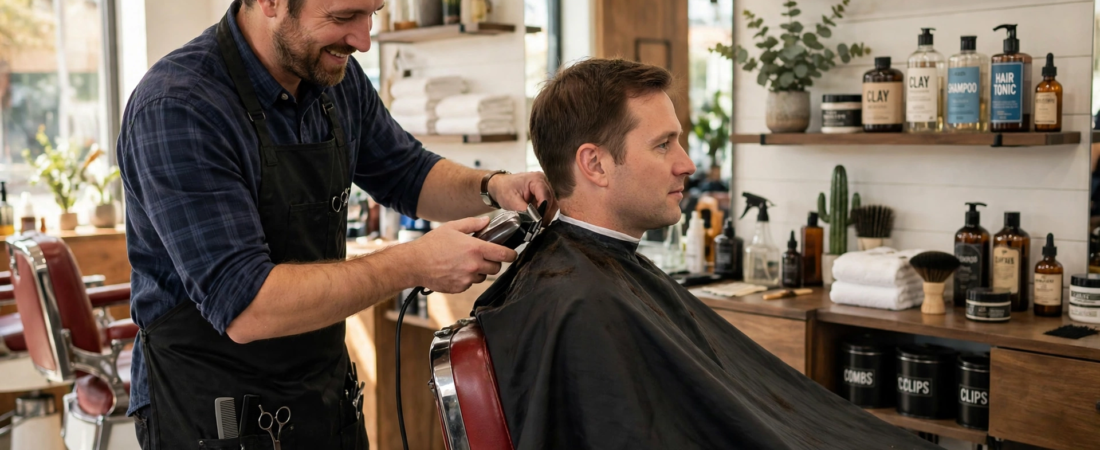
A new client walks in, sits in your chair, and says something you only half understand. Your hands know exactly what to do — but the words? They get stuck. If you cut hair in the US, that moment is familiar, and these English phrases for barbers are the fix: 80 real lines American barbers actually say, from the greeting at the door to the goodbye at the counter, ready to use word for word.
This guide follows one haircut from start to finish. You will get the exact words for greeting the client, asking what style they want, checking in during the cut, showing them the mirror, taking payment, and booking the next visit. There is a short role-play you can practice out loud, a list of mistakes to avoid, and a quick quiz at the end. Everything is written in plain, natural American English — the kind clients hear every day in a real barbershop.
1. Greeting and seating the client (phrases 1–10)
First impressions happen in about ten seconds. A warm greeting relaxes the client, and a clear question about their appointment keeps the line moving.
- 1. “Hi, welcome in!” — the simplest, friendliest way to greet anyone who walks through the door.
- 2. “Do you have an appointment today?” — ask this before anything else when the shop is busy.
- 3. “What’s the name on the appointment?” — the polite way to find their booking.
- 4. “Come on in and have a seat.” — use it when the waiting area is open and their chair is not ready yet.
- 5. “I’ll be right with you — just give me a minute.” — perfect when you are finishing another client.
- 6. “Would you like some water while you wait?” — a small kindness clients remember.
- 7. “You can hang your jacket right here.” — point to the hook as you say it.
- 8. “Have a seat in the chair, please.” — the line that starts the haircut.
- 9. “How’s your day going?” — easy small talk while you put on the cape.
- 10. “Is this your first time with us?” — if the answer is yes, slow down and explain a little more as you go.
Notice how short these lines are. Nobody in a barbershop talks in long sentences. Short, warm, and clear beats long and fancy every single time.
2. Consultation — what style do you want? (phrases 11–25)
The consultation is the most important two minutes of the whole haircut. Get this part right and everything after it is easy. Get it wrong and you spend twenty minutes fixing a cut the client never wanted.
- 11. “What are we doing today?” — the classic opening question. Every American barber uses it.
- 12. “How would you like your hair cut?” — a little more formal, good for a first-time client.
- 13. “Do you have a photo of the style you want?” — photos save more haircuts than any question does.
- 14. “How short do you want it on the sides?” — the sides are where most misunderstandings happen, so ask first.
- 15. “Do you want a fade or a taper?” — a fade blends down to the skin; a taper stays a little longer. Clients often mix them up, so ask.
- 16. “How much do you want off the top?” — pair it with your fingers showing the length.
- 17. “Do you want to keep the top longer?” — useful when the client wants a big change on the sides but not on top.
- 18. “Would you like a buzz cut today?” — one length all over with the clippers. Confirm before you start.
- 19. “Do you want the back tapered or squared off?” — a small detail that makes a big difference to how the cut looks.
- 20. “How do you usually style your hair?” — the answer tells you how much length to leave.
- 21. “Do you part it on the left or the right?” — cut with the part, not against it.
- 22. “Anything you don’t want me to touch?” — clients with a favorite spot will love this question.
- 23. “Let me know if you have any sensitive spots.” — kind, professional, and it prevents a flinch mid-cut.
- 24. “So, short on the sides and longer on top — sound good?” — repeat the plan back before you pick up the clippers.
- 25. “Just a trim, or a whole new style?” — “just a trim” means a little off, nothing dramatic. Never guess which one they mean.
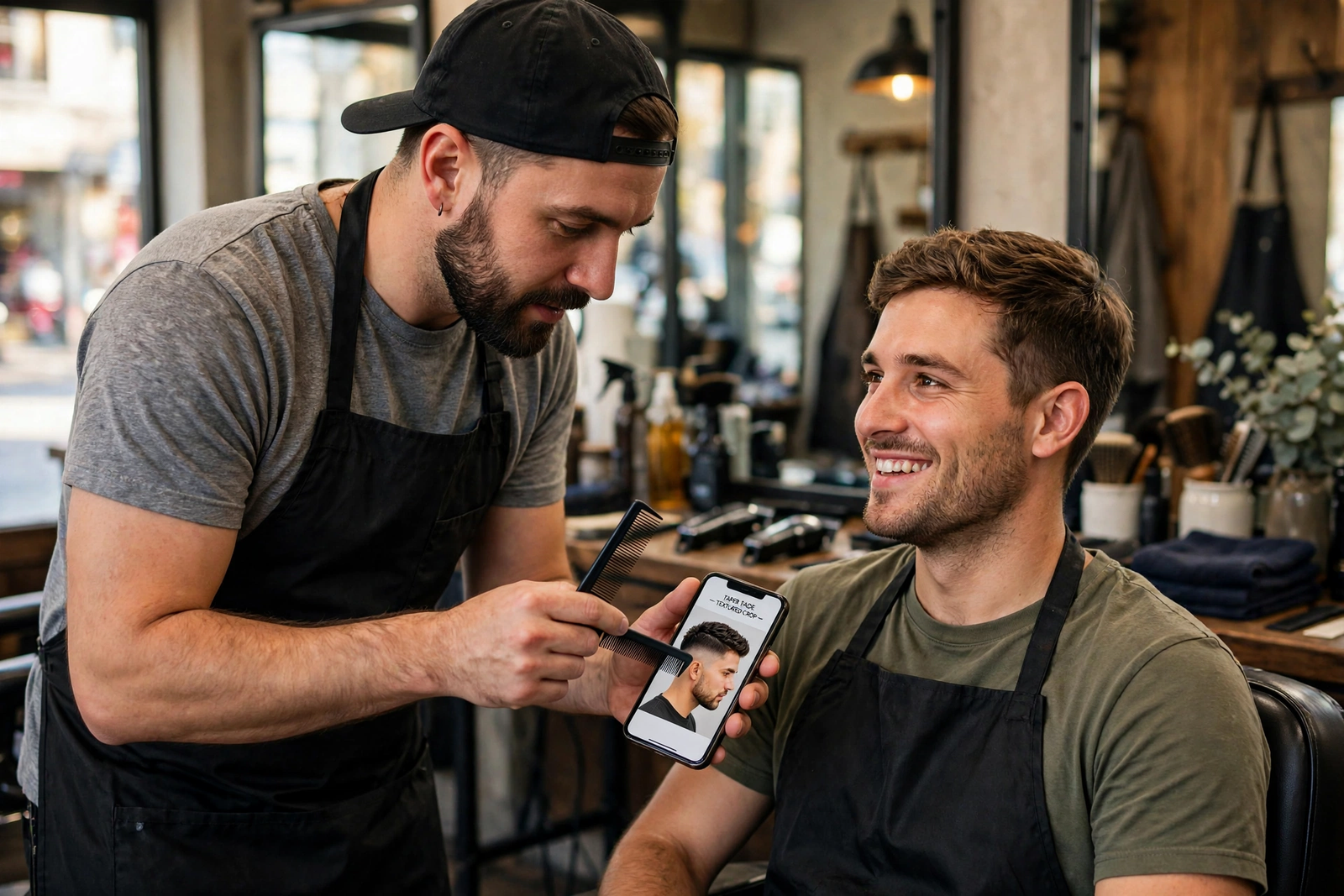
That last question matters more than it looks. “Just a trim” is one of the most common things a client says, and it means something very specific: take a little off, keep the style the same. If you hear it, repeat it back — “Just a trim, got it” — so the client knows you heard them.
Listen to that clip and pay attention to the rhythm. The barber asks, the client answers, the barber repeats the plan back. That repeat-back step is what separates a good consultation from a guessing game. “Short on the sides, longer on top” takes three seconds to say and can save a whole haircut.
3. During the cut — English phrases for barbers in action (phrases 26–50)
This is the longest part of the visit, and it is where your English does the quiet work: keeping the client comfortable, checking the length, and warning them before anything surprising happens.
- 26. “I’m going to start with a number two guard on the sides.” — a clipper guard number tells the client exactly how short the sides will be.
- 27. “Tell me if the clippers feel too hot.” — clippers warm up fast. This line shows you care.
- 28. “I’m going to blend the sides into the top now.” — “blend” means making the short and long parts flow together with no hard line.
- 29. “How does that length look so far?” — check early, while you can still change it.
- 30. “I’m going to take a little off the top.” — say it before you cut, not after.
- 31. “Keep your head still for me, just for a second.” — gentle and clear, much better than “don’t move.”
- 32. “Could you tilt your head down a little?” — for the back and the neckline.
- 33. “Look straight ahead for me, please.” — for evening out the front and the sides.
- 34. “I’m going to clean up the neckline.” — the hair at the very back of the neck.
- 35. “Do you want the sideburns the same length?” — sideburns are the strips of hair in front of the ears.
- 36. “I’m going to line up your hairline — nice and sharp.” — a “lineup” means straight, clean edges on the forehead and temples.
- 37. “Let me trim around your ears.” — say it before the clippers go near an ear, so nobody flinches.
- 38. “I’m using the scissors for the top now.” — clients like knowing when you switch tools.
- 39. “Do you want some layers in the top?” — layers mean shorter pieces on top of longer ones, for texture and movement.
- 40. “I’m going to thin it out a little so it lies flat.” — for thick hair that puffs up.
- 41. “How short do you want it on the back?” — ask again here; the back is the part the client cannot see.
- 42. “I’m going to use a hot towel on the back of your neck.” — a warm towel feels great, but warn them first.
- 43. “Let me know if you want it shorter — I can always take more off.” — the golden rule of cutting hair.
- 44. “I can’t put it back on, so let’s go a little at a time.” — say it with a smile. Clients laugh, and they also trust you more.
- 45. “We’re about halfway there.” — a quick update keeps the client relaxed.
- 46. “The fade is looking clean.” — a little confidence is reassuring. Clients want to hear that it looks good.
- 47. “I’m just evening out this side.” — explains a pause without any awkward silence.
- 48. “Do you want the beard trimmed too?” — many clients forget to ask until you offer.
- 49. “I’m going to shape up the beard and blend it into the hair.” — blending the beard into the haircut is what makes the whole look come together.
- 50. “Almost done — just a few finishing touches.” — the client can relax now; the hard part is over.
That clip is worth shadowing — say each line a half-second after you hear it. The two lines to memorize first are number 29 and number 43: “How does that length look so far?” and “Let me know if you want it shorter.” Those two questions prevent almost every “too short” complaint in a barbershop.
4. Finishing, styling, and the mirror check (phrases 51–60)
The mirror moment is the client’s verdict on your work. Slow down here. Let them look. And ask what they think before you take the cape off.
- 51. “Let me show you the back with the mirror.” — hold the hand mirror up behind them while they face the big mirror.
- 52. “How does that look?” — then wait. Give them a real moment to answer.
- 53. “Would you like it a little shorter anywhere?” — better to ask now than to hear about it tomorrow.
- 54. “I’m going to add a little pomade for hold.” — pomade is a styling product that keeps hair in place.
- 55. “Do you want a matte finish or a little shine?” — matte means no shine; some clients love it, some hate it. Ask.
- 56. “Let me blow-dry it so you can see the shape.” — a quick blow-dry shows the real shape of the cut.
- 57. “Would you like some styling cream today?” — a softer option than pomade, good for a natural look.
- 58. “Here’s how to style it at home — just a little product on damp hair.” — a one-sentence lesson the client will actually remember.
- 59. “That hot towel shave is finished — how does your skin feel?” — a hot towel shave is a close shave with warm towels, a classic barbershop service.
- 60. “You’re all set. Take a look in the mirror.” — the closing line of the cut itself. Say it like you mean it.
A note on number 58: teaching the client one styling trick is also the best sales line in the shop, because it leads naturally to the product shelf. No pressure, no speech — just one useful tip.
5. Payment, tip, and products (phrases 61–70)
Money talk feels awkward in any language, so keep these lines short and matter-of-fact. State the price, offer the options, and let the client choose. Describe what you say and what you charge — never promise anything about refunds or guarantees, since those are the shop’s policies, not yours to make up on the spot.
- 61. “That’ll be thirty-five dollars.” — state the price plainly and smile. (Use your shop’s real price, of course.)
- 62. “You can pay by card or cash — whichever you prefer.” — giving the choice makes paying feel easy.
- 63. “Would you like to add a tip on the card?” — the standard American way to ask. Never demand a tip; just offer the option.
- 64. “Would you like a receipt?” — some clients need one for work. Ask every time.
- 65. “We have a pomade that works well for your hair type.” — recommend from what you saw in the chair, not from a script.
- 66. “You can take a bottle home today if you’d like.” — “if you’d like” keeps it an offer, not a push.
- 67. “This shampoo is good for dry hair — want to try it?” — one product, one reason, one question.
- 68. “The pomade is twenty dollars, if you’d like one.” — always name the price before they decide.
- 69. “No rush — take your time at the counter.” — clients fumbling for a wallet appreciate this more than you would think.
- 70. “Your change is five dollars. Thanks so much.” — count the change out loud so there is never a mix-up.
Role-play: the full haircut in one conversation
Reading lists is one thing. Saying the words out loud is what makes them come out smoothly when a real client is in your chair. Read this dialogue with a friend, a family member, or by yourself, switching voices. Then listen to the clip and shadow it.
Barber: Hi, welcome in. Do you have an appointment, or are you walking in today? Client: I have an appointment at two o’clock, under James. Barber: Perfect, James. Come on over and have a seat. What are we doing today? Client: Just a trim on top, and a fade on the sides, please. Barber: How short on the sides? A number two guard, or shorter? Client: A number two is good. And keep the top a little longer, please. Barber: Got it. Short on the sides, longer on top. I’ll take a little off the top and blend it in. Sound good? Client: Sounds perfect. Thank you.
Short, right? That is the point. The whole consultation is eight lines, and every line is one you have already seen in the lists above. Practice it three times before your next shift and the words will be there when you need them — no thinking, no translating in your head, just the lines.

6. Goodbye and rebooking (phrases 71–80)
The last thirty seconds decide whether the client comes back. A warm goodbye plus one easy question about the next visit is all it takes.
- 71. “Would you like to book your next appointment today?” — the single most valuable sentence in this whole guide.
- 72. “How about the same time next month?” — give them a concrete option instead of an open question.
- 73. “We have an opening on Saturday morning, if that works.” — name the slot; clients decide faster that way.
- 74. “I’ll put you down for the second Tuesday of next month.” — repeat the date back so you both agree.
- 75. “If you need to change it, just give us a call.” — removes the fear of committing to a date.
- 76. “Thanks for coming in today.” — simple, warm, and always right.
- 77. “Have a great day — see you next time!” — the classic American goodbye. Use it every time.
- 78. “Your hair will grow out nicely with this cut — about four weeks.” — a gentle hint about when to return, without pressure.
- 79. “Tell your friends — walk-ins are always welcome.” — if your shop takes walk-ins, say so.
- 80. “Take care, and enjoy the new look!” — end on the haircut, not on the payment. That is what they will remember.
Common mistakes (and what to say instead)
A few habits make barbershop English harder than it needs to be. Check yourself against this list.
Mistake 1: “Do you want cut hair?” This is the most common mistake, and it comes straight from translating word by word. The natural version is: “Would you like a haircut?” — or, once they are in the chair, “What are we doing today?”
Mistake 2: “How do you want to cut?” The client is not cutting anything — you are. Say “How would you like your hair cut?” or simply “How short?” with your fingers showing the length.
Mistake 3: “Sit down, don’t move.” It sounds like an order, and orders make clients tense. Use “Have a seat in the chair, please” and “Keep your head still for me, just for a second.” The word “please” and the softener “just for a second” change everything.
Mistake 4: Cutting first and asking later. “I took a lot off the top — is that okay?” is too late. Ask before the scissors move: “How much do you want off the top?” Then repeat the plan back: “Short on the sides and longer on top — sound good?”
Mistake 5: Forgetting the goodbye. A client who leaves without a warm goodbye is a client who might not return. “Thanks for coming in — see you next time!” costs two seconds and earns the next appointment.
Mistake 6: Saying “okay” to everything. “Okay” is fine, but it tells the client nothing. Repeat the key detail back instead: “A number two on the sides, got it.” The client hears that you listened — and you double-check yourself at the same time.
Your 10 must-know lines
If these English phrases for barbers feel like a lot, start with these ten. They cover almost every haircut you will ever do.
| When | Say this |
|---|---|
| Greeting | “Hi, welcome in!” |
| Appointment | “Do you have an appointment today?” |
| Consultation | “What are we doing today?” |
| Length | “How short do you want it on the sides?” |
| Agreement | “Short on the sides and longer on top — sound good?” |
| During the cut | “How does that length look so far?” |
| Mirror check | “Let me show you the back with the mirror.” |
| Styling | “Would you like some styling cream today?” |
| Payment | “You can pay by card or cash — whichever you prefer.” |
| Rebooking | “Would you like to book your next appointment today?” |
Send this table to a friend who cuts hair, or print it and keep it near your station for the first week. Ten lines, practiced out loud every morning, will carry you through most of your day.
Key phrases to memorize
- “Just a trim on top, please.” — the client’s line, and the one you will hear most.
- “How short on the sides?” — the question that prevents the biggest mistakes.
- “Take a little off the top.” — slow, careful, and exactly what a good cut feels like.
- “Let me show you the back with the mirror.” — the line that ends every haircut well.
- “Would you like to book your next appointment today?” — the line that fills next month’s calendar.
Say all five out loud right now. Then say them again tomorrow morning before your first client. Five sentences, two minutes of practice, and your next haircut will already feel easier.
Quick Quiz
Try these five questions now. Click an answer to see right away if you are correct. Keep an eye on your score at the top.
Score: 0/5
1. A client says “just a trim.” What do they want?
2. The barber asks, “How short on the sides?” What is he asking about?
3. What does “blend the sides into the top” mean?
4. Which sentence is correct, natural English?
5. A happy client is leaving. Which line helps bring them back?
Frequently asked questions
What is the difference between a fade and a taper? A fade blends the hair down very short, often to the skin, with a smooth gradient. A taper is a gentler, more gradual shortening that stays a little longer. If a client says one word and means the other, your follow-up question — “How short on the sides?” — will catch it.
What does “just a trim” really mean? It means take a little off the ends and keep the same style. If a client says it, repeat it back — “Just a trim, got it” — and cut less than you think. You can always take more off; you cannot put it back on.
How do I ask about the price without sounding awkward? State it plainly and move on: “That’ll be thirty-five dollars. You can pay by card or cash.” Short and matter-of-fact is polite. Never promise anything about refunds or guarantees — those are the shop’s policies.
What should I say if I do not understand the client? Be honest and friendly: “Sorry, could you say that again a little slower?” or “Could you show me a photo?” Clients respect that far more than a nervous smile and a guessed haircut.
How can I practice these phrases? Read the role-play out loud three times, then listen to the audio clips and shadow them. Practicing with your voice, not just your eyes, is what makes the sentences come out smoothly when a real client is sitting in your chair.
Keep going
These 80 English phrases for barbers sound like a lot, but you do not need all eighty tomorrow. Start with the ten must-know lines, practice the role-play once before your next shift, and add a few new phrases each week. In a month, the whole haircut — greeting, consultation, cut, mirror check, payment, goodbye — will feel like a conversation instead of a test.
When you are ready for the next work situation, our English for Work lessons have more on-the-job dialogues. These two posts pair well with this one: 100 English phrases for nail technicians working in the US and 50 English phrases for Uber and Grab drivers, from pickup to drop-off.
Which phrase will you use first? Tell us in the comments — and if you work in a barbershop, share the one client line that always makes you smile. Your story might be the exact practice another barber needs tonight.