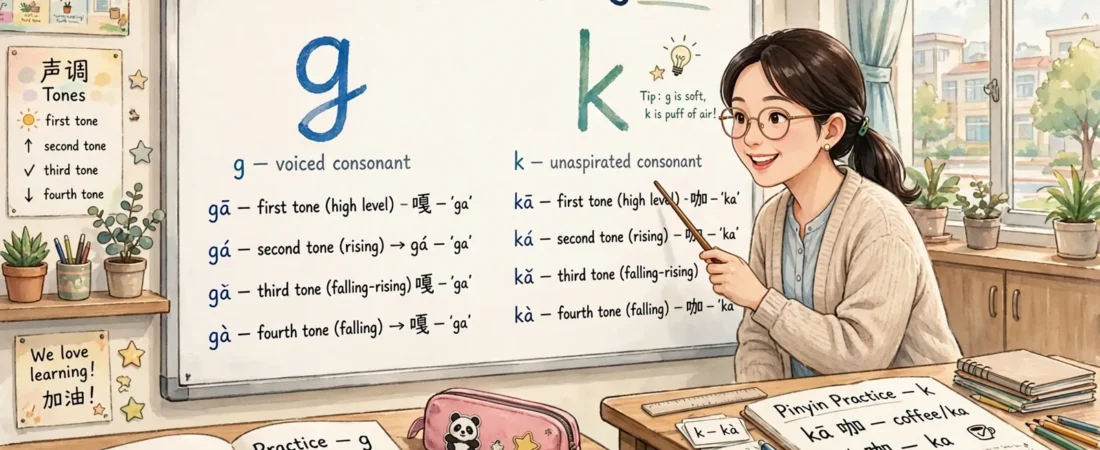
You read 高 as gāo and 考 as kǎo — they sound the same to you, yet Chinese speakers still frown. The problem is not the tone; it is one tiny puff of air right at the start of the sound. Get that puff of air right, and you will tell g and k apart in Pinyin starting today, and never confuse 哥哥 (older brother) with 可以 (can, may) again.
This article explains exactly one thing: where g and k differ, what they sound like, and how to practise until your ears and your mouth get used to them. There is an example table with Hanzi and pinyin, audio so you can listen to each sound pair, and 5 short exercises you can do right away. The article is for beginners, at HSK 1–2 level under the current HSK 2.0 standard (the HSK 3.0 standard applies to exams from 13/12/2026) — finish it and you can put what you learn to use in everyday conversation straight away.
g and k: same place, different puff of air
Both sounds are born in the same place: the back of the tongue touches the soft palate, then releases. The only difference is the puff of air. Say g and no strong stream of air bursts out — the sound is short and dry. Say k and a strong stream of air puffs out the moment the tongue leaves the palate. That is why g is called an unaspirated sound and k an aspirated one.
Here is a Vietnamese example to make it easy to picture: the sound g in Chinese is quite close to the “c” in “cơm” — say it lightly, with no puff of air. The sound k in Chinese is like the “c” but with a strong puff of air pushed out, close to how you say “kh”, except it is a plosive, not a fricative. The Vietnamese “g” (as in “gà”), on the other hand, is a voiced fricative — pronounce the Chinese g that way and it is wrong right away; it will sound like a completely different sound.
Have a listen to the word pairs below, and pay attention to the puff of air at the start of each sound:
Example table: 10 g–k pairs — hear them once and remember them
Read each pair aloud, slowly, and feel the puff of air at the start of the sound. Every pair is a real word, used every day.
| Hanzi | Pinyin (g) | Meaning | Hanzi | Pinyin (k) | Meaning |
|---|---|---|---|---|---|
|
高

|
gāo | tall, high |
考

|
kǎo | exam, test |
|
哥哥

|
gēge | older brother |
可以

|
kěyǐ | can, may |
|
狗

|
gǒu | dog |
口

|
kǒu | mouth |
|
工作

|
gōngzuò | work, job |
口渴

|
kǒukě | thirsty |
|
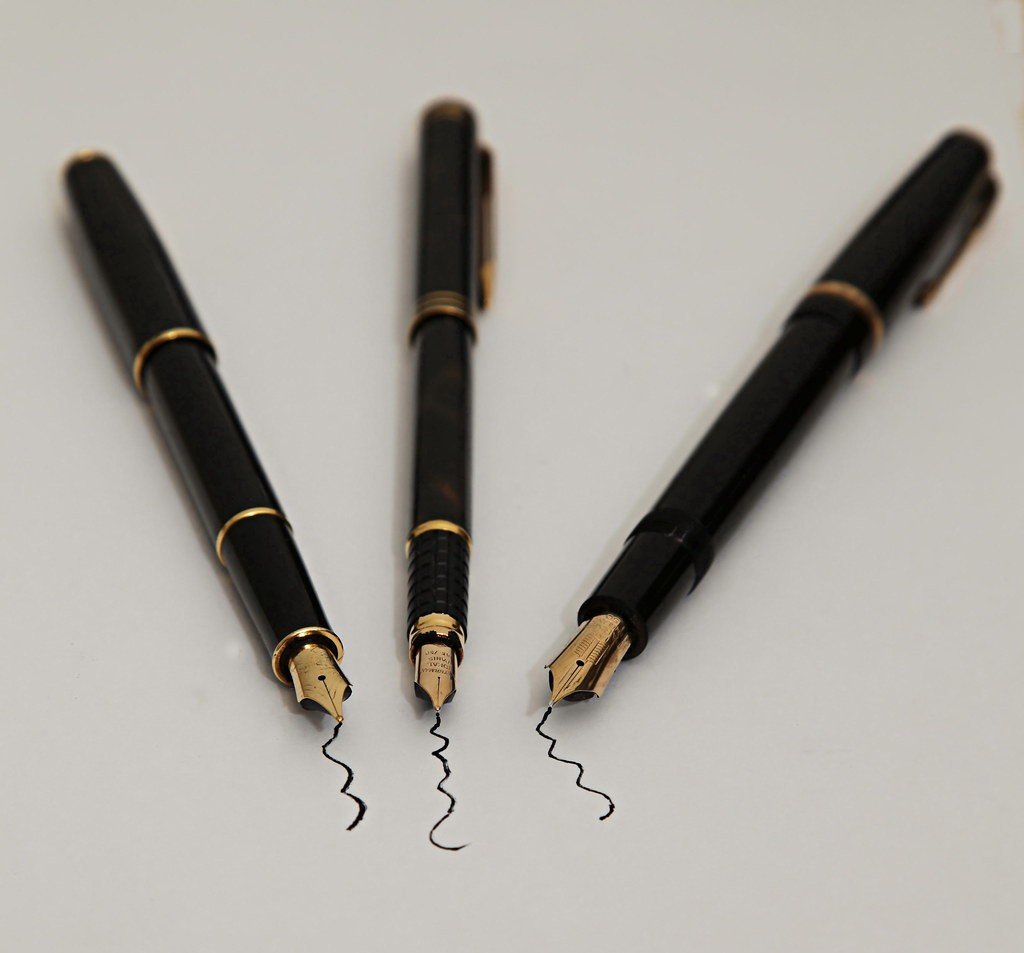
钢笔
|
gāngbǐ | fountain pen |
看

|
kàn | to look, to see |
Look at the pair 高 – 考: they differ only in the puff of air at the start, yet the meaning changes completely, from “tall” to “exam”. Mix them up inside a sentence and listeners can usually still guess from context — but in an HSK listening test there is no context to save you: mishear one sound and you lose a whole question.
Have a listen: words starting with g
All four words start with g; said aloud they sound short and dry, with no air puffing out. Listen, then read along — three times for each word:
- 哥哥很高兴。 (Gēge hěn gāoxìng.) — Older brother is very happy.
- 狗在公园里。 (Gǒu zài gōngyuán lǐ.) — The dog is in the park.
- 工作很忙。 (Gōngzuò hěn máng.) — Work is very busy.
- 钢笔在桌子上。 (Gāngbǐ zài zhuōzi shàng.) — The fountain pen is on the table.
Have a listen: words starting with k
All four words start with k — hold your hand in front of your mouth as you say them, and you will clearly feel the air puff into your palm:
- 可以吗? (Kěyǐ ma?) — May I? / Is that OK?
- 口渴了。 (Kǒukě le.) — Thirsty now.
- 看书。 (Kànshū.) — Reading a book.
- 考试很难。 (Kǎoshì hěn nán.) — The exam is very hard.

The paper test: how to check yourself in 10 seconds
This is the trick pronunciation teachers use most, and you can do it yourself at home: tear a small piece of thin paper, hold it in front of your mouth, about 5 cm from your lips. Say gā — the paper barely moves. Say kā — the paper clearly flies up. If the paper flies up when you say g, you are puffing out too much air and nearly turning it into k. If the paper stays still when you say k, you are not puffing out enough air, and it will sound like g.
Do this test every time you practise — it takes just 10 seconds. When your hand can feel the difference without you looking at the paper, your mouth has remembered it. Then move on to listening practice: ask a study partner to read a word from the table while you close your eyes and guess whether it is g or k. Get 8 out of 10 right and your ears can tell them apart.
3 mistakes Vietnamese learners make most with g and k
Reading g like the “g” in “gà”. This is the most common mistake. The Vietnamese “g” is a fricative — the throat vibrates, and it sounds soft and drawn out. The Chinese g is an unaspirated plosive, short and crisp like the “c” in “cơm”. Fix it like this: first read 高 (gāo) as “cao”, then add the tone on top.
Reading k like the “kh” in “không”. The Vietnamese “kh” is a fricative — the air squeezes through a narrow gap and sounds hissy. The Chinese k is an aspirated plosive — the tongue blocks the air, then releases it in one strong puff. Read 看 (kàn) as the Vietnamese-style “khàn” and Chinese listeners will still understand you, but they will spot the foreign accent right away. Fix it like this: read “càn” with one strong puff of air at the start.
Getting single sounds right but wrong in long sentences. Say gāo and kǎo on their own and they are spot on, but inside a long sentence the breath goes haywire — g turns into k and k turns into g. The reason is that you read the sentence too fast, with no time to prepare the breath for each sound. Fix it like this: slow the sentence down to half speed, and emphasise the puff of air at the start of every word with g or k.
5 short exercises: do them and it sticks
Exercise 1 — Listen and choose. Play the word-pair audio above, listen to one word, and write down on paper whether it is g or k. Do 10 rounds — getting 8 or more right means you pass.
Exercise 2 — Read along with the table. Read the whole table of 10 pairs aloud, 3 times per pair, with your hand in front of your mouth to feel the air. Pay special attention to the pair 哥哥 – 可以, because these two words appear most in everyday conversation.
Exercise 3 — The paper test. Do the paper test with 4 sounds: gā, kā, gē, kē. Note down the result: which sounds make the paper fly, and which leave it still.
Exercise 4 — Read the sentences. Read the 3 sentences below aloud 3 times, slowly, emphasising the puff of air on the first sound:
- 我哥哥今天很高兴。(Wǒ gēge jīntiān hěn gāoxìng.) — My older brother is very happy today.
- 他可以看书,可是口渴了。(Tā kěyǐ kànshū, kěshì kǒukě le.) — He can read a book, but he has got thirsty.
- 工作很多,考试也很难。(Gōngzuò hěn duō, kǎoshì yě hěn nán.) — There is a lot of work, and the exam is very hard too.
Exercise 5 — Record yourself. Record yourself reading the 3 sentences above, listen back, and compare with the sample audio. Wherever a sound comes out like g when you meant k (or the other way round), read that word on its own 5 more times.
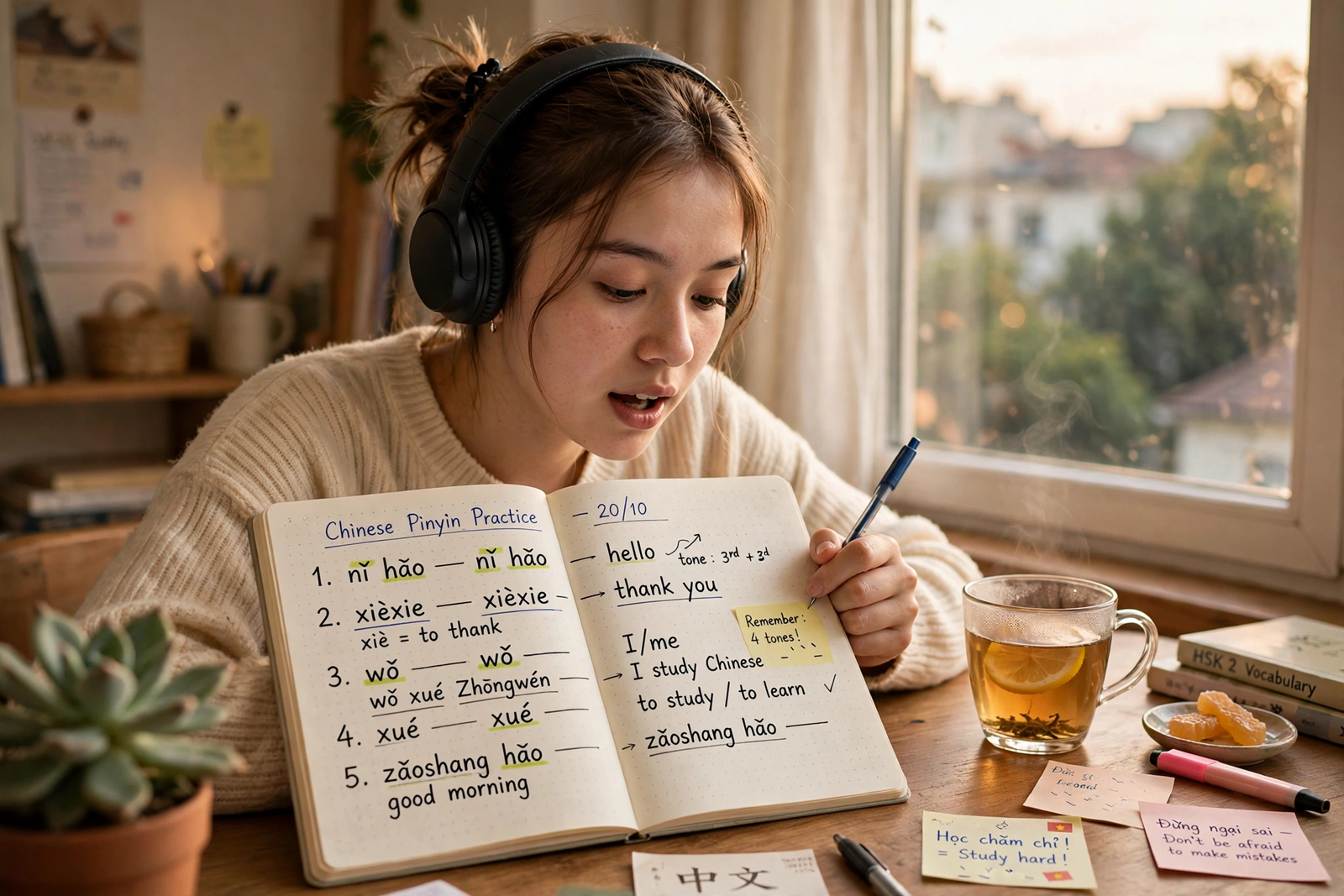
Want more practice: combine the sounds with the Pinyin chart
Once you can tell g and k apart, the next step is to combine them with all the finals: ga, ge, gu, gua, guan, ka, ke, ku, kua, kuan… Each combination makes a different syllable, and hearing all 4 tones of each syllable is the fastest way for your ears to get used to this whole sound family. You can combine them yourself and have a listen on LingoBubbo’s Pinyin combination chart with audio — choose the initial g or k, combine it with any final, and tap each tone to hear it. Practise 10 minutes a day with this chart, and within a week you will no longer mix up g and k by ear.
Quick quiz: can your ears tell g and k apart yet?
Tap the answer you choose — you will know right away whether it is right or wrong.
Your score: 0/5 — tap an answer to check right away.
Question 1. How do g and k in Pinyin differ?
Question 2. Which word below starts with the k sound?
Question 3. In the paper test, when you say the k sound, what happens to the paper in front of your mouth?
Question 4. What does 高 (gāo) mean?
Question 5. Which sound do Vietnamese learners often mispronounce the Chinese g as?
Frequently asked questions about telling g and k apart in Pinyin
If I mix up g and k by ear, will Chinese speakers still understand me? In everyday conversation, most of the time they will still understand thanks to context — say "wǒ gēge" or "wǒ kěyǐ" and listeners guess from the sentence. But in an HSK listening exam, each sound is a different answer, and mishearing one really costs you marks.
How long does it take to be able to tell g and k apart? If you practise 10 minutes a day with the paper test and the pair table, most beginners hear 8 out of 10 correctly after about a week. Your ears get used to it first, your mouth follows — do not get impatient if your speaking is not yet as accurate as your listening.
Are g and k like the b/p pair? They are alike in principle: b and p are also an unaspirated – aspirated pair, exactly like g and k. Grasp the aspiration principle once, and you can tell both pairs apart — the d/t pair included, later on.
Once I have finished g and k, what should I learn next? Move on to the d and t pair, then to j, q and x. Every pair shares the same aspiration principle, so each new one comes faster. You can review the pronunciation foundations in the article Pinyin for beginners: the 4 Chinese tones packed into 10 minutes and the article Telling b and p apart in Pinyin with aspiration exercises — the same way of practising, just a different sound pair.
Telling g and k apart in Pinyin really comes down to one puff of air: g has no puff, k has a strong one. Remember the paper test, work through the 5 short exercises in this article, and listen to the pair audio once a day. In a week's time, close your eyes and listen to the audio at the top of the article again — can your ears spot straight away which words are g and which are k? Tell me how it goes in the comments, and send this article to a study buddy who still mixes up 哥哥 and 可以. If you want to keep learning along the roadmap, start from LingoBubbo's Chinese page — every lesson there already comes with vocabulary, audio and a quiz. And if you want to combine g and k with all the finals and hear all 4 tones, drop by the Pinyin combination chart with audio — a free tool you can practise with for as long as you like.
📷 Photo credits: real photos from the open photo libraries Openverse / Wikimedia Commons / Flickr (CC0, CC BY, CC BY-SA licences) — one real-life photo for each word, no AI illustrations. Stroke-order animation: Make Me a Hanzi data (HanziWriter).