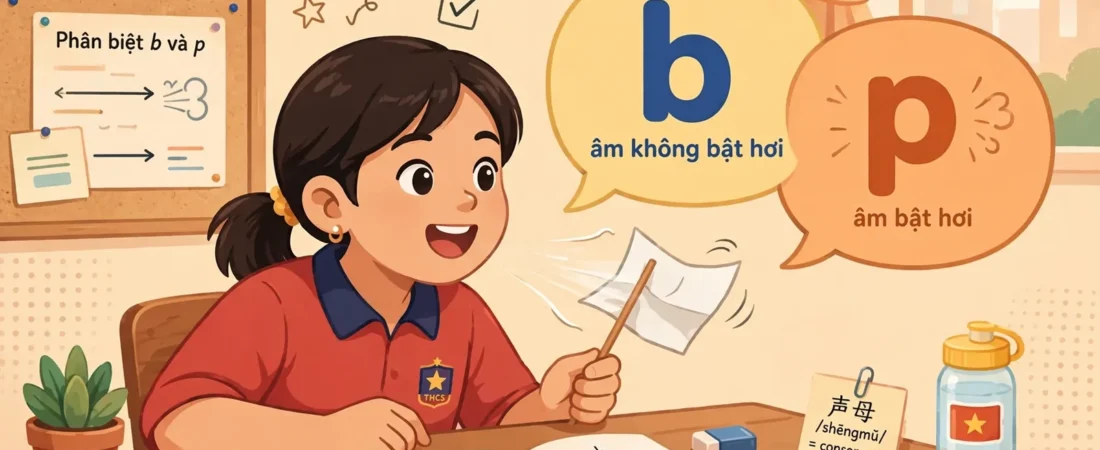
You say 包子 (bāozi — steamed bun), but your Chinese listener hears “pāozi” and stares at you blankly? Or you read 漂亮 (piàoliang — beautiful) and it somehow comes out as “biàoliang”? If so, you’re far from alone. The b and p pair in Pinyin is the pronunciation trap that almost every Vietnamese person starting Chinese falls into at least once — and the good news is that you only need to understand one single concept, “aspiration”, to untangle the whole pair.
This article does just one thing: it helps you tell b and p apart in Pinyin through aspiration exercises, hear the difference with your own ears, and say them correctly from today. No long-winded theory — only exercises you can do straight away at your desk.
Why do Vietnamese speakers keep mixing up b and p in Pinyin?
The reason is that Vietnamese and Chinese divide the b and p sounds in two different ways. In Vietnamese, the letter “b” (as in “bánh”) is a voiced sound, while the letter “p” (as in “pin”) comes with almost no strong aspiration. Vietnamese ears are used to telling “b” and “p” apart by how much they vibrate, not by the flow of air.
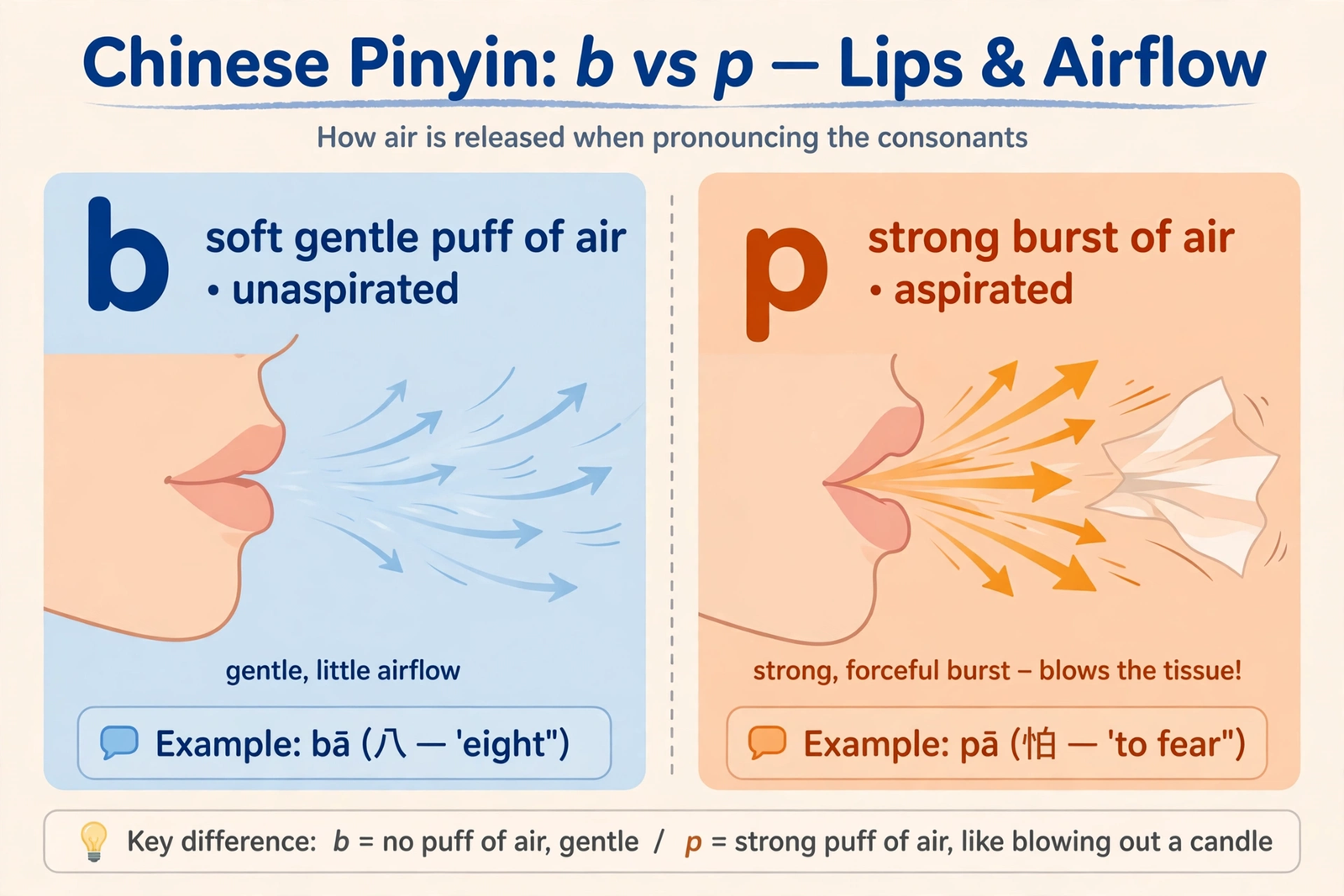
Chinese is exactly the opposite. Both b and p in Pinyin are unvoiced sounds — your vocal cords don’t vibrate when you say either of them. The one and only difference is the airstream: b is an unaspirated sound, and p is a strongly aspirated one. In other words, Chinese speakers tell b and p apart by “wind or no wind”, while Vietnamese speakers are used to telling them apart by “vibration or no vibration”. Carry the old habit across and you’ll say p as b — or, worse, say p as “ph” just to be safe — and both are wrong.
One more very common mistake: reading p like the letters “ph” in Vietnamese. Read 怕 (pà — afraid) as “phà” and your listener won’t understand a thing, because Chinese has no “ph” sound of that kind in this position. Keep this firmly in mind: p in Pinyin is still a “p” sound — it’s simply aspirated more strongly than b.
Aspiration exercises: feel the difference with your hands and eyes
Before training your mouth, train your ears and hands first. The three exercises below take only five minutes, but they work better than an hour of sitting and reading theory.
Exercise 1 — the tissue paper. Tear off a small piece of tissue paper and hold it about 5 cm in front of your mouth. Say “bā” — the paper stays almost completely still. Say “pā” — the paper flies forward. If the paper doesn’t budge when you say p, it means you’re not aspirating strongly enough yet. Repeat each sound 10 times, alternating bā — pā — bā — pā, until your eyes can see the difference clearly.
Exercise 2 — the palm of your hand. Hold your palm about 10 cm from your mouth. Say b: you feel only a light, warm breath wash over it. Say p: you feel a distinct puff of wind hit your hand, like blowing out a small candle. This exercise is handy because you can do it anywhere, even on the bus or in your lunch break.
Exercise 3 — the candle. Light a small candle and set it about 20 cm from your mouth. Say b: the flame only leans slightly. Say p: the flame sways hard, and may even go out if you aspirate well enough. Children especially love this exercise — turning pronunciation practice into a game is the best way I’ve found to keep them seated for longer.
A little tip: when you say b, imagine you’re whispering the letter “b” really softly — your lips close and open without pushing any air out. When you say p, imagine you’re blowing a speck of dust off the table — your lips close and open in exactly the same way; the only difference is the force of the air you push out.
Minimal pairs: hear them once, remember them for life
The fastest way to get your ear used to b and p is to practise pairs of words that differ in exactly this one sound. Read each pair slowly, do the tissue-paper exercise alongside, then listen to the model audio to check yourself.
- 八 (bā — eight) / 趴 (pā — to lie face down): 八个人 (bā gè rén — eight people) and 趴在桌子上 (pā zài zhuōzi shàng — lying face down on the table).
- 包 (bāo — to wrap, a bun) / 抛 (pāo — to throw, to toss): 包子 (bāozi — steamed bun) and 抛球 (pāo qiú — to throw a ball).
- 笔 (bǐ — a pen) / 匹 (pǐ — measure word for horses and cloth): 一支笔 (yì zhī bǐ — a pen) and 一匹马 (yì pǐ mǎ — a horse).
- 波 (bō — a wave) / 坡 (pō — a slope): 波浪 (bōlàng — waves) and 山坡 (shānpō — a hillside).
- 杯 (bēi — a cup) / 配 (pèi — to match, to pair with): 一杯水 (yì bēi shuǐ — a cup of water) and 配合 (pèihé — to coordinate, to work together).
- 不 (bù — not, no) / 铺 (pù — to spread out, a shop): 不是 (bú shì — is not) and 铺床 (pù chuáng — to make the bed).
Listen to the model sentences below and repeat after them. In sentences with lots of b, read with a light breath; in sentences with lots of p, remember to push the air out:
Listen to the standard pronunciation — a sentence full of b sounds: “bố bế em bé” (Dad holding the baby in his arms)
Listen to the standard pronunciation — a sentence full of p sounds: “bạn mập sợ chạy bộ” (The chubby friend is afraid of jogging)
Listen to the standard pronunciation — a sentence mixing b and p: “bố sợ mập nên chạy bộ mỗi ngày” (Dad is afraid of getting chubby, so he jogs every day)
Listen to the standard pronunciation — a sentence mixing b and p: “bánh bao ngon, bà mua rất nhiều bánh bao” (The steamed buns are tasty, so Grandma buys lots of steamed buns)
Listen carefully and you’ll hear it: in the all-b sentence, the reader’s voice is smooth and the breath even; in the all-p sentence, every sound pops out with a little burst of air. That is exactly the sign you need to copy.
Practise by level: from slow to native-speaker speed
Level 1 — single sounds. Read alternately bā — pā, bō — pō, bǐ — pǐ, ten times per pair, at a slow speed. Goal: the tissue paper reacts in two clearly different ways.
Level 2 — two-syllable words. Read the two-syllable words: 爸爸 (bàba — Dad), 宝宝 (bǎobao — baby), 包子 (bāozi — steamed bun), 胖胖 (pàngpang — chubby), 怕 (pà — afraid), 跑步 (pǎobù — to jog), 漂亮 (piàoliang — beautiful), 朋友 (péngyou — friends). Note: in two-syllable words the second syllable is usually read more lightly, but p’s aspiration still has to stay exactly the same.
Level 3 — short sentences. Read complete sentences at a moderate speed: 爸爸抱着宝宝,宝宝笑了。(Bàba bàozhe bǎobao, bǎobao xiào le. — Dad holds the baby in his arms, and the baby laughs.) 胖胖怕跑步,跑得很慢。(Pàngpang pà pǎobù, pǎo de hěn màn. — Pangpang is afraid of jogging and runs very slowly.)
Level 4 — tongue twisters. Once you’re solid, try the classic tongue twister: 八百标兵奔北坡,炮兵并排北边跑。(Bā bǎi biāo bīng bēn běi pō, pào bīng bìng pái běi biān pǎo. — Eight hundred crack soldiers charge up the north slope, while the artillery troops run side by side along the northern edge.) Read this sentence fluently at a normal speed, and you can count yourself graduated from the b–p pair.
Three common mistakes and how to fix each one in 30 seconds
Mistake 1: Saying p as “ph”. This is the mistake of learners who try to aspirate too hard, until the p turns into a fricative. The fix: press your lips firmly shut, then pop them open decisively — the air escapes in one short beat instead of dragging out into a “phờ”. Try saying “pa”, then shorten it step by step: “pa — p — pa”.
Mistake 2: Saying p as b. The opposite case: many learners are afraid of aspirating, so they read p as lightly as b. The fix: go back to the tissue-paper exercise. Until the paper flies, your p hasn’t made it yet.
Mistake 3: Right at a slow speed, wrong at a fast one. In a long sentence your mouth gets in a hurry, so the aspiration can’t keep up. The fix: slow the sentence down to half speed, stress the p sounds properly, then build the speed back up day by day. Don’t jump from slow to fast in a single session — your mouth muscles need time to form the habit.
Summary table: where do b and p differ?
| Feature | b | p |
|---|---|---|
| Aspiration | Unaspirated | Strongly aspirated |
| Tissue paper in front of your mouth | Stays almost still | Flies forward |
| Example | 八 bā, 包 bāo, 笔 bǐ | 趴 pā, 抛 pāo, 匹 pǐ |
| Mistake Vietnamese learners often make | Reading it voiced, like the Vietnamese “b” | Reading it as “ph”, or as b |
| Quick check | The paper doesn’t move | The paper clearly flies |
Quick Quiz
Choose the correct answer for each question — click an answer to see the result straight away:
Your score: 0/5 — click an answer to check it right away.
Question 1. What is the one and only difference between b and p in Pinyin?
Question 2. How is 包子 read?
Question 3. In the tissue-paper exercise, which sound makes the paper fly forward?
Question 4. How is 漂亮 (beautiful) read?
Question 5. You read p as “ph” — which mistake is that, and how do you fix it?
Frequently asked questions about telling b and p apart in Pinyin
How long does it take to learn to tell b and p apart? Most learners get it right after two or three practice sessions with the tissue-paper exercise. The hard part isn't understanding it — it's turning it into a reflex when you speak quickly, and that takes about two weeks of practising short sentences for ten minutes a day.
Can Chinese listeners hear it when I mix up b and p? Yes, and it sometimes causes genuine misunderstandings: 八 (bā — eight) and 趴 (pā — to lie face down) mean completely different things. But don't be afraid of saying it wrong — listeners can usually work it out from the context, and you'll fix it bit by bit.
Should I learn the other aspirated pairs too, like d/t and g/k? Very much so, because the principle is exactly the same: d is unaspirated and t aspirated; g is unaspirated and k aspirated. Once you've finished b/p, just apply the same tissue-paper exercise to the other two pairs and you're done.
Are you mixing up b and p on any other words? Try the tissue-paper exercise tonight and tell me how it went in the comments — and if this article helped you untangle one tricky pair of sounds, send it to a friend who's also learning Chinese; maybe they're saying "pāozi" too without realising it. Want to put the whole of Pinyin in order from the very beginning? Pop over to LingoBubbo's Pinyin chart to keep practising.