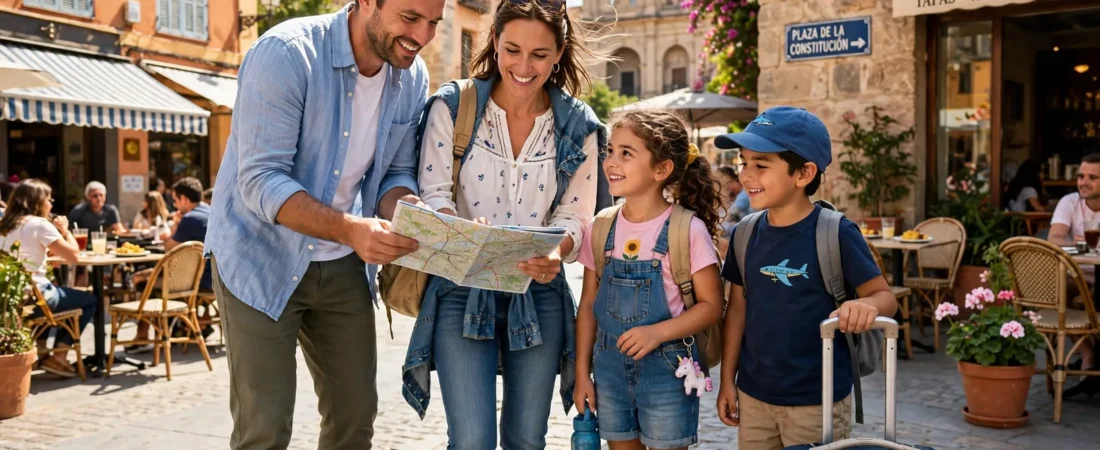
Picture this: you land in Madrid with two tired children, a suitcase with a broken wheel, and a taxi driver asking you something you do not understand. You know hola. You know gracias. And right now, neither one is getting you to your hotel. This is the gap these 30 Spanish travel phrases for families are built to close — the real sentences parents actually need, grouped by the moment you need them, with plain English translations. Learn them before you fly, and the trip gets noticeably easier.
A quick note on how to use this list. You do not need to memorise all 30. Pick five from each group that fit your trip — the airport six if you are flying, the hotel six if you are staying somewhere new — and practise them out loud with your children. Kids love being the family translator, and a child who can order their own drink in Spanish will remember that holiday forever. One more tip: in Spain, people say vosotros and use the vosotros verb forms for “you all”; in most of Latin America, ustedes is used instead. The phrases below use usted forms, which are polite everywhere — nobody has ever been offended by being addressed politely.
Your 30 Spanish travel phrases for families
At the airport
| Spanish | English |
|---|---|
| ¿Dónde está la puerta de embarque? | Where is the boarding gate? |
| Tengo una maleta para facturar. | I have a suitcase to check in. |
| ¿El vuelo tiene retraso? | Is the flight delayed? |
| ¿Dónde recojo el equipaje? | Where do I collect the luggage? |
| Necesito cambiar mi vuelo. | I need to change my flight. |
| ¿Dónde está la cinta de equipaje? | Where is the baggage carousel? |
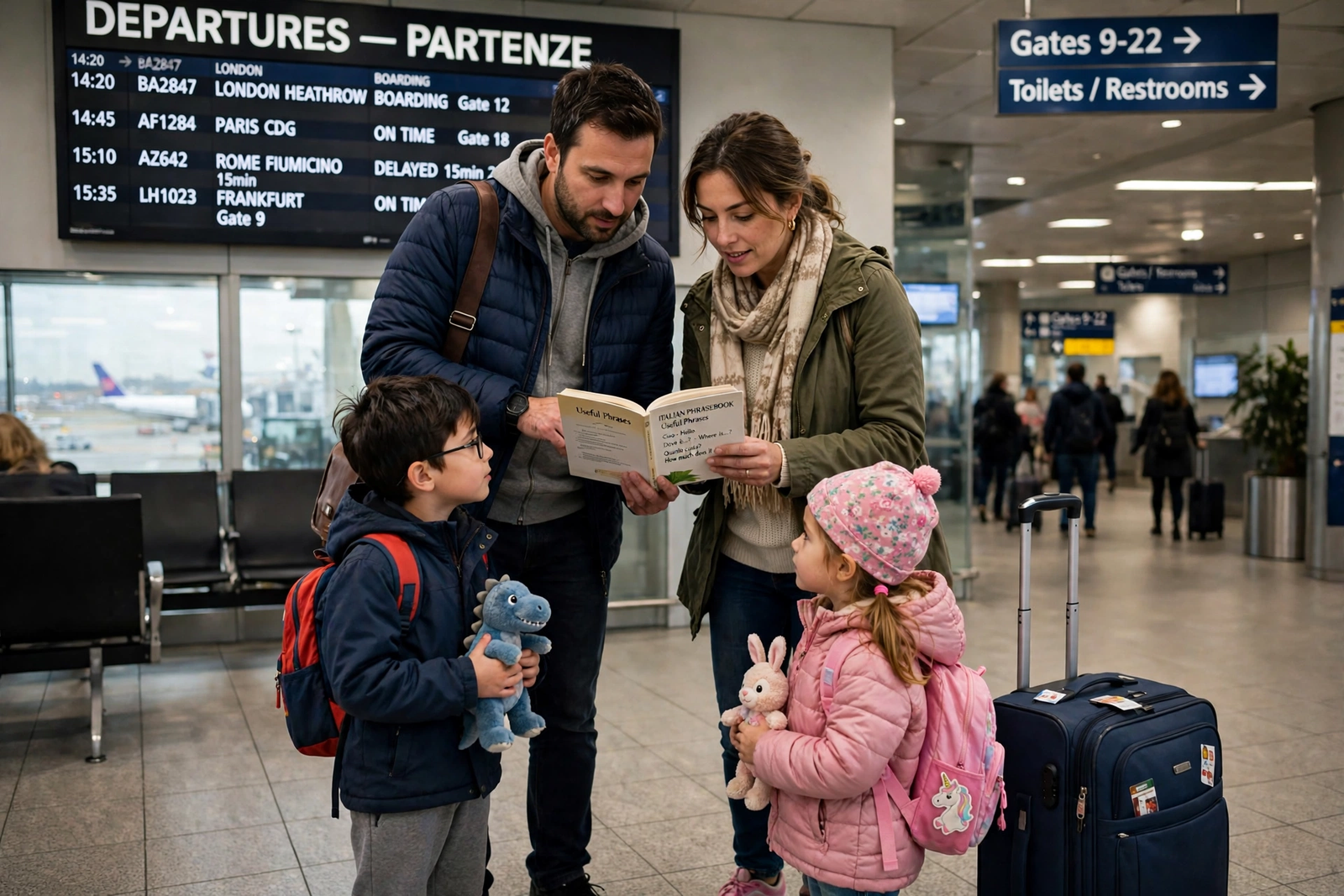
The airport is where most family trips start going wrong, and it is almost always a vocabulary problem, not a courage problem. Learn “¿Dónde está…?” (where is…?) and you can ask for anything: the gate, the toilet, the taxi rank. It is the single most useful question in this whole list, and children pick it up in about two minutes.
At the hotel
| Spanish | English |
|---|---|
| Tengo una reserva a nombre de García. | I have a reservation under the name García. |
| ¿A qué hora es el desayuno? | What time is breakfast? |
| ¿Me puede dar otra toalla, por favor? | Could you give me another towel, please? |
| La habitación no tiene agua caliente. | The room has no hot water. |
| ¿Dónde está el ascensor? | Where is the lift / elevator? |
| ¿Me puede despertar a las siete, por favor? | Could you wake me at seven, please? |
Hotel Spanish is polite-request Spanish, and the magic word is ¿Me puede…? — “Could you…?” Attach it to almost anything and you sound courteous: another towel, a wake-up call, an extra pillow. Swap in your own family name for García at check-in, and let your children say the breakfast question themselves — hotel staff love it when children try, and it is the friendliest possible first conversation.
At the restaurant
| Spanish | English |
|---|---|
| Una mesa para cuatro, por favor. | A table for four, please. |
| ¿Tienen un menú infantil? | Do you have a children’s menu? |
| Soy alérgico a los cacahuetes (maní in Latin America). | I am allergic to peanuts. |
| La cuenta, por favor. | The bill, please. |
| ¿Aceptan tarjeta de crédito? | Do you accept credit cards? |
| Un vaso de agua, por favor. | A glass of water, please. |
Two of these are worth learning word-for-word before you travel: the allergy sentence and the children’s menu question. If you are a woman or speaking for a daughter, say soy alérgica instead of alérgico — Spanish adjectives change with gender, and getting this one right matters. “La cuenta, por favor” is another small cultural note: in Spain and Latin America, the bill does not arrive until you ask for it. Sitting quietly and waiting is not slow service; it is politeness. Ask, and it comes.
Directions and getting around
| Spanish | English |
|---|---|
| ¿Dónde está el baño? | Where is the bathroom? |
| ¿Cómo llego a la estación de tren? | How do I get to the train station? |
| ¿Está lejos de aquí? | Is it far from here? |
| Gire a la izquierda. | Turn left. |
| Siga recto. | Go straight on. |
| ¿Cuánto cuesta el billete? | How much is the ticket? |
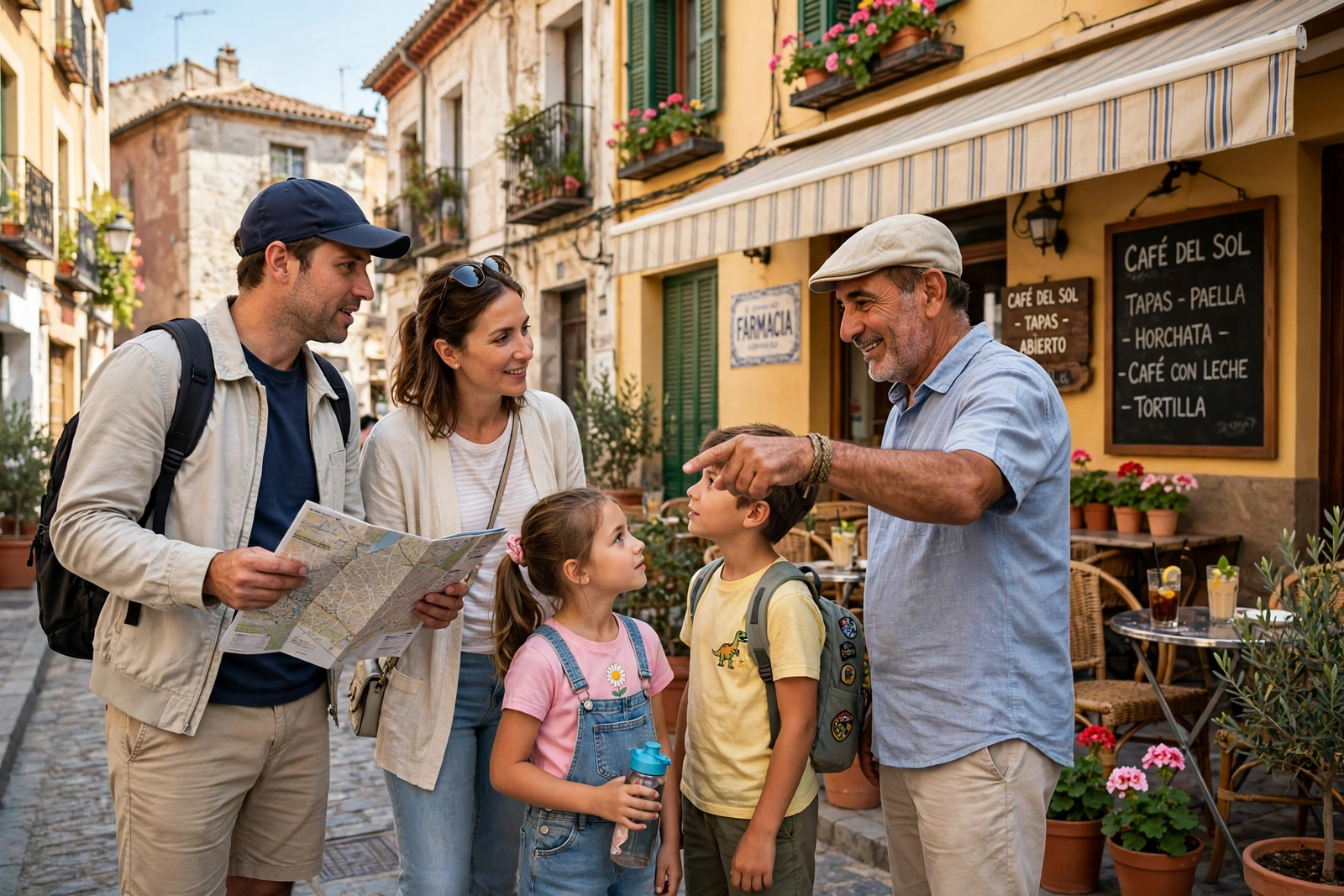
Directions are the one place where understanding matters more than speaking. You can ask “¿Dónde está el baño?” perfectly and still miss the answer if it comes fast. Two tricks help. First, ask slowly: ¿Puede hablar más despacio, por favor? — “Can you speak more slowly, please?” Second, listen for the landmarks: a la izquierda (to the left), a la derecha (to the right), recto (straight). And remember ¿Cuánto cuesta? — “How much does it cost?” — works for tickets, souvenirs, ice creams, and taxi rides alike.
Emergencies (hope you never need them)
| Spanish | English |
|---|---|
| Necesito un médico. | I need a doctor. |
| Llame a una ambulancia, por favor. | Call an ambulance, please. |
| Mi hijo se ha perdido. | My son is lost. (For a daughter: Mi hija se ha perdido.) |
| ¿Dónde está el hospital más cercano? | Where is the nearest hospital? |
| Necesito ayuda. | I need help. |
| ¿Habla inglés? | Do you speak English? |
Nobody plans to use these, which is exactly why they are worth learning. Necesito ayuda — “I need help” — is three words, and it is the one to teach your children first, along with the name of your hotel. In Spain, the emergency number is 112, the same as across the European Union; in many Latin American countries it is 911, but some use a different number, so check your destination before you fly. Save the number, and keep the hotel’s address card in your child’s pocket.
Quick Quiz
Test yourself on these Spanish travel phrases for families. Click an answer to see if you are right — your score is at the top.
Score: 0/5
1. The post calls “¿Dónde está…?” the single most useful question in the list. It lets you ask…
2. You have finished your meal in Spain and want the bill. What do you say?
3. A woman saying she is allergic to peanuts should say…
4. What does the pattern “¿Me puede…?” let you do?
5. What is the emergency number in Spain?
Quick answers
Should we learn European or Latin American Spanish for a trip?
Learn the Spanish of the place you are going, but do not worry about the differences — they are small at travel level. The phrases here work everywhere. The main differences you will hear are pronunciation (in Spain, z and c before e or i sound like “th”) and the vosotros form in Spain, which this list avoids by using polite forms.
How much Spanish do children actually need for a trip?
About ten phrases, used confidently, beat fifty memorised and never spoken. Start with greetings, please and thank you, “¿Dónde está el baño?”, and one sentence they can use themselves — ordering a drink or an ice cream is the classic first win.
Is it rude to switch to English if I get stuck?
Not at all — but try one Spanish sentence first. Even “¿Habla inglés?” asked in Spanish shows respect for the place you are visiting, and people respond to it warmly. A clumsy sentence in Spanish opens more doors than a perfect one in English.
Thirty phrases, five everyday moments, and one family that can handle the airport, the hotel, the restaurant, the streets, and the unexpected. Practise five a day for a week before you fly, let the children be the translators, and watch how much friendlier the trip feels. Our Spanish programme teaches travel Spanish the same way — real sentences for real moments — and the 7-day Spanish challenge is a good warm-up the week before you travel.