
Seven Days. One Rule: Spanish Only.
Textbooks teach you Spanish. Real life makes you speak it. This 7-day challenge gives you one real-world mission per day — the market, the café, small talk, directions, a phone call, the kitchen — each with the exact phrases you need and survival tips for when words fail you.
The rule is simple: during each day’s mission, Spanish only. Pointing is allowed. Switching to English is not. By day seven you will not be fluent, but you will be braver — and bravery is what fluency is built from.
The Rules of the Challenge
- Do one mission per day, in order. Each builds on the last.
- Learn the day’s phrase list before the mission, then use at least five phrases live.
- Keep a small notebook. Write down every word you had to look up — that list is pure gold.
- No perfection required. Mistakes are the tuition you pay for fluency.
Before Day 1: Your 30-Minute Prep
Thirty minutes of prep on the evening before Day 1 will save you three awkward rescues later. Grab a small notebook — the paper kind, not an app, because you will scribble in it standing in a market aisle — and copy the Day 1 phrase list onto the first page. Then pick your battlefield: one market or fruit stand and one café within walking distance, so Day 1 and Day 2 never depend on a car or a plan. Tell one friend you are doing the challenge, out loud, today. A witness turns a private idea into a promise, and promises are harder to quit on Day 4 when directions get hard. Finally, block twenty minutes a day in your calendar and label it in Spanish: mi reto, my challenge. You do not need to be good at Spanish to start this. Day 1 assumes you can barely order a coffee — that is the whole point.
Day 1: The Market — ¿Cuánto cuesta?
Head to a market, grocery store, or fruit stand and buy three things using only Spanish. Greet the vendor, ask prices, and say thank you like you mean it.
- ¿Cuánto cuesta? — How much does it cost?
- ¿Cuánto cuestan las manzanas? — How much are the apples?
- Quisiera un kilo de naranjas. — I would like a kilo of oranges.
- ¿Tiene algo más barato? — Do you have something cheaper?
- Gracias, hasta luego. — Thanks, see you later.
Survival tip: Vendors speak fast. Smile and say más despacio, por favor (slower, please) — they hear it every day and will happily slow down.
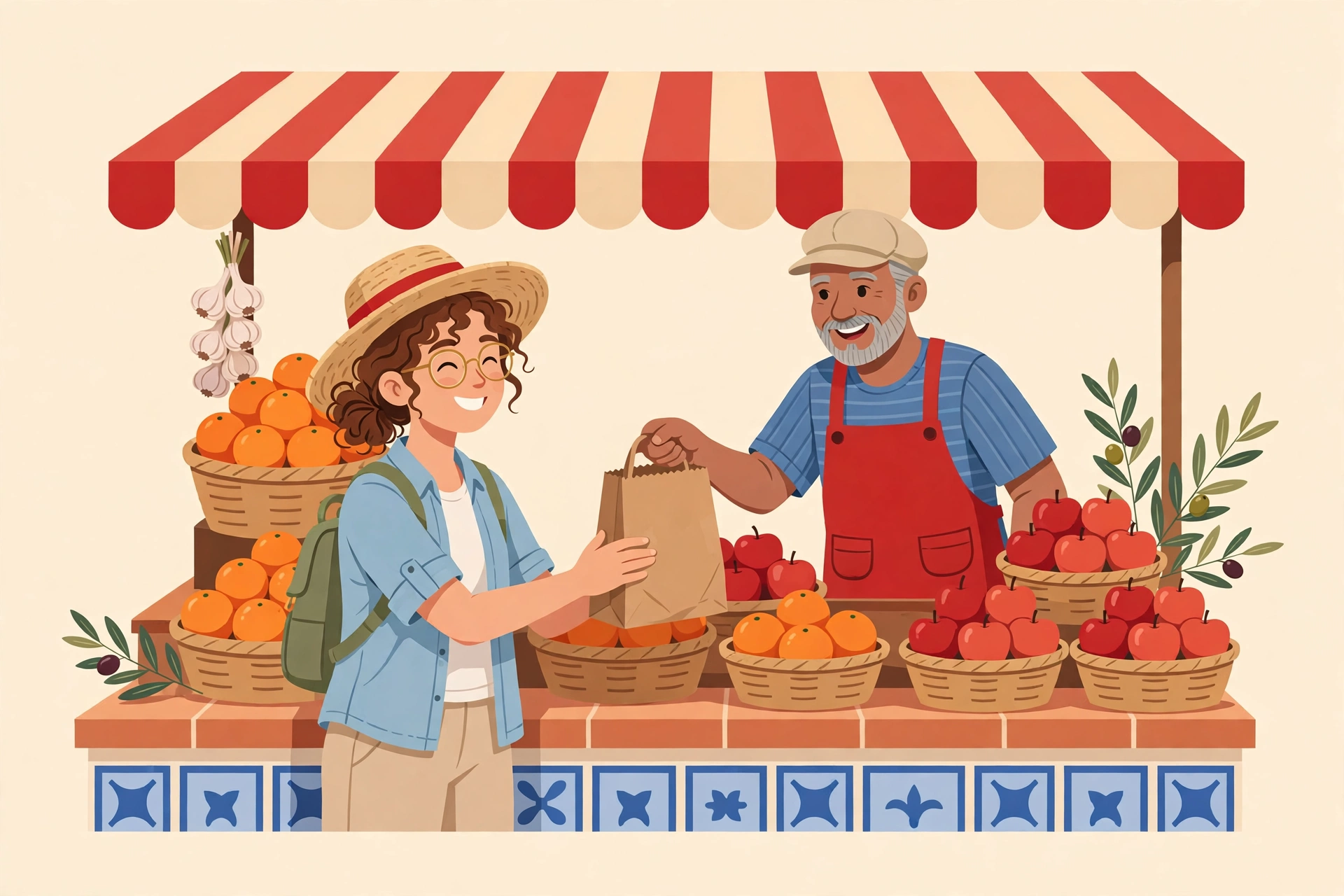
🎧 Listen: market phrases — ¿Cuánto cuesta? Quisiera un kilo de naranjas…
Play it twice before you leave the house: once just to listen, once repeating each phrase out loud. Hearing the rhythm before you need it is half the battle — your mouth already knows the shape of the words when the vendor looks at you expectantly.
Day 2: The Café — Un café, por favor
Order a drink and a snack at a café, then sit and stay a while. Cafés are the friendliest classrooms on earth.
- Un café con leche, por favor. — A café latte, please.
- Para tomar aquí. — For here. (Or para llevar — to take away.)
- ¿Tienen leche de avena? — Do you have oat milk?
- Sin azúcar, gracias. — Without sugar, thanks.
- La cuenta, por favor. — The check, please.
Survival tip: Learn está riquísimo (it is delicious). Complimenting the coffee buys you goodwill and often a free refill of conversation.
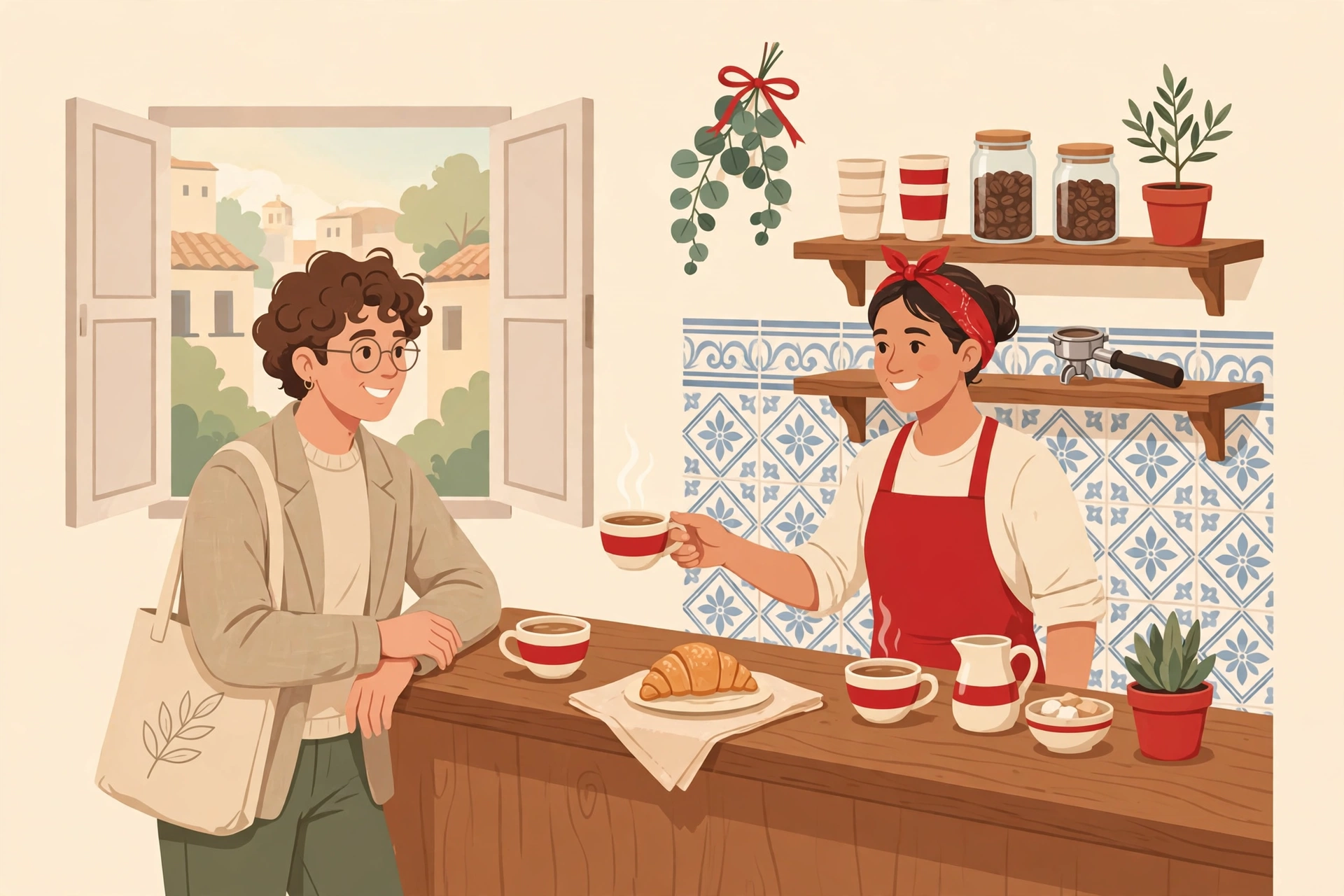
🎧 Listen: café phrases — Un café con leche, por favor…
Order with the audio fresh in your ears. The café is the gentlest mission of the week: the menu is small, the barista has heard every accent on earth, and nobody has ever been laughed out of a café for saying para llevar slowly.
Day 3: Small Talk — De dónde eres
Start three small conversations today: a neighbor, a coworker, a fellow commuter. Small talk is a skill, and today you practice it in Spanish.
- ¿De dónde eres? — Where are you from?
- Soy de Vietnam, ¿y tú? — I am from Vietnam, and you?
- ¿A qué te dedicas? — What do you do for work?
- Estoy aprendiendo español. — I am learning Spanish.
- ¡Qué interesante! — How interesting!
Survival tip: Estoy aprendiendo español is a magic sentence. Say it early and people switch from judging your Spanish to cheering for it.
Day 4: Directions — ¿Dónde está?
Navigate somewhere new using only Spanish. Ask for directions twice, even if your phone could do it — the point is the asking.
- Disculpe, ¿dónde está la estación? — Excuse me, where is the station?
- ¿Está lejos de aquí? — Is it far from here?
- ¿Puedes repetir, por favor? — Can you repeat that, please?
- A la derecha / a la izquierda / todo recto. — To the right / to the left / straight ahead.
- Muchas gracias por su ayuda. — Thank you very much for your help.
Survival tip: Repeat the directions back: entonces, a la derecha y todo recto, ¿sí? (so, right then straight, yes?). People love correcting you, and corrections are lessons.
Day 5: The Phone Call — Llamo para…
The boss level. Call a restaurant to book a table, or a shop to ask their hours. No faces, no gestures — just your voice and your Spanish.
- Hola, llamo para reservar una mesa. — Hello, I am calling to reserve a table.
- Una mesa para dos, por favor. — A table for two, please.
- ¿A qué hora abren? — What time do you open?
- Perdón, no entendí bien. — Sorry, I did not quite understand.
- Gracias, nos vemos pronto. — Thanks, see you soon.
Survival tip: Write your opening sentence down and read it. Native speakers read scripts on calls too — there is no shame in it, only in hanging up.
🎧 Listen: the phone call — Hola, llamo para reservar una mesa…
Listen to the whole call once, then say your opening sentence along with the audio three times before you dial. The first ten seconds are the hardest part of the call; once you have said Hola, llamo para… out loud, the rest of the script carries itself.
Day 6: Cooking — ¡Buen provecho!
Cook a Spanish or Latin dish — tortilla española, tacos, or even just guacamole — while narrating every step in Spanish. Talk to the onions. They do not judge.
- ¿Me pasas la sal? — Can you pass me the salt?
- Hay que cortar la cebolla. — You have to chop the onion.
- ¿Cuánto tiempo necesita? — How long does it need?
- ¡Buen provecho! — Enjoy your meal!
- Está riquísimo. — It is delicious.
Survival tip: Narrate in the present tense and do not worry about recipes in Spanish yet — the goal is thinking in Spanish while your hands are busy.

Cooking day is the most forgiving mission of the week: there is no audience, no time pressure, and the only thing listening is the food. If a sentence comes out wrong, the onions will not correct you — but saying it out loud anyway is exactly how it sticks.
Day 7: Reflection — Lo logré
No new mission today. Re-read your notebook, count the phrases you actually used, and write five sentences about your week — in Spanish, obviously.
- Lo logré. — I did it.
- Lo más difícil fue… — The hardest part was…
- Lo que más me gustó fue… — What I liked most was…
- La próxima semana voy a… — Next week I am going to…
- ¡Hasta la próxima! — Until next time!
Survival tip: Circle the three phrases you used most. Those are yours now — they crossed from “studied” to “spoken,” which is the whole game.
Survival Tips for the Whole Week
- Gesture freely. Pointing, miming, and facial expressions are part of communication, not cheating.
- Learn “I do not understand” before anything fancy. No entiendo keeps conversations alive longer than any vocabulary list.
- Forgive every mistake instantly. You will mix up está and es. Everyone does. Keep talking.
- Celebrate out loud. Every completed mission deserves a ¡lo logré! — say it like you mean it.
Keep the Streak Going
Seven days of real missions will teach you more usable Spanish than a month of app exercises — but the real win is what comes next. Our Spanish hub keeps the momentum going with structured lessons, conversation practice, and new weekly challenges. Your day eight starts at LingoBubbo Spanish.
Common Mistakes (and How to Dodge Them)
Most people who quit this challenge do not quit because Spanish is hard. They quit because of four avoidable mistakes:
- Preparing too much, starting too late. If you spend a week memorizing phrase lists, the challenge never starts. Learn the day’s five phrases, then go. The market is the classroom.
- Rehearsing in your head instead of speaking. Silent practice feels safe and teaches almost nothing. Say the phrases out loud — to the vendor, to the barista, to the onions. Your mouth needs the workout, not just your eyes.
- Apologizing for your Spanish before every sentence. “Sorry, my Spanish is terrible” eats the first ten seconds of every conversation and teaches the other person to switch to English. Start with Estoy aprendiendo español instead — it invites help rather than excuses.
- Skipping the notebook. The words you look up mid-mission are the words you actually needed. If you do not write them down, you will look up the same word three times and learn it zero times.
FAQ
Do I need to already speak some Spanish?
No. Day 1 assumes you know almost nothing — the phrases are printed right there, and pointing is allowed. If you can say hola, you can start.
What if there is no Spanish speaker near me?
Use a language-exchange app for the small-talk and phone-call days, order in Spanish at any Mexican or Spanish restaurant, or call a Spanish-speaking business and ask their opening hours. The missions work anywhere people answer the phone in Spanish.
Can I repeat the challenge?
Please do. Round two is where the real gains show up: same missions, new places, and this time you ban the notebook for phrases you already used in round one. Many learners repeat it monthly with harder missions — a doctor’s appointment, a job-interview role-play, a full dinner party in Spanish.
Quick quiz
See how much stuck! Click one answer per question — you get instant feedback either way. Score: 0/5
1. What does “¿Cuánto cuesta?” mean?
2. Which phrase asks someone to speak more slowly?
3. Why is Day 5 the “boss level”?
4. What should you write in your challenge notebook?
5. What do you do on Day 7?
How did you score? If you missed a few, replay the three audio clips above and take the quiz once more — round two is almost always better than round one. Seven days of real missions will teach you more usable Spanish than a month of app exercises, and the notebook you filled is now your personal phrasebook for the next trip. Keep the streak alive in LingoBubbo Spanish — and when you want fresh phrases to play with, try these 20 Spanish idioms you will actually hear — and share this challenge with a friend who keeps saying they want to learn Spanish: do it together and neither of you will quit on Day 4. Which day are you most nervous about? Tell us in the comments — and come back after Day 7 to report your ¡lo logré! moment. ¡Buena suerte!