You hear it. You know you hear it. The speaker said either 心 (xīn, heart) or 星 (xīng, star), and you cannot tell which one. The two words sound almost the same, and yet to a Chinese speaker they are as different as “cat” and “car.” If this has happened to you, you are not bad at listening. You are facing one of the most famous listening traps in Pinyin: the difference between -in and -ing. This post will train your ear to hear it, with real minimal pairs, four audio drills, and five short exercises you can do tonight.
What -in and -ing actually are
Pinyin syllables have three parts: an initial (the beginning sound, like x or j), a final (the vowel plus ending, like -in or -ing), and a tone. The finals -in and -ing are twins. They share the same vowel sound, a short “ee” sound, and they differ only in the very last sound.
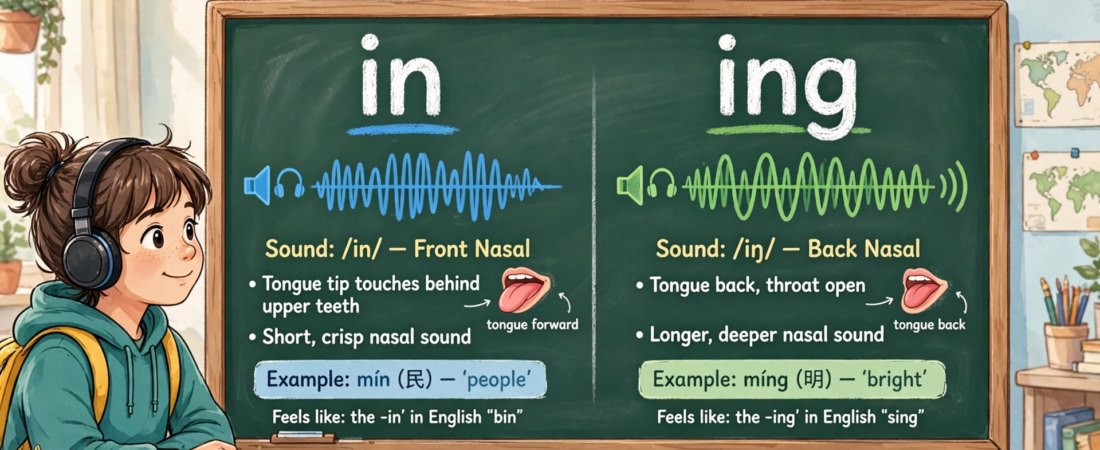
The final -in ends with the sound “n.” Your tongue tip touches the ridge just behind your upper teeth. Say “in” slowly and feel it. The tongue tip goes up, right at the front of your mouth.
The final -ing ends with the sound “ng.” Your tongue tip stays down, and the back of your tongue rises to touch the soft part at the back of the roof of your mouth. Say “ing” slowly and feel it. The action happens at the back, not the front.
That tiny difference, front of the tongue versus back of the tongue, is the whole secret. When you listen, do not try to hear a different vowel, because there is not one. Listen for where the sound ends: front, or back. When you speak, do not try to make a different vowel either. Just move your tongue to the right place at the end.
Here is a trick that helps almost everyone. Say the English word “sing” and hold the last sound. Feel the back of your tongue go up. That is -ng. Now say the English word “sin” and hold the last sound. Feel your tongue tip go up at the front. That is -n. You already know how to make both sounds. You just need to hear them in Chinese words.
The minimal pairs: hear the difference
A minimal pair is two words that differ in exactly one sound. These pairs are your training ground. Listen to the first audio clip now, slowly, and try to hear which word ends at the front of the mouth and which ends at the back.
心 (xīn) – 星 (xīng). 金 (jīn) – 京 (jīng). 民 (mín) – 明 (míng). 音 (yīn) – 英 (yīng). 亲 (qīn) – 青 (qīng). 信 (xìn) – 兴 (xìng).
Here is the full table, with the meanings. Read it out loud after the speaker, and exaggerate the ending on purpose. Overdoing it at first is how your mouth learns the movement.
| -in word | Pinyin | Meaning | -ing word | Pinyin | Meaning |
|---|---|---|---|---|---|
| 心 | xīn | heart | 星 | xīng | star |
| 金 | jīn | gold | 京 | jīng | capital (as in Beijing) |
| 民 | mín | people | 明 | míng | bright, clear |
| 音 | yīn | sound | 英 | yīng | hero, brave |
| 亲 | qīn | dear, close | 青 | qīng | green, blue |
| 信 | xìn | letter, to believe | 兴 | xìng | interest (as in 兴趣, xìngqù) |
Look at the pairs one more time. 心 and 星 have the same initial (x) and the same tone (first tone). The only difference is the ending. That is what makes them a perfect test: if you can hear the difference here, you can hear it anywhere.
Two notes for careful learners. First, 兴 has two readings: xīng (to rise, as in 兴奋, xīngfèn, excited) and xìng (interest, as in 高兴, gāoxìng, happy). In this post we use xìng, the “interest” reading, because it pairs cleanly with 信 (xìn). Second, every pair in this table shares the same tone within the pair, so the tone cannot help you cheat. Your ear has to do the work, and that is exactly the point.
Sentences that make the difference real
Words in a list are easy. Words in real sentences are the real test, because that is how you will actually hear them. Listen to the second clip. It has two short sentences, one with -in and one with -ing. Can you hear which is which before you read the transcript?
我的心跳得很快。(Wǒ de xīn tiào de hěn kuài.)
天上的星星很亮。(Tiān shàng de xīngxing hěn liàng.)
The first sentence says “My heart is beating very fast.” The word is 心 (xīn). The second says “The stars in the sky are very bright.” The word is 星星 (xīngxing). Same first sound, same vowel, different ending, different meaning, and a native speaker hears the difference instantly.
Here is the third clip, with two of the most useful place names in Chinese. You will say these words for the rest of your Chinese life, so now is the time to get them right.
他是北京人,我是天津人。(Tā shì Běijīng rén, wǒ shì Tiānjīn rén.)
北京很大,天津也很美。(Běijīng hěn dà, Tiānjīn yě hěn měi.)
“He is from Beijing, I am from Tianjin. Beijing is very big, and Tianjin is very beautiful.” 北京 (Běijīng) ends with -ing. 天津 (Tiānjīn) ends with -in. Two of the biggest cities in China, and their names are a perfect minimal pair hiding in plain sight. Every time you say one of these cities, you are practicing this exact difference.

Five listening exercises you can do tonight
This is a practice post, so here is the practice. Each exercise takes about five minutes. Do them in order, and do not skip the audio. Reading the answers without listening trains your eyes, not your ears.
Exercise 1: Listen first, look second. Play audio clip 1 again with your eyes closed. Point to the front of your mouth when you hear -in, and to the back of your head when you hear -ing. Silly? Yes. Effective? Very. Your body remembers what your ears are still learning.
Exercise 2: Say it wrong on purpose. Say 心 (xīn) with an -ng ending, then say 星 (xīng) with an -n ending. Feel how wrong it feels. Then say them correctly. Making the mistake on purpose teaches your mouth the difference faster than trying to be perfect from the start.
Exercise 3: The city test. Say 北京 (Běijīng) and 天津 (Tiānjīn) ten times, alternating. Then ask a friend or a recording app to play them back to you in random order and guess which city you hear. Eight out of ten right means your ear is getting it.
Exercise 4: Shadow the sentences. Play audio clip 4 and repeat each sentence right after the speaker, copying the rhythm exactly. Shadowing trains your mouth and your ear at the same time.
请听我说:我叫李明,我是中国人。(Qǐng tīng wǒ shuō: wǒ jiào Lǐ Míng, wǒ shì Zhōngguó rén.)
我喜欢听音乐,也喜欢看电影。(Wǒ xǐhuan tīng yīnyuè, yě xǐhuan kàn diànyǐng.)
“Please listen to me: my name is Li Ming, I am Chinese. I like listening to music, and I also like watching movies.” Did you catch them? 李明 (Lǐ Míng) ends with -ing. 电影 (diànyǐng, movie) ends with -ing too. 听 (tīng) and 音 (yīn) sit side by side in 听音乐 (tīng yīnyuè, to listen to music), one with -ing and one with -in, in the same breath. Real Chinese is full of these pairs, which is why training your ear now pays off in every conversation later.
Exercise 5: Write what you hear. Play any of the four clips, write down the pinyin of what you hear, then check against the transcript. If you wrote -in when the answer was -ing, listen again and feel where the sound ends. One wrong answer that you fix is worth ten right answers you never thought about.
Three mistakes that keep -in and -ing confusing
Only practicing with your eyes. If you always read the pinyin while you listen, your brain cheats: it sees -in or -ing and pretends it heard the difference. Close the book. Listen first, then check. Your ears need the workout, not your eyes.
Practicing only one pair. Some learners drill 心 and 星 until they are perfect, then fail on 金 and 京. The skill is not memorizing one pair. It is hearing the -n versus -ng ending in any word. Rotate through all six pairs in the table above, and add new ones as you meet them: 宾 (bīn, guest) and 并 (bìng, and), 品 (pǐn, product) and 平 (píng, flat).
Giving up after a week. This difference is genuinely hard for many learners, and that is normal. Ears need time. Ten minutes a day for two weeks beats one long weekend of drilling. If you still mix them up after a week, you are not failing. You are halfway there.
If you want to check the exact sound of any word in this post, the Pinyin chart tool on LingoBubbo lets you hear every initial and final, including -in and -ing side by side. Use it as your reference every time you are unsure.

Your -in vs -ing cheat sheet
Here is the whole post in one table. Save it, print it, or send it to a friend who is also learning Chinese and keeps mixing these two up.
| What to check | -in | -ing |
|---|---|---|
| Ending sound | n | ng |
| Tongue position | Tip up at the front | Back rises at the back |
| English feel | “sin” | “sing” |
| Example pair | 心 xīn (heart) | 星 xīng (star) |
| Example pair | 金 jīn (gold) | 京 jīng (capital) |
| Example pair | 民 mín (people) | 明 míng (bright) |
| Example pair | 音 yīn (sound) | 英 yīng (hero) |
| Example pair | 亲 qīn (dear) | 青 qīng (green) |
| Example pair | 信 xìn (letter) | 兴 xìng (interest) |
| Famous words | 天津 Tiānjīn | 北京 Běijīng |
| Famous words | 人民 rénmín (the people) | 听 tīng (to listen) |
One last tip before the quiz. When you are listening to real Chinese and you are not sure which one you heard, look at the meaning. If the sentence is about a heart, it is 心. If it is about a star, it is 星. Context is your safety net while your ear is still learning, and native speakers use it too.
Quick Quiz
Test your ear on -in vs -ing. Click an answer to see if you are right, and your score is at the top.
Score: 0/5
1. Which of these words ends with the final -ing?
2. What does 明 (míng) mean?
3. Which city name ends with -ing?
4. How do you make the -ng sound at the end of -ing?
5. What is the pair 信 (xìn) and 兴 (xìng)?
FAQ
How long does it take to hear the difference between -in and -ing?
Most learners start hearing it clearly after one to two weeks of ten minutes of daily listening practice. A few get it in days, a few need a month. Both are normal. Daily short practice matters far more than long weekend sessions.
Why do -in and -ing sound the same to me?
Because your first language may not use the -n versus -ng difference at the end of a syllable in the same way, so your brain treats them as the same sound. This is not a hearing problem. It is a habit, and habits change with focused listening like the drills in this post.
Should I practice speaking -in and -ing, or just listening?
Both, but listening first. Your mouth cannot reliably produce a difference your ear cannot hear. Listen for a few days with the audio clips here, then start saying the pairs out loud and recording yourself to compare.
Are there other Pinyin pairs like this?
Yes. The same front-versus-back trick applies to -en versus -eng and -an versus -ang. Once your ear learns the -n versus -ng ending, those pairs get easier too. Our guide to b and p in Pinyin uses the same minimal-pair method for a different sound, and our guide to Pinyin initials and finals covers the whole sound system.
What if I still cannot hear it after two weeks?
Slow the audio down and exaggerate the endings on purpose. Say -in with a very strong front “n” and -ing with a very strong back “ng.” The exaggeration makes the difference obvious, and your ear will start catching the smaller, natural version soon after.
Your turn: ten minutes tonight
You now know the secret: -in ends at the front of your tongue, -ing ends at the back, and six minimal pairs are waiting in the table above. Tonight, play the four audio clips, do the five exercises, and take the quiz. Ten minutes is enough to start, and tomorrow your ear will already be a little sharper than it is today.
Keep practicing with the Chinese lessons on LingoBubbo, where listening drills like the ones in this post appear in every lesson. If this guide helped you, send it to a friend who is also learning Chinese and keeps mixing up 心 and 星. And tell us in the comments: which pair was hardest for you to hear, and how many days did it take before the difference clicked?