
Your nine-year-old comes home from school, drops the backpack by the door, and announces, “I can say something in Chinese!” Then they freeze. They know the words for apple and cat, but when you ask what they like to do after school, the Chinese stops. Sound familiar? If you want your child to actually speak Chinese instead of just memorizing flashcards, hobbies are the easiest place to start, because kids love talking about the things they already love doing. This guide shows you how kids practice speaking Chinese about hobbies with 15 short sentences, four listen-and-repeat audio clips, and three games that take five to ten minutes at the kitchen table.
Why hobbies work better than flashcards
Think about the last time your child talked non-stop. It probably was not about a vocabulary list. It was about the drawing they finished, the goal they scored, or the song stuck in their head. Hobbies give children something real to say, and real things to say are much easier to remember than words on a card.
A Grade 4 child, around nine or ten years old, can already say full sentences in their first language about what they like. Chinese works the same way. Two little patterns carry almost the whole conversation: 我喜欢 (wǒ xǐhuan, “I like”) and 我会 (wǒ huì, “I can”). Once your child can swap different hobbies into those two frames, they can suddenly say dozens of sentences, and that feeling of “I can really say this” is what keeps them going.
You do not need to speak Chinese yourself to help. You just need ten minutes, a bit of patience, and a willingness to sound silly together. The audio clips in this post do the pronunciation work for you. Press play, repeat after the voice, and let your child be the expert who corrects you. Kids love that part.
How kids practice speaking Chinese about hobbies: the 15 sentences
Here are the 15 sentences, grouped so you can learn them in small bites. Start with the first five. When those feel easy, add the next group. There is no rush, and there is no test at the end of the day. Five sentences said with a smile beat fifteen sentences drilled with tears.
Part 1: “I like…” — five sentences to start with
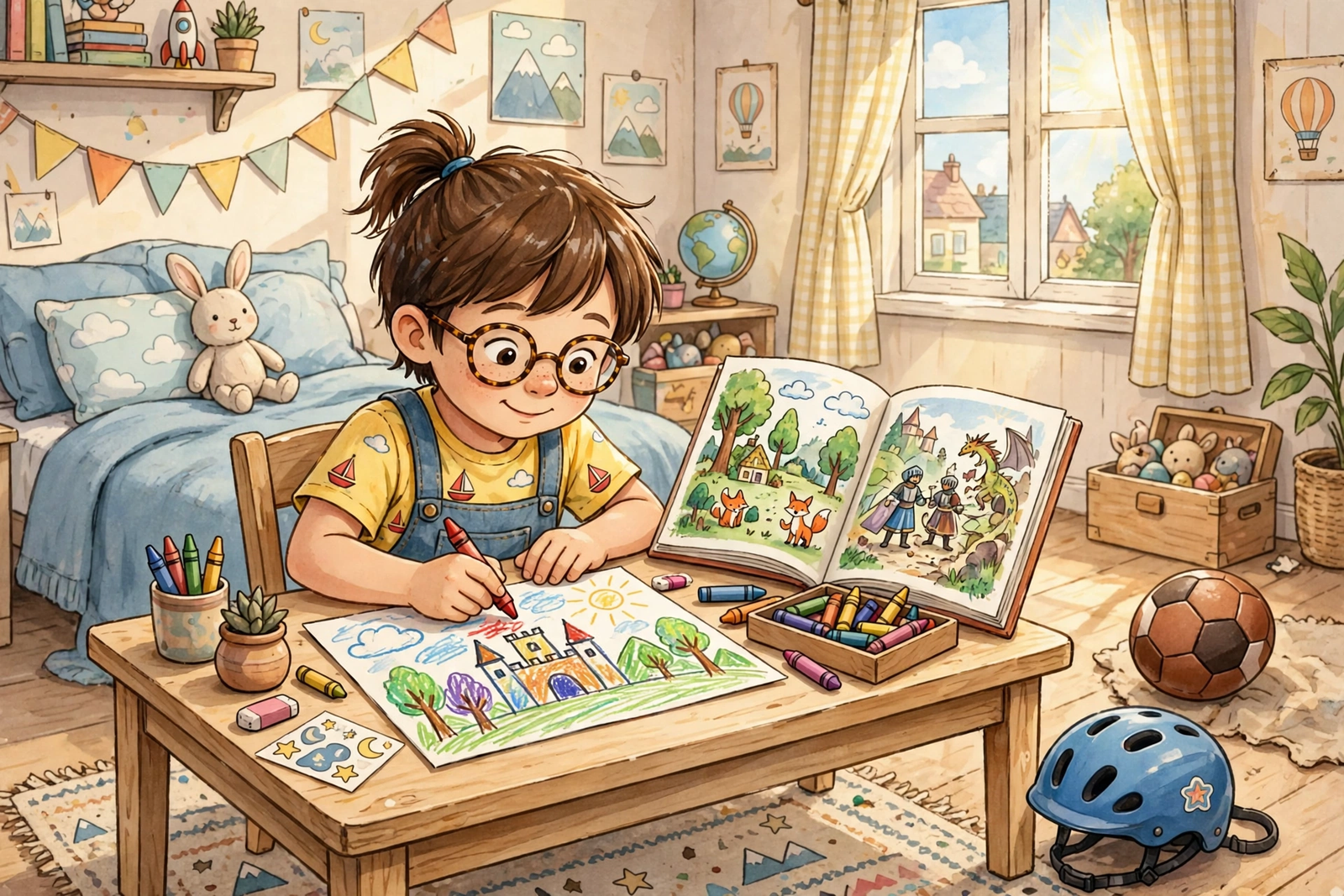
The pattern is 我喜欢 (wǒ xǐhuan) plus the hobby. Say the Chinese slowly, then the English, then say the Chinese again. Let your child point at the real thing while they say it: the book on the shelf, the crayons on the table, the football by the door.
- 1. 我喜欢看书。 — Wǒ xǐhuan kàn shū. — “I like reading books.”
- 2. 我喜欢画画。 — Wǒ xǐhuan huà huà. — “I like drawing pictures.”
- 3. 我喜欢踢足球。 — Wǒ xǐhuan tī zúqiú. — “I like playing football.”
- 4. 我喜欢游泳。 — Wǒ xǐhuan yóuyǒng. — “I like swimming.”
- 5. 我喜欢唱歌。 — Wǒ xǐhuan chàng gē. — “I like singing.”
Listen to the clip twice. The first time, just listen. The second time, say each sentence out loud right after you hear it. A small tip for parents: 看书 (kàn shū) literally means “look at books,” which is how Chinese says “read books.” If your child asks why, that is a lovely little discovery, not a mistake to fix.
Part 2: “I can…” — five sentences about what your child can do
Now switch the frame to 我会 (wǒ huì), “I can.” This pattern is a confidence builder. Children love announcing what they can do, and every sentence is a small proud moment. Notice that sentence ten uses the same hobby as sentence three, 踢足球 (tī zúqiú, “play football”), but with a different frame. That is the whole trick of this method: same words, new frame, new sentence.
- 6. 我会跳舞。 — Wǒ huì tiàowǔ. — “I can dance.”
- 7. 我会弹钢琴。 — Wǒ huì tán gāngqín. — “I can play the piano.”
- 8. 我会骑自行车。 — Wǒ huì qí zìxíngchē. — “I can ride a bike.”
- 9. 我会玩游戏。 — Wǒ huì wán yóuxì. — “I can play games.”
- 10. 我会踢足球。 — Wǒ huì tī zúqiú. — “I can play football.”
Try this at dinner tonight. Ask your child, in English, “What can you do?” and let them answer in Chinese with one of these five. One sentence is enough. If they want to show off all five, even better. The piano sentence is the longest one, so give it an extra listen. Break it into pieces if it helps: 弹钢琴 (tán gāngqín), then 我会弹钢琴 (wǒ huì tán gāngqín).
Part 3: Asking and answering — five sentences that make a conversation
Sentences are good. Conversations are better. These last five turn the lists above into a real back-and-forth, the kind your child can actually use with a classmate, a teacher, or you in the car.
- 11. 我喜欢看动画片。 — Wǒ xǐhuan kàn dònghuàpiàn. — “I like watching cartoons.”
- 12. 你喜欢什么? — Nǐ xǐhuan shénme? — “What do you like?”
- 13. 我喜欢跳舞。 — Wǒ xǐhuan tiàowǔ. — “I like dancing.”
- 14. 你会弹钢琴吗? — Nǐ huì tán gāngqín ma? — “Can you play the piano?”
- 15. 我喜欢画画,也喜欢唱歌。 — Wǒ xǐhuan huà huà, yě xǐhuan chàng gē. — “I like drawing pictures, and I also like singing.”
Listen to the dialogue in the third clip and play the two parts with your child. You ask 你喜欢什么? (nǐ xǐhuan shénme?), and your child answers with any of the sentences above. Then swap roles. Children who get to ask the question remember it far faster than children who only answer it.
One more useful sentence for your dialogue, as a bonus: 我不会弹钢琴。 — Wǒ bú huì tán gāngqín. — “I cannot play the piano.” It answers question fourteen honestly, and it shows your child that saying “I can’t” in Chinese is just as useful as saying “I can.” A quick note for curious parents: 不 (bù) changes its tone to bú before 会 (huì), which is why the pinyin looks different here. Your child does not need to memorize that rule. Hearing it a few times is enough.
Three games that take five to ten minutes
You do not need worksheets for this. You need a kitchen table, a living room floor, or a car ride. Each game below uses only the sentences from this post, and each one fits into five to ten minutes, which is exactly the attention span you can count on after a school day.
Game 1: Hobby charades. One person acts out a hobby without speaking. Swimming arms, pretend piano fingers, an invisible football kick. The other person guesses in Chinese: 你喜欢游泳? (Nǐ xǐhuan yóuyǒng? “Do you like swimming?”) or 我会游泳! (Wǒ huì yóuyǒng! “I can swim!”). Even a wrong guess is good practice, because the guess itself is a full Chinese sentence. Keep score if your child likes that, or skip the score entirely and just laugh at the acting.
Game 2: Say it and point. Put five things on the table: a book, a crayon, a ball, a toy piano or a picture of one, and a pair of swimming goggles if you have them. Point at one and say its sentence in Chinese. Then point at another, faster. Then let your child be the pointer and you be the speaker. The speed is the fun part. When the pointing gets fast, the Chinese has to come out fast too, and that is real speaking practice disguised as a race.
Game 3: Sentence chain. Start with one sentence, for example 我喜欢画画 (wǒ xǐhuan huà huà, “I like drawing pictures”). Your child adds a second one with 也 (yě, “also”), just like sentence fifteen: 我喜欢画画,也喜欢唱歌 (wǒ xǐhuan huà huà, yě xǐhuan chàng gē). Then you add a third. How long can the chain grow before someone forgets a link? Five links is a great result for a first try. This game is wonderful in the car, because it needs no props at all, just two voices and a road.

Play the fourth clip before a game round. It repeats the sentences your child will need most in the games, so the words are fresh in their ears right when they need them. If you want more game ideas after these three, our Chinese word games page has matching and memory games your child can play right after speaking practice.
How to practice ten minutes a day without a battle
The hardest part of helping a child learn Chinese is not the Chinese. It is the routine. Here is what actually works for busy families, in plain terms.
Pick one moment that already exists. Right after breakfast, in the car to school, or while dinner is cooking. Attach the ten minutes to something that already happens every day, instead of inventing a new “study time” that everyone dreads. Three sentences in the car count. They really do.
One new sentence at a time. If your child learned 我喜欢看书 today, that is a win. Add the next sentence tomorrow. Children who learn one sentence well remember it next week. Children who are pushed through ten sentences in one sitting often remember none of them by Friday.
Praise the trying, not just the getting it right. “You said the whole sentence by yourself!” matters more than “Your tone was wrong on the third word.” Tones improve with listening, and your child is listening every time you press play on the audio. Correct one thing at a time, gently, and let the rest go for today.
Let your child teach you. Ask them to teach you one sentence, then say it back with a deliberately silly mistake and let them correct you. Children who teach remember far more than children who only repeat, and the laughter does more for motivation than any sticker chart.
Never force it on a bad day. If your child is tired, upset, or just not in the mood, skip the day. Ten minutes of happy practice beats thirty minutes of tears, every single time. The sentences will still be here tomorrow.
All 15 sentences at a glance
Save this table or print it for the fridge. It is the whole post on one screen, for quick review before a game round.
| Chinese | Pinyin | English |
|---|---|---|
| 我喜欢看书。 | Wǒ xǐhuan kàn shū. | I like reading books. |
| 我喜欢画画。 | Wǒ xǐhuan huà huà. | I like drawing pictures. |
| 我喜欢踢足球。 | Wǒ xǐhuan tī zúqiú. | I like playing football. |
| 我喜欢游泳。 | Wǒ xǐhuan yóuyǒng. | I like swimming. |
| 我喜欢唱歌。 | Wǒ xǐhuan chàng gē. | I like singing. |
| 我会跳舞。 | Wǒ huì tiàowǔ. | I can dance. |
| 我会弹钢琴。 | Wǒ huì tán gāngqín. | I can play the piano. |
| 我会骑自行车。 | Wǒ huì qí zìxíngchē. | I can ride a bike. |
| 我会玩游戏。 | Wǒ huì wán yóuxì. | I can play games. |
| 我会踢足球。 | Wǒ huì tī zúqiú. | I can play football. |
| 我喜欢看动画片。 | Wǒ xǐhuan kàn dònghuàpiàn. | I like watching cartoons. |
| 你喜欢什么? | Nǐ xǐhuan shénme? | What do you like? |
| 我喜欢跳舞。 | Wǒ xǐhuan tiàowǔ. | I like dancing. |
| 你会弹钢琴吗? | Nǐ huì tán gāngqín ma? | Can you play the piano? |
| 我喜欢画画,也喜欢唱歌。 | Wǒ xǐhuan huà huà, yě xǐhuan chàng gē. | I like drawing pictures, and I also like singing. |
Quick Quiz
Try these five questions together with your child. Click an answer to see right away if you are correct. Keep an eye on your score at the top. All the answers come from the sentences in this post.
Score: 0/5
1. What does 我喜欢画画 mean?
2. How do you say “I can ride a bike” in Chinese?
3. What does 你喜欢什么? mean?
4. Which sentence means “I can play the piano”?
5. In 我喜欢画画,也喜欢唱歌, what does 也 (yě) mean?
Frequently asked questions
How long should my child practice each day? Ten minutes is plenty for a nine- or ten-year-old. A short, happy session every day builds far more Chinese than one long session on the weekend. If your child wants to keep going past ten minutes, let them, but stop while it is still fun.
My child forgets the tones. Is that a problem? Not at this stage. Tones improve naturally with listening, and the audio clips in this post give your child a clear model to copy. Praise the sentence first, and only gently fix one tone at a time if you fix anything at all.
Should I correct every mistake? No. Correcting everything makes children afraid to speak, which is the opposite of what we want. Pick one small thing per session, fix it with a smile, and move on. Speaking with confidence matters more than speaking perfectly at this age.
What if my child only wants to say one sentence over and over? Let them. One sentence said happily, twenty times, is real practice. The other sentences will come when your child is ready for them, usually sooner than you expect once the first one feels easy.
Do we need to learn the Chinese characters too? Speaking can come first, and for most Grade 4 beginners it should. When your child is ready to meet the characters behind these words, our Chinese character picture matching game for kids pairs each character with a picture, which is a gentle next step after speaking.
Keep going
Fifteen sentences is a real milestone. Your child can now say what they like, what they can do, and ask someone else the same question. That is a conversation, not a vocabulary list, and it is worth celebrating. Tonight, ask your child one question in Chinese at dinner, 你喜欢什么?, and see what comes back. You might be surprised how much they remember.
When those fifteen sentences feel easy, keep the momentum going with our Chinese word games, where your child can match, remember, and play with the words they just learned. And if your child loves picture-based learning, our post on 15 wild animals in Chinese with pictures uses the same listen, repeat, and play approach with animals instead of hobbies.
Know another parent whose child is learning Chinese? Send them this post. The sentences are short, the games need no preparation, and the best practice partner a child can have is a parent who is willing to sound silly in Chinese right alongside them.