
“What’s the weather like today?” — this simple question turns up almost every day, in nearly every small-talk conversation in English. But many learners only know sunny and rainy, and then get stuck when there’s hail, fog or humid, sticky heat.
This post brings together 20 English words and phrases about the weather, grouped by type of weather, each with an everyday example sentence so that you can use them straight away in chats with friends or while travelling.
The good news is that you don’t need to learn hundreds of new words. The 20 words in this post are enough to open any conversation about the weather — from a morning greeting to a colleague to texting a friend “how’s the weather over there?”. Once you’ve learnt them, try looking out of the window and describing today’s weather in English — I’m sure you’ll manage it right away.
Sunny skies and fine weather
Lovely sunshine is the easiest topic to open a conversation with. The five words below are enough for you to praise a beautiful day, or grumble that it’s as hot as Saigon in April.
- sunny /ˈsʌni/ (sunny, with sunshine): It’s sunny today, let’s go for a walk. (It’s sunny today, let’s go for a walk.)
- clear /klɪər/ (clear, cloudless): The sky is clear tonight, we can see the stars. (The sky is clear tonight, so we can see the stars.)
- warm /wɔːrm/ (warm): It’s warm enough to wear a T-shirt. (It’s warm enough to wear a T-shirt.)
- hot /hɑːt/ (hot): It’s so hot today, I need a cold drink. (It’s so hot today, I need a cold drink.)
- humid /ˈhjuːmɪd/ (humid, muggy): It’s humid today, my clothes feel sticky. (It’s humid today, my clothes feel all sticky.)
One handy tip: Americans often say It’s a beautiful day instead of just saying It’s sunny. This sounds much more natural, especially when you want to start a conversation with someone.
Rain and storms
Rain in English has plenty of “levels” — drizzle is completely different from pouring rain, and your listener will understand the level straight away if you pick the right word.
- rainy /ˈreɪni/ (rainy): Don’t forget your umbrella, it’s rainy outside. (Don’t forget your umbrella, it’s raining outside.)
- drizzle /ˈdrɪzəl/ (drizzle, light misty rain): It’s just a light drizzle, we don’t need an umbrella. (It’s only a light drizzle, we don’t need an umbrella.)
- pouring /ˈpɔːrɪŋ/ (pouring, raining in sheets): It’s pouring! Let’s wait inside for a while. (It’s pouring! Let’s wait indoors for a bit.)
- thunderstorm /ˈθʌndərstɔːrm/ (a storm with thunder and lightning): A thunderstorm is coming, let’s close the windows. (A thunderstorm is coming, let’s close the windows.)
- lightning /ˈlaɪtnɪŋ/ (a lightning flash): The lightning lit up the whole sky. (Lightning lit up the whole sky.)
- hail /heɪl/ (hail): Hail damaged a lot of cars last night. (Hail damaged lots of cars last night.)
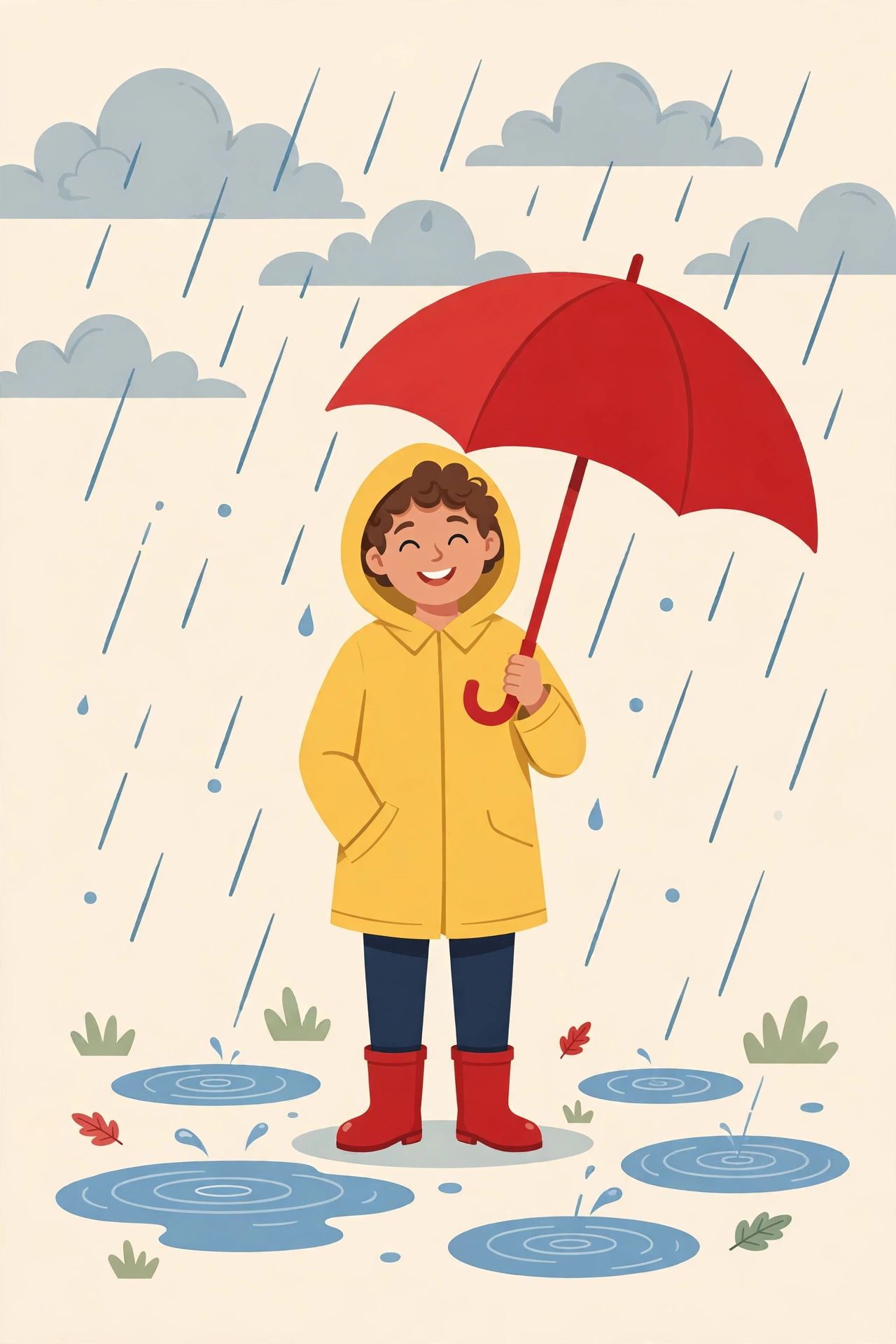
Did you notice: pouring always goes with strong emotion — people practically shout “It’s pouring!” when the rain suddenly comes crashing down. Whereas drizzle is the opposite — so gentle that plenty of people don’t even bother to open an umbrella.
Cold weather, fog and snow
This group matters most when you travel to a cold country, or simply when you want to tell friends about winter in the US.
- cold /koʊld/ (cold): It’s cold today, wear a jacket. (It’s cold today, put a jacket on.)
- freezing /ˈfriːzɪŋ/ (freezing cold): It’s freezing outside, I can see my breath. (It’s freezing outside, I can see my breath.)
- foggy /ˈfɑːɡi/ (foggy): It’s foggy this morning, drive carefully. (It’s foggy this morning, drive carefully.)
- snowy /ˈsnoʊi/ (snowy): It’s snowy today, the kids are building a snowman. (It’s snowy today, the children are building a snowman.)
- windy /ˈwɪndi/ (windy): It’s too windy to ride a bike today. (It’s too windy to ride a bike today.)
- cloudy /ˈklaʊdi/ (cloudy): It’s cloudy but it probably won’t rain. (It’s cloudy but it probably won’t rain.)
Remember: cold is just ordinary cold, whereas freezing is cold down to the point where water freezes — around 0°C or below. Say “It’s freezing” on a 15°C day and your listener will burst out laughing.
3 phrases native speakers use every day
- It’s raining cats and dogs. — Raining as if it were being poured out. (A fun idiom — it has no literal meaning about cats and dogs!)
- It’s a perfect day. — The weather today is absolutely wonderful. (Use it when the weather is fine, with gentle sun and a cool breeze.)
- The weather is unpredictable. — The weather is really unpredictable. (A “lifesaver” sentence for when you don’t know how to describe the weather.)
Chatting about the weather like a native speaker
Knowing the vocabulary is one thing; opening your mouth to start a conversation is quite another. The weather is the “safest” topic for starting any conversation in English — with a colleague, a neighbour or a taxi driver. You only need to learn the few sentence patterns below by heart, and that’s enough
- What’s the weather like today? — What is the weather like today? (The classic question, one you can use at any time.)
- It’s supposed to rain later. — I hear it will rain later. (Use it when you’ve already seen the forecast, be supposed to means “is expected to”.)
- Looks like it’s clearing up. — It looks as if the sky is clearing. (Use it when the rain has just stopped and the clouds are dispersing.)
- I can’t believe how hot it is today! — I can’t believe how hot it is today! (A very natural exclamation that Americans use all summer long.)
- It’s freezing — I need my coat. — Absolutely freezing — I need my coat. (Half a grumble, half stating a need — it sounds very real.)
Listen to this short dialogue between two friends, then read along with it:
🎧 Listen to the dialogue: Two friends talk about today’s weather
After listening, take on the role of one of the people in the dialogue and say all of that character’s lines again. Listen — repeat — swap roles: with just these three steps, your reflexes will be noticeably different after a week.
Pairs of words that are easy to confuse
Learning vocabulary in opposite or near-meaning pairs makes it stick longer than learning words one by one. Here are the four pairs my students confuse most often:
- drizzle — pouring: drizzle is light misty rain that hardly wets your clothes; pouring is rain coming down in sheets, soaking you through in a few seconds. Between these two words there is also ordinary rain and shower (a short shower of rain).
- foggy — misty /ˈmɪsti/ (with a light mist): foggy is thick fog, where you can’t see into the distance; misty is just a thin layer of mist hanging in the early morning.
- hot — warm: warm is pleasantly warm, just right for wearing a T-shirt; hot is hot to the point of discomfort, making you look for a shady spot.
- windy — breezy /ˈbriːzi/ (with a light breeze): windy is strong wind that blows your hair all over the place; breezy is a gentle, pleasant, cooling wind. Everyone loves a breezy.
The three bonus words in this section — shower, misty, breezy — are not part of the main 20 words, but knowing them as well will make the way you speak noticeably more subtle.
How to talk about the weather in all four seasons
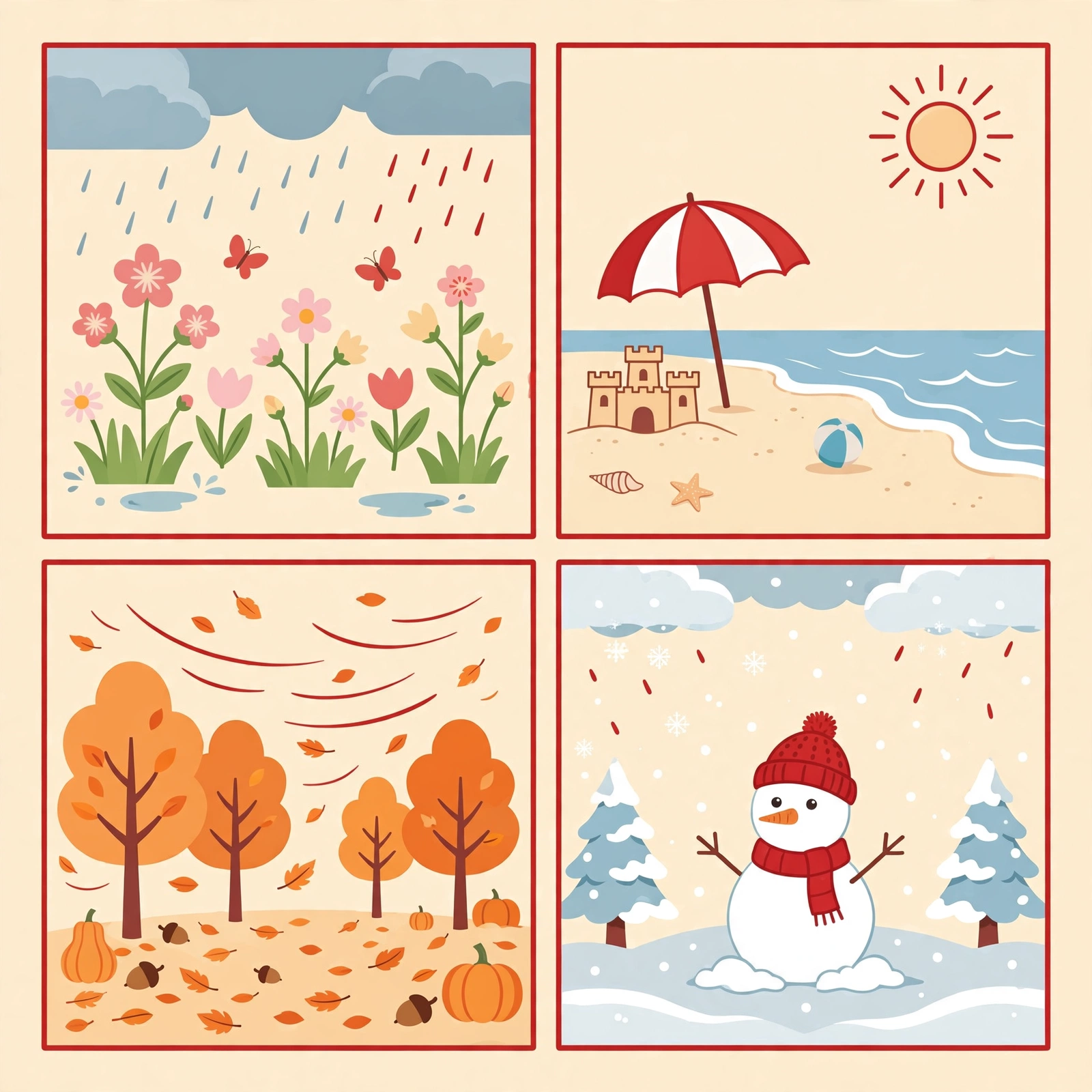
Each season has its own weather “vibe”, and English has words ready-made to describe exactly that feeling:
- Spring: spring showers (spring rain showers) — It’s spring, so expect a few showers. (It’s spring, so there will be a few rain showers.)
- Summer: heatwave /ˈhiːtweɪv/ (a spell of very hot weather) — A heatwave is coming this weekend. (A heatwave is coming this weekend.)
- Autumn: crisp air (crisp, chilly, fresh air) — I love the crisp air in autumn. (I love the crisp, fresh air in autumn.)
- Winter: blizzard /ˈblɪzərd/ (a snowstorm) — A blizzard hit the city last night. (A blizzard hit the city last night.)
Common mistakes when talking about the weather
I’ve put together the three mistakes Vietnamese learners make most often when talking about the weather — fix these three and you’ll sound much more “Western”:
- Don’t say “It’s rain.” The correct sentence is It’s raining (it is raining now) or It’s rainy (it is rainy). Rain is a noun or a verb; it cannot stand after It’s as an adjective.
- Don’t say “I feel hot” when you want to describe hot weather. I feel hot means your own body is hot (perhaps because of a fever or exercise). To say the weather is hot, say It’s hot today.
- Don’t translate “trời mưa to” word by word into “the rain is big”. Native speakers say It’s pouring or It’s raining heavily. The phrase rain heavily (heavy rain) is well worth learning by heart.
How to remember these 20 words in 1 week
- Every morning, describe the weather in English in 1 sentence. Look out of the window and say: “It’s sunny today” or “It’s cloudy but warm” — only 10 seconds, but surprisingly effective.
- Learn in groups, not word by word in isolation. Remember sunny–cloudy–rainy–snowy as one group meaning “what the weather is like”, and hot–warm–cold–freezing as the group for “how hot or cold it is”.
- Attach words to real experiences. Next time you run into drizzle, say “drizzle” out loud — a word attached to a real experience sticks far longer than a word learnt from a book.
Summary table of the 20 words
Save this table so you can revise quickly before travelling or before a conversation in English:
| Word | Meaning | Group |
|---|---|---|
| sunny | with sunshine | Beautiful sunshine |
| clear | clear and cloudless | Beautiful sunshine |
| warm | warm | Beautiful sunshine |
| hot | hot | Beautiful sunshine |
| humid | humid and muggy | Beautiful sunshine |
| rainy | rainy, with rain | Rain & storms |
| drizzle | light misty rain | Rain & storms |
| pouring | raining in sheets | Rain & storms |
| thunderstorm | a storm with thunder and lightning | Rain & storms |
| lightning | a lightning flash | Rain & storms |
| hail | hail | Rain & storms |
| cold | cold | Cold / snow |
| freezing | freezing cold | Cold / snow |
| foggy | foggy, with fog | Cold / snow |
| snowy | snowy, with snow | Cold / snow |
| windy | windy, with wind | Cold / snow |
| cloudy | cloudy, many clouds | Cold / snow |
| raining cats and dogs | raining in torrents | Idiom |
| a perfect day | a day of wonderful weather | Idiom |
| unpredictable weather | unpredictable weather | Idiom |
Listen and practise speaking
Listening is the fastest way for these words to “sink into your ears” and stay there for a long time. Press play on the two clips below, listen 2–3 times, then read along out loud:
🎧 Listen to the most important weather sentence patterns
🎧 Listen to a short weather forecast and practise your listening comprehension
Frequently asked questions
How do sunny and clear differ?
Sunny emphasises that there is sunshine (even if the sky might be a little cloudy), while clear emphasises a clear, cloudless sky — often used for the evening: The sky is clear tonight.
How do you say “trời mưa to” in English so it sounds natural?
Say It’s pouring or It’s raining heavily. If you want it to sound more fun, use the idiom It’s raining cats and dogs.
How long does it take to learn these 20 words?
If every morning you spend 10 seconds describing the weather outside your window in English, in about a week you’ll know all 20 words — because every single word is attached to a real experience of your own.
Try it today
Look out of the window right now and try describing the weather using 2 English words you’ve just learnt. If you can do that, you’ve gained one more natural topic of conversation for your next English conversation.
Want to expand this stock of everyday conversational phrases further? Read the post 20 English sentences Americans say every day on LingoBubbo — the weather is the perfect topic to open with, and the sentences in that post will help you keep the conversation going naturally. You can also take a look at the post English for communicating at work in the US for beginners to use this vocabulary straight away in an office environment.
Send this post to a friend who is learning English — who knows, tomorrow the two of you might text each other your first sentence in English: “It’s sunny today!” And if you want to learn in a more structured way, drop by the LingoBubbo homepage to discover more free lessons and language games.
Quick Quiz
Let’s check how many words you remember. Choose the correct answer for each question — as soon as you’ve answered them all, you’ll know your score.
Score: 0/5
Question 1: “It’s pouring” — what does it mean?
Question 2: Which word do you use when it is so cold that you can see your own breath?
Question 3: “Drizzle” is what kind of rain?
Question 4: Which sentence is correct when you want to say that it is raining?
Question 5: “It’s raining cats and dogs” — what does it mean?