Your child reads pinyin fluently and can say several dozen sentences, but when it is time to write Chinese characters their face falls and the pen goes down on the desk? Do not rush to scold your child for being lazy — for children, writing Chinese characters easily becomes torture when every character is a maze of strokes that they do not understand why they have to memorise.
The good news: children do not hate Chinese characters; they hate the dry way of learning them. The 7 methods below turn character-writing time into a game, and most importantly — each one takes only 10–15 minutes a day. If there is just one thing you try tonight, try method number 1: tell your child a story about a single character. Many parents say that one story alone was enough to make their child ask to learn a second character.
Why is your child afraid of writing Chinese characters?
Before fixing the way of learning, look at writing time through your child’s eyes once. Your child sits down at the desk after a long day at school, facing a page full of empty squares. Each character has a dozen or more strokes; write one stroke wrong and they have to erase it and write it again — and the rewrite can still be wrong. In your child’s mind, Chinese characters are not a language — they are a test whose questions they have not yet understood.
There are three most common fears. The first is the fear of being ugly: your child sees that your characters are nicer than theirs, while theirs are all wobbly, so they would rather not write than write badly. The second is the fear of forgetting: learn ten characters today, forget eight tomorrow, and the child concludes that they have no talent. The third is the fear of boredom: copying one character over ten lines bores even adults, let alone children. Luckily, all three fears can be dealt with — no extra study time needed, just a change in the way of learning.
One principle runs through this whole article: for children, writing Chinese characters must start from understanding before memorising, from playing before practising. When your child understands what story a character tells, they remember it far longer than when they only copy its shape. And when a study session is only as long as making a bottle of milk, your child will not have to summon all their courage just to sit down at the desk.
1. Tell stories for characters — do not make your child copy them dryly
Every Chinese character is a miniature picture. The character 休 (xiū, to rest) is a person (人) leaning against a tree (木) to rest; the character 森 (sēn, dense forest) is three trees 木 standing side by side. When your child understands “why the character looks the way it does”, they remember the character without having to copy it over 10 lines.
Listen to the first three characters that tell stories, together with your child:
Listen: the characters for rest, dense forest and good
At home, you can tell more stories in your own way; they do not need to be by the book. For example, the character 山 (shān, mountain) looks like three mountain peaks rising up; the character 日 (rì, sun) is a square with a horizontal line in the middle, like the sun in a window frame. Ask your child: “What does this character look like to you?” Your child’s funny answer is the best memory hook of all, because it is theirs, not the book’s.
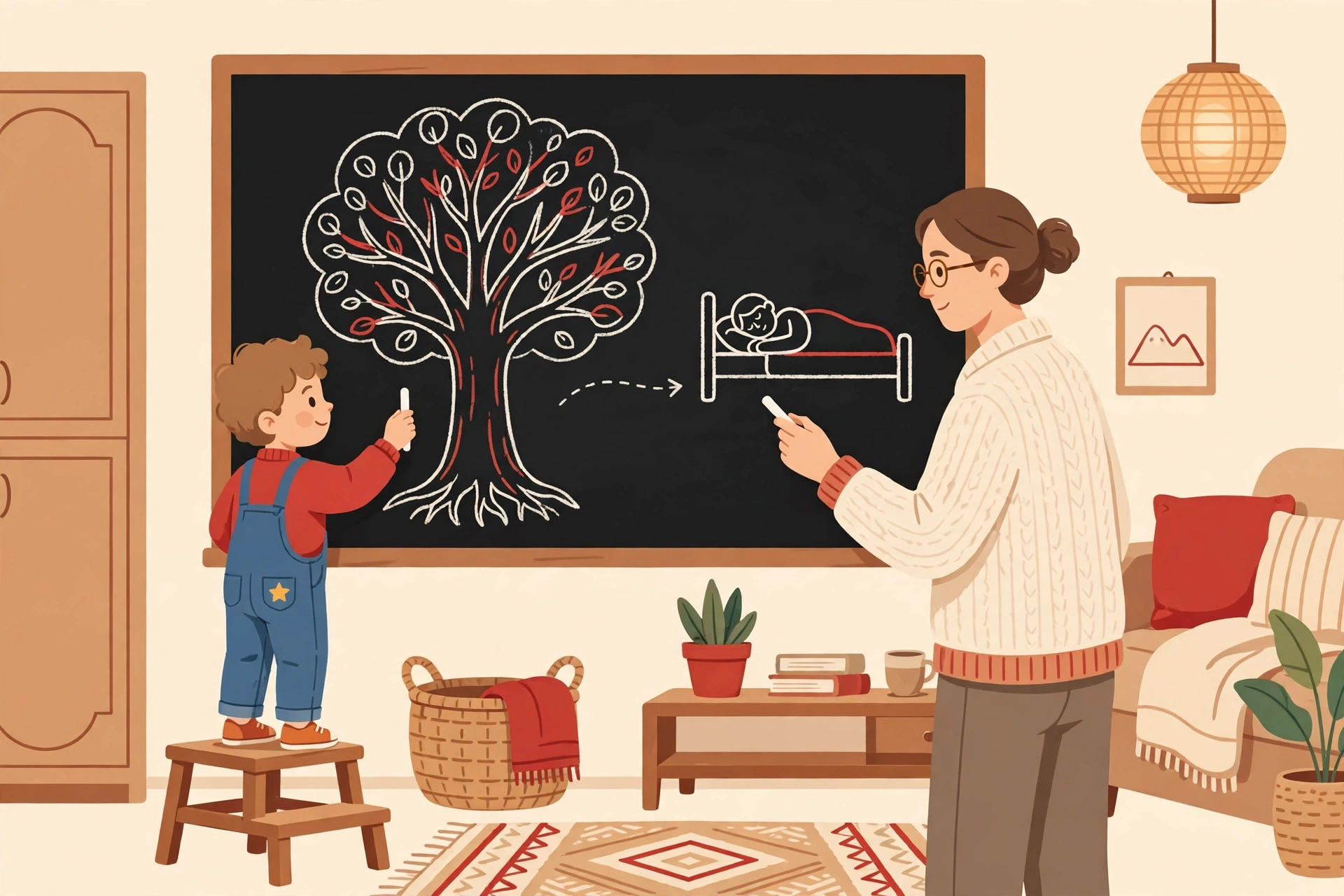
A small tip for busy evenings: tell just one character each evening; telling it while brushing teeth or before bedtime is fine. Your child needs no notebook — just listening and imagining. The next morning, ask again: “Yesterday, what was the character with the person leaning against a tree?” If your child remembers it, you have already won half the battle.
2. Split characters into familiar parts
Instead of memorising the whole character 好 (hǎo, good) as one block, split it apart: 女 (nǚ, girl) + 子 (zǐ, boy) = good. Children remember 2 pieces more easily than 1 unfamiliar block. Parents can review the 20 basic radicals together with their child in the article Chinese characters for beginners: 20 radicals that help you guess the meaning of characters you have never learnt.
Splitting characters also helps your child guess the meaning of new characters. Meeting a character with the radical 水 (shuǐ, water), such as 河 (hé, river) or 海 (hǎi, sea), your child guesses straight away that it is related to water. Meeting a character with the radical 木 (mù, tree), such as 林 (lín, woods) or 森 (sēn, dense forest), your child guesses it is related to trees. Your child does not need to know everything; just knowing “look at the radical and guess the direction of the meaning” already makes them far more confident when they open a book and meet an unfamiliar character.
A small weekend exercise: take a sheet of paper, write the character 好 really big in the middle, then draw two arrows out to 女 and 子. Let your child colour each radical a different colour. Stick that sheet on the fridge for a week. Every time your child walks past, they read it once — no one needs to remind them to study.
3. Write big, write in unusual places — writing messily is fine too
Let your child write characters with chalk in the yard, with a finger in the sand, with a big brush on large paper. When a character is written 10 times bigger than usual, the pressure to “write beautifully” disappears and your child dares to try. Writing messily in the first few weeks is normal — your child’s hand needs time to get used to the strokes.
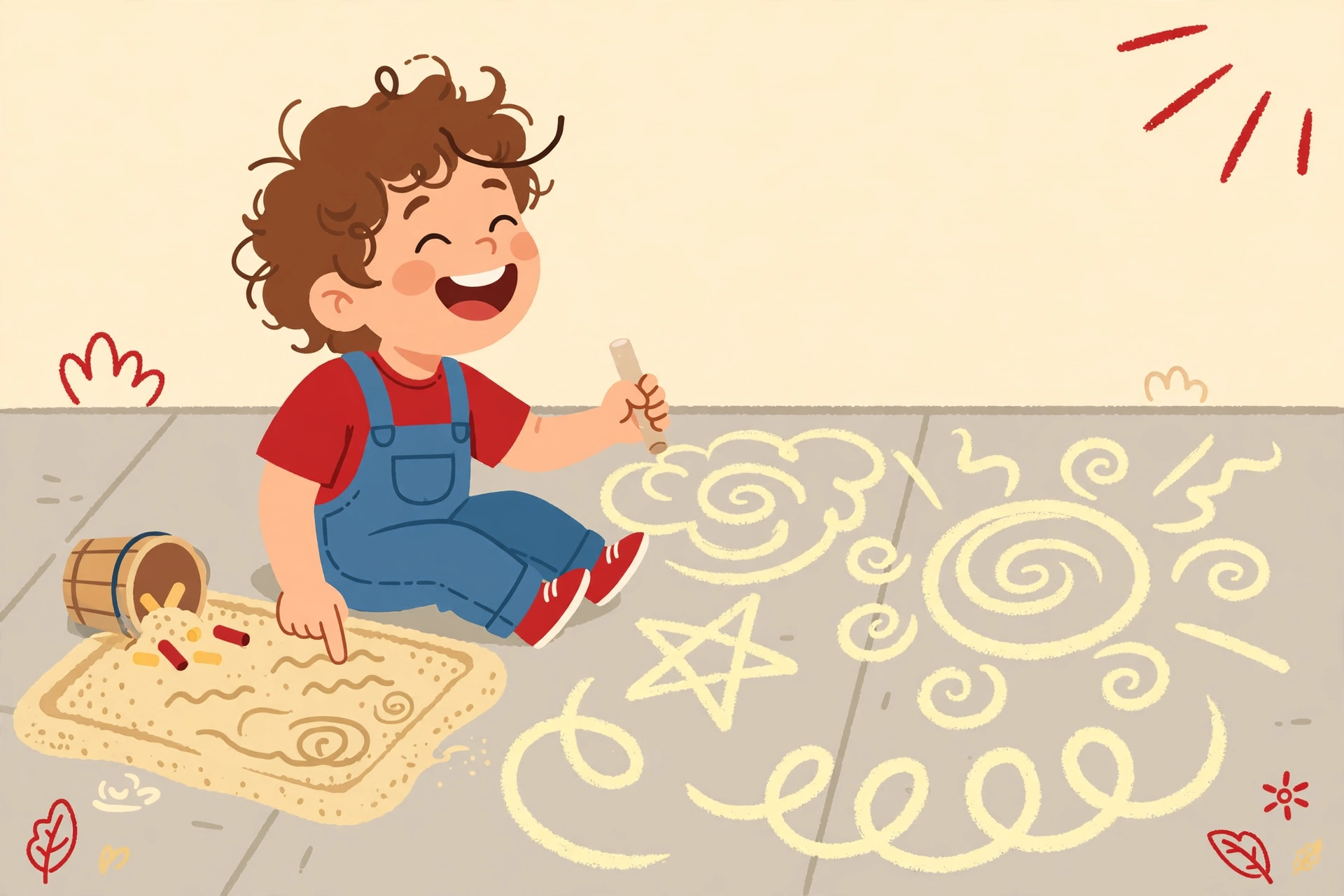
If your home has no yard, write on the bathroom mirror with a finger after a bath, write on a tray of flour while cooking, or write with a big marker on old newspaper. What matters is that your child’s hand can move freely, not squeezed into a small square right from the start. Once the hand is used to a character’s shape at a large size, shrinking it down to notebook size becomes much easier.
One parent once shared: her child would only write when allowed to write with coloured chalk on the balcony, each character as big as a hand span. Two weeks later, she put out an A4 sheet of paper and her child wrote smaller without protesting at all. Change the playground first, change the character size second — that order matters more than we think.
4. Only 3 new characters a day; review old characters with games
Do not assign 20 characters at once. The golden rule: at most 3 new characters a day, and the remaining time goes to games reviewing old characters — guessing characters on cards, finding characters in stories, racing to see who writes faster. Spaced review is what keeps characters in memory for a long time, as the article Your child learns Chinese but keeps forgetting characters: a spaced review schedule for busy parents explains in detail.
Review games need nothing bought. Character cards can be sticky notes cut out, with the Chinese character on the front and the pinyin and meaning on the back. Play face-down cards: turn one over and read it aloud. Play “find the character” in a comic book: whoever finds the character 水 first wins. Play “write on the back”: Mum or Dad writes a character on the child’s back with a finger, and the child guesses which character it is. These three games are enough to rotate through a whole week without getting bored.
Listen and review four familiar characters from this article:
Listen: reviewing the characters for person, tree, rest, girl, boy and good
5. Let your child “teach” Mum and Dad back
Tonight, let your child be the teacher: your child writes a character on the board and explains to Mum and Dad which parts it is made of and what it means. Children remember most deeply exactly what they have taught back to someone else — and the feeling of “I am better than Mum and Dad” is a stronger motivation than any reward.
For this game to be fun, Mum and Dad should play “not knowing” honestly: ask naive questions, write wrongly on purpose so your child can correct you. “Oh, how many strokes does this character have, teacher? Teacher, write it again slowly so Mum can see.” The more your child explains, the more they remember. If your child explains one place wrongly, do not correct them in mid-sentence; wait until they have finished, then ask again: “Just now you said this part is a tree — Mum thinks it really does look like a tree. And what is that other part?” A child who corrects themselves remembers far longer than a child who is corrected.
6. Attach characters to real objects in the home
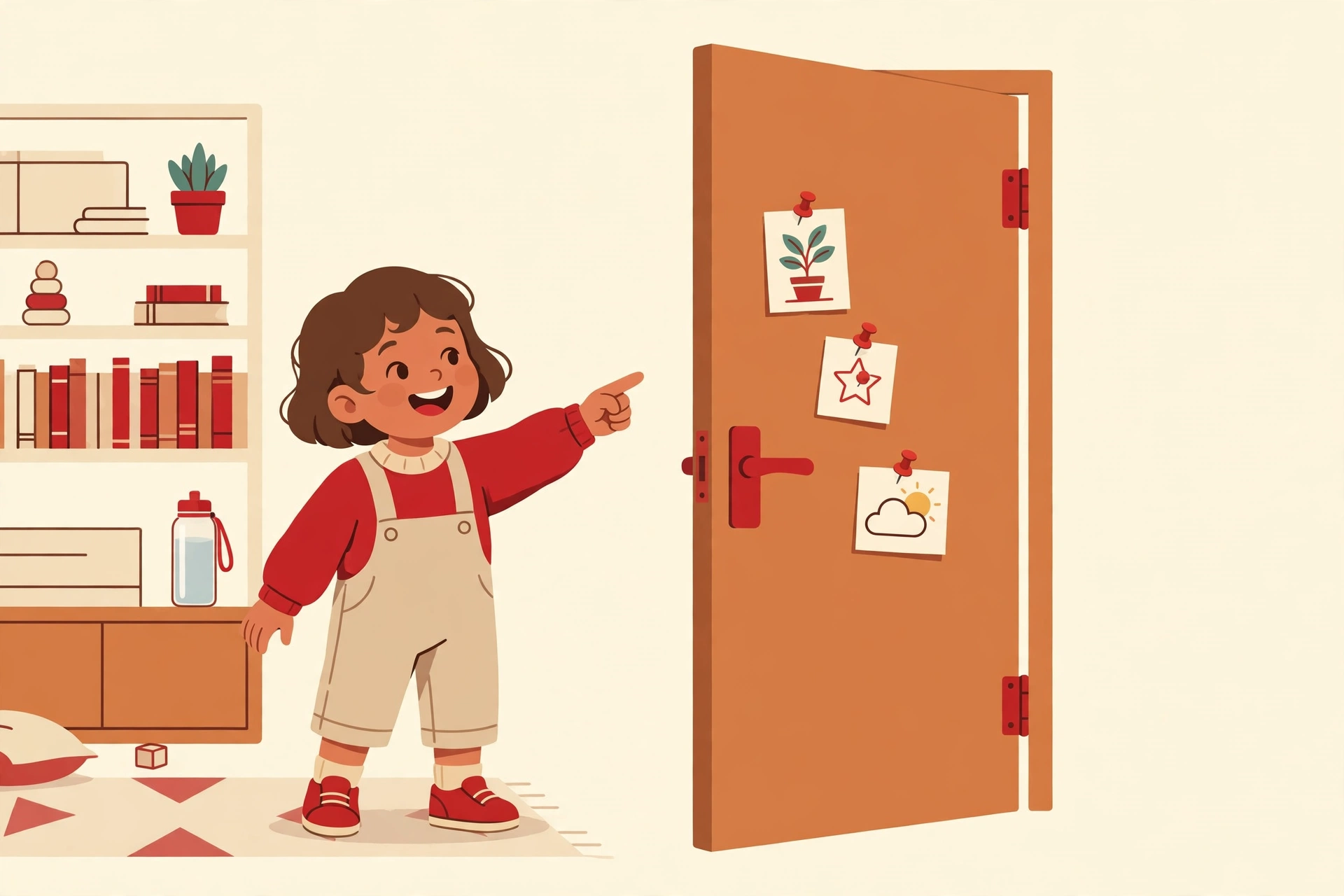
Stick Chinese character labels on objects: 门 (mén, door) stuck on the door, 水 (shuǐ, water) stuck on the water bottle, 书 (shū, book) stuck on the bookshelf. Your child meets the characters every day without needing to “sit down at the desk and study”, and the joy comes from being able to read the labels on the objects in their own home by themselves.
Listen to the three most familiar object labels in the home:
Listen: the characters for door, water and book
Start with just 5 labels; do not label the whole house at once. When your child can read those 5 labels fluently, replace 2 old labels with 2 new ones. The kitchen is the best place for labels: the fridge, the rice cooker and the dining table are all objects your child touches every day. A week later, challenge your child: “Bet you cannot find the character for water in the kitchen within 10 seconds!”
Listen to sentences your child can say every day at home:
Listen: the child asks for water and asks for a book
7. Praise the process, do not only praise the result
Instead of “why is this character so ugly?”, say “today your horizontal stroke is straighter than yesterday’s”. Children are afraid of writing characters mostly because they are afraid of being criticised. When every writing session ends with one specific compliment, your child will ask to write more tomorrow by themselves.
Specific praise means praising exactly one visible point: a straighter horizontal stroke, a character sitting more correctly in its square, today your child remembered the tree radical without being reminded. Avoid generic praise like “well done” after every character, because your child will not know what they did well in order to repeat it. And avoid comparing them with siblings or friends, even accidentally: “Why can your sister write more beautifully than you?” One sentence like that can ruin a whole week of effort.
A sample 15-minute schedule for one week
If you want a concrete schedule to start with tonight, here is one many families can apply: 3 minutes telling the story of one new character, 5 minutes writing big with chalk or a brush, 4 minutes playing cards to review old characters, 3 minutes with your child “teaching back” to Mum and Dad the character just learnt. When the 15 minutes are up, stop, even if your child is still keen. Stopping while it is still fun means your child will want to play again tomorrow; dragging it out until your child is tired means they will avoid it tomorrow.
Monday: learn a new character; Tuesday: review Monday’s character plus one new one; Wednesday: only play the character-hunting game; Thursday: learn a new character; Friday: your child teaches back the whole week; the weekend: rest, or just add one more object label. This schedule is not rigid: busy families can cut it down to 10 minutes, drop the big writing, and keep the storytelling and card games. Regularity is the key point, not a full 15 minutes.
Three mistakes parents often make (and how to avoid them)
The first mistake is assigning too many characters in order to “learn fast”. Learning fast but forgetting fast is not fast at all. Three new characters a day come to nearly 90 characters after a month — a number big enough for your child to read many simple sentences, without any day feeling overwhelming.
The second mistake is correcting every wrong stroke straight away. Your child is writing while Mum or Dad sits beside them saying “wrong, this stroke must go like this” — your child just wants to put the pen down. Let your child finish writing the whole character, then point out just one single point to fix, and fix it by writing a model slowly beside it, not by criticising your child’s character.
The third mistake is rewarding by removing study: “Write 10 characters and then you can play.” This accidentally teaches your child that writing characters is a punishment and playing is the reward. Try swapping it around: the writing time itself is already a game — writing with chalk in the yard, guessing characters, teaching Mum and Dad — so no outside reward is needed any more.
A quick checklist for busy parents
- At most 3 new characters a day; the rest is reviewing old characters through games.
- Every new character has a story or a picture for your child to imagine.
- Write big first, write beautifully later; writing messily in the first few weeks is normal.
- Stick 5 Chinese character labels on objects in the home, replacing them gradually as your child learns them.
- End each session with one specific compliment, on exactly one point of progress.
- Stop while it is still fun; keep study time short but regular every day.
In short: if you want your child to love Chinese characters, put away the copy-punishment notebook — tell stories for characters, play with characters, and praise every small step of progress. With just 15 minutes a day, after one month you will see your child pick up the pen by themselves without being reminded. If your child likes learning through games even more, try Teaching your child Chinese through Chinese character games: 7 games that need no books !
Frequently asked questions
If my child writes messily, should I make them write it again? In the first few weeks, there is no need. Your child’s hand is getting used to the strokes; writing again many times only makes them more afraid. Fix just one point per session, and fix it by writing a model slowly.
My child learns a character today but forgets it tomorrow — what then? That is normal; it does not mean your child is weak. Spaced review — meeting the character again after 1 day, 3 days, then 1 week — is what keeps characters in place. See the detailed review schedule in the article about spaced review linked above.
What if nobody in the family knows Chinese — how do we teach our child? You do not need to know Chinese; you only need to be the “referee” of the games: play the standard model for your child to listen to, keep study time fun, and praise in the right places. The expertise is already in the lessons and model audio on LingoBubbo.
Quick Quiz
Answer 5 quick questions about this article together with your child. Click an answer to see straight away whether it is right or wrong.
Question 1: Which parts is the character 休 (xiū) made of?
Question 2: What does the character 森 (sēn) mean?
Question 3: How many new characters should be learnt at most each day?
Question 4: In the article, the character 水 (shuǐ) is stuck on which object?
Question 5: When praising their child, how should parents praise?
Send this article to a parent who is struggling with their child’s Chinese character writing time, and tell LingoBubbo in the comments: which method will you try first tonight — telling stories for characters, writing with chalk in the yard, or letting your child be the teacher? Keep learning together with your child through the lessons and Chinese character games on LingoBubbo!