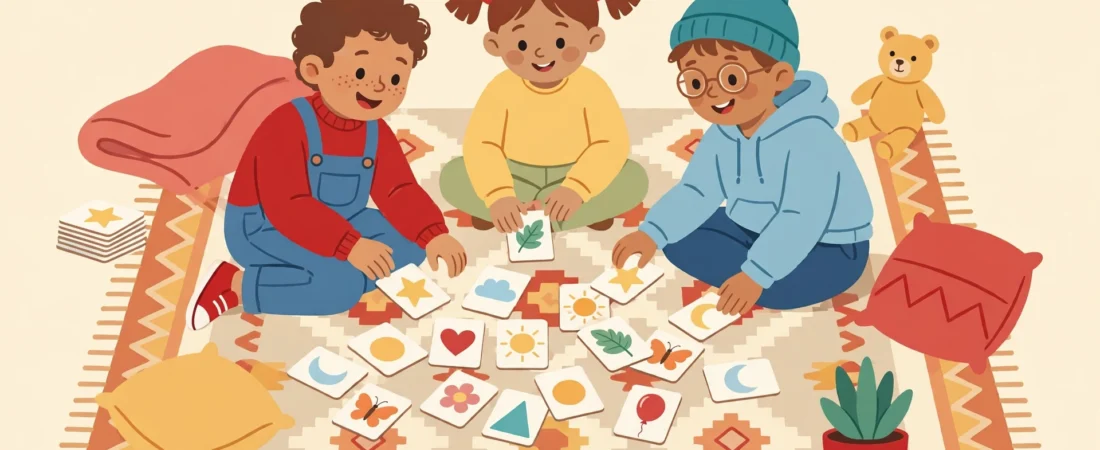
You want your child to get familiar with Chinese, but every time the textbook opens, your child gets bored? With young children, Chinese characters should not start with a writing workbook — they should start with games.
This article suggests 7 Chinese-character games that parents can play with their children right at home. No expensive books needed; each game takes only 10–15 minutes and still helps your child remember the characters naturally.
Why start with games, not writing workbooks?
Chinese characters are pictographic — every character has a shape that hints at a real thing. For children, “looking at a character like looking at a picture” is far easier than “copying characters until they stick”. Games make the most of exactly this: your child looks, guesses, touches, laughs — and the characters quietly stay in their head with no forced studying.
One shared principle for all 7 games below: play only 1 game per session, use only 5–8 new characters per game, and always stop while your child is still having fun — do not wait until they are bored to end the session.
7 Chinese-character games for kids
1. Guess the character from the picture
Draw or print simple pictures (the sun, a tree, a mountain, water) and place them next to the matching character cards: 日 (rì, sun), 木 (mù, tree), 山 (shān, mountain), 水 (shuǐ, water). Your child’s task is to match the right picture to the right character. These pictographic characters are the ideal starting point, because the picture and the character already look alike.
2. Chinese-character bingo
Make a 3×3 bingo board with 9 characters your child already knows, for example: 人 (rén, person), 口 (kǒu, mouth), 手 (shǒu, hand), 大 (dà, big), 小 (xiǎo, small), 天 (tiān, sky), 月 (yuè, moon), 火 (huǒ, fire), 田 (tián, rice field). You read out the pinyin or the meaning, and your child finds and marks the matching character. Whoever completes a row first wins.
3. Treasure hunt around the house
Stick character cards onto the objects in your home: 门 (mén, door) on the door, 床 (chuáng, bed) on the bed, 书 (shū, book) on the bookshelf. Each day, you read out one character and your child runs to find the right object. This game ties characters to real living space, so your child remembers them for a very long time.
4. Build characters with objects
Use ice-lolly sticks, beans or modelling clay to build simple character shapes such as 十 (shí, ten), 工 (gōng, work), 王 (wáng, king). Count the strokes as you build — your child learns stroke order too, with no writing workbook.
5. Sing and move with the characters
Attach a movement to each character: on hearing 上 (shàng, up), raise your hands high; on hearing 下 (xià, down), sit down; on hearing 左 (zuǒ, left), step to the left; on hearing 右 (yòu, right), step to the right. This game suits active children and helps them tell the direction characters apart very quickly.
6. Go fishing for characters
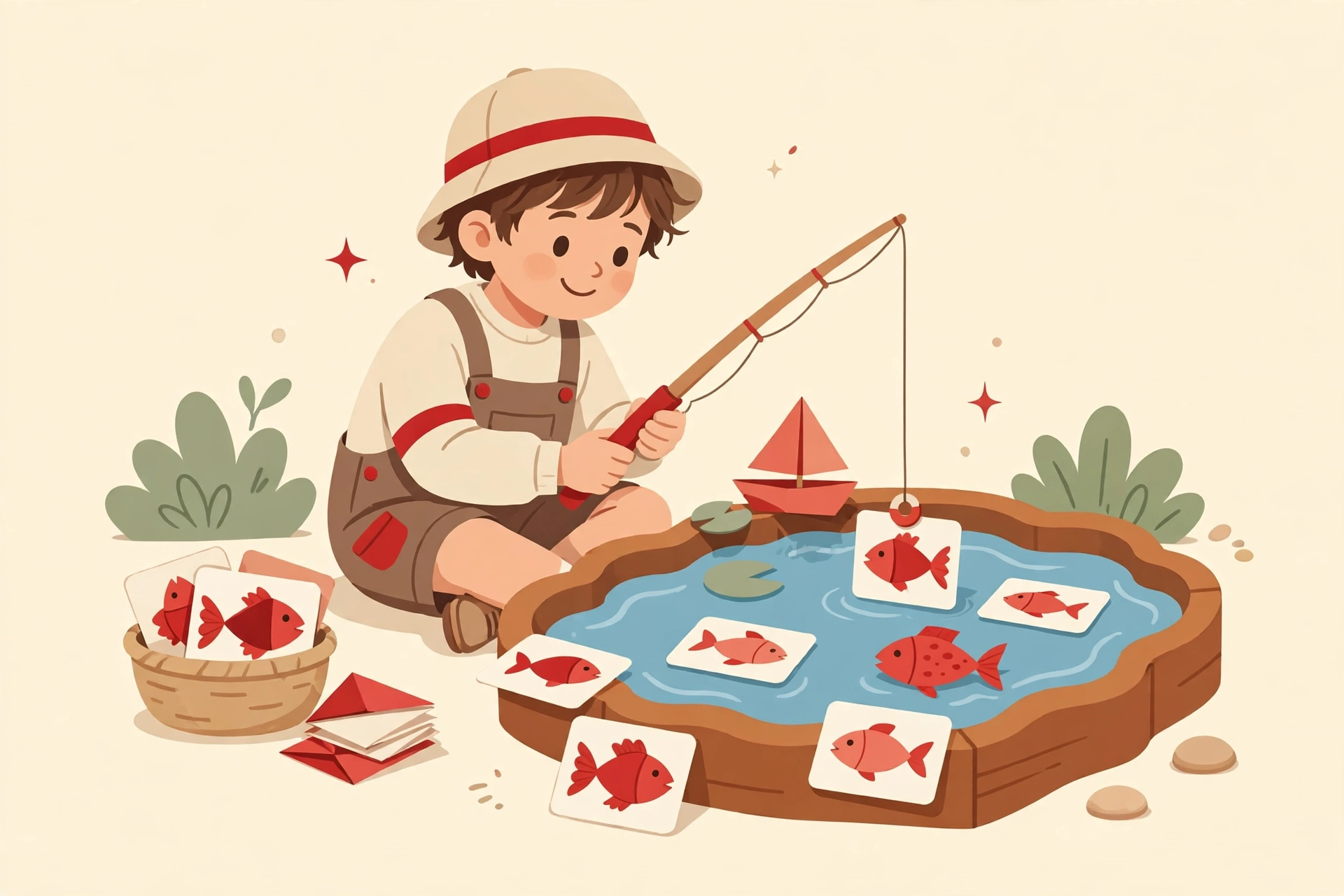
Write characters on small pieces of paper, attach paper clips, and use a magnet on a string to “fish”. You read out a character, and your child fishes up the right “fish” carrying that character. Just 10 characters per session is plenty, and your child will ask to play again and again without realising they are reviewing their lesson.
7. Tell a story with 5 characters
Choose 5 characters your child already knows, for example 人, 山, 水, 日, 月, then make up a short story together using all 5: “A person (人) climbs a mountain (山) to watch the sun (日) and the moon (月) beside the water (水).” Storytelling is the best way for characters to move from “recognising the face” to “being able to use them”.
A suggested play schedule for busy parents
- Mondays, Wednesdays, Fridays: 1 game of 10–15 minutes, 5–8 new characters per session.
- Sundays: review with a bingo game using all the characters learned during the week.
- Every day: stick 2–3 character cards on objects around the house so your child “meets” the characters naturally.
After one month, your child can recognise around 40–60 simple characters — a good enough foundation to step into compound words and short sentences without a shock.
Things parents should avoid
- Do not force your child to write characters from memory too early: writing Chinese characters needs fine motor skills that young children have not yet developed enough — forcing writing early only makes your child afraid of characters.
- Do not teach too many characters at once: 5 characters remembered well are better than 20 characters skimmed and then completely forgotten.
- Do not correct mistakes by shouting: when your child guesses wrong, laugh and play again — a game with pressure is no longer a game.
- Do not compare your child with other children: every child remembers characters at their own pace, and interest matters more than speed.
Start this weekend
This weekend, all you need is to prepare 8 simple character cards (日, 月, 山, 水, 木, 人, 口, 手) and play the picture-guessing game with your child for 10 minutes. If your child laughs and asks to play again, you have succeeded — the rest is simply keeping it regular.
To help your child meet a short Chinese sentence every day in a learn-while-playing way, have a look at the article One Chinese sentence a day with your child on LingoBubbo — every short sentence is a chance for your child to meet again the characters they played with during the week. Chinese characters are not hard; you just need to start the right way: with games, not with workbooks.
Want to learn with a 90-day roadmap?
The HSK 1 lessons on LingoBubbo are always free — and the roadmap package for you: a day-by-day study schedule + an exclusive workbook (not available on the web) + a weekly “what can I say now?” checklist + 186 flashcards, learning as if a teacher were beside you. From only $4.99, one-time purchase, no subscription.
Chinese-character games for children: three play situations right at home
Many parents ask me: we have no Chinese toys at home and not much time either — how can we play? The truth is, Chinese characters are everywhere in your home; you just have not spotted them yet. In a single evening, you can turn three familiar situations into three Chinese-character games for your child without buying anything extra.
The first situation is cooking time. You stick a note with the character 水 shuǐ on the water jug, the character 米 mǐ on the rice jar, and the character 菜 cài on the vegetable basket. Each time your child fetches water, you ask softly: what are you getting? Your child points at the character and reads it aloud. There is no need for your child to read it right straight away. The first time they read it wrong, you read it again slowly, laugh with them, and leave it there. By the fifth time, the tenth time, your child will read it aloud before you even ask. Learning in the middle of housework has one big advantage: the character is tied to smells, to touch, to a real meal, so your child remembers it far longer than a character on a dry paper card.
The second situation is the walk to the school gate to pick your child up, or a stroll around the neighbourhood. You play the character-hunt game: today the whole family looks for the character 人 rén, which means person. Whoever sees a human figure on a sign, in a picture, or on someone’s shirt points and calls out. Tomorrow, switch to the character 大 dà, which means big, and hunt for something big. The lovely thing about this game is that your child is not sitting still to study — they are moving, watching, laughing. Have you ever seen your child remember a word just because they shouted with joy when they found it? Happy emotions are the glue of memory.
The third situation is texting or video-calling the grandparents. You teach your child one character, then let them show off to their grandparents: today I know the character 山 shān, which means mountain. Your child draws a mountain, holds it up to the camera, and reads it aloud. The grandparents say one word of praise, and your child is happy all evening. Children learn because they want to be recognised, and to tell the people they love. One character they can show off to their grandparents is worth more than ten characters read alone in a room.
🎧 Listen and read along: 人 — rén (Person)
Have you noticed? None of these three situations makes your child sit down at a desk. Young children learn Chinese characters best when the character goes together with what they are doing, the people they are meeting, and the feelings they are having. Busy parents can still play, because the game lives inside the routines you already have — it is not one more lesson added to the day.
When your child gets bored of the old game: how to vary it without buying anything new
Every game gets boring eventually, even the best one. The signs your child is bored are usually very clear: they answer just to get it over with, they look away, they ask for the phone. At that point, do not force them to keep playing, and do not rush out to buy a new toy set. You only need to change one small rule, and the old game becomes a new game.
Take the character-card flipping game, for example. In the first week your child flips a card and reads the character. The next week, you change the rule: your child flips a card and must not read it — they have to act it out with their body. Flip the character 大 dà, and they stretch their arms out really wide. Flip the character 小 xiǎo, and they curl up really small. Flip the character 口 kǒu, and they open their mouth wide and laugh. Children love acting, and the body helps them remember meanings more deeply. A character that has passed through their hands and feet stays longer than one that only passed through their eyes.
Another variation is swapping roles. Usually the parents ask and the child answers. Today, let your child be the teacher and the parents be the students, and let the parents deliberately answer wrongly once. Your child will eagerly correct you, laughing while repeating the right character. Think about it — when children get to correct a grown-up, do they not feel cleverer than ever? That sense of mastery feeds their confidence, and confidence feeds a lasting interest in learning.
🎧 Listen and read along: 大 — dà (Big)
You can also change the space: today play in the kitchen, tomorrow in the yard, the day after in the bath, with characters written on the steamed-up mirror. Changing the space wakes the brain up again, just like adults work more enthusiastically when they change cafés. No new toys needed — just one small change in how you play, and the old game feels fun again.
If you want more ideas for playing with your child every day, drop by One Chinese sentence a day with your child on LingoBubbo. One sentence a day, a few minutes of playing with your child, and after a month your child already has a whole stock of real conversation sentences.
A fun tracking chart: which characters has your child played with?
Parents do not need a score sheet, but a wall chart is very much worth having. Not to grade your child — but so your child can see for themselves how far they have come. Draw a simple chart; each character your child plays with confidently gets a star, or draw a flower next to that character. Your child looks at the chart every morning and sees: oh, I already know this many characters.

| Character | Meaning | Where did your child play with it? | Who has your child shown it off to? |
|---|---|---|---|
| 人 rén | person | on walks around the house | grandparents over video |
| 大 dà | big | acting it out with the body | mum and dad |
| 水 shuǐ | water | in the kitchen while cooking | older siblings |
| 山 shān | mountain | drawing a picture to show the grandparents | grandparents |
Do you find the last column odd? I added the “who has your child shown it off to” column on purpose, because children remember a character longer when it is tied to a specific person and a specific word of praise. A character your child can show off becomes your child’s own character. A character only read in a room, told to no one, drifts away much faster.
At the weekend, sit with your child, look at the chart together and ask: which new character do you want to play with next week? Let your child choose, whether they pick a hard character or an easy one. When children get to choose, they play far more eagerly. If your child picks a character you do not know either, the two of you learn it together — get it wrong together, laugh together. Parents do not need to know everything to teach their child. Parents only need to play with their child — regularly, and happily.
🎧 Listen and read along: 水 — shuǐ (Water)
Try it tonight: stick one character on the water jug, and when your child fetches water, ask just one soft question. Do not ask many, do not test. Just one question, one smile. Tomorrow you will be surprised — your child reads that character aloud before you even ask.
Quick Quiz
Question 1: Why does playing with characters while cooking help your child remember for longer?
Question 2: How do you play the 人 rén character-hunt game?
Question 3: When your child gets bored of the card-flipping game, which variation is suggested?
Question 4: Why does the tracking chart have a “who has your child shown it off to” column?
Question 5: What does the character 水 shuǐ mean?
Playing with your child does not need to be perfect — it just needs to be regular and fun. Come back to LingoBubbo for more play ideas every day, share this article with a parent who is also teaching their child Chinese, or leave a comment telling us which game your child loves most — who knows, that game might become a great suggestion for many other families.