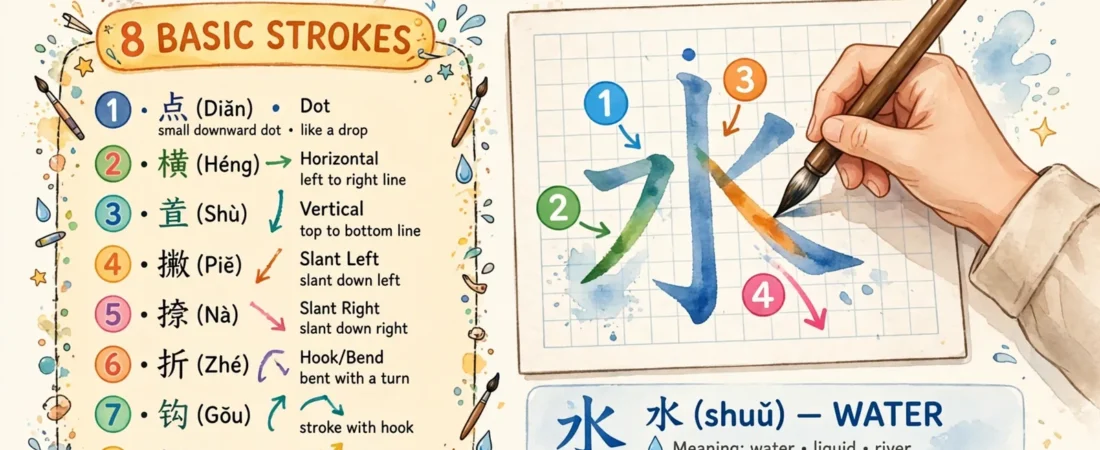
You look at a Chinese character and all you see is a jumble of horizontal and vertical lines that makes your eyes cross? Good news: almost every Chinese character is assembled from just 8 basic strokes. Learn these 8 strokes and you’ll know where to start writing, in what order, and why other people’s characters look like real characters while yours look like a pile of matchsticks. This post walks you through the 8 common Chinese character strokes and how to practise them as a complete beginner, with real example characters and short exercises you can try tonight.
One thing to make clear first: Chinese character strokes are the same in both the HSK 2.0 and HSK 3.0 syllabuses, because they are the general writing rules for simplified characters, not knowledge tied to any one exam set. Learn them once and you can use them with every textbook from here on.
Why learn strokes before learning characters?
Imagine learning to write the letter “a” without knowing whether the curved part or the straight part comes first. Chinese characters are the same, except each character has more strokes. The general rules Chinese people follow when writing are: top to bottom, left to right, horizontal before vertical, outside before inside, and the middle first, then the two symmetrical sides. That sounds like a lot, but once you know the 8 basic strokes, these rules start to make sense on their own, because you can look at a character and immediately see which strokes it is made of.
Another benefit few people mention: knowing strokes helps you look characters up in a dictionary by radical and stroke count, guess at characters when reading signs, and type characters on your phone using stroke-based input. In other words, these 8 strokes are the key that unlocks the whole world of Chinese characters behind them.
Listen to the 8 basic stroke names read aloud
The 8 common Chinese character strokes: names, how to write them, and examples
Below are the 8 strokes you’ll meet in most of your first Chinese characters. Read each one slowly, look at the illustration, then try writing it on squared paper. Squared paper matters a lot for beginners: the grid keeps your characters from drifting and coming out in random sizes.
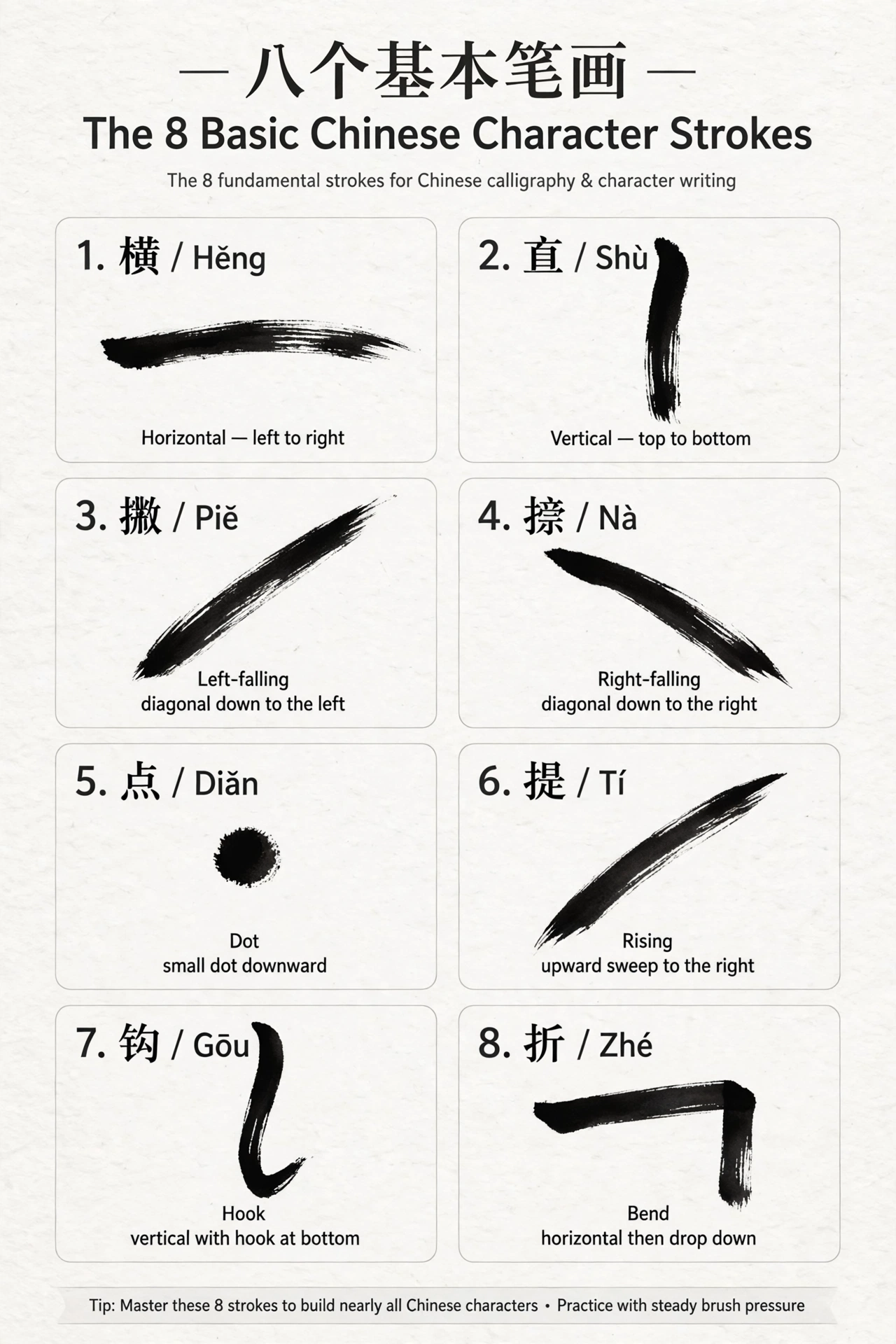
- 1. Horizontal stroke — 横 (héng). Write from left to right, rising very slightly at the end. Example: the character 一 (yī — the number one) has exactly one horizontal stroke. Common mistake: writing the horizontal stroke with its head drooping down, which makes the character look sad.
- 2. Vertical stroke — 竖 (shù). Write from top to bottom, straight up and down. Example: the character 十 (shí — ten) is made of one horizontal stroke and one vertical stroke. Common mistake: writing the vertical stroke at a slant, so the character leans to one side.
- 3. Left-falling stroke — 撇 (piě). Write diagonally from the top right down to the bottom left, thick at the start and pointed at the end. Example: the character 人 (rén — person) begins with a left-falling stroke. Common mistake: making this stroke too long, so the character loses its balance.
- 4. Right-falling stroke — 捺 (nà). Write diagonally from the top left down to the bottom right, with the end flicking out like the edge of a blade. Example: the character 人 (rén) ends with a right-falling stroke. The left-falling and right-falling pair in 人 looks like two human legs standing, which makes it easy to remember.
- 5. Dot stroke — 点 (diǎn). A small dot, written from top to bottom with a slight tilt. Example: the character 小 (xiǎo — small) has a dot stroke on each side. Common mistake: making the dot round like a Vietnamese full stop, when a Chinese dot stroke should have a pointed head and a clear direction.
- 6. Rising stroke — 提 (tí). Flick up from the bottom left to the top right, short and neat. Example: the character 冰 (bīng — ice) has a rising stroke at the end. This stroke is often written too long, making the character look as if it is about to topple over.
- 7. Turning stroke — 折 (zhé). A stroke that changes direction halfway, for example going horizontally then turning down into a vertical. Example: the character 口 (kǒu — mouth) is all turning strokes and horizontal-vertical combinations. The turning stroke asks you to pause lightly at the corner and then change direction decisively — don’t round the corner off.
- 8. Hook stroke — 钩 (gōu). A vertical or horizontal stroke ending in a small upward hook. Example: the character 小 (xiǎo) has a hook stroke in the middle, and 水 (shuǐ — water) begins with a vertical hook stroke. The hook is only a small flick at the end — don’t make it so big it turns into the letter J.
Summary table of the 8 strokes — print it out and stick it on your desk
This table gathers all 8 common Chinese character strokes. Screenshot it or print it out and keep it in sight whenever you practise writing.
| Stroke | Chinese name | Pinyin | Writing direction | Example character |
|---|---|---|---|---|
| Horizontal |
横

|
héng | Left to right | 一 (yī — one) |
| Vertical |
竖
|
shù | Top to bottom | 十 (shí — ten) |
| Left-falling |
撇

|
piě | Top right down to bottom left | 人 (rén — person) |
| Right-falling |
捺

|
nà | Top left down to bottom right | 人 (rén — person) |
| Dot |
点

|
diǎn | Top to bottom, slightly tilted | 小 (xiǎo — small) |
| Rising |
提

|
tí | Bottom left up to top right | 冰 (bīng — ice) |
| Turning |
折

|
zhé | Changes direction halfway | 口 (kǒu — mouth) |
| Hook |
钩

|
gōu | Ends in a small hook | 水 (shuǐ — water) |
The character 永 (yǒng) — one character that practises all 8 strokes
People in the old days had a very neat trick called the “Eight Principles of Yong” (永字八法): the character 永 (yǒng — forever) contains all 8 basic strokes in a single character. That means just practising 永 until it looks good takes you through all 8 strokes. How to practise: write 永 10 times a day for a week, writing slowly each time and silently counting the stroke order: dot, horizontal, vertical, hook, rising, short left-fall, long left-fall, right-fall. After a week, your hand will gradually get used to the rhythm of writing Chinese characters.
Listen: the character 永 gives you all 8 strokes in one
How to practise the 8 strokes in 15 minutes a day
You don’t need to set aside a whole hour. A regular 15-minute session every day beats one 2-hour session followed by a week off by a long way. Here’s a suggested practice schedule:
- Minutes 0–3: Warm up your hand. Write each stroke on its own 5 times on squared paper — no need to form characters yet. Just train your hand to make straight strokes and curves evenly.
- Minutes 3–10: Write real characters. Each day, pick 3 characters from the example table above: 一, 十, 人, 小, 口, 水. Write each character 5 times, saying the stroke names quietly to yourself as you write.
- Minutes 10–15: Compare and fix. Look back at the row of characters you just wrote, circle the best-looking one and the worst one, and ask yourself: which stroke is making the character look bad? Next round, fix just that one stroke.
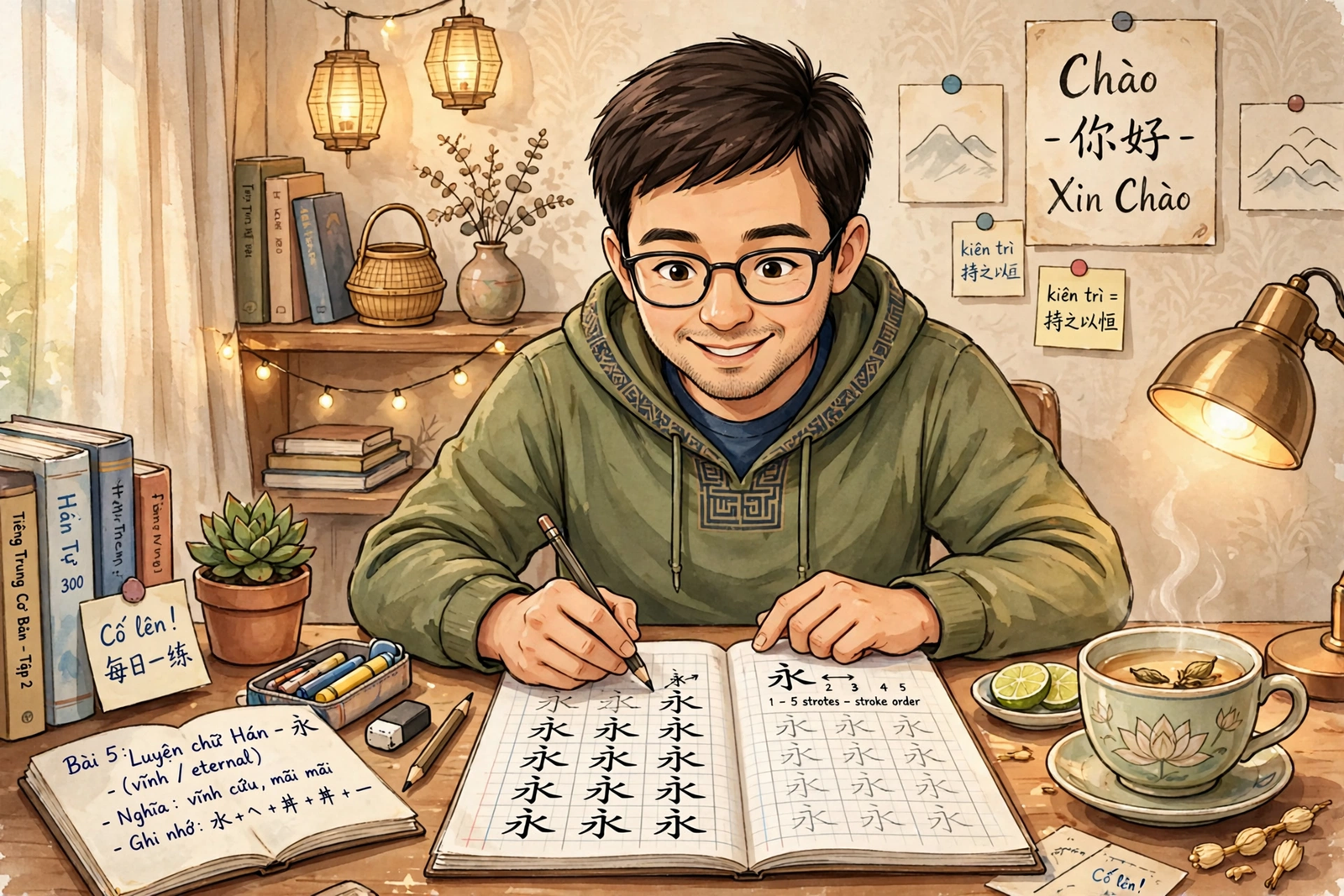
One small tip from teaching beginners: don’t write your characters too big. Big characters hide mistakes; characters that just fill one grid square show clearly which stroke is off. Once your characters sit neatly in a square, they’ll look good big or small.
Stroke order for the first 3 characters you’ll write
Listen to the stroke order of 人
The character 人 (rén — person), 2 strokes: the left-falling stroke first, then the right-falling stroke. The two strokes meet at the top and spread out like a person’s two legs.
Listen to the stroke order of 水
The character 水 (shuǐ — water), 4 strokes: the vertical hook stroke in the middle first, then the horizontal left-falling stroke on the left, the left-falling stroke on the right, and finally the right-falling stroke. The rule “middle first, then the two sides” shows up clearly in this character.
The character 小 (xiǎo — small), 3 strokes: the vertical hook stroke in the middle first, then the left dot and the right dot. The most common mistake is writing the two dots first and the middle stroke afterwards, which throws the character off balance.
5 short exercises to learn the 8 strokes this week
- Exercise 1: Look at any Chinese character in a book and try naming each of its strokes before checking the answer.
- Exercise 2: Write the character 永 10 times, silently counting all 8 strokes each time.
- Exercise 3: Write the 3 characters 一, 十, 人, 10 times each, so that all the characters in a row are the same height.
- Exercise 4: Quiz a family member or a study buddy: you call out a stroke name, they write that stroke on paper. Whoever gets more wrong makes the tea.
- Exercise 5: Open the LingoBubbo Chinese character dictionary, choose any 5 characters, look at their stroke order, then write along with it.
Common mistakes when practising the 8 Chinese character strokes
First, writing the horizontal stroke drooping down or flicking up too much at the end. A standard horizontal stroke rises only slightly at the end and stays nearly level. Second, rounding the corner of the turning stroke: the turn must be sharp and decisive. Third, making the hook stroke too big, which weighs the character down at its foot. Fourth — and most common of all — learning the wrong stroke order from the start and practising it into a hard-to-fix habit. Writing slowly in the right order is better than writing fast in the wrong order, because stroke order also affects how you look characters up in a dictionary and type them later.
If you want to understand more deeply why stroke order matters so much, read the post HSK 1 handwriting practice: the stroke order of the 22 characters beginners write wrong most often and the post 20 radicals that help you guess the meaning of words you’ve never learnt — these two posts pick up exactly where today’s post leaves off.
Quick quiz: do you know your 8 strokes yet?
Tap the answer you choose — you’ll know right away whether it’s right or wrong.
Your score: 0/5 — click an answer to check it right away.
Question 1. Which stroke is 横 (héng)?
Question 2. In what order do you write 人 (rén)?
Question 3. How many strokes does 水 (shuǐ) have?
Question 4. Which character contains all 8 basic strokes in a single character?
Question 5. What stroke is 钩 (gōu)?
Frequently asked questions about the 8 Chinese character strokes
Do beginners need to learn all 8 strokes before learning characters? You should get to know the 8 strokes first, but you don't need to memorise them by heart before learning characters. The best way is to learn both in parallel: for each new character you learn, name its strokes. Within a few weeks you'll know both.
Does writing in the wrong stroke order matter? Readers will still understand your characters, but they'll be hard to make beautiful, and you'll struggle when looking characters up by stroke or typing with stroke input. Fixing it early is always easier than fixing it late.
What pen should I practise with? A pencil or a ballpoint pen is fine. What matters is squared paper and writing slowly. Save the brush pen for later, once your hand is steady.
How long until my Chinese handwriting looks good? There's no single number, but with 15 minutes a day, after about a month you'll see your characters become noticeably neater. Good handwriting is a matter of persistence, not talent.
Do these 8 strokes apply to traditional characters too? Yes. The basic strokes are the shared foundation of Chinese characters — simplified and traditional characters use the same stroke system; they differ only in the number of strokes and the shape of some characters.
Tonight, why not try writing 永 10 times? Take a photo of your first row of characters, then write it again a week later and compare — you'll be surprised at the difference. If your friends or your children are also practising Chinese characters, send them this post, and leave a comment telling me which stroke you "wrestled" with most — I'll untangle it in the next post. To keep practising, head to LingoBubbo's Chinese character dictionary to look up the stroke order of any character you come across.
📷 Image credits: real photos from the open photo libraries Openverse / Wikimedia Commons / Flickr (licences CC0, CC BY, CC BY-SA) — one real-life photo for each word, no AI drawings. Stroke-order animations: Make Me a Hanzi data (HanziWriter).