
Say qī out loud right now. Did it come out sounding like “chee,” or maybe like “kee”? If so, you are in very good company. The pinyin q is one of the three sounds that trip up almost every beginner, and most learners keep mispronouncing it for months simply because nobody ever showed them where the tongue goes. Five minutes a day with the right mouth position fixes it for good, and this guide shows you exactly how.
What the pinyin q really sounds like
Here is the short version: q is an aspirated sound, which means it comes out with a strong puff of air. Say the English word “cheese” and hold your hand in front of your mouth. Feel that little burst? Now say qī. The burst should feel stronger, sharper, and cleaner. The tongue sits in a different place too, which is why “cheese” is only a rough cousin, never a twin.
Phonetically, q is written as [tɕʰ]. You do not need to memorize that symbol, but it helps to know what your mouth is doing. The tip of your tongue rests behind your lower teeth and stays there. The middle of your tongue — the blade — lifts up toward the hard palate, the bony roof of your mouth. Air builds up behind that narrow gap and then releases in one crisp puff. Your lips stay spread, almost in a slight smile, and they never round the way they do for an English “oo” or “qu.”
Two things q is not. It is not the English letter q, so “queen” will lead you astray. And it is not a plain “ch.” If a native speaker hears “chee” when you meant qī (七, seven), they will probably still understand you from context, but the accent will sound noticeably off, and in some words the meaning can genuinely blur.
One more fact that surprises learners: q only ever appears before i and ü. You will never see qa, qo, or qu with a plain u in real pinyin. Keep that in your back pocket — it becomes a useful spelling check later.
The mouth position, step by step
Forget the diagram for a second and do this with me. It takes thirty seconds.
First, smile slightly and let your tongue tip drop down behind your lower front teeth. Leave it there. That is the hardest part to remember, because English “ch” wants the tongue tip to jump up. For q, the tip stays down the whole time.
Second, lift the middle of your tongue toward the roof of your mouth until the gap feels narrow, like you are about to say “y” in “yes.” Hold that shape.
Third, breathe out in one short, strong puff while releasing into an “ee” sound. Qī. You should feel cool air on the back of your hand if you hold it a few inches from your mouth. If you feel almost nothing, you are probably saying j, the unaspirated partner of q. Push more air.
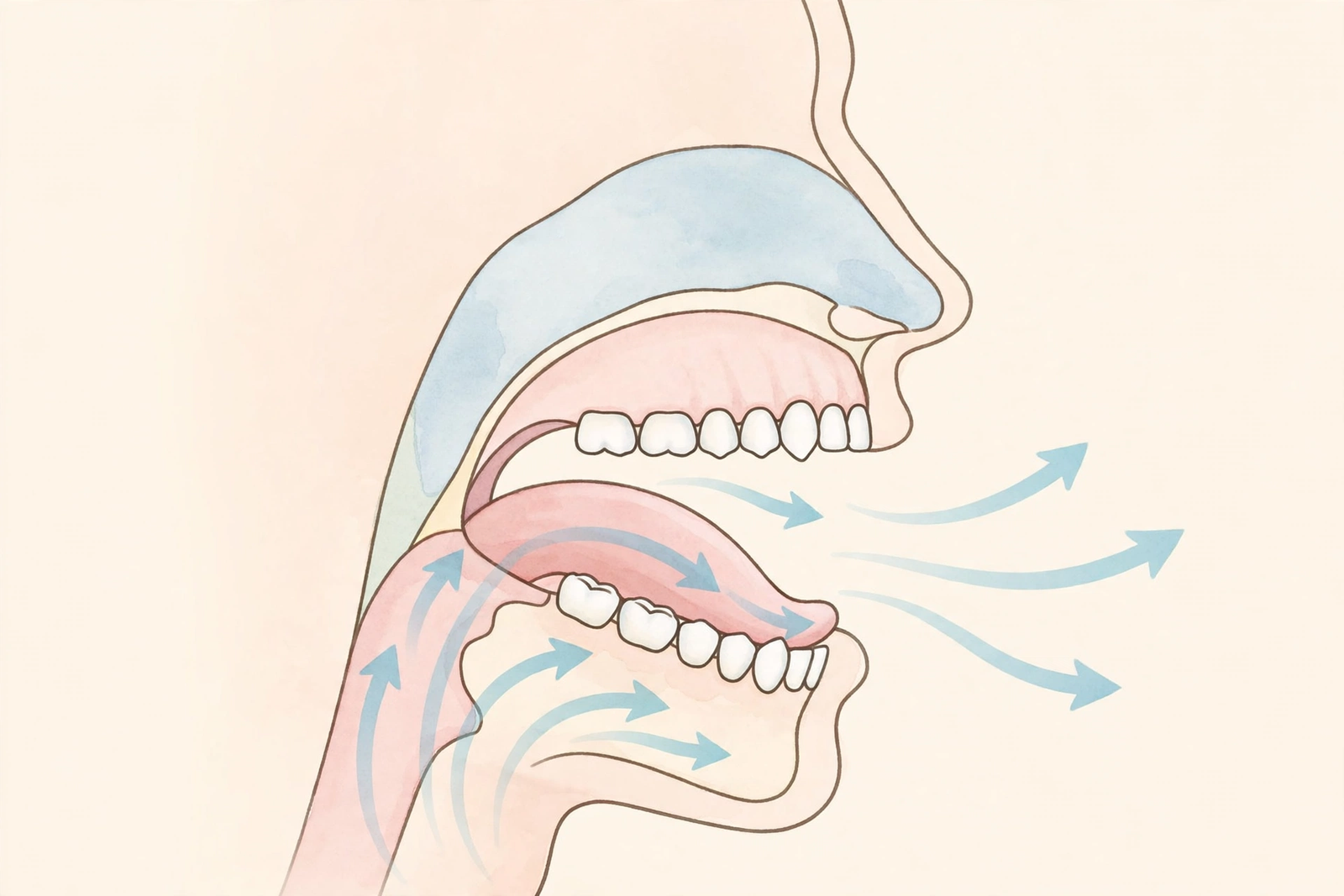
Now try it with a mirror. Watch your lips. If they round or push forward, reset them into that light smile. Round lips turn q toward ch, which is exactly the habit we are breaking. Three slow repetitions in the mirror, then three at normal speed, and you have done the hardest part of today’s practice.
Q in all four tones
Tones change meaning in Mandarin, so q is not one sound — it is four, one per tone. The good news is that you can learn all four with four everyday words. Listen to the clip, then say each word after it, exaggerating the tone the first few times.
| Pinyin | Character | Tone | Meaning |
|---|---|---|---|
| qī | 七 | 1st — high and flat | seven |
| qí | 齐 | 2nd — rising | neat, together |
| qǐ | 起 | 3rd — dipping | to rise, to get up |
| qì | 气 | 4th — falling, sharp | air, breath |
A quick note on levels, since learners often ask: 七 (qī), 去 (qù), and 请 (qǐng) — three of the words in this guide — are HSK 1 words in both the HSK 2.0 syllabus and the newer HSK 3.0 syllabus (Level 1). So this is not advanced material. It is day-one vocabulary, which is exactly why it is worth getting right early, before the wrong habit settles in.
Say the four words in a row, slowly: qī — qí — qǐ — qì. Then again, a little faster. If the third tone feels wobbly, that is normal; the dip takes the longest to feel natural. Keep the mouth position identical for all four and let only the pitch move.
Everyday q words you will actually use
Tones are easier to remember when they live inside words you need. These six show up constantly in beginner conversations, and every one of them starts with q.
| Pinyin | Character | Meaning | Where you will use it |
|---|---|---|---|
| qǐng | 请 | please | 请坐 (qǐng zuò) — please sit down |
| qù | 去 | to go | 我去学校 (wǒ qù xuéxiào) — I go to school |
| quán | 全 | whole, complete | 全部 (quánbù) — all, everything |
| qiū | 秋 | autumn | 秋天 (qiūtiān) — autumn, fall |
| qū | 区 | district, area | 地区 (dìqū) — region |
| qún | 群 | group, crowd | 一群人 (yì qún rén) — a group of people |
Notice something about the spelling: 去 is written qù, but the vowel is really ü, not u. After q (and after j and x), the two dots on ü are dropped in writing, so qù is pronounced with rounded lips on the vowel — “chü” with a q start, never “koo.” The same rule hides inside 全 (quán) and 群 (qún). If you ever catch yourself saying “kwan” for 全, that dropped-dot rule is the thing you forgot.
Q in real sentences
Sounds stick when they carry meaning. Read each sentence aloud, then listen to the clip and compare. Slow is fine. Clear beats fast every single time.
- 请问,去火车站怎么走?(Qǐngwèn, qù huǒchē zhàn zěnme zǒu?) — Excuse me, how do I get to the train station?
- 秋天很美,我喜欢秋天。(Qiūtiān hěn měi, wǒ xǐhuan qiūtiān.) — Autumn is beautiful. I love autumn.
- 七个人一起去。(Qī gè rén yìqǐ qù.) — Seven people are going together.
- 请起立。(Qǐng qǐlì.) — Please stand up.
Did you catch how many q sounds hide in that third sentence? 七 (qī), 一起 (yìqǐ), 去 (qù) — three in one short line. Sentences like that one make excellent daily drills precisely because they force the mouth to reset to the q position again and again.
Q vs. ch: the mix-up that gives you away
If q has a rival, it is ch. Both are aspirated, both start with a burst of air, and English speakers tend to collapse them into one sound. Native ears hear the difference instantly, though, and it comes down to one thing: where the tongue tip is.
For q, the tongue tip stays down behind the lower teeth, and the blade rises to the hard palate. For ch, the tongue tip curls up and back toward the roof of the mouth. Say 七 (qī, seven) and then 吃 (chī, to eat) back to back. Qī feels flat and forward in the mouth. Chī feels curled and further back. That is the whole difference, and once you can feel it, you can hear it too.
Try this little test on yourself. Say this pair three times, slowly: 七,七,七 — 吃,吃,吃. If the two words start to sound identical, your tongue tip has drifted up. Drop it back behind the lower teeth and try again. This pair is worth keeping in your practice rotation for a week; it is the fastest way to lock the distinction in.
Five short practice drills
The bank outline for this topic asks for five short exercises, and here they are — each one takes about a minute. Do one a day, or run all five in a single five-minute session.
1. The hand test. Hold your palm a few inches from your mouth. Say qī five times. You should feel a clear puff on every single one. Then say jī five times. Almost no puff, right? That contrast is your built-in checker. If q starts feeling like j, your air has gone missing.
2. Tone ladder. Climb the tones in order — qī, qí, qǐ, qì — then climb back down. Do it three times, then swap in a new word family: xī, xí, xǐ, xì is a good partner drill, since x is q’s unaspirated cousin and uses the same tongue shape.
3. Word chain. Say 请 (qǐng), then build a sentence with it: 请坐. Add another word: 请坐下. Keep adding until the sentence is five words long, then start over with 去. Chaining forces your mouth to find q quickly, the way real conversation demands.
4. The mirror minute. Stand in front of a mirror and say the four tone words — 七,齐,起,气 — while watching your lips. Smile shape the whole time. If your lips round on any word, say that word five extra times. This drill looks silly and works wonderfully.
5. The sentence sprint. Take the sentence 七个人一起去 and say it five times in a row, a little faster each time. The goal is not speed for its own sake; it is keeping q crisp while the rest of the sentence moves at normal pace. When the sentence stays clean at full speed, the sound is yours.

Mistakes to watch for
Before the quiz, here is the short checklist I hand to my own students. If a sentence feels off, run down this list.
| Mistake | What it sounds like | The fix |
|---|---|---|
| Saying q like English “k” or “qu” | “kee” instead of qī | Tongue tip down, blade up, strong puff |
| Saying q like “ch” | 七 sounds like 吃 | Drop the tongue tip behind the lower teeth |
| Forgetting the air | q sounds like j | Hold your hand up — no puff, no q |
| Rounding the lips | q drifts toward ch | Keep the light smile shape |
| Reading qù as “koo” | 去 sounds wrong | Remember the hidden ü: qù is q + ü |
| Flat tones | all four tones sound alike | Exaggerate the pitch shape for a week |
Print that table, or copy it into your notebook. Checking yourself against it once a day beats an hour of unfocused repetition.
Quick Quiz
Try these five questions now. Click an answer to see right away if you are correct. Keep an eye on your score at the top.
Score: 0/5
1. Where does the tip of your tongue rest when you say q?
2. What does 七 (qī) mean?
3. Which of these words does NOT start with q?
4. Why is 去 written as qù instead of qü?
5. What is the fastest way to check whether your q has enough air?
Frequently asked questions
Is q pronounced like “ch” in English? Close, but no. English “ch” curls the tongue tip up and back. For q, the tip stays down behind the lower teeth and the middle of the tongue does the work. That one difference is what makes q sound like q.
Why does q only go with i and ü? That is simply how Mandarin syllables are built. The sounds j, q, and x are made with the tongue in a high, forward position, and they only combine with the high front vowels i and ü. You will never need qa or qo, so treat any word starting with q as a signal to shape an “ee” or “ü” vowel next.
How long does it take to fix a bad q habit? Most learners hear a clear difference within a week of five-minute daily drills, and the new habit usually sticks after two to three weeks. The hand test and the mirror minute are the two drills that move the needle fastest.
Do I need to learn q before HSK 1? Yes — q shows up in HSK 1 words such as 七, 去, and 请 in both the HSK 2.0 and HSK 3.0 syllabi, so it is one of the first sounds worth getting right.
Keep going
Five minutes a day is all this takes. Pick one drill from the list, run it before breakfast or on your commute, and let the q sound settle in while you learn the rest of your vocabulary. When you are ready to hear how q sits next to every other initial, open the Pinyin Chart tool and tap through the full chart — listen to q, then j, then x, and feel how the tongue barely moves between them. If you want more beginner vocabulary built the same way, our HSK 2 weather and seasons vocabulary post is a good next step, and how to use 了 for past events shows you what to do with these words once you can say them.
Did the hand test surprise you? Tell us in the comments which mistake from the checklist was yours — and share this guide with a friend who keeps saying “chee” when they mean qī.