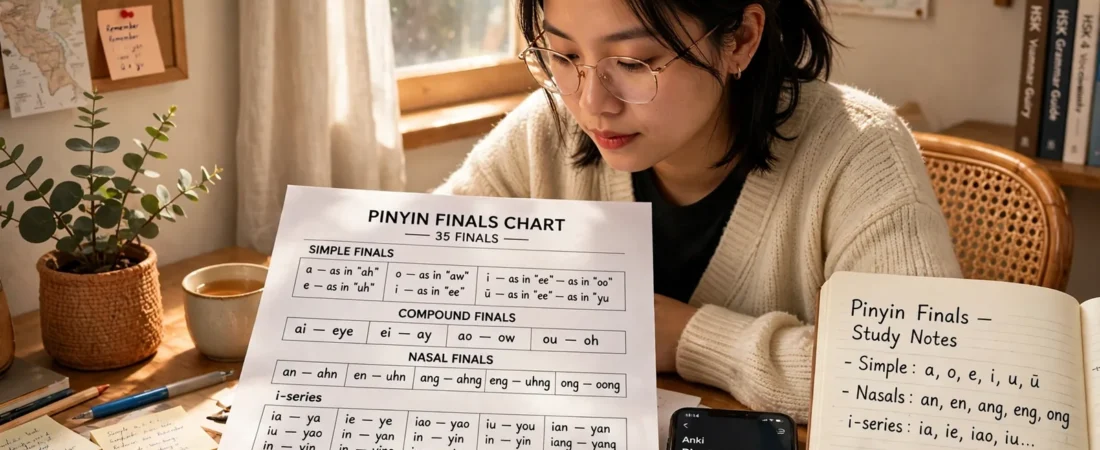
Have you ever read out every single letter “correctly” and still watched your listener frown, not understanding a word? For many people starting Chinese, the culprit is the final — the tail of the syllable, the part that decides whether a word sounds crisp and clear or whether everything blurs into vague sameness. The Chinese finals chart with examples and audio below gathers all the common finals in one place, each with a real word, a pronunciation guide close to how it sounds, and audio so you can listen and repeat straight away.
This article is for beginners working on pronunciation. You do not need to memorise the whole chart in one sitting — just read group by group, listen to the audio, then do the 5 short exercises at the end of the article. Each group takes only a few minutes, but once you can read finals correctly, learning new words later becomes twice as fast.
What is a final, and why do you keep misreading it?
A Chinese syllable has three parts: the initial is the opening consonant, the final is everything that remains, and the tone is the pitch of your voice. Take the character 妈 (mā, mother): m is the initial, a is the final, and tone 1 is the tone. In 光 (guāng, light), g is the initial, uang is the final, and tone 1 is the tone. The final is the “resonating” part of the syllable — it begins at the vowel and stretches to the very end of the sound.
Vietnamese speakers usually misread finals for two reasons. First, they carry Vietnamese reading habits across: pronouncing “e” like “ê”, reading “eng” the Vietnamese way, and stretching “ou” out like a long “âu”. Second, Chinese has finals that Vietnamese simply does not have, such as ü, er and iong — meet them for the first time and your mouth has no idea where to go.
The good news is that finals follow clear patterns. Learn them by group — single, compound, nasal — and each group has only a few mouth shapes; learn them once and you can read the whole family. This article follows exactly that approach, and every group has audio so you can check your sound right after reading. To look up the full Pinyin chart quickly, open LingoBubbo’s interactive Pinyin chart — tap any cell to hear the standard sound.
The 6 single vowels: learn these first, use them for life
The six single vowels are a, o, e, i, u, ü. They are the foundation: every other final is built from these six sounds. Master these six and you can already read half of all Chinese syllables.
| Final | Sounds close to | Example |
|---|---|---|
| a | “a” as in “father” | 妈 mā — mother |
| o | “o” with rounded lips, deeper than the English “o” | 波 bō — wave (as in 玻璃 bōli, glass) |
| e | a short, clipped “uh” | 歌 gē — song |
| i | like the “ee” in “see” | 一 yī — the number one |
| u | “oo” as in “too” | 书 shū — book |
| ü | an “ee” sound, but with lips rounded as if whistling | 雨 yǔ — rain |
The letter ü is the sound that trips beginners up the most. Shape your mouth as if to say “ee” but round your lips, while your tongue stays in the “ee” position. Try this pair to hear the difference clearly: 绿 lǜ (green) and 路 lù (road) — they differ only in ü and u, yet their meanings are completely different. Mix these two sounds up and your listener will immediately understand a different story.
One small habit with a big effect: spend 2 minutes a day reading these 6 single vowels through all 4 tones — ā á ǎ à, ō ó ǒ ò, ē é ě è, ī í ǐ ì, ū ú ǔ ù, ǖ ǘ ǚ ǜ. As your mouth gets used to the degree of openness and lip rounding, the compound group will feel much lighter.
Compound finals: ai, ei, ao, ou and the two odd ones, ie, üe, er
A compound final is two vowels gliding into each other within one syllable. To read ai, open your mouth wide on “a”, then gradually close towards “i” — like the “y” in “my”, but crisper. Ei is close to the “ay” in “day”. For ao, open wide on “a”, then close into a rounded-lip “o”. For ou, start from a rounded-lip “o”, then glide up to “u”.
| Final | How to say it | Example |
|---|---|---|
| ai | “ai” — the mouth opens, then closes | 爱 ài — love |
| ei | almost like “ay” | 飞 fēi — to fly |
| ao | “ao” — opens wide, then closes round | 好 hǎo — good |
| ou | almost like “oh”, but shorter | 狗 gǒu — dog |
| ie | “yeh”, gliding from i to e | 谢谢 xièxie — thank you |
| üe | “weh”, with the rounded lips of ü | 月 yuè — moon, month |
| er | a curled-tongue “er”, a special sound | 二 èr — the number two |
The most common mistakes in this group are reading “ao” as “au”, and stretching “ou” out like a long “oh”. The fix is very concrete: for ao, hold your mouth wide open on “a” for one beat longer before closing; for ou, do not stretch it — keep it short and crisp, like a quick “oh”. Listen to the audio below and repeat after each pair, and you will feel your mouth adjust on its own.
A final is only half of a syllable — the tone is what decides the meaning of a word. If you are not yet sure about the 4 tones, read the article The 4 tones of Chinese Pinyin on LingoBubbo, then come back here, and every example will “click” much more easily.
Nasal finals: an, ang, en, eng, in, ing, ong
The nasal group ends in -n or -ng. For -n, the tip of your tongue touches the back of your upper teeth and the sound stops short. For -ng, the back of your tongue rises, the sound resonates in your nose and lasts a little longer. The two endings sound clearly different, yet beginners often read them merged as one.
| Final | How to say it | Example |
|---|---|---|
| an | “an” — tongue touching the teeth | 安 ān — peaceful, calm |
| ang | “ang” — resonating in the nose | 帮 bāng — to help |
| en | almost like “un” in “sun”, short and clipped | 门 mén — door |
| eng | almost like “ung” in “sung”, resonating in the nose | 灯 dēng — lamp |
| in | “in” — tongue touching the teeth | 心 xīn — heart |
| ing | “ing” — resonating in the nose | 听 tīng — to listen |
| ong | “ung” with rounded lips, resonating in the nose | 中 zhōng — middle (as in 中国 Zhōngguó, China) |
The pairs easiest to confuse are an with ang, en with eng, and in with ing. Practise telling them apart like this: say “an”, keep your mouth exactly as it is, and only raise the back of your tongue — you will hear “ang” appear. Do it slowly 5 times, and your ear will begin to separate them. Try the same with “en” and “eng”, “in” and “ing” — the same trick, with exactly the same effect.
The extended i and u families: ian, iang, uan, uang, iu, ui
After you have mastered the single, compound and nasal groups, you will meet the i family and the u family — finals that begin with i or u and then connect to a vowel or a nasal ending. The reading rule does not change: say the first vowel very lightly, then glide into what follows. The sound after it is the main sound; the first one is only a “bridge”.
| Final | How to say it | Example |
|---|---|---|
| ia | “ia” — a light i, then into a | 家 jiā — home, family |
| iao | “iao” — gliding i-a-o | 小 xiǎo — small |
| ian | almost like “yen” | 天 tiān — sky |
| iang | almost like “yeng”, resonating in the nose | 亮 liàng — bright |
| iu | almost like “yo” (the shortened form of iou) | 六 liù — the number six |
| ua | “ua” — a light u, then into a | 花 huā — flower |
| uo | “uo” — a light u, then into o | 我 wǒ — I, me |
| uai | “uai” — gliding u-a-i | 快 kuài — fast |
| uan | almost like “wan” | 碗 wǎn — bowl |
| uang | almost like “wang”, resonating in the nose | 光 guāng — light |
| ui | almost like “way” (the shortened form of uei) | 回 huí — to return |
| un | a short “wun”, tongue touching the teeth | 问 wèn — to ask |
| ün | like “yoon”, but with the rounded lips of ü | 云 yún — cloud |
| iong | “iong” — resonating in the nose | 熊 xióng — bear |
The two names iu and ui confuse many beginners, because they look alike but are read differently. Remember them with this small trick: iu is read as “yo” (it starts with i), ui is read as “way” (it starts with u). The first sound in the name of the final is the sound you pronounce first. Read this pair out loud: 六 liù (six) and 回 huí (to return) — your ear will catch the difference straight away.
Chinese finals chart with examples and audio: quick reference
The chart below summarises all the finals in this article by group. You do not need to memorise this chart in one sitting — just save it to look things up whenever you meet an unfamiliar syllable, then listen to the audio in that group.
| Group | Final | Remember it as | Example word |
|---|---|---|---|
| Single vowels | a, o, e, i, u, ü | mouth open, lips rounded, “ee” with rounded lips | 妈 mā, 歌 gē, 雨 yǔ |
| Basic compounds | ai, ei, ao, ou, ie, üe, er | glide from one vowel into another | 爱 ài, 好 hǎo, 月 yuè |
| The i family, the u family | ia, iao, ian, iang, iu, ua, uo, uai, uan, uang, ui, un, ün, iong | i/u opens lightly, the vowel after it carries the tone | 家 jiā, 花 huā, 天 tiān |
| Front nasals | an, en, in, un, ün | the tip of the tongue touches the back of the upper teeth | 门 mén, 心 xīn, 问 wèn |
| Back nasals | ang, eng, ing, ong, iong | the sound resonates in the nose | 灯 dēng, 听 tīng, 熊 xióng |
| Special | er | curl the tongue | 二 èr |
A small note on the numbers: depending on how you count, the full finals chart has more than thirty finals. This article picks the finals you will meet most often in basic everyday vocabulary. Master this group first — rare finals like ueng (only found in 翁 wēng, old man) can wait until you actually meet them.
Where does the tone mark go? The 10-second rule
This is the part beginners get wrong most often, even once they know the finals by heart. The rule is only three lines long: if there is an a, put the mark on the a; if there is no a, put it on the o or the e; otherwise, for iu put it on the u, and for ui put it on the i. Try it right away: hǎo (ao has an a, the mark goes on the a), liù (iu has no a, the mark goes on the second vowel, u), huí (ui has no a, the mark goes on the second vowel, i), xiǎo (iao has an a, the mark goes on the a).
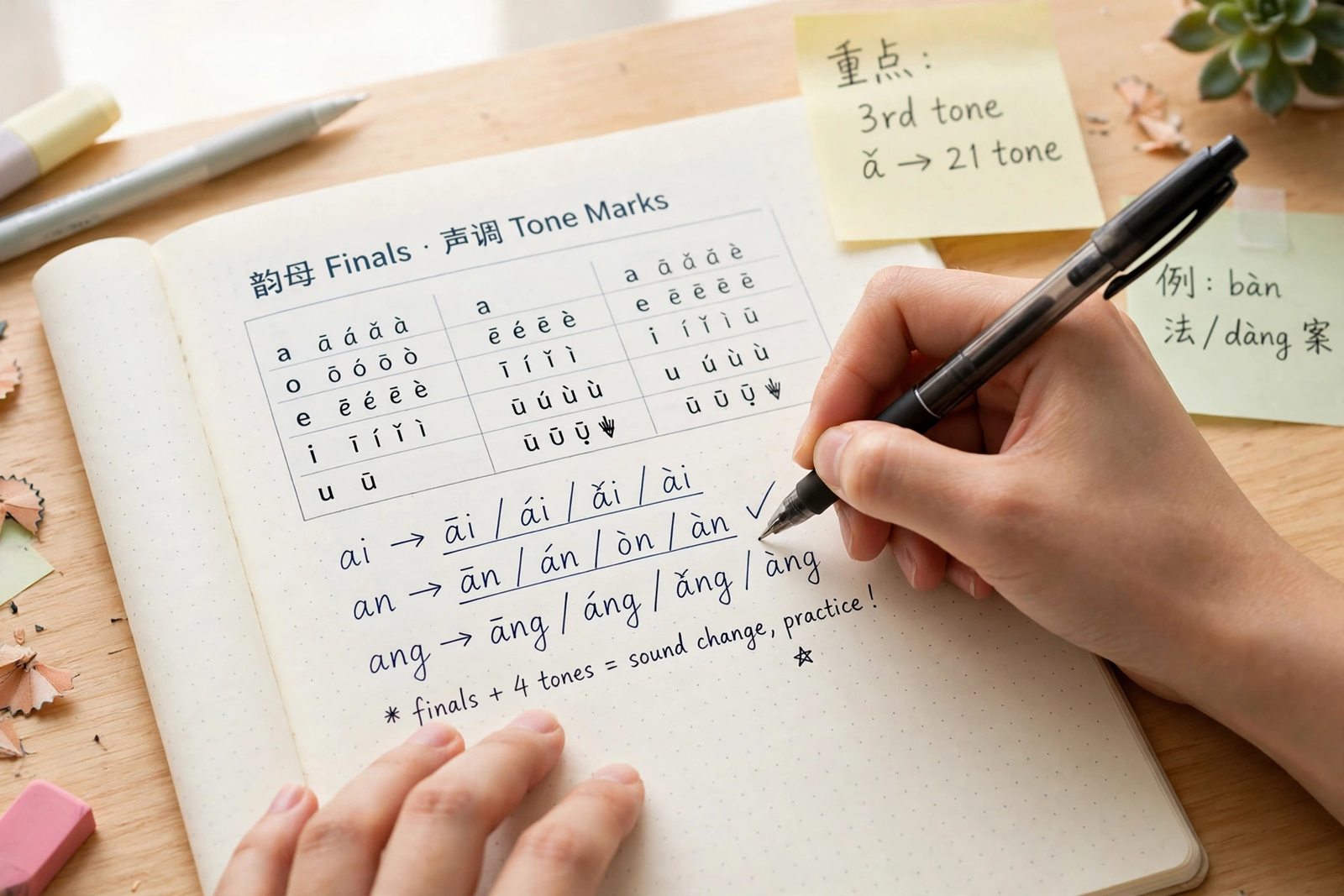
The letter ü has a rule of its own: after j, q, x and y, ü loses its two dots but is still read as ü. 雨 yǔ (rain), 月 yuè (moon), 学 xué (to learn) — written yu, yue, xue, but your mouth still reads ü. After n and l, ü keeps its two dots: 女 nǚ (woman), 绿 lǜ (green). Remember this rule and you will no longer wonder why “yu” is read as ü rather than “yoo”.
The three finals iu, ui and un are shortened forms used when an initial comes before them: iu is iou shortened (六 liù), ui is uei shortened (回 huí), un is uen shortened (问 wèn). Knowing this, you will understand why “iu” has only two letters but reads like three sounds — and why the tone mark lands exactly on the second vowel. To see the full picture of how initials combine with finals, read the article Pinyin: initials, finals and standard pronunciation on LingoBubbo.
Listen and repeat: how to use the audio to check your sounds
Using the audio in this article is very simple: listen once, repeat out loud right away, then record yourself on your phone and compare with the model. Your ear will correct your mouth after a few rounds — nobody needs to mark your work for you. Ten minutes of listen-and-repeat a day is enough; what matters is doing it regularly, not cramming it all into one session and then dropping it for a whole week.

The three example sentences below combine many finals within one real sentence, so you practise whole phrases rather than bare rhymes. Read them through, then listen to the audio to check:
我爱吃米饭。(Wǒ ài chī mǐfàn.) — I like eating rice.
他在学习汉语。(Tā zài xuéxí Hànyǔ.) — He is learning Chinese.
妈妈买了苹果。(Māma mǎi le píngguǒ.) — Mum has bought apples.
Did you notice? These three sentences contain ai (ài), an (fàn), üe (xué), ü (yǔ), ing (píng), uo (guǒ) and e (le). One sentence can train a dozen finals — that is why you should learn through real sentences, not bare rhymes. Once you can read these three sentences fluently, your mouth is already used to almost every type of final.
5 short exercises, done in 10 minutes
Exercise 1. Read the 6 single vowels through the 4 tones, each sound 4 times: ā á ǎ à, ō ó ǒ ò, ē é ě è, ī í ǐ ì, ū ú ǔ ù, ǖ ǘ ǚ ǜ. Read slowly, and hear your own voice ring in the room. Whichever sound feels “awkward in your mouth”, read that sound on its own 5 more times.
Exercise 2. Combine an initial with a final and read the result as a word: b + a = bā (八, eight); m + a = mā (妈, mother); h + ǎo = hǎo (好, good); g + ǒu = gǒu (狗, dog); t + iān = tiān (天, sky). If you can combine these 5 words, you have grasped how a Chinese syllable is put together.
Exercise 3. Place the tone mark in the right spot, using the 10-second rule above: liu → liù (六, six); hui → huí (回, to return); xiao → xiǎo (小, small); jia → jiā (家, home); gua → guā (瓜, melon). Write them out on paper, then read each word aloud once more.
Exercise 4. Listen to audio 2 again and write down the pinyin of the 6 words you hear: ān, bāng, mén, dēng, xīn, tīng. Listen twice: the first time, write what you hear; the second time, check each word again. Getting 5 out of 6 right is a pass.
Exercise 5. Make up your own sentence using at least 3 nasal finals. Suggestion: 今天天气很好,我去公园听音乐。(Jīntiān tiānqì hěn hǎo, wǒ qù gōngyuán tīng yīnyuè.) — The weather is lovely today; I am going to the park to listen to music. This sentence has tiān (ian), hěn (en), tīng (ing) and yīn (in) — try reading it fluently, then make a sentence of your own.
Quick quiz: which final, which word?
Tap the answer you choose — right or wrong, you will know on the spot.
Your score: 0/5 — tap an answer to check it right away.
Question 1. Which of the following finals is a single vowel?
Question 2. In “liù”, which vowel does the tone mark go on?
Question 3. “yuè” (月, moon) — what is its final?
Question 4. Which word contains the final “ang”?
Question 5. “wǒ” (我, I) — what is its final?
Frequently asked questions about the Chinese finals chart
Should you learn finals first, or vocabulary first? Learn finals first — at least the 6 single vowels together with ai, ei, ao, ou and the nasal group an, ang, en, eng. Once you can read them correctly, new words come twice as fast, because every new word is just a matter of combining sounds you already know. Learn words first with the wrong pronunciation, and fixing it later costs several times as much.
How long until I can read all the finals properly? With 10 minutes of listen-and-repeat a day, in about 2–3 weeks your ear will be used to most finals, and your mouth will feel less "awkward". The nasal groups an/ang and en/eng usually take the longest — just practise that pair on its own for 5 minutes a day and you will be fine.
How do initials and finals differ? The initial is the opening consonant of a syllable (b, p, m, f...), and the final is everything that remains. One syllable = initial + final + tone. Some syllables have no initial, such as a, ai, ou — in that case the final stands alone as the syllable.
Do I need to learn the whole finals chart by heart? No need to learn it by heart right away. Learn the single group and the basic compound group first, and pick up the nasal groups and the i/u families gradually through real words. The reference chart above is for looking things up whenever you meet an unfamiliar syllable, not for memorising once and for all.
Can misread finals be fixed? Yes, they can — and the sooner, the easier. Recording yourself and comparing with the model audio in this article is the fastest way to catch your own mistakes. If you read "eng" as "en", practise that pair on its own for a few minutes a day, and within a week your ear will be able to tell them apart.
If you have read this far, you now hold the whole finals chart, real examples and check-yourself audio in your hands. Now open LingoBubbo's interactive Pinyin chart to tap and listen to each cell, try combining a few syllables of your own, then come back and take the quiz again to see whether your score has gone up. Which final trips you up the most — an or ang, iu or ui? Tell me in the comments, and send this article to a friend who is learning Chinese and whose pronunciation still sounds vaguely "off", no matter how much they practise.