Say 不是 the way your textbook first taught you, bù shì, and a native speaker will still understand you. Say it the way they say it, bú shì, and something small but real changes: you stop sounding like a textbook and start sounding like a person talking. One tiny word, 不, quietly changes its tone depending on the word behind it, and this post explains the rule, shows you the sound, and gives you five short exercises to make it yours. If you are learning Chinese and tones still feel like a puzzle, this is the piece that makes several other pieces click.
The rule in one sentence
不 is pronounced bù (fourth tone) on its own and before first, second, and third tones, but it changes to bú (second tone) before a fourth-tone word. That is the whole rule. Everything below is examples, listening, and practice.
Why does it change? Because two falling tones in a row are hard to say fast. Try saying bù shì five times quickly and you will feel your voice tripping over itself. Bú shì flows. Chinese solved this problem long ago by letting the first tone rise instead of fall, and your job is simply to copy the solution.
One thing to know before you practice: dictionaries list 不 as bù, its citation form, the way it sounds alone. Textbooks write the changed tone in real words, so you will see bú shì, bú yào, bú duì written out. Both are correct in their place: bù is the dictionary form, bú is what your mouth actually does before a fourth tone. The examples in this post follow HSK 2.0 Level 1 vocabulary, and the rule itself is the same in the newer HSK 3.0 standard, so you are learning it once and keeping it.
The four tones, in thirty seconds
If the tones are still new to you, here is the quick refresher you need for this post. Chinese has four main tones plus a light, unstressed tone.
| Tone | Shape | Example |
|---|---|---|
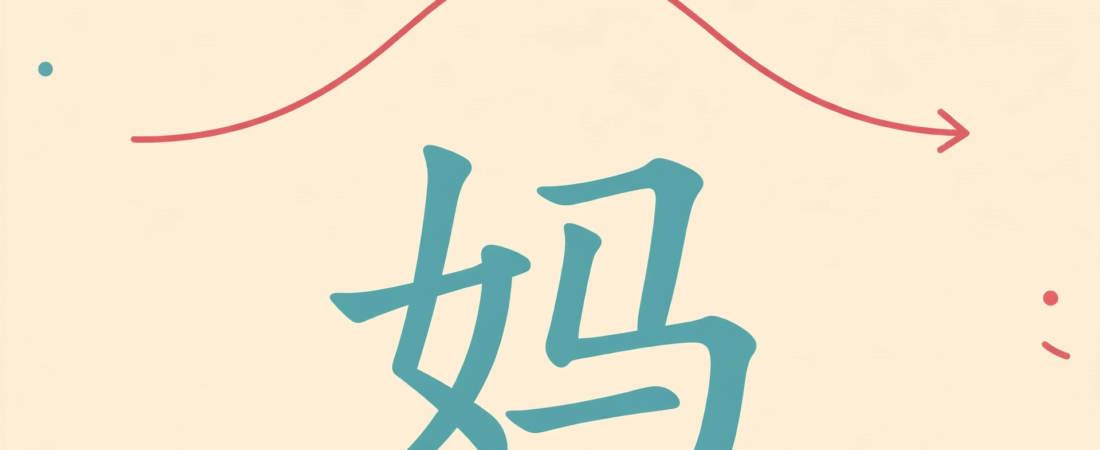
| 1st tone | High and flat, like singing one note | 妈 mā (mother) |
| 2nd tone | Rising, like asking “what?” | 麻 má (hemp) |
| 3rd tone | Falling then rising, a little dip | 马 mǎ (horse) |
| 4th tone | Sharp fall, like a firm “no!” | 骂 mà (to scold) |
不 lives in the fourth tone by default: bù, a sharp fall. The rule you are learning today is what happens when another sharp fall comes right after it. The answer is simple: the first one rises instead.
If you want a slower walk through all four tones first, our guide on the four Chinese tones for beginners takes about ten minutes, and the Pinyin chart tool on LingoBubbo lets you hear every sound in this post.

The tone change in action: when 不 becomes bú
Here is the rule in action. Read each row out loud, and notice how your voice behaves: before a fourth tone, 不 lifts up into a rising second tone.
| Chinese | Pinyin (as spoken) | English meaning |
|---|---|---|
| 不是 | bú shì | is not |
| 不要 | bú yào | do not want |
| 不对 | bú duì | is not right / wrong |
| 不去 | bú qù | will not go |
| 不看 | bú kàn | will not watch / read |
| 不会 | bú huì | cannot / will not (know how) |
| 不怕 | bú pà | is not afraid |
| 不错 | bú cuò | not bad / good |
Listen to the whole set now. Say each word right after the speaker, and exaggerate the rise on bú for the first few rounds. Exaggeration is how your ear learns the shape, and you can soften it later.
Now look at the pattern in that table. Every word after 不 is a fourth tone: shì, yào, duì, qù, kàn, huì, pà, cuò. Sharp fall after sharp fall, so 不 rises. That is the only thing deciding the change: the tone of the word behind it.
When 不 stays bù: the other half of the rule
The change only happens before a fourth tone. Before any other tone, 不 keeps its normal fourth tone, bù. Compare the two groups side by side and the rule becomes obvious.
| Chinese | Pinyin (as spoken) | Why it stays bù |
|---|---|---|
| 不吃 | bù chī | 吃 chī is 1st tone |
| 不喝 | bù hē | 喝 hē is 1st tone |
| 不来 | bù lái | 来 lái is 2nd tone |
| 不行 | bù xíng | 行 xíng is 2nd tone |
| 不好 | bù hǎo | 好 hǎo is 3rd tone |
| 不喜欢 | bù xǐhuan | 喜 xǐ is 3rd tone |
| 不买 | bù mǎi | 买 mǎi is 3rd tone |
| 不懂 | bù dǒng | 懂 dǒng is 3rd tone |
Listen to the two groups back to back. First the bù group, then the bú group from the table above. Your ear will catch the difference within two rounds: bù falls hard, bú lifts up.
A quick memory trick if the two groups blur together: ask yourself one question about the word after 不. Is it a sharp fall, a fourth tone? If yes, rise: bú. If no, fall as usual: bù. One question, every time, and you will be right.
One special case: 不 in the middle of a question
There is one more sound of 不 you will hear every day, and it is neither bù nor bú. In the question pattern A-不-A, like 好不好 (hǎo bu hǎo, good or not?) or 是不是 (shì bu shì, is it or not?), the 不 in the middle is light and unstressed, written as neutral-tone bu. It is quick, soft, and almost disappears: hǎo-bu-hǎo, shì-bu-shì, duì-bu-duì.
Do not worry about mastering this one today. Just notice it when you hear it, so it does not confuse you later. The rule for 不 at the start of a phrase is the one that matters most, and you already know it: bú before a fourth tone, bù everywhere else.
Five short exercises you can do today
Each exercise takes about five minutes. Do them in order, out loud, and do not just read them silently. Tones live in your mouth, not on the page.
1. The two-line drill. Say the two lines below five times, slowly, then faster. Feel the difference between the falling bù and the rising bú.
不吃,不行,不好。(Bù chī, bù xíng, bù hǎo.)
不是,不要,不对。(Bú shì, bú yào, bú duì.)
2. Copy the speaker. Listen to these sentences and repeat each one right after the speaker, three times. Match the rise on bú before you worry about speed.
我不喜欢吃辣的。(Wǒ bù xǐhuan chī là de. I do not like eating spicy food.)
他不去学校。(Tā bú qù xuéxiào. He is not going to school.)
我不看电视。(Wǒ bú kàn diànshì. I do not watch TV.)
你不来吗?(Nǐ bù lái ma? Are you not coming?)
我们不喝酒。(Wǒmen bù hē jiǔ. We do not drink alcohol.)
Check your own answers as you go: 不喜 bù xǐ because 喜 is third tone, 不去 bú qù because 去 is fourth tone, 不看 bú kàn because 看 is fourth tone, 不来 bù lái because 来 is second tone, 不喝 bù hē because 喝 is first tone. Five sentences, five correct tones, and the rule already feels less like a rule.
3. The swap game. Take one sentence and swap the verb. Start with 我不去公园 (Wǒ bú qù gōngyuán, I am not going to the park). Now swap in 吃 (chī, to eat): 我不吃米饭 (Wǒ bù chī mǐfàn, I do not eat rice). One word changes, the tone of 不 flips with it. Do five swaps of your own with verbs you know.
4. The mini dialogue. Listen to this short exchange and answer the questions out loud before the next line comes. Speed matters here more than perfection: real conversations do not wait.
你要不要喝水?(Nǐ yào bu yào hē shuǐ? Do you want water or not?)
我不要,谢谢。(Wǒ bú yào, xièxie. I do not want any, thank you.)
你去不去商店?(Nǐ qù bu qù shāngdiàn? Are you going to the shop or not?)
我不去,我在家。(Wǒ bú qù, wǒ zài jiā. I am not going, I am staying home.)
你吃不吃米饭?(Nǐ chī bu chī mǐfàn? Do you eat rice or not?)
我吃,我喜欢米饭。(Wǒ chī, wǒ xǐhuan mǐfàn. I do eat it, I like rice.)
Notice the pattern in the questions: 要不要 yào bu yào, 去不去 qù bu qù, 吃不吃 chī bu chī. The 不 in the middle of these questions is the light neutral bu from the special case above, while the 不 at the start of an answer follows the main rule: 不要 bú yào, 不去 bú qù. Two sounds, two jobs, one small word.
5. Hunt for 不 in the wild. Open any Chinese lesson or video you like and count every 不 you hear for five minutes. Say each one out loud after the speaker, with its correct tone. You will be surprised how often this one word appears, and every time you catch it, the rule gets a little more automatic.

Four mistakes that keep the tone wrong
Always saying bù, everywhere. This is the most common mistake, and the most forgiving one: people understand you, you just sound stiff. Fix it by drilling the bú table above for one week.
Changing the tone of the wrong word. The change happens to 不, not to the word after it. 不是 is bú shì, not bù shí. Keep the second word exactly as it is.
Writing bú in a dictionary search. Dictionaries list the citation form bù. If you search for bú and find nothing, search bù instead. Textbooks write the spoken form; dictionaries write the base form.
Thinking the rule is about meaning. It is not. 不 means “not” in every row of both tables. The tone changes for sound only, never for meaning. If you know the meaning, you already know half the word.
Your cheat sheet: the whole rule on one table
| The word after 不 | Say 不 as | Example |
|---|---|---|
| 1st tone | bù | 不吃 bù chī |
| 2nd tone | bù | 不行 bù xíng |
| 3rd tone | bù | 不好 bù hǎo |
| 4th tone | bú | 不是 bú shì |
| Middle of an A-不-A question | bu (light, neutral) | 好不好 hǎo bu hǎo |
Save this table or send it to a friend who is learning Chinese. One table, one question to ask yourself (“is the next word a fourth tone?”), and the rule is yours.
Quick Quiz
Test yourself on the tone change of 不. Click an answer to see if you are right, your score is at the top.
Score: 0/5
1. How do you pronounce 不 in 不是?
2. Which of these keeps 不 as bù?
3. Before a fourth-tone word, 不 changes to which tone?
4. How do you say “I do not want coffee” with the correct tones?
5. In 好不好 (hǎo bu hǎo), how is the 不 read?
FAQ
Is this tone change a beginner topic or an advanced one?
Beginner, and an early one. 不 is HSK 1 vocabulary in both HSK 2.0 and HSK 3.0, and its tone change appears in the first lessons because the word itself appears everywhere. Learn it now and every later lesson gets easier.
Do native speakers really say bú shì, or is bù shì also fine?
Native speakers say bú shì in normal speech. Bù shì is understood, and nobody will correct you harshly for it, but bú shì is what you will hear in every real conversation. The sooner you copy it, the sooner you sound natural.
Does the same rule apply to other words, like 一 (yī)?
Yes, and it works in a similar spirit: 一 changes its tone depending on what follows it. That is a separate rule with its own pattern, and our guide on tone changes in Chinese, starting with 你好 explains how the third-tone change works. Learn 不 first, then 一, and tones start to feel like a system instead of a list of exceptions.
Why do textbooks write bú shì but dictionaries write bù?
Textbooks write the sound you actually say, so they write bú shì. Dictionaries list the base form of the word, bù, the way it sounds on its own. Both are right, and knowing both keeps you from getting confused when you look a word up.
How long until this feels automatic?
Most learners need about a week of short daily practice: five minutes of the two-line drill and one round of listening. After that your mouth does it before your brain has to think about it, and that is exactly the goal.
Your turn: say it out loud today
You now know the rule, the sound, and the practice: 不 is bù before first, second, and third tones, and bú before a fourth tone, with a light bu in the middle of A-不-A questions. That is one small change with a big payoff, because 不 shows up in almost every Chinese sentence you will ever say. Do the two-line drill once today, out loud, and listen for 不 the next time you hear Chinese. You will catch it everywhere now.
Keep learning with the Pinyin chart tool on LingoBubbo, where you can hear every tone in this post, and read how to use 不 correctly in HSK 1 practice, without mixing it up with 没 to see the word in real exam sentences. If this guide helped you, send the cheat sheet table to a friend who is learning Chinese. And tell us in the comments: which 不 phrase do you use most, and did you say bú or bù before today?