The first email you write to a Chinese colleague sets the tone for everything that follows. Get it right and you sound polite, organised, and easy to work with. Get it wrong — too casual, too blunt, or just a little off — and the other person will still answer you, but the relationship starts a step behind. I have seen this happen to good people with good Chinese, because nobody ever taught them business Chinese email phrases. They knew the language. They did not know the register.
Chinese business email has its own rhythm, and it is not the same as English business email. It is warmer at the start, more indirect in the middle, and more formal at the end than most English speakers expect. The good news is that the whole system runs on a small set of fixed phrases. Learn fifteen of them, and you can write almost any routine work email in Chinese.
Opening lines: start warm, start respectful
Never open a Chinese business email with just a name and a request. The opening line is where the relationship lives, and it costs you one sentence.
| Chinese | Pinyin | Meaning | When to use it |
|---|---|---|---|
| 尊敬的王经理: | zūnjìng de Wáng jīnglǐ: | Dear Manager Wang: | First email to someone senior — use their title, not just their name |
| 您好! | nín hǎo! | Hello! | Almost every business email; 您 is the respectful “you” |
| 谢谢您的来信。 | xièxie nín de láixìn. | Thank you for your email. | Replying to any email — this is the standard opener |
| 很高兴收到您的邮件。 | hěn gāoxìng shōudào nín de yóujiàn. | I am very glad to receive your email. | A warmer reply, for good news or a new contact |
| 冒昧打扰,不好意思。 | mào mèi dǎrǎo, bù hǎoyìsi. | Sorry to bother you out of the blue. | Cold emailing someone for the first time |
Two details matter here. First, always use 您 (nín), the respectful “you”, never 你 (nǐ), in a work email — even if you are friends outside work. Second, use the person’s title: 王经理 (Manager Wang), 李老师 (Teacher Li), 张总 (Director Zhang). In Chinese business culture, the title is part of the name.

The middle: say what you want, gently
This is where English speakers most often sound too blunt. In English, “Send me the report by Friday” is a normal request. Translated directly into Chinese, it sounds like an order. The fix is a softening word — 请 (qǐng, please), 麻烦 (máfan, to trouble), or a question form — and it changes everything.
| Chinese | Pinyin | Meaning | When to use it |
|---|---|---|---|
| 我写信是想跟您确认一下…… | wǒ xiěxìn shì xiǎng gēn nín quèrèn yíxià…… | I am writing to confirm with you… | Stating your purpose, politely and clearly |
| 关于……的问题,我想跟您商量一下。 | guānyú……de wèntí, wǒ xiǎng gēn nín shāngliang yíxià. | Regarding the matter of…, I would like to discuss it with you. | Raising a topic without sounding demanding |
| 请问您能不能……? | qǐngwèn nín néng bù néng……? | May I ask whether you could…? | Any request — the softest, safest way to ask |
| 麻烦您看一下附件。 | máfan nín kàn yíxià fùjiàn. | Could I trouble you to look at the attachment? | Sending a document — 麻烦 turns a demand into a favour |
| 附件是这次会议的资料,请查收。 | fùjiàn shì zhè cì huìyì de zīliào, qǐng cháshōu. | The attachment is the material for this meeting. Please find it enclosed. | Attaching anything — always say what it is |
Notice the little words that do the softening: 一下 (yíxià, “a little”, as in 看一下, 确认一下) and 请问 (qǐngwèn, “may I ask”). They cost you nothing and they make your email sound like it was written by someone who understands how Chinese workplaces talk. A direct translation of an English email almost never includes them, which is exactly why it sounds off.
Closing lines: end formal, end warm
Chinese business emails close more formally than they open. A warm ending is not optional decoration — it is the part the reader remembers.
| Chinese | Pinyin | Meaning | When to use it |
|---|---|---|---|
| 期待您的回复。 | qīdài nín de huífù. | Looking forward to your reply. | Almost any email that needs an answer |
| 如有任何问题,请随时联系我。 | rú yǒu rènhé wèntí, qǐng suíshí liánxì wǒ. | If you have any questions, please contact me any time. | After giving information or instructions |
| 谢谢您的帮助。 | xièxie nín de bāngzhù. | Thank you for your help. | When someone has done something for you |
| 此致敬礼 | cǐ zhì jìng lǐ | With best regards (formal letter closing) | Formal letters and very formal emails |
| 顺祝商祺 | shùn zhù shāng qí | Wishing you prosperous business | The classic formal business closing — use it with clients and partners |
顺祝商祺 is worth learning even if you never write anything else in this list. It is the closing line Chinese business people expect on a formal email, and using it signals that you know the customs. 祝好 (zhù hǎo, best wishes) is the lighter everyday alternative for colleagues you already know well.
A full email built from these business Chinese email phrases
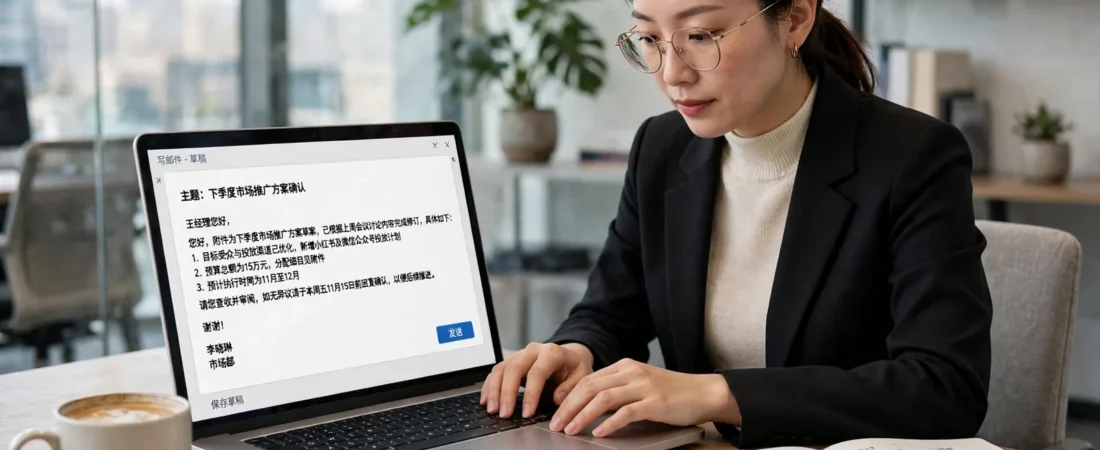
Here is what a short, real email looks like when you put the phrases together. Read it once through, then notice how little of it is original writing — most of it is the fixed phrases, doing their job.
尊敬的王经理:
您好!谢谢您的来信。
我写信是想跟您确认一下下周会议的时间。关于会议资料的问题,我想跟您商量一下。请问您能不能把最新的资料发给我?附件是这次会议的资料,请查收。
期待您的回复。如有任何问题,请随时联系我。
谢谢您的帮助。
顺祝商祺
That is a complete, professional email. The writer stated a purpose, made a request, attached a document, and closed politely — all with phrases that any Chinese colleague will recognise instantly as correct.
Your before-you-send checklist
Read this list before you press send on any Chinese work email:
☐ Did I use 您 (nín), not 你 (nǐ), throughout?
☐ Did I address the person with their title?
☐ Did I thank them for their email, or apologise for bothering them, in the first line?
☐ Is my request in question form or softened with 请, 麻烦, or 一下?
☐ Did I say what the attachment is, instead of just attaching it silently?
☐ Does my closing match the relationship — 顺祝商祺 for formal, 祝好 for familiar?

Quick Quiz
Test yourself on business Chinese email phrases. Click an answer to see if you are right — your score is at the top.
Score: 0/5
1. Which form of you should you always use in a Chinese work email?
2. What does 谢谢您的来信 mean?
3. Which little word softens a phrase by meaning a little, as in 看一下?
4. What should you always do when you send an attachment?
5. Which closing is the classic formal business closing for clients and partners?
Quick answers
Can I write a Chinese business email in English style, just translated?
You can, and people will understand you — but you will sound blunt. English business writing values directness; Chinese business writing values warmth and indirectness. A few softening phrases (请问, 麻烦您, 一下) are the difference between “understood” and “pleasant to work with”.
What is the single most important phrase to learn first?
谢谢您的来信 (thank you for your email). It opens almost every reply, it costs you nothing, and it immediately marks you as someone who knows the customs. After that, learn 请问您能不能……? for requests.
Should I use 此致敬礼 in an email?
It is correct but very formal — better for letters and the most formal emails. For everyday work email, 顺祝商祺 is the standard business closing, and 祝好 works for colleagues you know well. Match the closing to the relationship, not to the template.
Good business Chinese is mostly good manners in fixed phrases. Our Chinese programme teaches the formal and everyday registers side by side, so you always know which version of a sentence fits the room you are in — try the free HSK 1 trial lessons and start building the Chinese your work needs.