
A customer walks into your shop. You smile, you say something in Chinese, and in three seconds the customer decides whether you are a friendly shopkeeper or a stranger reading from a phrasebook. That first sentence matters more than any other sentence you will say all day. Get it right, and the customer relaxes, looks around, and buys something. Get it wrong, and they are already thinking about the shop next door.
This guide gives you the natural Chinese phrases shopkeepers actually use to greet customers, with pinyin, English meanings, audio to copy, and two full dialogues you can practice today. These are everyday work phrases for a clothing shop, a small store, or any shop where you meet customers face to face. No textbook stiffness, no robotic sentences. Just the words a real shopkeeper says, all day, every day.
## Why your greeting decides the sale
In China, a shop greeting is not small talk. It is the whole relationship in one sentence. 欢迎光临 (huānyíng guānglín, welcome to our shop) tells the customer three things at once: I saw you, I am glad you came, and you are free to look around. That last part matters most. Many customers, especially first-time visitors, are nervous about being pressured to buy. A warm greeting that includes 请随便看看 (qǐng suíbiàn kànkan, please look around) removes that pressure in a single breath.
Here is what happens when the greeting goes wrong. A shopkeeper who says nothing makes the customer feel invisible. A shopkeeper who follows the customer around the shop saying 买吗?买吗?(mǎi ma? mǎi ma? Want to buy? Want to buy?) makes them want to leave. The sweet spot is in the middle: greet once, warmly, offer help once, and then let the customer breathe. The phrases in this post are built for exactly that rhythm.
## The 14 phrases every shopkeeper needs
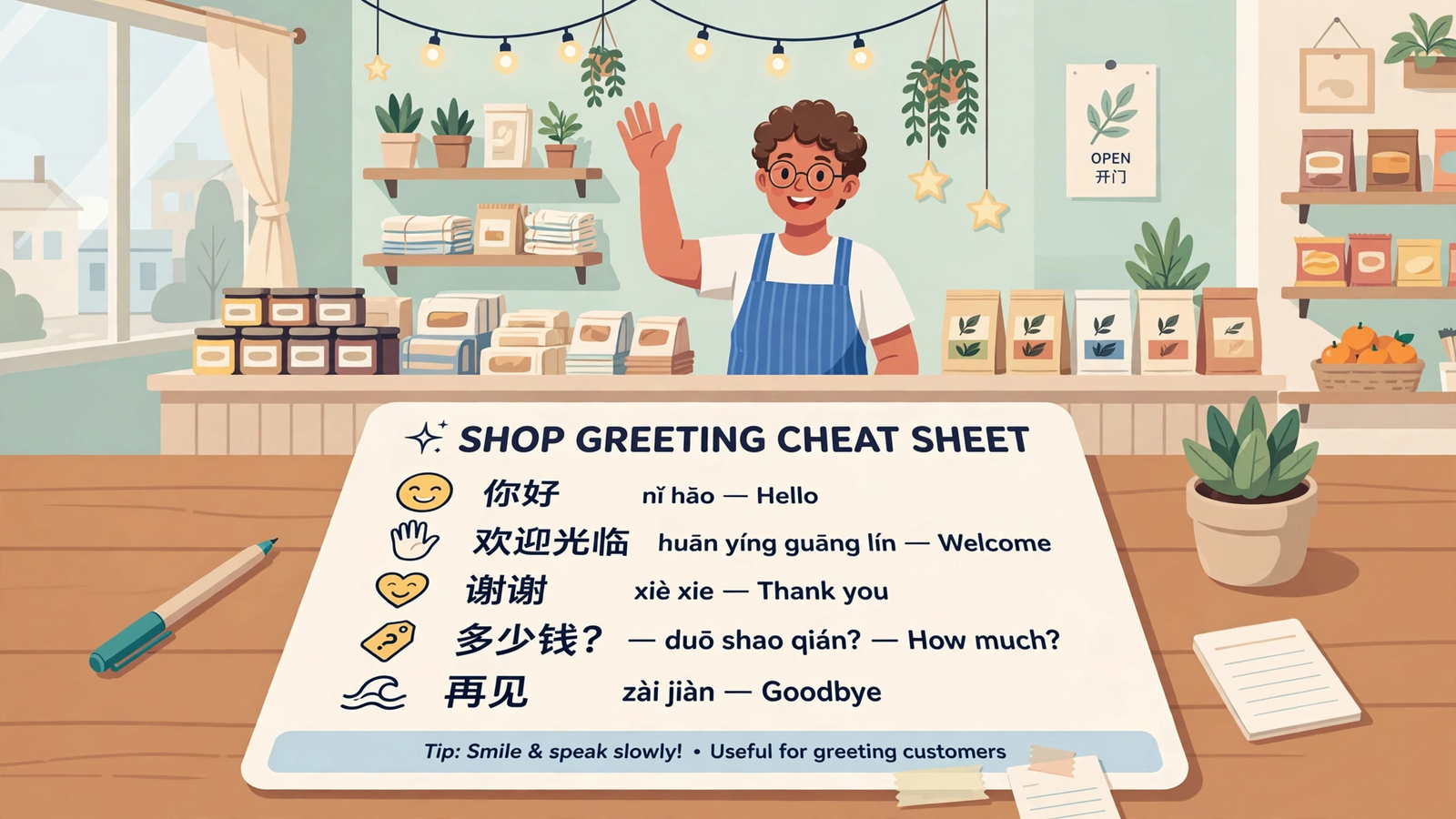
Learn these fourteen first. They cover the whole visit: the greeting, the offer to help, the recommendation, the price question, and the goodbye. Say each one out loud as you read it.
| Chinese | Pinyin | English meaning |
|—|—|—|
| 欢迎光临 | huānyíng guānglín | Welcome to our shop |
| 你好 | nǐ hǎo | Hello |
| 请随便看看 | qǐng suíbiàn kànkan | Please look around |
| 请问你想买什么? | qǐngwèn nǐ xiǎng mǎi shénme? | May I ask what you would like to buy? |
| 我可以帮你吗? | wǒ kěyǐ bāng nǐ ma? | Can I help you? |
| 这件很漂亮 | zhè jiàn hěn piàoliang | This one is very beautiful |
| 你可以试一试 | nǐ kěyǐ shì yí shì | You can try it on |
| 有别的颜色吗? | yǒu bié de yánsè ma? | Do you have other colors? |
| 多少钱? | duōshao qián? | How much is it? |
| 太贵了 | tài guì le | Too expensive |
| 可以便宜一点吗? | kěyǐ piányi yìdiǎn ma? | Can it be a bit cheaper? |
| 谢谢光临 | xièxie guānglín | Thank you for coming |
| 欢迎下次再来 | huānyíng xià cì zài lái | Please come again next time |
| 慢走 | màn zǒu | Take care, walk slowly (a warm goodbye) |
A few notes on the trickier ones. 欢迎光临 (huānyíng guānglín) is the formal, full welcome. You will hear it in every shop in China, from a tiny market stall to a big department store. 慢走 (màn zǒu) literally means “walk slowly,” but nobody is telling the customer to walk slowly. It is a warm way of saying goodbye, like “take care” in English. And 请随便看看 (qǐng suíbiàn kànkan) is your best friend: it gives the customer permission to browse without pressure, and it buys you time to watch what they are interested in.
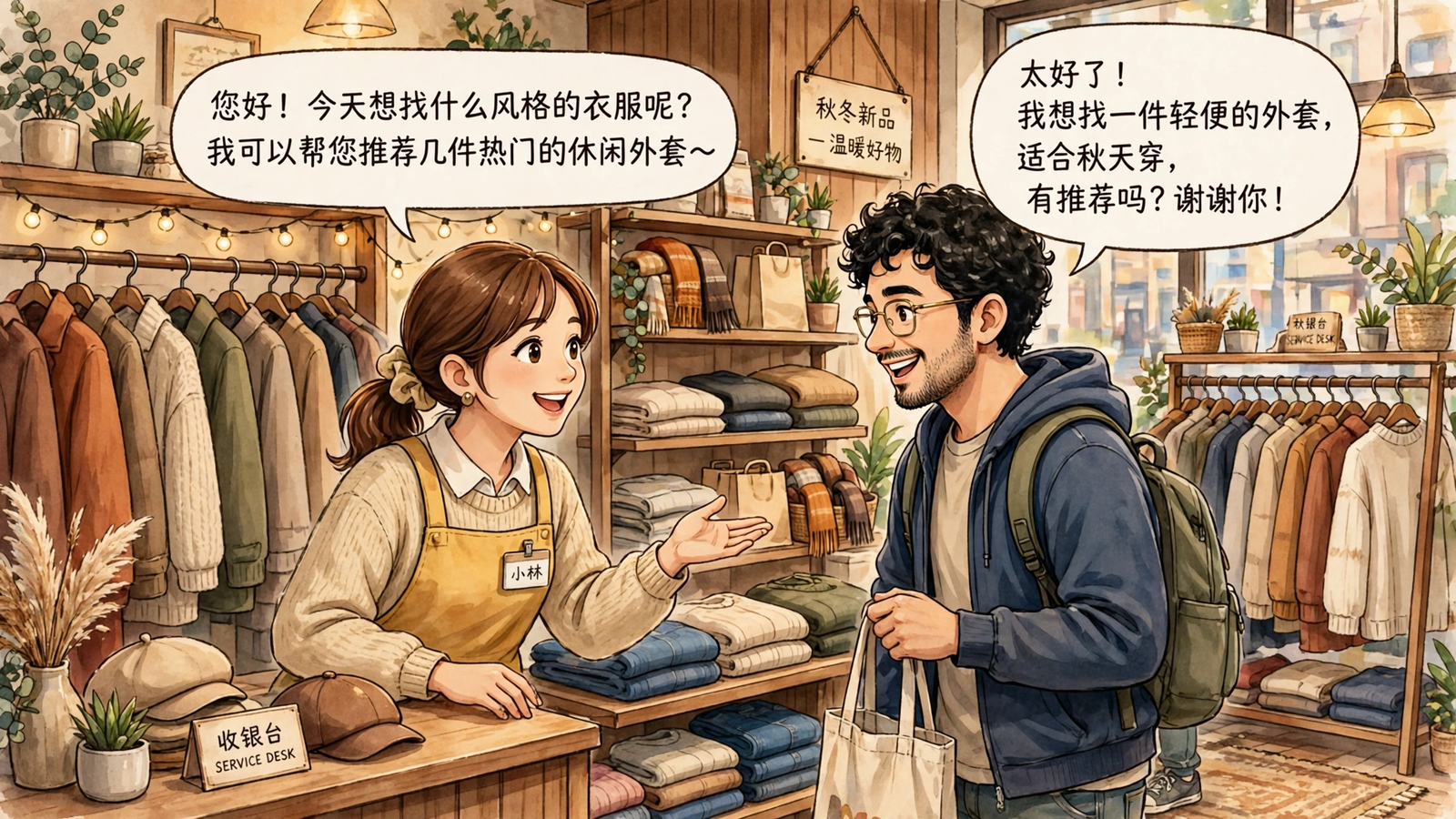
## The welcome: your first ten seconds
The greeting happens the moment the customer steps through the door. Stand up straight, smile, and say it like you mean it. Here is the exact sentence, with audio.
欢迎光临!请随便看看,有什么需要就告诉我。
(Huānyíng guānglín! Qǐng suíbiàn kànkan, yǒu shénme xūyào jiù gàosu wǒ.)
Welcome! Please look around, and let me know if you need anything.
Say it three times, out loud, right now. Notice the rhythm: 欢迎光临 is bright and quick, 请随便看看 is soft and relaxed. That contrast is the whole message. I am happy you are here, and there is no rush. If your tones feel shaky, listen to the audio again and copy the rise and fall. The tones are the difference between sounding warm and sounding like a robot.
One thing to avoid: do not greet the customer and then immediately ask what they want to buy. Give them at least thirty seconds to look around first. A customer who has had thirty seconds to browse is far more likely to answer your question than a customer you pounced on at the door.
## Offering help without being pushy
After the customer has looked around a little, it is time to offer help. One sentence is enough. Here it is.
你好,请问你想买什么?我可以帮你介绍一下吗?
(Nǐ hǎo, qǐngwèn nǐ xiǎng mǎi shénme? Wǒ kěyǐ bāng nǐ jièshào yíxià ma?)
Hello, may I ask what you would like to buy? Can I introduce some things for you?
The magic word here is 请问 (qǐngwèn), which softens the question into a polite request. Without it, 你想买什么?(nǐ xiǎng mǎi shénme?) sounds direct, almost demanding. With it, the same question sounds like good service. Small word, big difference. If the customer says 我自己看看 (wǒ zìjǐ kànkan, I will look by myself), smile, say 好的 (hǎo de, okay), and step back. They will come to you when they are ready, and they will remember that you did not pressure them.
## Recommending a product
When a customer picks something up or tries something on, that is your moment. A short, honest compliment works better than a long sales speech. Here is the classic line.
这件衣服很漂亮,穿上一定很好看。你可以试一试。
(Zhè jiàn yīfu hěn piàoliang, chuān shàng yídìng hěn hǎokàn. Nǐ kěyǐ shì yí shì.)
This piece of clothing is very beautiful, it will definitely look great on you. You can try it on.
Notice what this sentence does not do. It does not say “buy it now.” It says the item is beautiful, it will look good on you, and you are welcome to try it. Three gentle steps, no pressure at all. 你可以试一试 (nǐ kěyǐ shì yí shì, you can try it on) is one of the most useful sentences in a shop, because trying something on is the moment a customer starts to imagine owning it.
If the customer asks about other colors or sizes, you already have the phrase: 有别的颜色吗?(yǒu bié de yánsè ma?) is what they will ask you, and it is also what you can ask them. 有别的尺码吗?(yǒu bié de chǐmǎ ma?) means “do you have other sizes?” Learn both, and you will never freeze when a customer points at something and asks.
## Dialogue 1: A customer walks into a clothing shop
Here is the whole visit in one short conversation. Read it out loud, playing both parts. The shopkeeper is A, the customer is B.
A: 欢迎光临!请随便看看。
(Huānyíng guānglín! Qǐng suíbiàn kànkan.)
Welcome! Please look around.
B: 谢谢,我想看看衣服。
(Xièxie, wǒ xiǎng kànkan yīfu.)
Thank you, I would like to look at the clothes.
A: 你好,请问你想买什么?我可以帮你介绍一下吗?
(Nǐ hǎo, qǐngwèn nǐ xiǎng mǎi shénme? Wǒ kěyǐ bāng nǐ jièshào yíxià ma?)
Hello, may I ask what you would like to buy? Can I introduce some things for you?
B: 我想买一件外套。
(Wǒ xiǎng mǎi yí jiàn wàitào.)
I would like to buy a jacket.
A: 这件很漂亮,你可以试一试。
(Zhè jiàn hěn piàoliang, nǐ kěyǐ shì yí shì.)
This one is very beautiful, you can try it on.
B: 多少钱?
(Duōshao qián?)
How much is it?
A: 两百块。
(Liǎng bǎi kuài.)
Two hundred yuan.
B: 太贵了,可以便宜一点吗?
(Tài guì le, kěyǐ piányi yìdiǎn ma?)
Too expensive, can it be a bit cheaper?
A: 可以,一百八十块,怎么样?
(Kěyǐ, yì bǎi bāshí kuài, zěnmeyàng?)
Yes, 180 yuan, how about that?
B: 好的,我买了。
(Hǎo de, wǒ mǎi le.)
Okay, I will buy it.
A: 谢谢光临,欢迎下次再来。慢走!
(Xièxie guānglín, huānyíng xià cì zài lái. Màn zǒu!)
Thank you for coming, please come again next time. Take care!
That is a complete sale, start to finish, in about one minute. Notice how short every sentence is. Real shop Chinese is short. Nobody gives a speech in a shop. Learn this dialogue by heart, and you can handle a real customer on your first day.
## Dialogue 2: A customer is just browsing
Not every customer buys. This dialogue is just as important, because a customer who leaves happy comes back later.
A: 欢迎光临!
(Huānyíng guānglín!)
Welcome!
B: 你好,我随便看看。
(Nǐ hǎo, wǒ suíbiàn kànkan.)
Hello, I am just looking around.
A: 好的,请随便看看,有什么需要就告诉我。
(Hǎo de, qǐng suíbiàn kànkan, yǒu shénme xūyào jiù gàosu wǒ.)
Okay, please look around, and let me know if you need anything.
B: 谢谢。
(Xièxie.)
Thank you.
A: 不客气。
(Bú kèqi.)
You are welcome.
Short, warm, and finished. The customer browsed, felt welcome, and left with a good impression. That is a win, even without a sale. And here is the goodbye to use when they do buy, or when they leave after browsing.
谢谢光临,欢迎下次再来。慢走,再见!
(Xièxie guānglín, huānyíng xià cì zài lái. Màn zǒu, zàijiàn!)
Thank you for coming, please come again next time. Take care, goodbye!
## 4 mistakes that make you sound like a phrasebook
**Greeting too late, or not at all.** The greeting belongs at the door, in the first three seconds. A customer who has been in your shop for a minute without a word already feels ignored.
**Following the customer around.** Greet once, offer help once, then step back. A customer who feels watched will leave faster than a customer who feels ignored.
**Forgetting 请 (qǐng, please).** 请 turns a command into a polite invitation. 请随便看看 sounds like a welcome. 随便看看 on its own sounds like an order. One little word, and the whole feeling changes.
**Saying the goodbye too fast.** 慢走 (màn zǒu) is meant to be slow and warm. Say it like you mean it, with a smile, while the customer is still at the door. A rushed goodbye erases a good visit.
## Your 7-day practice plan
– **Day 1:** Memorize 欢迎光临 and 请随便看看. Say them 20 times each, out loud.
– **Day 2:** Add 我可以帮你吗? and 你可以试一试. Practice the welcome plus the offer to help as one flow.
– **Day 3:** Read dialogue 1 out loud, playing both parts, three times.
– **Day 4:** Read dialogue 2 out loud three times. Practice the goodbye: 谢谢光临,欢迎下次再来。慢走。
– **Day 5:** Listen to all four audio clips and repeat each one right after the speaker, without looking at the text.
– **Day 6:** Role-play with a friend or family member. One of you is the shopkeeper, one is the customer. Swap roles.
– **Day 7:** Say the whole greeting-to-goodbye flow from memory, out loud, without looking at this post. If you can do it, you are ready for a real customer.
## Quick Quiz
Test yourself on greeting customers in Chinese. Click an answer to see if you are right — your score is at the top.
Score: 0/5
1. What do you say when a customer walks into your shop?
2. What does 请随便看看 mean?
3. A customer asks 多少钱? What do they want to know?
4. Which phrase offers help to a customer?
5. What does 慢走 mean when a customer is leaving?
## FAQ
**Do I need to say 欢迎光临 to every customer?**
Yes, every time, with a smile. It takes two seconds, and it is the single most expected phrase in a Chinese shop. Customers notice when it is missing.
**What if the customer does not speak Chinese well?**
Speak slowly, smile, and use the short phrases in this post. Short sentences and a warm tone work even when the customer’s Chinese is basic. If they switch to English, follow their lead.
**Is it rude to ask what the customer wants to buy?**
Not if you ask politely with 请问 (qǐngwèn) and give them time to browse first. The rude version is asking at the door, before they have looked at anything. Wait thirty seconds, then ask once.
**What should I say if the customer says the price is too high?**
Stay friendly. You can say 可以便宜一点 (kěyǐ piányi yìdiǎn, it can be a bit cheaper) and offer a lower price, or say 这已经是最便宜的了 (zhè yǐjīng shì zuì piányi de le, this is already the cheapest price). Never argue about the price.
**How do I practice these phrases if I work alone?**
Record yourself saying the dialogues and play them back. Even better, practice with a friend: one plays the customer, one plays the shopkeeper, then swap. The 7-day plan above works with a partner or alone.
## Your turn: greet your next customer in Chinese
You now have fourteen phrases, two full dialogues, and four audio clips to copy. You do not need all of them tomorrow. You need one: 欢迎光临. Say it to your next customer, with a smile, and watch what happens. Then add 请随便看看 the day after, and 我可以帮你吗? the day after that. In a week, the whole flow will feel natural.
Keep learning with the [Chinese lessons on LingoBubbo](https://lingobubbo.com/tieng-trung/), where work phrases like these appear in short dialogues you can practice every day. If this guide helped you, send it to a friend who works in a shop or is learning Chinese for work — a good greeting is the easiest skill in the language, and it pays off on the very first customer. And tell us in the comments: which phrase do you use most in your shop, and which one still feels tricky to say?