
You ask in Chinese: Nǐ jīntiān zài xuéxiào zuò le shénme? — what did you do at school today? Your child looks up from their plate and answers in English: “Nothing much.” If your child answers in English when you speak Chinese, you are far from alone. It happens in thousands of homes every evening, and it does not mean your child has lost Chinese. It means English has become the easier road, and your job is to make the Chinese road just as easy to walk.
The good news: you do not need a new curriculum or a stern lecture. You need a script — a few warm, ready-made lines for the moment, so the conversation stays in Chinese without turning into a battle.
Why your child answers in English (and what it really means)
Children choose the language that gets them what they want fastest. At school, everything runs in English: lessons, jokes, friendships, praise. English becomes the language of getting things done; Chinese stays the language of home — warm, but optional. When your child answers in English, they are not rejecting Chinese. They are taking the shortcut.
There is another reason, and it matters more. Many heritage kids understand far more Chinese than they can speak, and speaking feels risky when the words will not come quickly. A child who answers in English may be thinking, “I know what you said — I just can’t say my answer back fast enough.” That gap is completely normal — and a good script can close it. If this sounds familiar, our piece on heritage kids who understand Chinese but won’t speak it explains the gap in more depth.
The script: what to say when your child answers in English
Here is the golden rule: never correct, always offer. When your child answers in English, do not say “No, say it in Chinese!” Answer in Chinese, hand them the words inside your reply, and let them use those words if they want. Try this table at dinner tonight.
| Your child says (in English) | What you can say back (in Chinese) |
|---|---|
| “I’m hungry.” | Wǒ è le — “I’m hungry.” Say it, and the snack is yours. |
| “I don’t know.” | Wǒ bù zhīdào zěnme shuō — “I don’t know how to say it.” Say it together, slowly. |
| “Can I watch TV?” | Yòng Zhōngwén shuō — “Say it in Chinese.” Then wait, smiling, while they try. |
| “No!” | Nǐ shuō “bù yào”? Hǎo, wǒ tīng dǒng le — “You said ‘I don’t want it’? Good, I understood.” |
| “I love you, Mommy.” | Wǒ ài nǐ, Māma — “I love you, Mom.” Say it back and watch them glow. |
Notice the pattern: you never refuse English, and you never scold. You simply make Chinese the language in which good things happen — snacks appear, TV turns on, love gets answered. A child will always walk toward the language that works.

Three everyday moments to practise the script
Pick one moment this week — five minutes, no pressure.
1. Dinner: the easiest win
Dinner is the best place to start — everyone is already talking. Ask one question in Chinese and accept any answer, even one word. “What was the best part of today?” can be answered with hǎochī (delicious), if the best part was dinner itself. Celebrate it. Tomorrow, ask for two.
2. The car: a captive audience
The school run is a gift: nobody can walk away, nobody holds a screen, and the ride is short. Play a simple game — you say a sentence in English, your child says it in Chinese. Start with things they actually want: “I want an apple” becomes Wǒ xiǎng chī píngguǒ. If they get stuck, feed them the first word only. For more small-moment ideas, see our guide on how to help your child practise Chinese speaking.
3. The grandma call: the reason it matters
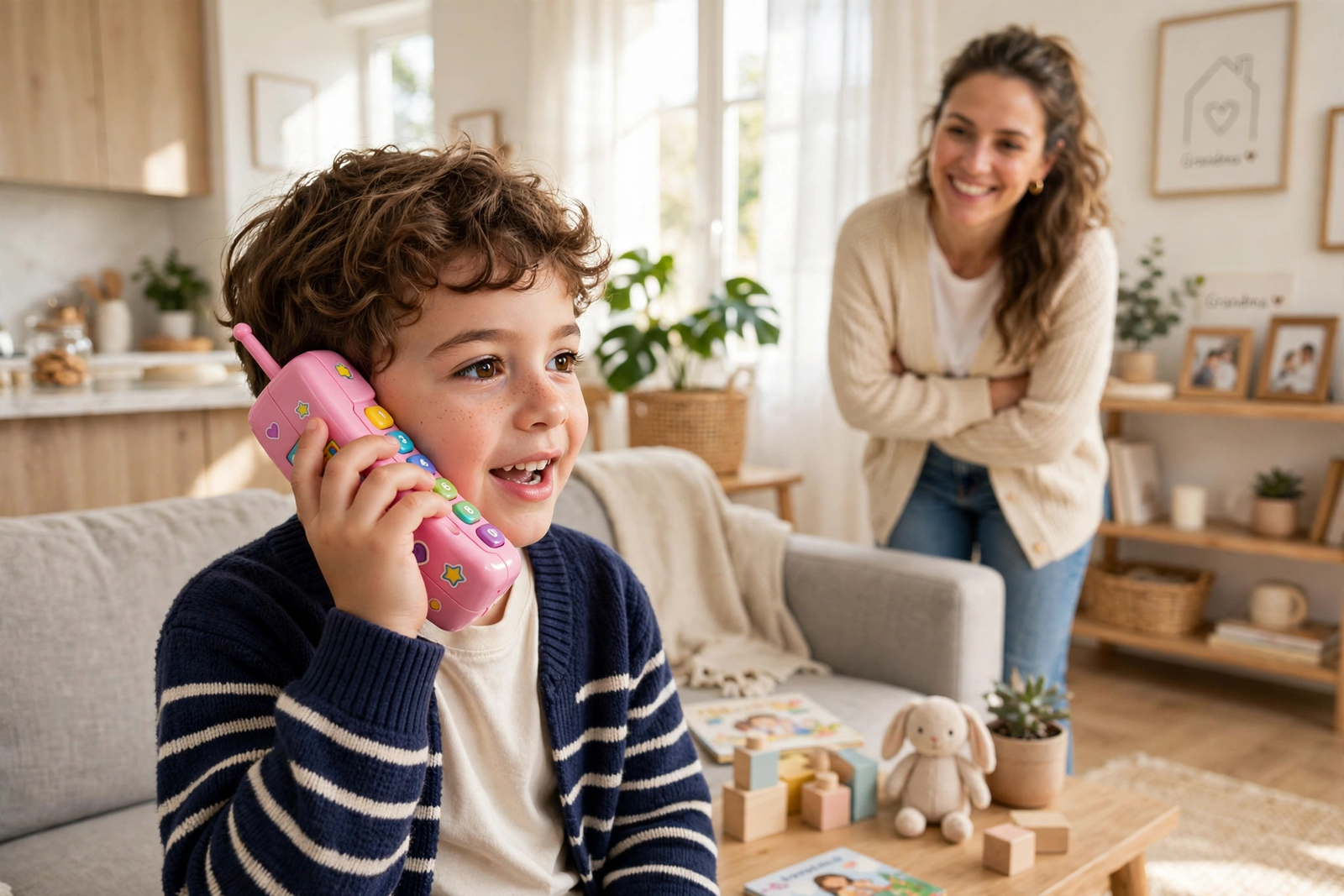
Nothing motivates a child like a real person on the other end of the line. Before you call grandma, rehearse one line together: Nǎinai, wǒ ài nǐ! — “Grandma, I love you!” Then hand your child the phone. When grandma lights up, your child learns something no worksheet can teach: Chinese is how you reach the people you love. A toy phone works too — let them “call” grandma during play.
Three mistakes that push Chinese away
Good intentions can backfire. Each of these three traps makes English feel safer and Chinese feel like a test.
First, pretending not to understand English. Some parents say “I don’t understand English” — Wǒ tīng bù dǒng Yīngwén — hoping the child will switch. Children see through it in a week, and it becomes a power struggle. Use that line as a joke, with a wink, never as a rule.
Second, correcting every mistake. If your child bravely says a sentence in Chinese and you fix three tones in it, they will not try again tomorrow. Repeat it back correctly inside your own reply, and move on. They hear the right version without feeling graded.
Third, making Chinese a chore. The moment Chinese becomes flashcards after a long school day, it loses to English every time. Keep it inside things your child already loves: dinner, the car, grandma, games.
Your 7-day mini challenge
One week is enough to feel the shift. Try this:
- Day 1–4: Use the script at dinner, then add the car game on the school run — three sentences a day.
- Day 5: Rehearse the grandma line and make the real call.
- Day 6: Let your child teach you a word — ask Zài shuō yí biàn (“say it one more time”) and copy them.
- Day 7: Count how often they chose Chinese without being asked. Even twice is a win.
Keep the tally on your fridge — when your child sees it grow, they start competing with themselves.
Quick Quiz
Test yourself on what to say when your child answers in English. Click an answer to see if you are right — your score is at the top.
Score: 0/5
1. What is the golden rule in the script?
2. Why do children answer in English, according to the post?
3. Which moment is called the easiest win to start with?
4. What should you do if your child gets upset when asked to speak Chinese?
5. Why is pretending not to understand English a mistake?
Frequently asked questions
Is it too late if my child already answers in English most of the time?
No. If your child still understands you in Chinese, the foundation is intact — the words are already in there, and speaking comes back faster than most parents expect.
Should I stop speaking English to my child completely?
That backfires — a home where one language is forbidden becomes a home where children hide. Keep English where it fits, and make Chinese the language of warmth, food, family and fun.
What if my child gets upset when I ask them to speak Chinese?
Back off and lower the bar: ask for one word, not a sentence, and accept a mix of both languages — that mixing is a normal stage, not a failure. Once Chinese feels safe again, the words return.
Your child answering in English is not the end of their Chinese — just a small detour, and you now have the lines to guide them back. Start tonight: one question in Chinese, and a smile while you wait for the answer.
Ready to give your child more Chinese they can actually use? Our HSK 1 trial lessons turn everyday words like these into short, playful lessons at home — try the first lessons free.