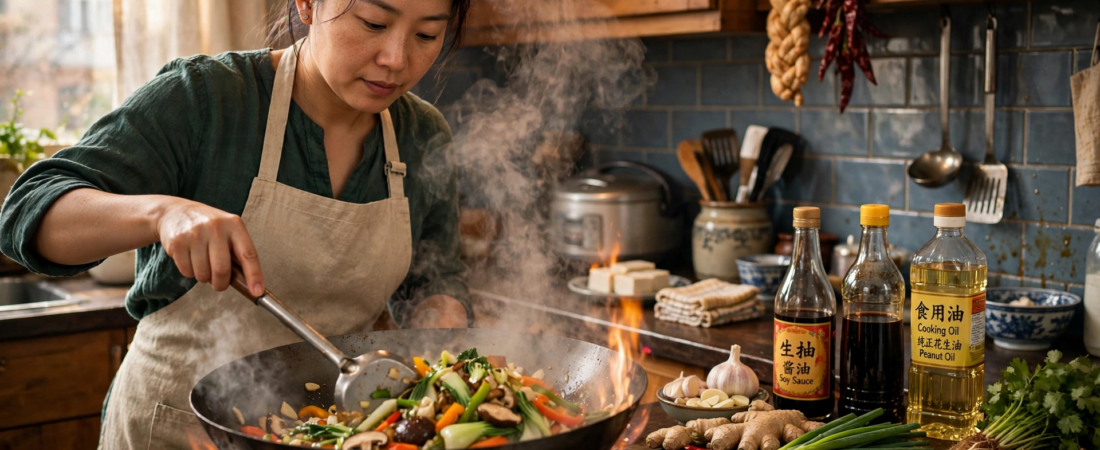
Open a Chinese recipe for the first time and it looks like a wall of characters. Then you spot one you know, then another, and suddenly the wall has a door in it. That is what Chinese cooking words do: a small set of verbs and pantry words turns a recipe you cannot read into a dinner you can actually cook. Think of this as your Chinese cooking words kitchen starter pack.
They are a perfect first vocabulary set for another reason: you can use them the same evening you learn them. Tonight, you will know what to do with the wok, the salt and the soy sauce. By the end of the week, you will be reading a real recipe.
Chinese cooking words kitchen: the five verbs that do the work
Almost every Chinese recipe runs on five cooking verbs. Learn these first.
| Word | Pinyin | Means | Picture it |
|---|---|---|---|
| 炒 | chǎo | stir-fry | Tossed fast in a hot wok |
| 煮 | zhǔ | boil | Rice bubbling in water |
| 蒸 | zhēng | steam | Dumplings in a bamboo steamer |
| 烤 | kǎo | roast or bake | Duck in a hot oven |
| 切 | qiē | cut | A knife slicing vegetables |
炒 (chǎo) is the star. Stir-frying is fast, hot and loud, and it is the verb behind half the dishes on a Chinese menu. 煮 (zhǔ) is its calm opposite: food sitting in boiling water while you wait. 蒸 (zhēng) is the gentle one, steam doing the cooking so nothing dries out. Learn them as a set, not one by one.
Three more verbs finish the toolkit. 炸 (zhá) means deep-fry, the golden crunch of spring rolls. 煎 (jiān) means pan-fry, food sizzling flat in a little oil. 拌 (bàn) means mix or toss, as in a cold salad. Two helpers appear in nearly every set of instructions: 加 (jiā), add, and 放 (fàng), put in.
Listen: cracking eggs and cutting tomatoes for a stir-fry
The pantry shelf: six words that season everything
Verbs tell you what to do. Pantry words tell you what to do it with.
| Word | Pinyin | Means | Watch out for |
|---|---|---|---|
| 盐 | yán | salt | Use a little |
| 糖 | táng | sugar | Balances salt and sour |
| 酱油 | jiàngyóu | soy sauce | Dark and salty |
| 醋 | cù | vinegar | Sharp, use a splash |
| 油 | yóu | oil | Heats the wok first |
| 米饭 | mǐfàn | cooked rice | The meal’s base |
Here is a memory trick for the whole shelf: learn them in pairs that taste opposite. 盐 (yán, salt) with 糖 (táng, sugar). 酱油 (jiàngyóu, soy sauce) with 醋 (cù, vinegar). Your tongue already knows the difference, so your memory has something to hold on to.
And do not skip 面条 (miàntiáo, noodles). Rice gets the glory, but noodles show up in almost as many recipes, and the word is fun to say: miàn-tiáo.

Read a real recipe: tomato and egg stir-fry
The classic first dish for Chinese learners is 番茄炒蛋 (fānqié chǎo dàn), tomato and egg stir-fry. Ten minutes, forgiving mistakes, and it uses nearly every word in this guide.
先把鸡蛋打散,再把西红柿切成小块。 “First beat the eggs, then cut the tomatoes into small pieces.” 打散 (dǎsàn) means beat until broken up, and 切 (qiē) is our cutting verb. Two verbs, two ingredients, one sentence.
热锅,加一点儿油,把鸡蛋炒一下。 “Heat the wok, add a little oil, and stir-fry the eggs briefly.” 热 (rè) means hot, 锅 (guō) is the wok, and 加 (jiā) is add. Then: 把西红柿放进去,加一点儿盐,再加一点儿酱油。 “Put the tomatoes in, add a little salt, then add a little soy sauce.”
That is a whole recipe in three sentences: the verbs and pantry words you learned five minutes ago. Cook it tonight.
Listen: adding salt and soy sauce while cooking
What is actually in the dish: ingredients worth knowing
Once you can follow the verbs, the next words you need are the ingredients.
姜 (jiāng) is ginger, the warm, spicy root that starts a thousand stir-fries. 蒜 (suàn) is garlic, usually crushed and fried first so the oil carries its smell. 葱 (cōng) is scallion, the green finishing touch on a finished dish. 辣椒 (làjiāo) is chilli pepper, and the word itself warns you: 辣 (là) means spicy hot.
Then the building blocks. 鸡蛋 (jīdàn) is egg. 肉 (ròu) is meat. 菜 (cài) means vegetables, and also a dish in general, which is why a menu is a 菜单 (càidān). 豆腐 (dòufu) is tofu, the sponge that soaks up whatever sauce you give it.
At the table, three more words complete the scene: 碗 (wǎn), a bowl; 盘子 (pánzi), a plate; and 筷子 (kuàizi), chopsticks. Ask for them by name and the people around the table will notice.
Listen: cooking rice and stir-frying vegetables
The mix-ups that change dinner completely
炒 (chǎo, stir-fry) and 煮 (zhǔ, boil) are the big one. 炒鸡蛋 is a quick, fluffy stir-fried egg. 煮鸡蛋 is a boiled egg. Ask for the wrong one and breakfast changes completely. 蒸 (zhēng, steam) and 烤 (kǎo, roast) are another pair to keep apart: steamed fish is delicate, roasted fish is crisp.
Then there is 盐 (yán, salt) and 糖 (táng, sugar). They look alike in a small bowl, and they both sit in identical jars in many kitchens. Taste before you pour. Every Chinese cook has a sugar-in-the-soup story.

Your kitchen vocabulary checklist for this week
Stick this list on your fridge and tick each word off as you use it:
☐ 炒 chǎo — I stir-fried something in a wok
☐ 煮 zhǔ — I boiled rice or noodles
☐ 蒸 zhēng — I steamed something (even a bun counts)
☐ 盐 yán and 糖 táng — I told them apart without tasting first
☐ 酱油 jiàngyóu — I added soy sauce to a dish
☐ 米饭 mǐfàn and 面条 miàntiáo — I cooked one
☐ 番茄炒蛋 fānqié chǎo dàn — I cooked tomato and egg stir-fry
Quick answers about Chinese cooking words
What is the difference between 炒 and 煮?
炒 (chǎo) is stir-frying: food tossed fast in a hot wok. 煮 (zhǔ) is boiling: food in bubbling water. Stir-fry is quick and crisp, boiling is slow and soft.
Is 酱油 the same as soy sauce?
Yes. 酱油 (jiàngyóu) is soy sauce, the dark salty sauce in most Chinese dishes. The light kind, 生抽 (shēngchōu), is the everyday one.
How do I remember so many similar words?
Learn them in pairs that taste or feel opposite, like salt and sugar, and cook with them the same day. A word you have used in your own kitchen is a word you will not forget.
Listen: asking whether someone can cook noodles and dumplings
The kitchen is the kindest classroom in Chinese. Every word you learn there comes with a smell, a taste and a dinner at the end of it. Start with tomato and egg stir-fry tonight, and when you are ready for the next step, our Chinese programme builds your vocabulary the same way, one real-life topic at a time.
Quick quiz: can you read a Chinese recipe?
Tap an answer to check yourself.
Question 1. What does 炒 (chǎo) mean?
Question 2. Which word means soy sauce?
Question 3. What does 蒸 (zhēng) mean?
Question 4. What does 米饭 (mǐfàn) mean?
Question 5. Which word means vinegar?