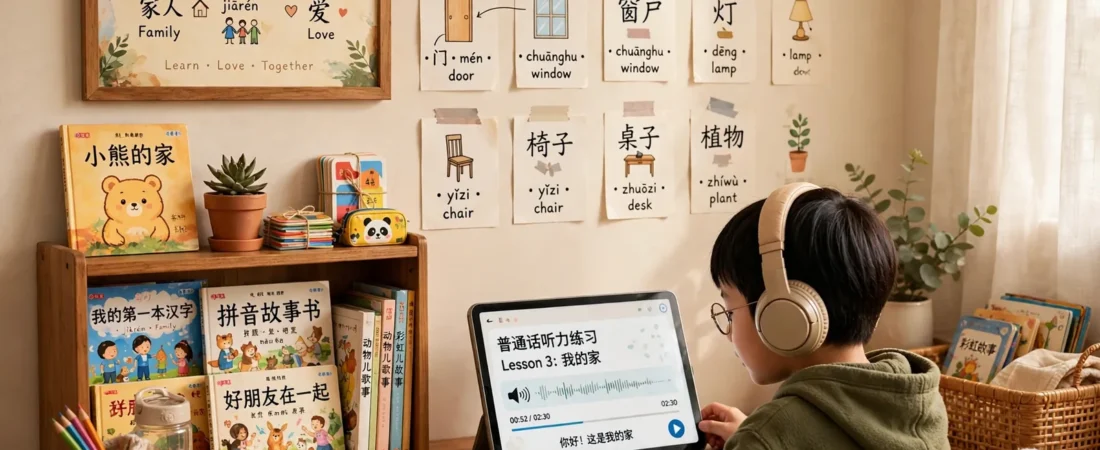
Last year a mum told me her son knew exactly three Chinese words after six months of lessons: hello, thank you, and “I forgot”. The lessons were fine. The problem was that between lessons, Chinese simply did not exist in his life. So we changed one thing — his home. Within a month he was reading the labels on his own bedroom door and asking what the fridge said. A chinese learning environment at home does not need a classroom, a tutor on call, or a single extra hour in the day. It needs a few well-placed triggers that make Chinese bump into your child (or you) without anyone scheduling it.
Think of it this way. A child who sees the same ten words every day, hears the same bedtime story every night, and sings the same two songs in the shower will learn more Chinese than a child who studies hard once a week and never meets the language again. Repetition beats intensity, and home is where repetition lives for free. Here is how to build it, one corner at a time.
Start with labels: the cheapest Chinese teacher you will ever hire
Labels work because they turn looking into learning. Print or hand-write a card for each object, with the character big, the pinyin underneath, and a tiny picture if your learner is young. Stick it on the thing itself, not on a study wall. The fridge gets 冰箱 bīngxiāng. The door gets 门 mén. The cup gets 杯子 bēizi, the chair gets 椅子 yǐzi, the table gets 桌子 zhuōzi.
Start with ten labels only, in the rooms your family actually lives in. Ten words seen twenty times a day beat fifty words seen once. When a word is known cold — your child reads it without thinking — swap it for a new one. A good rhythm is two new labels a week, which quietly adds up to about a hundred words a year from the kitchen and the hallway alone.
Then make the labels do double duty. Once a word is recognised, add a short sentence underneath it. Under 冰箱 bīngxiāng, write 冰箱里有苹果。Bīngxiāng lǐ yǒu píngguǒ. (There are apples in the fridge.) Under 门 mén, write 请关门。Qǐng guān mén. (Please close the door.) Now the label is not just a word; it is a sentence your learner reads every single day. One family I know turned this into a game: whoever reads a label aloud first at breakfast gets to choose the morning song. Nobody needed to be reminded to practise after that.

A book basket beats a bookshelf
A bookshelf looks impressive and gets ignored. A basket by the sofa, the bed, or the breakfast table gets opened. Fill it with five or six Chinese books at the right level — picture books with one short sentence per page for beginners, simple storybooks for learners who can already read a little — and rotate one or two titles every couple of weeks so the basket always feels fresh.
Do not worry if your learner cannot read every word yet. Looking at the pictures while hearing the story counts. Reading the same beloved book ten times counts even more: children memorise the sentences, then one day they notice they are actually reading the characters. If you are learning as an adult, the same trick works with graded readers and bilingual picture books. Keep them where you sit down anyway, not in a study you visit twice a month.
Listening that runs itself: the bedtime and breakfast routines
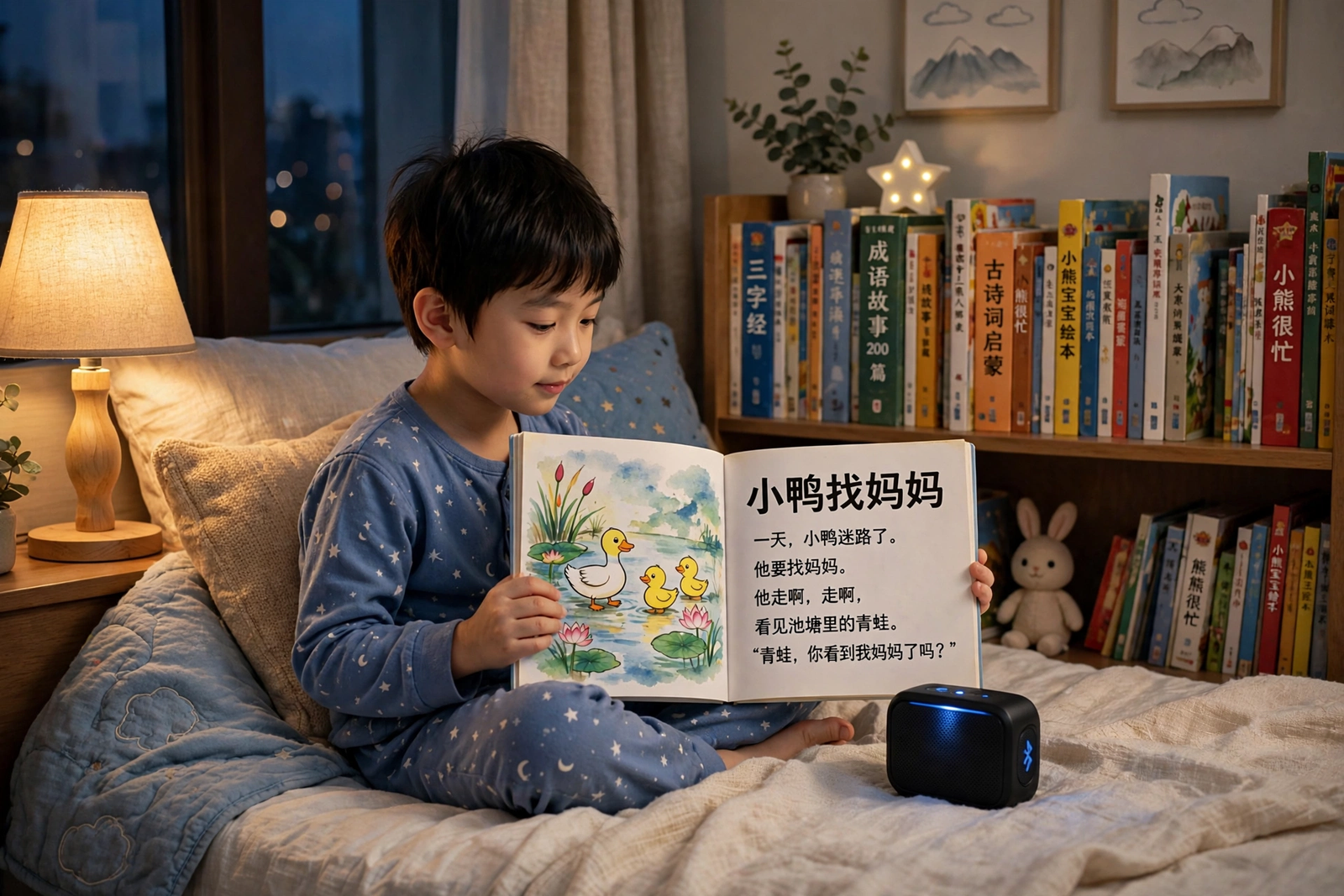
This is the part most families skip, and it is the part that builds the ear. Chinese is a tonal language, and ears are trained by hours of hearing, not by staring at characters. Put a small speaker in the bedroom and play ten minutes of Mandarin audio at bedtime: a story, a song, or a lesson dialogue. It does not need full attention. Half-asleep listening still teaches the brain what Mandarin sounds like, and children in particular soak up tones this way.
Breakfast works the same way. One song or one short dialogue while everyone eats is enough. Pick routines that already exist and attach Chinese to them, rather than inventing a new “study time” that has to fight the rest of the day. A learner who hears 晚安 wǎn’ān (good night) every night and 早上好 zǎoshang hǎo (good morning) every morning will own those words forever, because they are tied to real moments, not to a worksheet.
The 10-minute-a-day checklist for your chinese learning environment at home
Here is the whole system on one list. Print it, stick it on the fridge, and tick it off together:
- Read 3 labels aloud while walking through the house
- Listen to one Mandarin song or story (breakfast or bedtime)
- Read one page of a Chinese book from the basket
- Say one new sentence about something you can see (“This is a chair” — 这是椅子。Zhè shì yǐzi.)
- Swap in one new label when an old one is known cold
- End the day with 晚安 wǎn’ān — in Chinese, every night, no exceptions
Ten minutes. No homework battles. And because every item is attached to something the family already does, it survives busy weeks, holidays, and tired evenings — the exact moments when formal study usually falls apart.
Quick Quiz
Test yourself on building a Chinese corner at home. Click an answer to see if you are right — your score is at the top.
Score: 0/5
1. How many labels should you start with?
2. How many new labels a week is a good rhythm?
3. Where should the Chinese books go?
4. How long is the daily checklist meant to take?
5. What should you do when a word is known cold?
Quick answers families ask me
We do not speak Chinese at home. Can this still work?
Yes, and honestly it works beautifully. You do not need to teach; you need to set up the environment and learn alongside your child. Audio does the pronunciation for you, labels do the vocabulary, and books do the reading. Many parents tell me they end up learning faster than their children, because they read the labels too.
How many labels should we start with?
Ten. Fewer feels too easy, more feels like decorating. Ten labels in the kitchen and bathroom, where everyone goes every day, will be read hundreds of times in the first month. Add two a week from there.
What if my child ignores the labels after a week?
That is normal, and it is not failure. Rotate them: move a label to a surprising place, turn it into a race, or let your child make the next batch with coloured pens. Novelty restarts attention. Also check the level — a label that is far too hard gets ignored, while one that is just one step ahead gets read.
A home that speaks a little Chinese every day will always beat a classroom visited once a week. Set up the labels this weekend, fill a basket, and put a speaker by the bed — then let the house do the teaching. Our Chinese programme gives you the words, audio and stories to fill your corner at every level, and you can try the free HSK 1 trial lessons to get your first labels, songs and stories today.