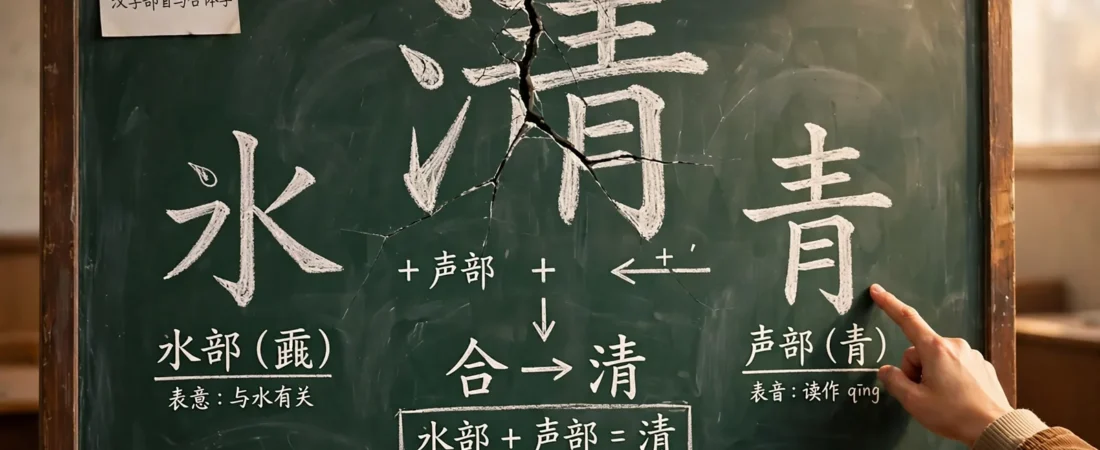
Open a Chinese textbook at a random page and pick a character you have never seen. It looks impossible — a tangle of strokes with no clue where to start. Look closer: inside that tangle there is almost always a familiar piece — a little tree, a drop of water, a mouth, a sun. That piece is a radical, and it is why Chinese characters are far more learnable than they look.
Chinese radicals are the building blocks of the writing system. There are 214 of them in the traditional dictionary count, but a small set — about 40 — shows up in the overwhelming majority of everyday characters. Learn those 40, and a new character stops being a stranger. Here are the 40, with the meaning each one carries and one real character it builds.
What a radical actually does
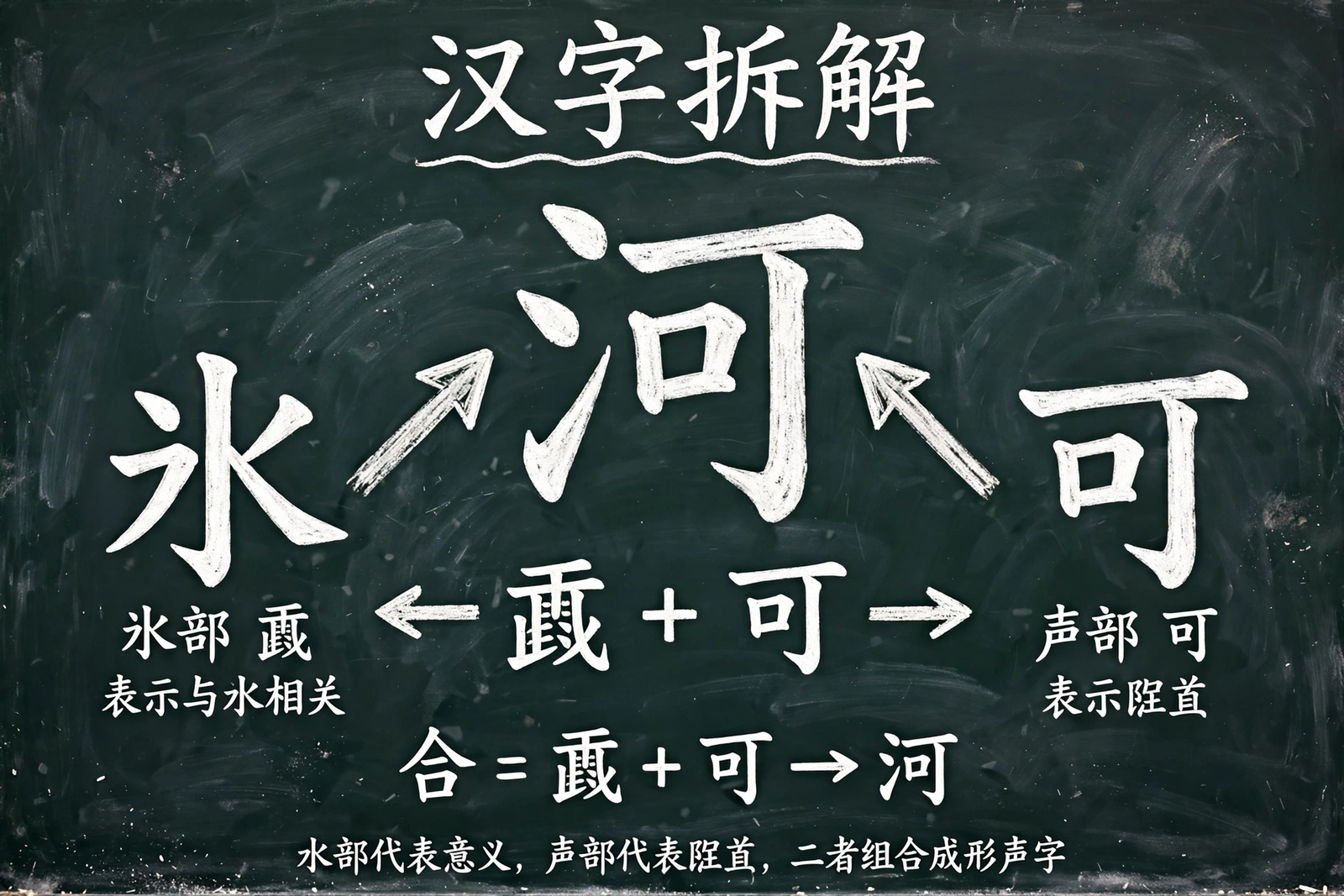
A radical is usually the part of a character that hints at its meaning. Most Chinese characters are made of two parts: a radical that suggests the meaning family, and a second part that hints at the sound. Take 河 (hé, river). The left side is 氵, the water radical — a squeezed version of 水 (shuǐ, water) — and the right side 可 (kě) hints at the sound “he”. Water plus the “he” sound gives you river.
The same trick repeats everywhere. Characters with the mouth radical 口 (kǒu) usually involve speaking, eating or sound: 喝 (hē, to drink), 吃 (chī, to eat). Characters with the hand radical 扌 — the squeezed form of 手 (shǒu, hand) — usually involve doing something with your hands: 打 (dǎ, to hit), 拿 (ná, to take). The radical is the character’s family name.
A note on shapes: radicals often change their form when squeezed into a character. 水 becomes 氵 on the left, 人 becomes 亻, 心 becomes 忄, 手 becomes 扌, 言 becomes 讠, 草 becomes 艹, 金 becomes 钅. They are the same radical in a narrower suit.
People and the body
Start with the radicals that are people, or parts of people. They are the easiest to see, because they look like what they mean.
| Radical | Pinyin | Meaning | Example character |
|---|---|---|---|
| 人 | rén | person | 你 nǐ, you |
| 手 | shǒu | hand | 拿 ná, to take |
| 口 | kǒu | mouth | 喝 hē, to drink |
| 目 | mù | eye | 看 kàn, to look |
| 耳 | ěr | ear | 取 qǔ, to take |
| 心 | xīn | heart | 想 xiǎng, to think |
| 女 | nǚ | woman | 好 hǎo, good |
| 子 | zǐ | child | 学 xué, to study |
| 足 | zú | foot | 跑 pǎo, to run |
| 辶 | chuò | to walk | 远 yuǎn, far |
Two of these are worth pausing on. 好 (hǎo, good) is 女 (woman) plus 子 (child) — a mother and child together. And 想 (xiǎng, to think) carries the heart radical 心 at the bottom, because in Chinese, thinking happens in the heart as much as in the head.
Nature — sun, water, trees and weather
The nature radicals are the oldest picture-words in the language, and many still look like what they describe.
| Radical | Pinyin | Meaning | Example character |
|---|---|---|---|
| 水 | shuǐ | water | 河 hé, river |
| 木 | mù | tree | 林 lín, forest |
| 日 | rì | sun | 明 míng, bright |
| 月 | yuè | moon | 有 yǒu, to have |
| 火 | huǒ | fire | 灯 dēng, lamp |
| 土 | tǔ | earth | 地 dì, ground, land |
| 山 | shān | mountain | 岛 dǎo, island |
| 石 | shí | stone | 破 pò, to break |
| 田 | tián | field | 男 nán, man |
| 雨 | yǔ | rain | 雪 xuě, snow |
林 (lín, forest) is two trees standing together — 木 plus 木 — and 明 (míng, bright) is the sun 日 next to the moon 月, the two lights in the sky. Once you see these, the characters stop being shapes to memorise and start being pictures to read.
Animals, plants and the things around us
The third family covers living things and everyday objects. These radicals are the fastest way to sort an unknown character into a category.
| Radical | Pinyin | Meaning | Example character |
|---|---|---|---|
| 金 | jīn | metal | 钱 qián, money |
| 马 | mǎ | horse | 骑 qí, to ride |
| 鸟 | niǎo | bird | 鸣 míng, to chirp |
| 鱼 | yú | fish | 鲜 xiān, fresh |
| 虫 | chóng | insect | 蚊 wén, mosquito |
| 草 | cǎo | grass | 花 huā, flower |
| 竹 | zhú | bamboo | 笔 bǐ, pen |
| 米 | mǐ | rice | 粮 liáng, grain |
| 衣 | yī | clothing | 被 bèi, quilt, blanket |
| 食 | shí | food | 饭 fàn, rice, meal |
鲜 (xiān, fresh) is fish 鱼 plus sheep 羊 — the two freshest foods a cook could imagine. And 笔 (bǐ, pen) carries the bamboo radical 竹 on top, because the first Chinese brushes were made from bamboo.
Actions, places and ideas
The last ten are the radicals that organise actions, places and abstract ideas.
| Radical | Pinyin | Meaning | Example character |
|---|---|---|---|
| 车 | chē | vehicle | 辆 liàng, measure word for vehicles |
| 门 | mén | door | 间 jiān, room |
| 宀 | mián | roof | 家 jiā, home, family |
| 广 | guǎng | shelter | 店 diàn, shop |
| 走 | zǒu | to walk | 起 qǐ, to get up |
| 刀 | dāo | knife | 分 fēn, to divide |
| 力 | lì | strength | 动 dòng, to move |
| 王 | wáng | king | 玩 wán, to play |
| 言 | yán | speech | 说 shuō, to speak |
| 见 | jiàn | to see | 视 shì, to look at |
家 (jiā, home) is a pig 豕 under a roof 宀 — in ancient China, a home was a house with a pig in it. 分 (fēn, to divide) is a knife 刀 cutting something in two.
How to use radicals when you meet a new character
Here is the routine. First, find the radical — usually on the left, the top, or the bottom. Second, ask what family it belongs to: water, mouth, hand, speech, roof? That gives you a first guess at the meaning. Third, look at the other part for a sound hint. Then check yourself in a dictionary. A wrong guess you can correct is worth more than a blank stare.
One honest warning: radicals hint, they do not guarantee. 男 (nán, man) has the field radical 田 because, in ancient farming life, the man worked the field. Treat radicals as a strong hint and a memory hook, not as a dictionary.
Quick Quiz
Test yourself on Chinese radicals. Click an answer to see if you are right — your score is at the top.
Score: 0/5
1. In 河 (hé, river), what does the left part 氵 tell you?
2. How many radicals does the post say show up in the overwhelming majority of everyday characters?
3. 好 (hǎo, good) is made of which two parts?
4. 林 (lín, forest) is built from…
5. When you meet a new character, what does the post tell you to look for first?
Quick answers
Do I need to learn all 214 radicals?
No. These 40 cover the great majority of characters a beginner meets. The full 214 matter mainly for dictionary lookup and advanced study.
Is the radical always the meaning part?
Usually, but not always. In most characters the radical hints at meaning and the other part hints at sound. A small group are pure pictures or stories, like 好 (woman + child = good).
How do I practise radicals with my child?
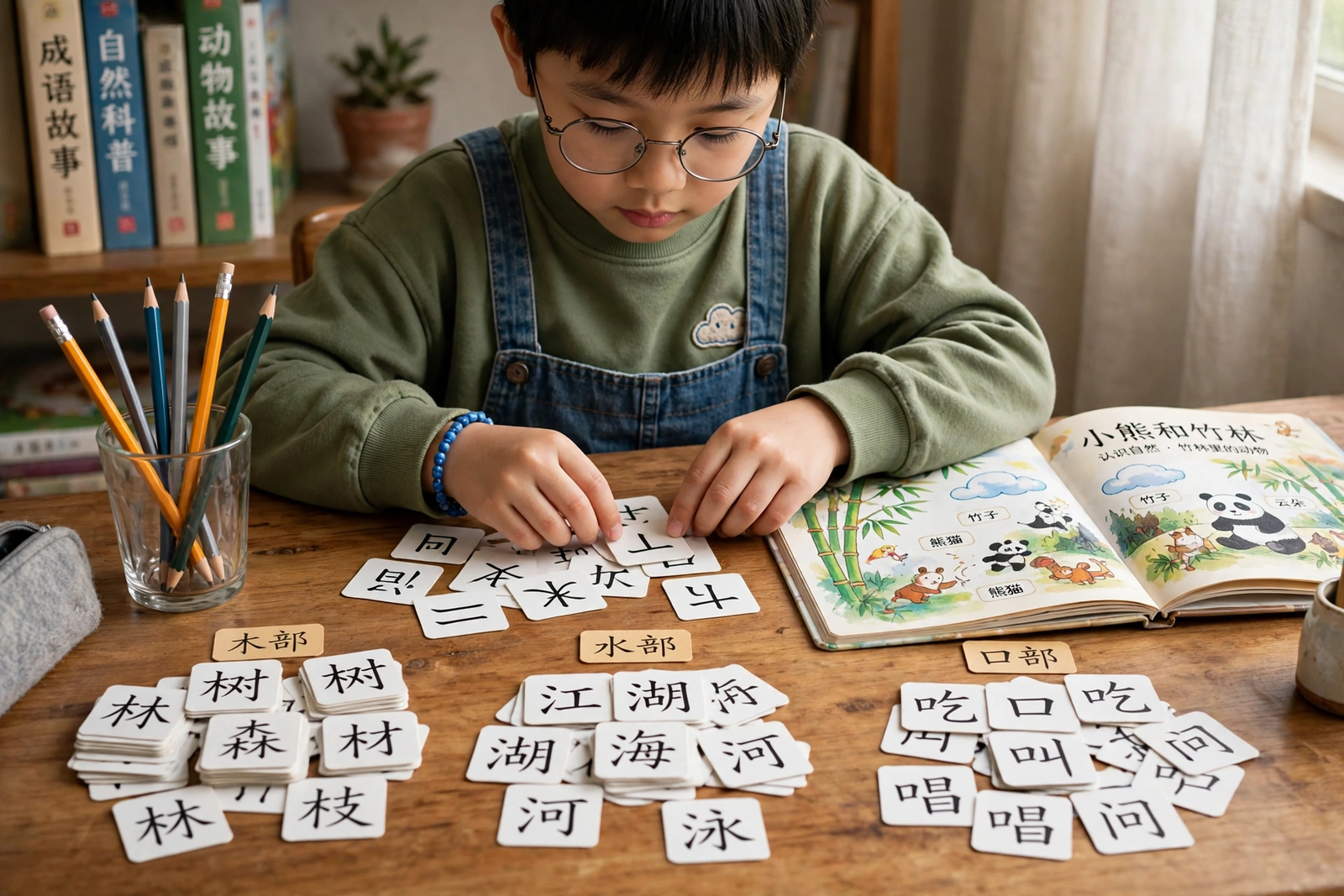
Play spot-the-radical. Open any page of a Chinese book, pick a character, and race to find its radical first. Ten minutes a day for two weeks, and the 40 families will be automatic.
Characters stop being scary the moment they start explaining themselves — and radicals are the explanation. Our Chinese programme teaches every HSK 1 character with its radical pointed out, from the very first word.