
Does your child memorise whole stretches of dialogue from Korean dramas, yet yawn after five minutes at the study desk? Don’t rush to ban the dramas. What makes your child remember those lines is exactly what home study time is missing: emotion, characters they love, and a line tied to a specific situation. This post shows parents how to turn a child’s K-drama passion into Korean study time for kids, with the first 10 sentences you can use at home today, a gentle 4-week schedule, and a few principles so your child learns while still feeling like they’re playing.
First, one reassurance for parents: the goal here is not to turn your child into a child actor speaking fluent Korean after one month. The goal is for your child to get used to hearing Korean, say a few sentences in the right context, and stay interested long enough for the learning to keep running on its own. A child who says “thank you” at the right moment to their teacher is worth more than a child who has memorised 50 words but never opens their mouth.
Why do Korean dramas “stick” with children so much?
Children don’t learn a language from word lists. They learn by imitating people they like, in moments they remember. When the main character bows and says 안녕하세요 (annyeonghaseyo — hello), your child doesn’t just hear a word; they see the politeness, the smile, and the reaction of the person opposite. That whole bundle of emotion makes vocabulary stay far longer than a dry flashcard.
One more reason: dramas give your child real Korean, at real speed and with real intonation. Textbooks teach standard sentences; dramas teach living ones. Both are needed, but for a child just starting out, living sentences are what draw them in first. Parents only need to do one extra thing: turn the sentences your child hears into sentences your child can say, by repeating them together after each episode.
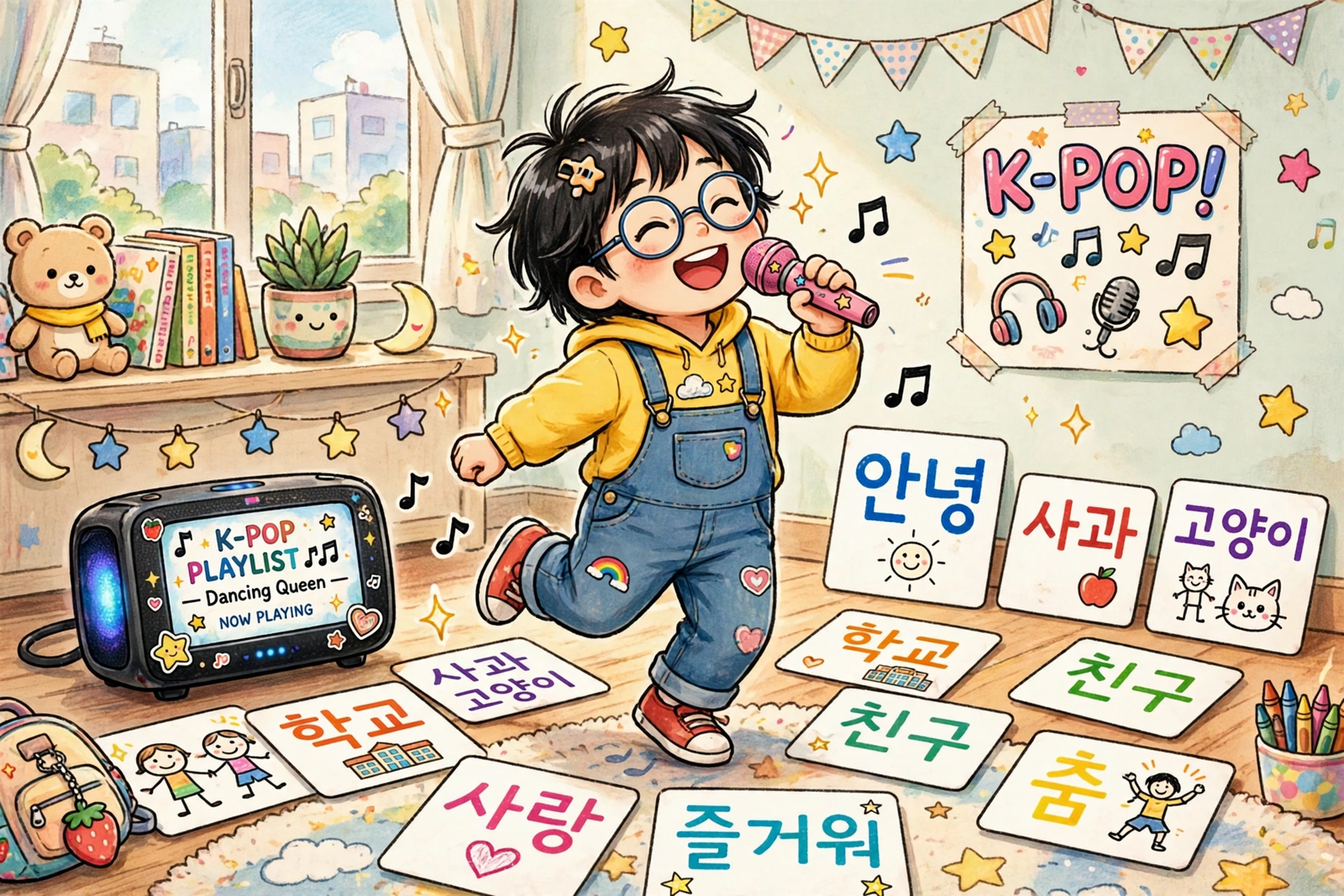
The first 10 Korean sentences to learn from dramas, ready to use at home
The 10 sentences below are ones your child hears in almost every Korean family or school drama. Each sentence comes with the Korean characters, an approximate pronunciation for parents, and the English meaning. Don’t teach all 10 at once — just 2 sentences a day, repeated in real daily life, is enough.
- 안녕하세요 (annyeonghaseyo) — Hello. A polite greeting, used with adults, teachers and strangers. In the morning, if your child greets Mum and Dad with this sentence, that’s already one round of speaking practice.
- 감사합니다 (gamsahamnida) — Thank you. When Mum hands your child a glass of water, instead of saying “thank you” as usual, try saying 감사합니다 once — your child will laugh because they feel “just like in the dramas”.
- 사랑해 (saranghae) — Mum/Dad loves you (an intimate way of saying it). This is the sentence your child hears most in dramas, and also the one most likely to make them love learning. Only use it with people you’re close to, never with teachers.
- 괜찮아 (gwaenchana) — It’s OK / It’s fine. When a younger sibling falls over lightly or spills water, your child saying 괜찮아 to them means they’ve just learnt and practised kindness at the same time.
- 빨리 빨리 (ppalli ppalli) — Hurry up, hurry up. This is a sentence every parent who watches Korean dramas knows by heart. Running late for school in the morning, the whole family saying 빨리 빨리 together makes an instant language game.
- 맛있어요 (masisseoyo) — It’s delicious. Dinner is the perfect stage: your child tastes Mum’s cooking, says 맛있어요, Mum smiles, and the child remembers the word. Learnt this way, every word is sweet.
- 잘 자요 (jal jayo) — Sleep well. A goodnight greeting, said to Mum and Dad or to siblings. One short sentence ending the day in Korean is a very gentle way to close the lesson.
- 친구 (chingu) — Friend. When your child talks about school and mentions their best friend, they call that friend 친구. This word opens up a whole topic of storytelling in Korean later on.
- 학교 (hakgyo) — School. “Did anything fun happen at 학교 today?” — a half-Vietnamese, half-Korean question like that is normal, even good, because your child is genuinely using the new word.
- 좋아요 (joayo) — I like it / Sounds good. If you ask your child “Ice cream?” and they answer 좋아요, congratulations — your child has just replied in Korean without having to think.
A small note on pronunciation: the romanisation above is only a bridge to help parents read along with their child, not an absolute pronunciation standard. Listening to the characters in the drama and imitating them is still the most accurate way. You don’t need perfect pronunciation to teach your child — learning together, making mistakes together and then fixing them together is exactly how your child sees that learning isn’t scary.
A 4-week schedule: 15 minutes a day, no pressure, no exam-style oral tests
This schedule is designed for busy families: 15 minutes each evening, after dinner or before bedtime. The most important thing is regularity, not length.
| Week | Main task | How to do it |
|---|---|---|
| Week 1 | Listen and greet | Watch 1 episode of a family drama with subtitles, focusing on just 2 sentences: 안녕하세요 and 감사합니다. The next morning, repeat them when greeting each other. |
| Week 2 | Talk at mealtimes | Add 맛있어요, 빨리 빨리, 잘 자요. The whole family competes to see who uses them correctly in context most often during the day. |
| Week 3 | Tell stories with new words | Add 친구, 학교, 좋아요. Every evening your child tells one story from class, trying to slip 1–2 Korean words in. |
| Week 4 | Review with games | Play word guessing: Mum and Dad act something out, the child guesses the word; or sing along to a Korean children’s song and pick out the words already learnt from the lyrics. |
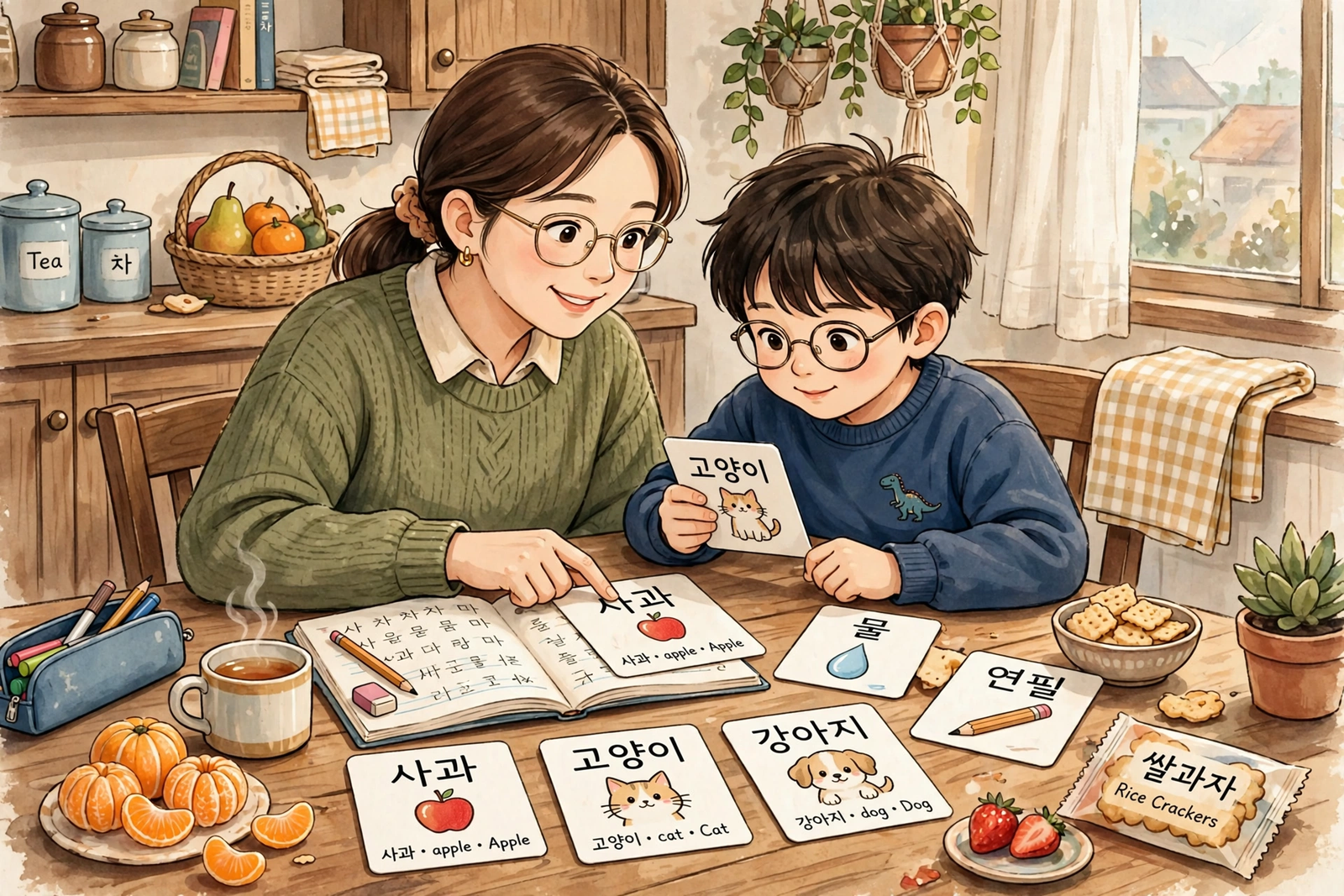
3 principles parents should keep so their child doesn’t end up hating Korean
First, any drama is fine, as long as it’s age-appropriate. Gentle family and school dramas suit children better than adult romances, however much they plead. Watching a few minutes beforehand to check the content is fine is enough; there’s no need to vet every episode.
Second, don’t turn drama time into study time. Watch first, learn afterwards, and only learn the parts your child brings up themselves. If, right after watching, your child asks “Mum, what did that line mean?”, that’s the golden moment — answer straight away; don’t save it for tomorrow’s “study time”.
Third, praise effort, don’t criticise pronunciation. If your child says 안녕하세요 a little unclearly, it’s still one brave time they opened their mouth. Correct by repeating it back correctly in a natural way (“Yes, 안녕하세요!”) rather than making them read it again 10 times. Children stop speaking not because they don’t know, but because they’re afraid of being corrected in front of others.
A quick checklist for tonight
- Choose one episode of a Korean family drama with Vietnamese subtitles, about 30 minutes long.
- Watch with your child, and notice which sentence they repeat on their own — that’s the starting sentence.
- Teach exactly 1 more sentence from the list of 10 above, and use it straight away at dinner or at bedtime.
- Write it down in a small notebook: what sentence your child said today, and in what context. Read it back at the end of the week — the whole family will be surprised how much faster your child is progressing than you thought.
Quick Quiz
Test yourself on learning Korean with K-dramas at home. Click an answer to see if you are right — your score is at the top.
Score: 0/5
1. Why do Korean dramas ‘stick’ with children, according to the post?
2. How many sentences a day does the post suggest teaching?
3. What does 맛있어요 mean?
4. How long is the daily schedule for busy families?
5. What should parents do when a child says a sentence a little unclearly?
To wrap up: dramas are a bridge, not the destination
K-dramas can’t replace a structured study programme, but they are the best bridge to bring your child closer to Korean without fear. You don’t need to be good at Korean to learn alongside your child — you just need to sit and watch together, ask what that line meant, and happily say it wrong together a few times. Learning a language with children, in the end, is like watching a drama: what keeps people staying isn’t the difficulty, but the feeling of belonging to that story.
To go further after these 4 weeks, parents can introduce their child to the alphabet through the post Hangul in One Afternoon on LingoBubbo, read more in My Child Is Learning Korean Because They Love K-pop: How Should Parents Support Them the Right Way?, and visit LingoBubbo’s Korean section to choose lessons that suit your child’s age. What drama is your family watching tonight, and which Korean sentence did your child pick up first? Tell us in the comments — and send this post to any parent whose child loves Korean dramas; maybe tonight their home will have one more fun study hour too.