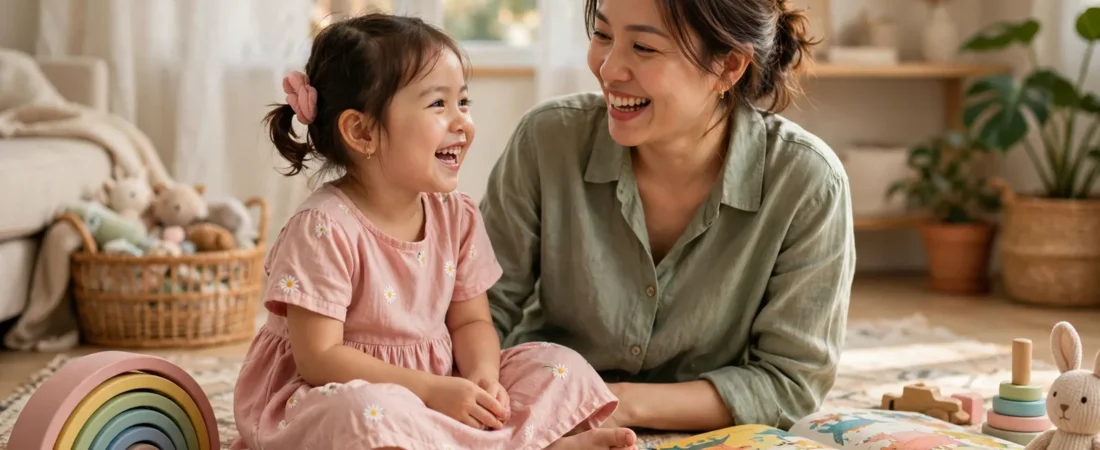
“Mẹ ơi, con muốn eat cơm với chicken!” (“Mum, I want to eat rice with chicken!”)
That sentence rang out in the middle of dinner, and the whole table paused for a beat. Mum looked at Dad. Dad looked at Mum. They were both thinking the same thing: is it a problem that our child talks like that? Does our child have a language disorder? Was it a mistake to let our child learn two languages at the same time?
If your home also has a little one who speaks half a sentence in Vietnamese, half in English — or half in Vietnamese, half in Chinese — this article is for you. The short answer first: **it’s completely fine.** Mixing two languages in one sentence is normal — in fact, it’s a sign that your child’s brain is working very skillfully with two language systems at once. The rest of this article will explain why, when parents really do need to pay attention, and how to help your child gradually separate the two languages without bans or constant corrections.
## What does it mean when a child mixes 2 languages?
Linguists call this phenomenon **code-switching**, also known as code-mixing: using two or more languages in the same conversation, even in the same sentence. Bilingual adults do this every day. Children do it too — they just do it more visibly, which is why parents get such a fright.
Listen to these three very real sentences below. Press play, then read on — they’ll sound very familiar:
“Mẹ ơi, con muốn eat cơm với chicken!” (“Mum, I want to eat rice with chicken!”)
“Con dog này cute quá, mẹ ơi!” (“This dog is so cute, Mum!”)
“Hôm nay ở school, cô giáo cho con một sticker.” (“Today at school, my teacher gave me a sticker.”)
All three sentences share the same pattern: the frame of the sentence is Vietnamese, and for a word your child doesn’t know yet — or finds easier to say — they slot in the English word. Your child isn’t getting the grammar wrong. They’re using exactly the words they have to finish saying what they want to say. That’s clever communication, not a mistake.

## Why does your child mix languages?
Your child doesn’t mix languages out of laziness, and it isn’t because they “can’t tell the two languages apart” either. There are usually just a few reasons, and every one of them makes sense:
**1. Your child doesn’t know that word yet in the language they’re speaking.** This is the most common reason. A 3-year-old who knows the word “chicken” from preschool but has never heard anyone say “gà” at home will quite naturally say “eat cơm với chicken”. Your child reaches for the word that’s already in their head instead of waiting until they’ve learned enough new words before daring to speak.
**2. The word from the other language is shorter and easier to say.** “Sticker” has just two syllables, while “miếng dán” is longer and unfamiliar in your child’s mouth. Children take the shortest route — exactly like adults who choose to say “OK” instead of “được rồi” in many situations.
**3. Your child copies the adults around them.** Many Vietnamese families in the US talk like this every day without noticing: “Hôm nay mẹ đi chợ mua đồ về cook dinner.” (“Mum went to the market today to buy things to cook dinner.”) Your child hears it, so they say it. Mixing languages is a habit of the whole household, not your child’s problem alone.
**4. Your child mixes languages to emphasize feelings.** Sometimes your child switches fully into the other language to show an attitude: Vietnamese with Mum when they’re cross, English when showing off to a friend. Bilingual adults do exactly the same — we’re just so used to it that we don’t notice.
Once you understand these four reasons, you can relax: your child mixes languages because they’re flexibly using both of their word stores, not because they’re confused.
## What the experts say: is mixing languages a problem?
This question has been studied for decades, and the experts’ answer is fairly consistent.
**Mixing languages does not cause speech delay.** The American Speech-Language-Hearing Association (ASHA) concludes that there is no evidence that exposure to two languages delays language development. Bilingual children babble, say their first word and combine two words on the same schedule as children who speak only one language: first word at around 1 year old, two-word sentences at around 2. The only difference is that your child’s vocabulary is shared between two languages, so if you only count the Vietnamese words, they can look “behind” their peers. Count both languages together and they’re not behind at all.
**Mixing languages does not hold back vocabulary.** Concordia’s Infant Research Lab followed nearly 400 young children in multilingual families and concluded that mixing languages does not slow down vocabulary building. Researcher Krista Byers-Heinlein puts it plainly: mixing languages is “neutral or beneficial” for children’s vocabulary. Another line from researcher Casey Lew-Williams is also worth remembering: children mix because, in the community around them, adults mix in just the same way.
**Mixing peaks between ages 2 and 4, then gradually fades.** While vocabulary in both languages is still thin, your child has to borrow from the other side to complete a sentence. From around age 5 to 7, once each language has enough words, most children separate them on their own: all Vietnamese with Grandma, all English with their teacher. Some older children still mix when talking with other bilinguals like themselves, and that’s still normal — in a bilingual community, mixing is simply the natural way of speaking.
In short, experts don’t see mixing languages as a problem that needs “fixing”. They see it as a normal stage of development — even as evidence that your child is managing two language systems at the same time very well.
## When should parents really pay attention?
That said, not every case can be waved away. Mixing languages is normal, but language delay is not. Parents should pay attention if they see the signs below — and note that they must be judged across **both languages combined**, not one language alone:
– Your child talks very little in both languages, with a total vocabulary clearly smaller than other children the same age.
– Your child’s understanding is poor: they don’t turn around when their name is called, and they don’t follow simple instructions like “lấy giày cho mẹ” (“get your shoes for Mum”).
– Your child still barely combines words into sentences after the age of two and a half, in either language.
– Your child gradually loses a language they used to speak well, along with withdrawing and communicating much less.
If you see any of these signs, take your child to see a speech-language pathologist. And remember one important point that ASHA stresses: the specialist must assess your child in **both languages**. Assessing only in English and concluding that your child is delayed is the wrong approach for a bilingual child. If the specialist works in only one language, ask whether they collaborate with someone who can assess the other language.
But if your child still understands well and still tells stories animatedly, and only mixes words a lot, you can relax. Your child doesn’t need “fixing” — they just need more time and more words.
## 5 ways to help your child gradually separate two languages — no bans needed
The good news is that parents don’t need to do anything drastic. The most effective approach isn’t banning mixing; it’s giving your child many more chances to hear and speak each language in full. Here are five things you can do right away in everyday life.
**1. Reply with one full sentence in one language.** Your child says “Mẹ ơi, con muốn eat cơm với chicken”, and Mum replies naturally: “Con muốn ăn cơm với gà hả? Gà hôm nay mẹ kho ngon lắm, con ăn thử nhé.” (“You’d like rice with chicken? The chicken Mum braised today is delicious — try some.”) No correcting, no making your child repeat it. Your child hears a full model sentence in Vietnamese, and next time they’ll have the word “gà” ready to use.
**2. Expand your child’s sentence a little.** Your child says “Con dog này cute quá”, and Mum continues: “Ừ, con chó này dễ thương thật. Nó đang vẫy đuôi mừng con kìa.” (“Yes, this dog really is cute. Look, it’s wagging its tail — it’s so happy to see you.”) This technique is called expansion, and it helps your child learn new words right inside the story they’re excited about — not in a forced lesson.
**3. Each person keeps one language — but don’t turn it into an iron rule.** Many families use “one person, one language”: Mum always speaks Vietnamese, Dad always speaks English. This helps your child attach each language to one person and separate them very well over time. But if Mum is tired one day and a few English sentences slip out, that’s fine too. A few mixed sentences won’t break a child’s whole language system. What matters is the general habit, not every single sentence.
**4. Read bilingual stories with your child every night.** Ten minutes of story time before bed is “golden time” for language. A book with both languages shows your child the same idea said in two different ways. Afterwards, ask your child a few questions in the language of that day’s story. If your family doesn’t know where to start, see the step-by-step guide in [Bilingual stories for kids: 5 steps to read together so it’s fun and the words stick](https://lingobubbo.com/truyen-song-ngu-cho-be-5-buoc-doc-cung-con/).

**5. Let your child meet people who speak only one language.** Children separate languages fastest when they have to use that exact language to be understood. Video-call Grandma in Vietnam, let your child play with a friend who speaks only English, or sign your child up for a class where they [introduce themselves in Chinese in 30 seconds](https://lingobubbo.com/day-be-tu-gioi-thieu-bang-tieng-trung-trong-30-giay/) with a teacher who speaks only Chinese: situations like these teach your child to “choose” a language better than any lecture.
One small note for all five approaches: patience is measured in months, not days. Your child’s vocabulary fills up little by little, and every new word they learn is one less time they need to borrow from the other language.
## Three things parents should avoid saying
Some things are said with good intentions but make children shy about speaking — and being shy about speaking is what is really worth worrying about:
– **”Nói một thứ tiếng thôi!”** (“Just speak one language!”) Your child is trying to communicate; being stopped mid-sentence means next time they’ll choose silence, to be safe. If you want your child to speak in the right language, reply in that language — don’t give orders.
– **”Sao con nói lộn xộn vậy?”** (“Why are you talking all mixed up like that?”) To your child, that sentence isn’t feedback — it’s criticism. They don’t understand what they did wrong; they only know that speaking up gets them told off.
– **”Thôi, nói tiếng Anh đi cho giỏi.”** (“Just speak English, so you get really good at it.”) This sentence accidentally teaches your child that Vietnamese is the “lesser” language. In the long run, your child may drop Vietnamese altogether, and the family loses a language because of one hasty sentence.
Instead of those three sentences, one is enough: “À, con muốn ăn cơm với gà hả?” (“Oh, you’d like rice with chicken?”) Reply to the content, in the language you want your child to use, then carry on with the conversation. Simple as that — and the most effective.
## Frequently asked questions
**My child is 4 and still mixes a lot — is it too late?**
Not too late. Mixing peaks between ages 2 and 4 and fades from 5 to 7 as vocabulary fills up. If your child understands well and talks a lot in both languages, just keep giving them more words and more chances to speak. Only seek an assessment if your child is delayed in both languages.
**Should I make my child say the sentence again in one language?**
Don’t make them — model it instead. Your child says a mixed sentence; you reply with a full sentence in one language. Children learn by listening, not by being made to repeat. Forced repetition only makes them afraid of saying it wrong.
**Everyone in our house mixes — will our child ever separate the languages?**
Yes. Children separate languages by listener: Vietnamese with Grandma, English with their teacher. But if the whole family mixes all the time, your child will separate a little more slowly, because they have no reason to separate. If you want them to separate faster, have each person keep one language at set times — for example, Vietnamese at dinner, English at story time.
**Is mixing Vietnamese with Chinese different from mixing with English?**
Not in essence. Children mix because they’re missing a word, or because the other word is easier — whether the second language is English, Chinese or Korean. The response is the same: reply with a full sentence, expand your child’s words, and let them meet people who speak only one language.
## Quick quiz: how well do you understand your child?
Try the 5 questions below to check the main points of this article. Pick an answer and see your score right away.
Score: 0/5
1. Your child mixes 2 languages in one sentence. What does this usually mean?
2. Why do children mix languages most often?
3. When does mixing languages usually fade?
4. When your child says a mixed sentence, what should parents do?
5. When should parents take their child to see a language specialist?
## In closing: when your child mixes, your child is learning
Next time you hear your child say “Mẹ ơi, con muốn eat cơm với chicken”, try listening with different ears. That isn’t a wrong sentence. That’s a little child using every word they have to finish saying what they want, in two languages at the same time. Your child’s brain is doing something many adults can’t manage.
Parents’ job isn’t to correct their child, but to keep giving them more words, more stories, and more people to talk with. Keep doing that steadily, and once their vocabulary is full enough, your child will separate the two languages on their own, as gently as they taught themselves to mix them.
If your family has story time tonight, try one idea from this article right away: read a bilingual storybook, reply to your child’s mixed sentence with a full sentence, and see how they respond. And if this article helped you worry less, send it to another parent raising a bilingual child. Who knows — maybe their house has just heard an “eat cơm với chicken” tonight too.
For more play-and-learn ideas with your child, visit [LingoBubbo](https://lingobubbo.com/) to see language lessons and games for kids, starting with [Bilingual stories for kids: 5 steps to read together so it’s fun and the words stick](https://lingobubbo.com/truyen-song-ngu-cho-be-5-buoc-doc-cung-con/).