
Sixteen words. That is all it takes to talk about your whole day in Chinese — what you did yesterday, what you are doing now, and what you plan to do tomorrow. No grammar tricks, no long sentences. Just sixteen time nouns, and suddenly you can say when things happen.
This guide lists every HSK 1 time noun with its character, pinyin, tone, and a real example sentence you can use today. There is audio to listen and repeat, a short quiz at the end, and a checklist you can screenshot and keep on your phone.
## One thing first: which HSK version is this?
This post follows **HSK 3.0**, the current standard published in 2021 under the name 《国际中文教育中文水平等级标准》 (Chinese Proficiency Grading Standards for International Chinese Language Education, standard number GF0025-2021). Under HSK 3.0, Level 1 covers **500 words**. The older HSK 2.0 Level 1 covered only **150 words**.
One honest update before you study: the HSK exam syllabus released in November 2025 trims the Level 1 exam list to 300 words, and some test centers still run HSK 2.0 exams, so check with your test center before exam day. Here is the good news: every word in this post was already in the old HSK 2.0 Level 1 list too, so these sixteen words count no matter which version your exam uses. When in doubt, the official test site is [chinesetest.cn](https://www.chinesetest.cn).
## Why time words come first
Think about the first conversation you will ever have in Chinese. Someone will ask you what you did yesterday, or what you are doing tomorrow. You cannot answer without time words. “I go to school” is a sentence. “Tomorrow I go to school” is a plan. “Yesterday I watched a movie” is a story. Time nouns turn bare sentences into real life.
They are also easy wins. Most of them are two characters, and the two characters often repeat: 今 (jīn) shows up in 今天, 明 (míng) in 明天, 天 (tiān) in both. Learn one, and the next one is half learned already. And unlike verbs, time nouns do not change form. 今天 is 今天 whether it is the subject, the object, or the start of the sentence. No conjugations, no surprises.
## The complete list: all 16 HSK 1 time nouns
Here is the full set at a glance. Read each one out loud — the pinyin tells you the sound, and the tone mark tells you how your voice should move.
| Chinese | Pinyin | Meaning | When you use it |
|—|—|—|—|
| 今天 | jīntiān | today | this day |
| 明天 | míngtiān | tomorrow | the next day |
| 昨天 | zuótiān | yesterday | the day before |
| 现在 | xiànzài | now | this moment |
| 早上 | zǎoshang | early morning | roughly 5–9 a.m. |
| 上午 | shàngwǔ | late morning | roughly 9 a.m.–noon |
| 中午 | zhōngwǔ | noon, midday | around 12 p.m. |
| 下午 | xiàwǔ | afternoon | roughly noon–6 p.m. |
| 晚上 | wǎnshang | evening, night | roughly 6 p.m.–bedtime |
| 年 | nián | year | 2026年 |
| 月 | yuè | month | 11月 |
| 日 | rì | day, date | 12日 |
| 星期 | xīngqī | week | 星期一 = Monday |
| 点 | diǎn | o’clock | 三点 = 3 o’clock |
| 分钟 | fēnzhōng | minute | 十分钟 = 10 minutes |
| 时候 | shíhou | time, when | 什么时候 = when |
Keep this table open while you read the rest. Now let us walk through the groups one by one.
## Group 1: today, tomorrow, yesterday
These three are the first time words most learners meet, and for good reason. They are the words you need to tell anyone about your life.
**今天 (jīntiān, today).** 今天天气很好。(Jīntiān tiānqì hěn hǎo.) — Today the weather is very good. Say it in the morning and you have already used Chinese before breakfast.
**明天 (míngtiān, tomorrow).** 明天我去学校。(Míngtiān wǒ qù xuéxiào.) — Tomorrow I go to school. Watch the tone on 明: míng is a rising second tone, not a flat one. Learners often say “mingtian” with no tone at all, and it sounds like mumbling. Lift your voice on 明 and let 天 stay high and flat.
**昨天 (zuótiān, yesterday).** 昨天我看电影。(Zuótiān wǒ kàn diànyǐng.) — Yesterday I watched a movie. The trap here is 昨: zuó is also a rising second tone. Say zuó-tiān slowly a few times — rising, then high — until it feels natural.
One pattern to notice: all three end in 天 (tiān, day). Once you know 天, you have the second half of three words for free. Chinese rewards you like that again and again.
## Group 2: the five parts of the day
Chinese splits the day into five parts, and each one has its own word. English gets by with “morning” and “afternoon” and a vague “evening.” Chinese is more precise, and once you feel the rhythm of the day in these words, you will wonder how you managed without them.

**早上 (zǎoshang, early morning).** 早上好。(Zǎoshang hǎo.) — Good morning. This is the greeting you use when you meet someone before about 9 a.m. — at the market, at the school gate, on your morning walk.
**上午 (shàngwǔ, late morning).** 上午 is the part of the morning after 早上, roughly 9 a.m. to noon. You do not greet people with it the way you do with 早上好, but you use it to plan: 上午我学习。(Shàngwǔ wǒ xuéxí.) — In the morning I study.
**中午 (zhōngwǔ, noon).** 中午我吃饭。(Zhōngwǔ wǒ chī fàn.) — At noon I eat. 中 literally means “middle,” so 中午 is the middle of the day. Easy to remember, hard to forget.
**下午 (xiàwǔ, afternoon).** 下午我学习。(Xiàwǔ wǒ xuéxí.) — In the afternoon I study. 下 means “down” or “below,” the sun going down after noon. Pair it with 上午 and you have a neat little system: 上 (up) for the morning, 下 (down) for the afternoon.
**晚上 (wǎnshang, evening, night).** 晚上我休息。(Wǎnshang wǒ xiūxi.) — In the evening I rest. 晚 also means “late,” which is why 晚上 covers both the evening and the night. If someone says 晚上见 (wǎnshang jiàn, see you tonight), they mean later today, not tomorrow.
Here is a question for you: what are you doing this afternoon? Try answering in Chinese, even if it is just one word: 下午,我学习。 Or 下午,我休息。 One sentence is a win.
## Group 3: telling the time
This is the part that makes people smile, because it works instantly. You already know the numbers from your first week of Chinese, and the clock just stacks them onto two words: 点 (diǎn) and 分钟 (fēnzhōng).
The pattern is simple: **number + 点 = the hour. Number + 分 = the minutes.** 分钟 is the full word for “minute,” but in clock time people usually shorten it to 分 (fēn).
– 现在三点。(Xiànzài sān diǎn.) — It is 3 o’clock now.
– 现在三点十分。(Xiànzài sān diǎn shí fēn.) — It is 3:10 now.
– 现在九点半。(Xiànzài jiǔ diǎn bàn.) — It is 9:30 now. 半 (bàn) means “half,” and it is the shortcut everyone uses for :30.
And the question you will ask a hundred times: **现在几点?(Xiànzài jǐ diǎn?) — What time is it now?** 几 (jǐ) means “how many” for small numbers, and it is the word you use when you expect an answer under ten. Learn this one question and you can ask the time in any Chinese-speaking place on earth.
A small warning: do not say 点钟 (diǎnzhōng) at HSK 1 level. It exists, but 点 on its own is what your textbook and your exam expect. Keep it simple, keep it right.
## Group 4: years, months, days, and weeks
Dates in Chinese run big to small: year first, then month, then day. It is the opposite of the American order, and once you get used to it, it feels more logical.
– **年 (nián, year):** 2026年 = the year 2026. Say the digits, then 年.
– **月 (yuè, month):** 11月 = November. Just the number plus 月. 一月 is January, 二月 is February, and so on up to 十二月.
– **日 (rì, day, date):** 12日 = the 12th. Put it after the month: 11月12日 = November 12.
– **星期 (xīngqī, week):** 星期一 (xīngqī yī) is Monday, 星期二 Tuesday, 星期三 Wednesday, 星期四 Thursday, 星期五 Friday, 星期六 Saturday, and 星期天 (xīngqī tiān) — or 星期日 — is Sunday. The number tells you the day: one is Monday, two is Tuesday. Sunday breaks the pattern with 天 or 日, so that is the one to memorize on its own.
Put it all together and you can say a full date: 今天是十一月十二日。(Jīntiān shì shíyī yuè shí’èr rì.) — Today is November 12. And you can talk about your week: 这个星期我很忙。(Zhège xīngqī wǒ hěn máng.) — This week I am very busy.
## 时候: the word that means “when”
时候 (shíhou) deserves its own little section, because it does a job no other word on this list does. It turns a sentence into a question about time.
**什么时候 (shénme shíhou) = when.** 你什么时候去?(Nǐ shénme shíhou qù?) — When are you going? Answer with any word from this post: 明天。(Tomorrow.) 下午。(In the afternoon.) 三点。(At three o’clock.) One question, sixteen possible answers, and you already know all of them.
You will also see 时候 in phrases like 的时候 (de shíhou, “when…”): 吃饭的时候 (chī fàn de shíhou) means “when eating” or “at meal time.” That pattern comes a little later in your studies, but now you know where it comes from.
## 5 mistakes every beginner makes (and how to fix them)
**Mixing up 早上 and 上午.** 早上 is early morning, 上午 is late morning. Saying 上午好 as a greeting sounds odd to a native ear — the greeting is 早上好. Use 上午 for plans, 早上 for greetings and early activities.
**Saying the tones flat.** 明天 is míngtiān, not mingtian. 昨天 is zuótiān, not zuotian. If you drop the tones, people will still understand you most of the time, but the words will sound wrong, and wrong tones are the hardest habit to fix later. Say the tones from day one.
**Putting the time word in the wrong place.** In Chinese, time words usually come at the start of the sentence or right after the subject: 明天我去学校 or 我明天去学校 — both are fine. What sounds wrong is putting the time at the very end, the way English sometimes does (“I go to school tomorrow”). Keep the time early.
**Forgetting 分 in clock time.** 三点十 means nothing on its own. It is 三点十分 — three o’clock, ten minutes. The 分 is not optional.
**Using 点 for minutes.** 点 is only for the hour. If you say 三点十点, a listener will be very confused. Hours get 点, minutes get 分. That is the whole rule.
## Your 10-minute daily practice
You do not need an hour a day to own these words. You need ten minutes, every day, for one week. Here is the plan.
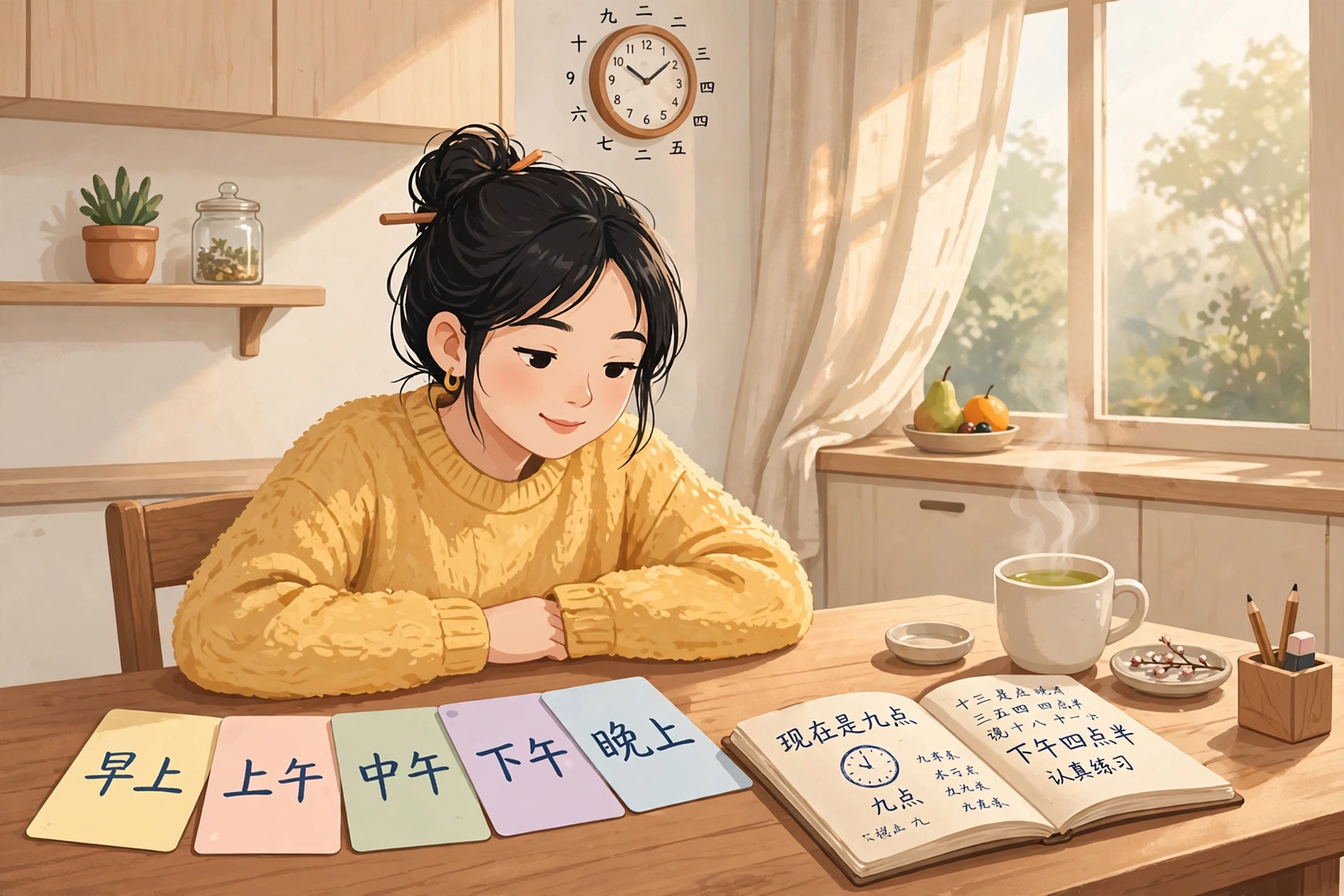
– **Day 1:** Say all 16 words out loud three times each, with the audio clips above. Circle the ones whose tones feel shaky.
– **Day 2:** Write five sentences about your own day: one with 今天, one with 明天, one with 昨天, one with 现在, one with 晚上.
– **Day 3:** Ask and answer the time out loud ten times. 现在几点?现在三点。 Change the hour each time.
– **Day 4:** Say the date out loud every morning before you check your phone. Today, tomorrow, and the day of the week.
– **Day 5:** Describe your day in five sentences, one for each part: 早上, 上午, 中午, 下午, 晚上.
– **Day 6:** Take the quiz below. Then take it again, and beat your score.
– **Day 7:** Teach someone else. Tell a friend or a family member what 今天, 明天, and 昨天 mean. Teaching is the fastest way to lock something in.
Screenshot the checklist above and keep it on your phone. If you are learning with your child, do the plan together — kids love the clock-time game, and asking 现在几点? ten times a day is the most fun drill in beginner Chinese.
## Quick Quiz
Test yourself on the sixteen time nouns. Click an answer to see if you are right — your score is at the top.
Score: 0/5
1. Which word means “tomorrow”?
2. What is the pinyin of 昨天?
3. 现在三点十分 means what time?
4. Which word do you use for the early morning, before about 9 a.m.?
5. Which sentence asks “What time is it now?”
## FAQ
**Is this the complete list of HSK 1 time nouns?**
These sixteen words are the time nouns in the HSK 3.0 Level 1 list. The full Level 1 list has 500 words under the 2021 standard, and this post covers the time group in full. Words like 今年 (this year) and 以前 (before) are not part of the HSK 1 time-noun set, so they are not on this list — you will meet them as you move past Level 1.
**Should I study HSK 2.0 or HSK 3.0?**
Study HSK 3.0 — it is the current standard, and it keeps almost everything from HSK 2.0. The words in this post appear in both versions, so they are safe either way. Before exam day, confirm which version your test center uses on the official site, chinesetest.cn.
**How do I say the date in Chinese?**
Big to small: year, month, day. 2026年11月12日 is November 12, 2026. Say the number, then 年 for year, 月 for month, 日 for the day.
**What is the difference between 早上 and 上午?**
早上 is the early morning (roughly 5–9 a.m.) and the one you use for the greeting 早上好. 上午 is the late morning (roughly 9 a.m.–noon) and is used for plans and schedules, not greetings.
**How do I ask what time it is?**
现在几点?(Xiànzài jǐ diǎn?) — What time is it now? Answer with the hour plus 点, and add the minutes with 分: 现在三点十分 is 3:10.
**What should I learn after time nouns?**
Numbers and measure words pair naturally with time — you need them for dates and clock times. Our guide to [Pinyin and the 4 tones in 10 minutes](https://lingobubbo.com/pinyin-4-thanh-dieu-tieng-trung/) will help if any tone in this list still feels shaky, and the [Chinese lessons on LingoBubbo](https://lingobubbo.com/tieng-trung/) keep building on these words in short dialogues.
## Your turn: say your day in Chinese
You now know all sixteen HSK 1 time nouns — today, tomorrow, yesterday, now, the five parts of the day, years, months, dates, weeks, clock time, and the word for “when.” That is enough to describe your whole day and to ask anyone about theirs. Try it right now: say one sentence about today, one about tomorrow, and one about yesterday. Out loud, with the tones.
Then keep going with the [Chinese lessons on LingoBubbo](https://lingobubbo.com/tieng-trung/), where these time words keep showing up in new dialogues and short conversations. If this list helped you, send it to a parent or a friend who is starting Chinese too — sixteen words is a much nicer gift than a whole textbook. And tell us in the comments: which time of day is your favorite to talk about in Chinese, and what did you do yesterday?