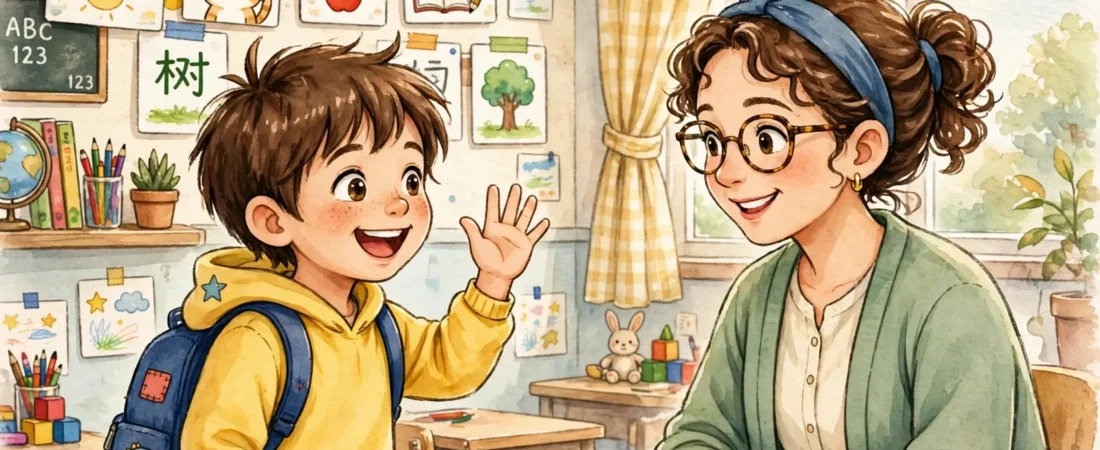
Thirty seconds. That is all a self-introduction needs to be when your child is six, seven, or eight years old. One hello, one name, one age, one thing they love, and a thank-you at the end — and suddenly your child is not just “learning Chinese,” they are speaking it, in front of real people, without freezing up. If you have ever watched your child go quiet when a teacher asks a simple question in Chinese, this post is for you. Below is a 30-second script any child can learn in one week, ten words and sentences to go with it, slow audio to copy, and a five-minute daily game that makes the whole thing stick.
This is a parent-and-child activity, not a test. You do not need to speak Chinese yourself. You just need five to ten minutes a day, a little patience, and the willingness to sound silly saying the words first so your child feels safe copying you. The script works for ages 6 to 8, and younger or older siblings can join in too — the only rule is that it stays fun. For more playful Chinese practice, try the Chinese word games on LingoBubbo.
Why 30 seconds is the perfect size for a child
A long self-introduction scares a child. A short one gives them a win. Four little lines, about thirty seconds of talking, and your child has done something most adults learning Chinese still avoid: opening their mouth in front of someone new. That first win matters more than ten perfect words said alone in a bedroom.
Think about how a child learns a song. Nobody hands them the whole songbook. They learn one verse, sing it ten times, and beg to sing it again. A self-introduction works the same way. Four lines, repeated every day for a week, becomes something your child owns. And once they own it, they start changing it — swapping in a new favorite thing, adding their age when their birthday comes. That is real language learning, not memorization.
One more thing before we start: practice with a nickname or first name only. A child never needs to share their full name, their school, or where they live to practice introducing themselves. Keep it simple, keep it safe, and keep the practicing at home or with a teacher you trust.
The 30-second script: four lines your child can learn this week
Here it is — the whole script. Four lines, about thirty seconds when spoken slowly. Listen to the audio first, then say each line together with your child.
Listen to the 30-second self-introduction: Hello! My name is Xiaoming. I am seven years old. I like drawing. Thank you!
| Line | Chinese | Pinyin | English |
|---|---|---|---|
| 1. Hello | 你好! | Nǐ hǎo! | Hello! |
| 2. My name is… | 我叫小明。 | Wǒ jiào Xiǎo Míng. | My name is Xiaoming. |
| 3. I am seven years old. | 我七岁。 | Wǒ qī suì. | I am seven years old. |
| 4. I like drawing. Thank you! | 我喜欢画画。谢谢! | Wǒ xǐhuān huà huà. Xièxie! | I like drawing. Thank you! |
Swap in your child’s own name and age, of course. 小明 (Xiǎo Míng) is just an example name — replace it with your child’s name, or even a fun Chinese nickname they pick themselves. And 画画 (huà huà, drawing) can become anything your child loves: 唱歌 (chàng gē, singing), 踢足球 (tī zúqiú, playing soccer), 跳舞 (tiào wǔ, dancing). The pattern never changes: 我喜欢 (wǒ xǐhuān, I like) + the activity.
Notice how short the sentences are. There is no grammar to explain, no long word list to memorize. Your child just copies the music of the sentence — the rise and fall of the tones — the way they would copy a song. That is exactly how children learn a first language, and it works just as well for a second one.

Ten words and sentences to go with the script
The script is the skeleton. These ten words and sentences are the muscles — they let your child answer when someone asks a follow-up question. Learn them in pairs, two a day, and your child will have all ten by Friday.
Listen to what your child likes: I like drawing. I like singing. I like playing soccer.
| Chinese | Pinyin | English | When to use it |
|---|---|---|---|
| 你好 | nǐ hǎo | hello | Every greeting |
| 我叫 | wǒ jiào | my name is | Introducing yourself |
| 名字 | míngzi | name | 你叫什么名字?— What is your name? |
| 七岁 | qī suì | seven years old | Saying your age (六岁 liù suì is six, 八岁 bā suì is eight) |
| 我喜欢 | wǒ xǐhuān | I like | Before any favorite thing |
| 画画 | huà huà | drawing | 我喜欢画画。— I like drawing. |
| 唱歌 | chàng gē | singing | 我喜欢唱歌。— I like singing. |
| 踢足球 | tī zúqiú | playing soccer | 我喜欢踢足球。— I like playing soccer. |
| 谢谢 | xièxie | thank you | Ending any introduction politely |
| 再见 | zàijiàn | goodbye | Saying goodbye — 明天见 (míngtiān jiàn) means “see you tomorrow” |
Two of these words deserve a little extra attention. First, 岁 (suì) — the word for “years old.” In Chinese you do not say “I am seven years,” you say 我七岁, literally “I seven years-old.” It feels strange in English, but children pick it up fast because the pattern is so short. Second, 喜欢 (xǐhuān) — “to like.” Once your child knows 我喜欢, they can build a dozen sentences by themselves, just by adding a new activity after it. That one little verb is the engine of the whole script.
Answering back: two little conversations
An introduction is never a speech — it is a conversation. Sooner or later someone will ask your child a question back. Two questions cover almost everything a teacher or a new friend will ask:
Listen to the questions and answers: What is your name? My name is Xiaoming. How old are you? I am seven years old.
- 你叫什么名字? (Nǐ jiào shénme míngzi?) — What is your name? Answer: 我叫小明。 (Wǒ jiào Xiǎo Míng.) — My name is Xiaoming.
- 你几岁? (Nǐ jǐ suì?) — How old are you? Answer: 我七岁。 (Wǒ qī suì.) — I am seven years old.
Practice these as a game of catch. You ask, your child answers. Then switch — your child asks, you answer. Children love being the one who asks the question, and asking is half of speaking. If your child can ask 你叫什么名字? and understand the answer, they are already having a real conversation in Chinese.
The 5-minute daily plan: one week to a confident introduction
Here is the whole system. Five to ten minutes a day, no worksheets, no tears. Do it at the same time every day — after dinner works well for most families — so it becomes a habit, not a chore.
| Day | 5-minute activity | What your child can do by bedtime |
|---|---|---|
| Monday | Listen to the script audio together three times. Say 你好 and 我叫 after each line. | Say hello and their name |
| Tuesday | Add the age line. Count 6, 7, 8 on your fingers while saying 六岁,七岁,八岁. | Say name + age |
| Wednesday | Add 我喜欢 + one favorite activity. Let your child pick the activity. | Say the full four-line script with help |
| Thursday | Play the question game: you ask 你叫什么名字? and 你几岁?, your child answers. | Answer two questions back |
| Friday | Performance night! Your child introduces themselves to the family — grandparents on a video call count double. | Do the whole 30 seconds alone |
| Weekend | Play it again in a new place: the car, the park, the kitchen. New place, same script. | Say it anywhere, not just at the table |
What if your child gets stuck on a tone? Do not stop and correct every sound. Say the line again, slowly, with a big smile, and let them copy you. Children fix their own tones by listening and repeating — the audio clips in this post are there for exactly that. Play them often, especially the slow ones, and let your child echo them like a song.
And what if your child refuses one day? That happens. Skip the lesson, play the game tomorrow. One missed day never broke a language learner. Ten forced minutes, on the other hand, can put a child off Chinese for a month. Keep it light, and the habit will build itself.
Three games that make the script stick
Games turn practice into playtime. Try one each day, and rotate them when your child gets bored.
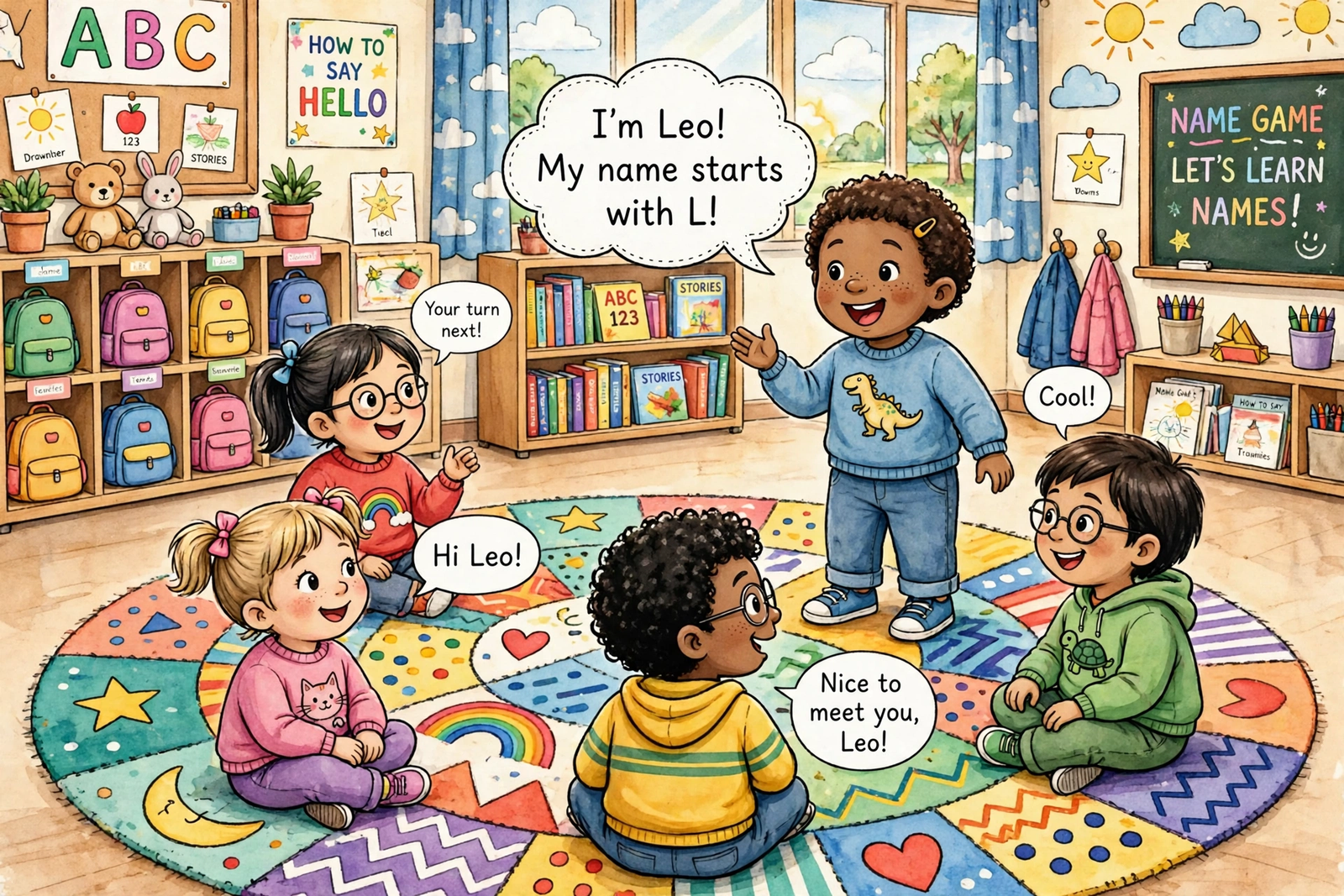
The name ball. Toss a soft ball back and forth. Whoever catches it says one line of the script. Miss a line, toss again — no points, no losing, just laughing. This is the game to play first, because it teaches the script without your child noticing they are studying.
Teacher for a day. Your child is the teacher. Their stuffed animals are the students. Each animal introduces itself — with your child’s help, of course. A teddy bear who says 我叫小熊,我三岁 (I am Little Bear, I am three) is the funniest thing in the world to a seven-year-old, and every giggle is a repetition of the pattern.
Goodbye chain. At bedtime, say goodbye in Chinese three different ways: 再见 (zàijiàn, goodbye), 明天见 (míngtiān jiàn, see you tomorrow), and 谢谢 (xièxie, thank you). Then let your child invent a fourth. Listen to the clip below and copy it together.
Listen and repeat the goodbye game: Thank you! Goodbye! See you tomorrow! Let’s play again tomorrow!
Three mistakes parents often make (and what to do instead)
Correcting every tone. A child who is corrected after every word stops talking. Praise the sentence first — “You said the whole thing!” — and fix one sound later, gently, by saying it correctly yourself. The child will copy you without even noticing.
Teaching too many words at once. Ten words in a week is plenty. Twenty words in a day is a recipe for tears. The script only needs four lines, and the ten words in the table above are already more than enough for a first month. Slow down; the words will still be there next week.
Asking for a performance in front of strangers too soon. Friday performance night is for family, not for the neighbors. Let your child choose when they are ready to show a teacher or a friend. Confidence grows when the child is in charge of the moment.
Checklist: is your child ready?
Tick these off together on Friday night. If you can check four out of five, your child is ready to introduce themselves in Chinese — and that is a real milestone.
- ☐ Says 你好! with a smile
- ☐ Says 我叫… with their own name
- ☐ Says 我七岁 (or their real age) without help
- ☐ Says 我喜欢… with one favorite activity
- ☐ Ends with 谢谢! and says 再见!
Send this checklist to another parent whose child is learning Chinese — a shared goal is twice as fun, and two children practicing together will race each other to Friday. For a bigger daily routine around this one, the 20-minute daily system for kids shows how busy parents fit language time into a normal day, and the guide to surrounding a young child with English has the same gentle, daily approach for a second language.
Quick Quiz: can your child introduce themselves in Chinese?
Tap the answer you think is right — you will know instantly if it is correct. (Parents: read the questions aloud and let your child pick!)
Your score: 0/5 — tap an answer to check it right away.
Question 1. How do you say “hello” in Chinese?
Question 2. “我叫小明” means…
Question 3. How do you say “I am seven years old”?
Question 4. What does 我喜欢画画 mean?
Question 5. Someone asks 你几岁? — what are they asking?
Frequently asked questions about teaching a child to introduce themselves in Chinese
My child is six, not seven. Does the script still work? Yes — just change the age line. Six is 我六岁 (Wǒ liù suì), eight is 我八岁 (Wǒ bā suì). The rest of the script stays exactly the same, which is the point: the pattern never changes, only the number does.
Do I need to speak Chinese to teach this? No. Play the audio clips in this post and copy them together with your child. Your job is to keep the routine going for five minutes a day, not to be the teacher. The audio is the teacher.
My child keeps forgetting the tones. Is that a problem? Not at this age. Children learn tones by hearing them many times, not by studying them. Keep playing the slow audio, keep the games going, and the tones will settle by themselves over a few weeks. Never turn a tone into a test.
Should my child learn the characters too? Not yet, and not in the same week. Speaking first, characters later. When your child can say the whole script without thinking, show them the characters for 你好 and 谢谢 as a fun extra — two characters a week is plenty.
What comes after the self-introduction? The next step is answering one more question: 你喜欢什么? (Nǐ xǐhuān shénme? — What do you like?) Your child already knows the answer pattern — 我喜欢… — so the next lesson is really just one new question. The Chinese word games on LingoBubbo are a good place to practice it.
Thirty seconds from now, your child could say hello in Chinese, give their name, tell you their age, and say what they love — all in one breath. Start tonight. Play the first audio clip, say 你好 together, and watch what happens when your child realizes they can really do this. Then tell us in the comments: which line did your child learn first, and what favorite activity did they swap in? And if this helped, share it with a parent whose child is learning Chinese too — the next 30-second introduction might be theirs.