
40 questions, 40 minutes, 120 points to pass. Sounds gentle, doesn’t it? Yet many learners who have finished the 300 HSK 1 words still get shaky hands at the very first listening question — not because they don’t know the words, but because they have never taken a complete paper under real exam timing. This mock paper was created to fix exactly that.
This is HSK 1 mock paper No. 1 with explanations: the full 40 questions following the real exam structure — 20 listening questions, 20 reading questions — with audio you can play right inside the article, an answer key and one line of explanation for every question. When you finish, you will know exactly where you stand and which part you need to revise more. This HSK 1 mock paper uses HSK 1 vocabulary, follows the new standard closely, and you can retake it as many times as you like.
Let’s be clear first: which HSK standard does this paper follow?
This paper follows the HSK 3.0 standard — the new Chinese proficiency standard with 9 levels, issued in 2021 and gradually replacing the old HSK 2.0 standard (6 levels). It is worth saying right away, because this is where new learners get most confused: old books, old papers and old apps may still say HSK 1 is 150 words, but under the new standard, HSK 1 rises from about 150 words (2.0) to about 300 words (3.0).
One more milestone you should remember: the HSK 3.0 standard applies to exams from 13 December 2026. If you take the exam after that date, revise using the new standard’s word list. The mock paper in this article uses vocabulary within the new standard’s HSK 1 framework — all familiar words such as 你好 (nǐ hǎo, hello), 谢谢 (xièxie, thank you), 妈妈 (māma, mother), 学校 (xuéxiào, school) — but with a few extra words the old standard did not have, true to HSK 3.0’s spirit of “broader coverage”.
And what if you are only learning Chinese in order to communicate? You can still take this paper happily. The basic communication words have not changed; the new standard has simply added more words. Taking a test paper is the fastest way to check whether your vocabulary can already “run” inside real sentences or not.
What does the real HSK 1 exam include?
The real HSK 1 exam has 40 questions, taken in 40 minutes, with a total of 200 points, and you pass with a score of 120 points or more. Each question is worth 5 points. The listening part makes up half of the questions, and it is also the part where many Vietnamese learners lose the most points, because they are not used to hearing a short sentence and choosing an answer straight away.
| Part | Task type | Number of questions | Listening / Reading |
|---|---|---|---|
| Part 1 | Listen to a sentence and judge true or false against a picture | 5 | Listening |
| Part 2 | Listen to a sentence and choose the matching picture | 5 | Listening |
| Part 3 | Listen to a short dialogue and answer the question | 5 | Listening |
| Part 4 | Listen to a short passage and answer the question | 5 | Listening |
| Part 5 | Read a sentence and choose the matching picture | 5 | Reading |
| Part 6 | Fill the correct word into the blank | 5 | Reading |
| Part 7 | Match each question with the correct answer | 5 | Reading |
| Part 8 | Read a short passage and answer the questions | 5 | Reading |
| Total | 40 questions — 200 points, pass from 120 points | 40 | 40 minutes |
A small note about the answers: the real exam has no “trick” answers built on hard words. The difficulty lies in having to listen in time, read in time and choose quickly. So this mock paper is the same: all HSK 1 words, nothing outside the syllabus.
Take this paper like the real exam
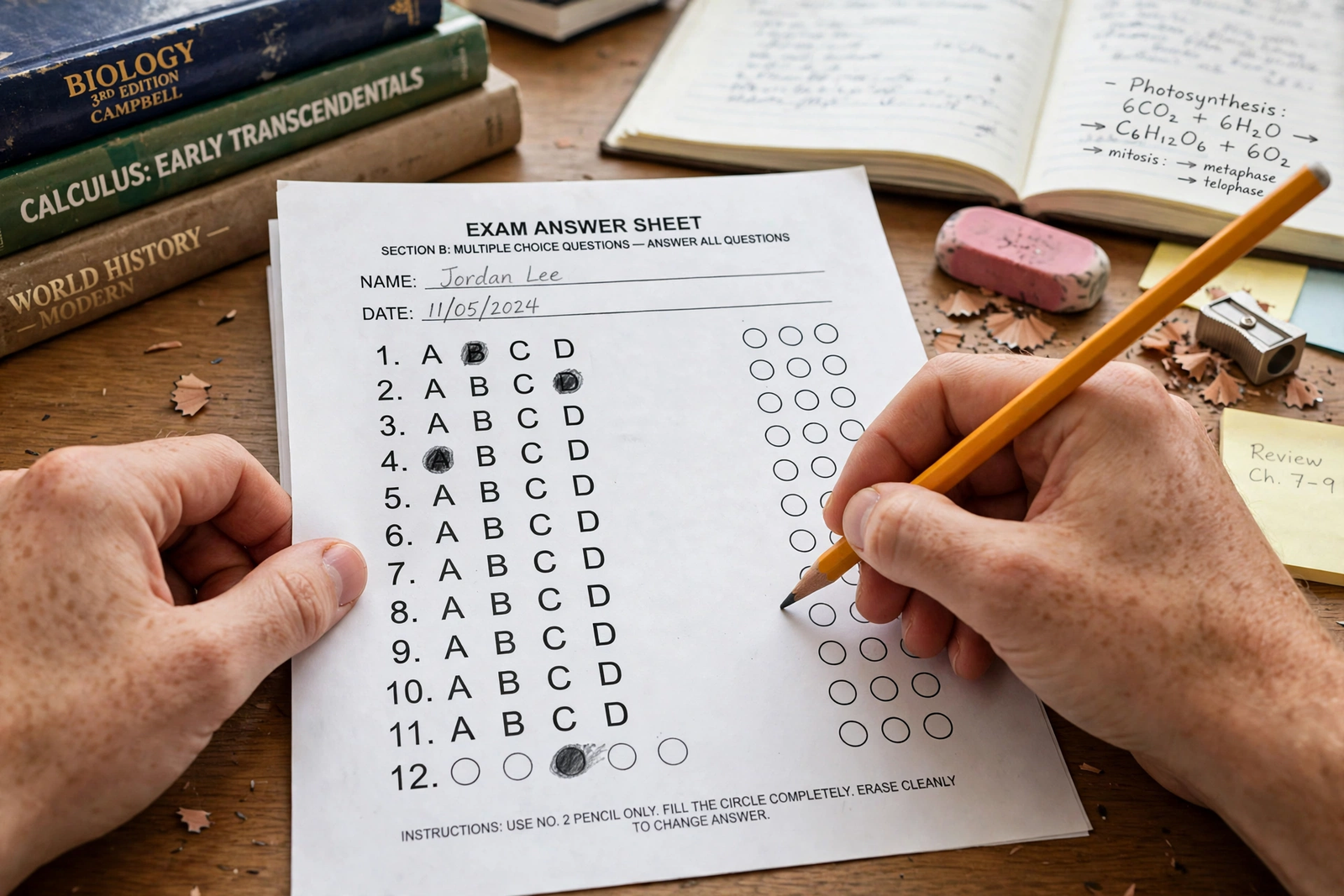
Prepare a sheet of paper and a pen, and set a timer for 40 minutes. Listen to each audio clip exactly once — listening again is cheating yourself. The pictures in the real exam are drawings; here, each picture is described in words so you can picture it in your mind, while the questions and answers stay in multiple-choice form.
How the picture descriptions work: every listening or reading question comes with a description of the picture. You read the description, listen to the sentence, then choose. Do not look words up in a dictionary midway. Only scroll down to the answer key after you have finished all 40 questions — and read the one-line explanations too, because that is where you learn something extra.
Listening: 20 questions — listen once, then choose
The listening part is half the paper, and also the half where many candidates drop points most unfairly. The only secret: choose as soon as you have listened; don’t hesitate. HSK 1 sentences are very short, and the second listen inside your own head is usually wronger than the first.
Part 1: Listen to a sentence and judge true or false (Questions 1–5)
Listen to each sentence once. If the sentence matches the picture described, choose 对 (duì, true). If it does not match, choose 错 (cuò, false).
Listen to the 5 sentences of Part 1:
Question 1. Picture: a man is reading a book. Sentence you hear: 他在看书。(Tā zài kàn shū. — He is reading a book.) — Choose 对 or 错?
Question 2. Picture: a girl is drinking water. Sentence you hear: 她在吃饭。(Tā zài chī fàn. — She is eating a meal.) — Choose 对 or 错?
Question 3. Picture: three apples placed on a table. Sentence you hear: 桌子上有三个苹果。(Zhuōzi shàng yǒu sān gè píngguǒ. — There are three apples on the table.) — Choose 对 or 错?
Question 4. Picture: outside the window it is raining. Sentence you hear: 今天天气很好,没有下雨。(Jīntiān tiānqì hěn hǎo, méiyǒu xià yǔ. — The weather is very good today; it is not raining.) — Choose 对 or 错?
Question 5. Picture: a boy and his mother are at home. Sentence you hear: 他和妈妈在家。(Tā hé māma zài jiā. — He and his mother are at home.) — Choose 对 or 错?
Part 2: Listen to a sentence and choose the matching picture (Questions 6–10)
Listen to each sentence once, then choose the picture that best matches what the sentence says.
Listen to the 5 sentences of Part 2:
Question 6. Sentence you hear: 我每天七点起床。(Wǒ měitiān qī diǎn qǐchuáng. — I get up at seven o’clock every day.) — A. A person who has just got out of bed in the morning. B. A person sleeping at night. C. A person eating breakfast.
Question 7. Sentence you hear: 这是我的汉语书。(Zhè shì wǒ de Hànyǔ shū. — This is my Chinese book.) — A. A Chinese book. B. A cup of tea. C. A pair of shoes.
Question 8. Sentence you hear: 我喜欢喝咖啡。(Wǒ xǐhuan hē kāfēi. — I like drinking coffee.) — A. A person drinking coffee. B. A person drinking plain water. C. A person eating noodles.
Question 9. Sentence you hear: 学校前面有一家商店。(Xuéxiào qiánmiàn yǒu yì jiā shāngdiàn. — There is a shop in front of the school.) — A. A shop in front of a school. B. A hospital behind a school. C. A school next to a river.
Question 10. Sentence you hear: 现在三点半,我要去上课。(Xiànzài sān diǎn bàn, wǒ yào qù shàng kè. — It is half past three now; I have to go to class.) — A. A clock showing 3:30. B. A clock showing exactly 3 o’clock. C. A clock showing 4:30.
Part 3: Listen to short dialogues (Questions 11–15)
Listen to each dialogue once, then answer the question. Three dialogues, five questions — the first dialogue has two questions, so listen carefully to both of its turns.
Listen to the 3 dialogues of Part 3:
Dialogue 1: A: 你好!你叫什么名字?(Nǐ hǎo! Nǐ jiào shénme míngzi? — Hello! What is your name?) B: 我叫小明。你呢?(Wǒ jiào Xiǎomíng. Nǐ ne? — My name is Xiaoming. And you?) A: 我叫小红。(Wǒ jiào Xiǎohóng. — My name is Xiaohong.)
Question 11. What is the boy’s name? — A. 小明 (Xiǎomíng) B. 小红 (Xiǎohóng) C. 小刚 (Xiǎogāng)
Question 12. What is the girl’s name? — A. 小明 (Xiǎomíng) B. 小红 (Xiǎohóng) C. 小刚 (Xiǎogāng)
Dialogue 2: A: 现在几点?(Xiànzài jǐ diǎn? — What time is it now?) B: 现在八点。你几点去学校?(Xiànzài bā diǎn. Nǐ jǐ diǎn qù xuéxiào? — It is eight o’clock now. What time do you go to school?) A: 我八点半去学校。(Wǒ bā diǎn bàn qù xuéxiào. — I go to school at half past eight.)
Question 13. What time is it now? — A. 七点 (7 o’clock) B. 八点 (8 o’clock) C. 九点 (9 o’clock)
Question 14. What time does he go to school? — A. 七点半 (half past seven) B. 八点半 (half past eight) C. 九点 (9 o’clock)
Dialogue 3: A: 这个多少钱?(Zhège duōshao qián? — How much is this?) B: 二十块,很便宜。(Èrshí kuài, hěn piányi. — Twenty yuan, very cheap.) A: 好,我买一个。(Hǎo, wǒ mǎi yí gè. — OK, I’ll buy one.)
Question 15. How much does this item cost? — A. 十块 (10 yuan) B. 二十块 (20 yuan) C. 三十块 (30 yuan)
Part 4: Listen to short passages (Questions 16–20)
Listen to each passage once, then answer the questions. An HSK 1 passage is only a few sentences long, but it holds enough information for 2–3 questions — so while you listen, quickly jot keywords down on your scrap paper.
Listen to the 2 passages of Part 4:
Passage 1: 我叫李明,我是中国人。我是学生,我在北京学习汉语。我每天早上七点起床,八点去学校。我很喜欢北京。(Wǒ jiào Lǐ Míng, wǒ shì Zhōngguó rén. Wǒ shì xuésheng, wǒ zài Běijīng xuéxí Hànyǔ. Wǒ měitiān zǎoshang qī diǎn qǐchuáng, bā diǎn qù xuéxiào. Wǒ hěn xǐhuan Běijīng. — My name is Li Ming, and I am Chinese. I am a student; I study Chinese in Beijing. I get up at seven every morning and go to school at eight. I like Beijing very much.)
Question 16. 李明是哪国人?(Which country is Lǐ Míng from?) — A. 美国人 (American) B. 中国人 (Chinese) C. 越南人 (Vietnamese)
Question 17. 李明几点去学校?(What time does Lǐ Míng go to school?) — A. 七点 (7 o’clock) B. 八点 (8 o’clock) C. 九点 (9 o’clock)
Question 18. 李明在北京做什么?(What does Lǐ Míng do in Beijing?) — A. 学习汉语 (studies Chinese) B. 学习英语 (studies English) C. 工作 (works)
Passage 2: 我家有五口人:爸爸、妈妈、哥哥、我和妹妹。爸爸是老师,妈妈是医生。我家有一只小狗,它很可爱。(Wǒ jiā yǒu wǔ kǒu rén: bàba, māma, gēge, wǒ hé mèimei. Bàba shì lǎoshī, māma shì yīshēng. Wǒ jiā yǒu yì zhī xiǎo gǒu, tā hěn kě’ài. — There are five people in my family: Dad, Mum, my elder brother, me and my younger sister. Dad is a teacher, Mum is a doctor. My family has a little dog; it is very cute.)
Question 19. 他家有几口人?(How many people are there in his family?) — A. 四口人 (4 people) B. 五口人 (5 people) C. 六口人 (6 people)
Question 20. 他妈妈是做什么的?(What does his mother do for a living?) — A. 老师 (teacher) B. 医生 (doctor) C. 学生 (student)
Reading: 20 questions — read carefully before choosing
Once the listening part is over, take a breath, then move on to reading. The reading part lets you control your own time, but don’t linger too long on a single question: if one is really stuck, mark it for now and come back to it later, because every question is worth the same 5 points.
Part 5: Read a sentence and choose the matching picture (Questions 21–25)
Read the Chinese sentence, then choose the picture that matches what the sentence says.
Question 21. 我在喝水。(Wǒ zài hē shuǐ. — I am drinking water.) — A. A person drinking water. B. A person eating a meal. C. A person reading a book.
Question 22. 她在买衣服。(Tā zài mǎi yīfu. — She is buying clothes.) — A. She is reading a book. B. She is buying clothes. C. She is sleeping.
Question 23. 外面在下雨。(Wàimiàn zài xià yǔ. — It is raining outside.) — A. The sun is shining brightly. B. It is raining outside. C. It is snowing outside.
Question 24. 他们在踢足球。(Tāmen zài tī zúqiú. — They are playing football.) — A. They are playing football. B. They are swimming. C. They are singing.
Question 25. 猫在桌子下面。(Māo zài zhuōzi xiàmiàn. — The cat is under the table.) — A. The cat is on the table. B. The cat is under the table. C. The cat is on the chair.
Part 6: Fill the correct word into the blank (Questions 26–30)
Each sentence is missing one word; choose the word to fill in so that the sentence is grammatically correct and makes sense. This part checks whether you have the basic sentence frames — for example, asking someone’s name always goes with 叫 (jiào), and stating someone’s job always goes with 是 (shì).
Question 26. 我每天早上___点起床。(Wǒ měitiān zǎoshang ___ diǎn qǐchuáng. — I get up at ___ o’clock every morning.) — A. 七 (qī, 7) B. 昨天 (zuótiān, yesterday) C. 喝 (hē, to drink)
Question 27. 你___什么名字?(Nǐ ___ shénme míngzi? — What is your name?) — A. 是 (shì, to be) B. 叫 (jiào, to be called) C. 在 (zài, at/in)
Question 28. 这是___书。(Zhè shì ___ shū. — This is ___ book.) — A. 我 (wǒ, I/me) B. 我的 (wǒ de, my) C. 你们 (nǐmen, you all)
Question 29. 他___汉语老师。(Tā ___ Hànyǔ lǎoshī. — He ___ a Chinese teacher.) — A. 是 (shì, is) B. 在 (zài, at) C. 有 (yǒu, has)
Question 30. 他___喝茶。(Tā ___ hē chá. — He ___ drinking tea.) — A. 喜欢 (xǐhuan, likes) B. 苹果 (píngguǒ, apple) C. 今天 (jīntiān, today)
Part 7: Match each question with the correct answer (Questions 31–35)
Read the question and choose the most sensible answer. A small tip: the correct answer always “matches” the question word — ask 几点 (what time) and the answer must give a time; ask 多少钱 (how much money) and the answer must give an amount of money.
Question 31. 你好吗?(Nǐ hǎo ma? — How are you?) — A. 我很好,谢谢。(Wǒ hěn hǎo, xièxie. — I’m very well, thank you.) B. 我是学生。(Wǒ shì xuésheng. — I am a student.) C. 再见。(Zàijiàn. — Goodbye.)
Question 32. 你叫什么名字?(Nǐ jiào shénme míngzi? — What is your name?) — A. 我很好。(Wǒ hěn hǎo. — I’m very well.) B. 我叫小华。(Wǒ jiào Xiǎohuá. — My name is Xiaohua.) C. 我是中国人。(Wǒ shì Zhōngguó rén. — I am Chinese.)
Question 33. 现在几点?(Xiànzài jǐ diǎn? — What time is it now?) — A. 现在三点。(Xiànzài sān diǎn. — It is three o’clock now.) B. 今天星期一。(Jīntiān xīngqī yī. — Today is Monday.) C. 我很好。(Wǒ hěn hǎo. — I’m very well.)
Question 34. 你家在哪儿?(Nǐ jiā zài nǎr? — Where is your home?) — A. 我家在北京。(Wǒ jiā zài Běijīng. — My home is in Beijing.) B. 我很好。(Wǒ hěn hǎo. — I’m very well.) C. 我是学生。(Wǒ shì xuésheng. — I am a student.)
Question 35. 这个多少钱?(Zhège duōshao qián? — How much is this?) — A. 三十块。(Sānshí kuài. — Thirty yuan.) B. 我很好。(Wǒ hěn hǎo. — I’m very well.) C. 再见。(Zàijiàn. — Goodbye.)
Part 8: Read a short passage (Questions 36–40)
Read the passage, then answer the 5 questions. This passage is a little longer than the listening passages, but its words are still all HSK 1 words. Read the passage through first, then read the questions — you will remember the main ideas more clearly than if you read the questions first.
The passage: 小红是越南人,她今年二十岁。她在河内学习汉语。她每天早上六点起床,七点去学校。她很喜欢汉语,也很喜欢中国菜。她有一个哥哥,哥哥是医生。(Xiǎohóng shì Yuènán rén, tā jīnnián èrshí suì. Tā zài Hénèi xuéxí Hànyǔ. Tā měitiān zǎoshang liù diǎn qǐchuáng, qī diǎn qù xuéxiào. Tā hěn xǐhuan Hànyǔ, yě hěn xǐhuan Zhōngguó cài. Tā yǒu yí gè gēge, gēge shì yīshēng. — Xiaohong is Vietnamese, and she is twenty years old this year. She studies Chinese in Hanoi. She gets up at six every morning and goes to school at seven. She likes Chinese very much, and she also likes Chinese food very much. She has an elder brother; her elder brother is a doctor.)
Question 36. 小红是哪国人?(Which country is Xiǎohóng from?) — A. 中国人 (Chinese) B. 越南人 (Vietnamese) C. 美国人 (American)
Question 37. 小红今年多大?(How old is Xiǎohóng this year?) — A. 十八岁 (18 years old) B. 二十岁 (20 years old) C. 二十二岁 (22 years old)
Question 38. 小红在哪儿学习汉语?(Where does Xiǎohóng study Chinese?) — A. 北京 (Beijing) B. 上海 (Shanghai) C. 河内 (Hanoi)
Question 39. 小红几点去学校?(What time does Xiǎohóng go to school?) — A. 六点 (6 o’clock) B. 七点 (7 o’clock) C. 八点 (8 o’clock)
Question 40. 小红的哥哥是做什么的?(What does Xiǎohóng’s elder brother do for a living?) — A. 老师 (teacher) B. 医生 (doctor) C. 学生 (student)
Answer key and explanations: 40 questions, one line each
Once you have checked your answers, circle the questions you got wrong and read their explanation lines carefully — that is your revision material. If your mistakes are concentrated in one part, revise that part again; don’t revise the whole paper in a vague way.
Answers for Part 1 (Questions 1–5)
Question 1 — Answer: 对. The picture shows a man reading a book, and the sentence 他在看书 describes exactly the action in the picture.
Question 2 — Answer: 错. The picture shows a girl drinking water, while the sentence 她在吃饭 says she is eating a meal — the wrong action.
Question 3 — Answer: 对. The picture has exactly three apples on the table, and the sentence 桌子上有三个苹果 counts the quantity correctly.
Question 4 — Answer: 错. The picture shows that it is raining outside the window, while the sentence says the weather is fine and there is no rain — the opposite of the picture.
Question 5 — Answer: 对. The picture shows a boy and his mother at home, and the sentence 他和妈妈在家 has the right people and the right place.
Answers for Part 2 (Questions 6–10)
Question 6 — Answer: A. 我每天七点起床 is about getting up in the morning; picture A is a person who has just got out of bed.
Question 7 — Answer: A. 这是我的汉语书 is about a Chinese book; picture A is a Chinese book.
Question 8 — Answer: A. 我喜欢喝咖啡 is about drinking coffee; picture A is a person drinking coffee.
Question 9 — Answer: A. 学校前面有一家商店 says there is a shop in front of the school; picture A has exactly that position.
Question 10 — Answer: A. 现在三点半 means half past three; picture A is a clock showing 3:30.
Answers for Part 3 (Questions 11–15)
Question 11 — Answer: A (小明). In the dialogue, the boy introduces himself: 我叫小明.
Question 12 — Answer: B (小红). The girl introduces herself: 我叫小红.
Question 13 — Answer: B (八点). The reply 现在八点 tells us it is 8 o’clock now.
Question 14 — Answer: B (八点半). He says 我八点半去学校 — he goes to school at half past eight.
Question 15 — Answer: B (二十块). The seller says 二十块 — the item costs 20 yuan.
Answers for Part 4 (Questions 16–20)
Question 16 — Answer: B (中国人). 李明 introduces himself: 我是中国人 — he is Chinese.
Question 17 — Answer: B (八点). 李明 says 八点去学校 — he goes to school at 8 o’clock.
Question 18 — Answer: A (学习汉语). 李明 says 我在北京学习汉语 — he studies Chinese in Beijing.
Question 19 — Answer: B (五口人). The passage says 我家有五口人 — the family has 5 people.
Question 20 — Answer: B (医生). 妈妈是医生 — his mother is a doctor.
Answers for Part 5 (Questions 21–25)
Question 21 — Answer: A. 我在喝水 says he is drinking water; picture A has exactly that action.
Question 22 — Answer: B. 她在买衣服 says she is buying clothes; picture B has exactly that action.
Question 23 — Answer: B. 外面在下雨 says it is raining outside; picture B is a rainy scene.
Question 24 — Answer: A. 他们在踢足球 says they are playing football; picture A has exactly that action.
Question 25 — Answer: B. 猫在桌子下面 says the cat is under the table; picture B has exactly that position.
Answers for Part 6 (Questions 26–30)
Question 26 — Answer: A (七). The sentence 我每天早上七点起床 needs an hour number standing before 点; 七 is the number 7.
Question 27 — Answer: B (叫). The pattern for asking someone’s name is 你叫什么名字; 叫 is the verb “to be called”.
Question 28 — Answer: B (我的). 这是我的书 needs the possessive form; 我的 stands before the noun 书.
Question 29 — Answer: A (是). The sentence 他是汉语老师 uses 是 to state someone’s job — the structure 是 + noun.
Question 30 — Answer: A (喜欢). 他喜欢喝茶 needs a verb expressing liking; 喜欢 stands before the verb 喝.
Answers for Part 7 (Questions 31–35)
Question 31 — Answer: A. 你好吗 asks after someone’s health, so the reply that fits is 我很好,谢谢.
Question 32 — Answer: B. 你叫什么名字 asks for a name, so 我叫小华 is the reply that truly answers the question.
Question 33 — Answer: A. 现在几点 asks the time, so 现在三点 is the reply that gives the time.
Question 34 — Answer: A. 你家在哪儿 asks where the home is, so 我家在北京 is the reply that gives the place.
Question 35 — Answer: A. 这个多少钱 asks the price, so 三十块 is the reply that gives an amount of money.
Answers for Part 8 (Questions 36–40)
Question 36 — Answer: B (越南人). The passage says 小红是越南人 — she is Vietnamese.
Question 37 — Answer: B (二十岁). 小红今年二十岁 — she is 20 years old.
Question 38 — Answer: C (河内). 小红在河内学习汉语 — she studies Chinese in Hanoi.
Question 39 — Answer: B (七点). 小红七点去学校 — she goes to school at 7 o’clock; six o’clock is the time she gets up.
Question 40 — Answer: B (医生). 哥哥是医生 — her elder brother is a doctor.
Scoring: where do you stand?
Each correct question is worth 5 points, out of a total of 200 points, and you pass from 120 points. Count your correct questions, then check the table below.
| Number of correct questions | Score | Where you stand |
|---|---|---|
| 36–40 questions | 180–200 | Excellent — you can register for the real exam now; just keep a light revision rhythm going. |
| 30–35 questions | 150–179 | Good — your knowledge is solid; practise listening more so you don’t drop points unfairly. |
| 24–29 questions | 120–149 | A pass, but a fragile one — revise your weakest part once more before the exam. |
| 16–23 questions | 80–119 | Not passing yet — go back to vocabulary and listening, then retake the paper after a week. |
| 0–15 questions | 0–79 | Just starting out — relearn the vocabulary in word groups, then come back to the paper. |
Your score is only half the story. The other half lies in where your mistakes are concentrated: many mistakes in the listening part mean your ears are not used to the rhythm of short sentences yet; many mistakes in the fill-in-the-blank part mean your sentence frames are not solid yet. Write your weakest part down on a sheet of paper, stick it on your study desk, and revise exactly that part this week.
Retake the paper after one week, still with the timer set to 40 minutes. If your score rises by 15–20 points or more, you are heading in the right direction. This is mock paper No. 1 — once your hand is used to it, you will find paper No. 2 much lighter going.
Quick quiz: 5 questions to re-check the structure of the HSK 1 exam
Tap the answer you choose — you will know right away whether it is right or wrong.
Your score: 0/5 — tap an answer to check it right away.
Question 1. What does 你好 (nǐ hǎo) mean?
Question 2. How many questions are there in the listening part of the HSK 1 exam?
Question 3. How many points do you need at minimum to pass HSK 1?
Question 4. 现在三点半 — what does the character 半 (bàn) mean in this sentence?
Question 5. How long do you have to take the HSK 1 exam?
Frequently asked questions about the HSK 1 mock paper
Does this mock paper follow the HSK 2.0 standard or the HSK 3.0 standard? The paper follows the HSK 3.0 standard — the new 9-level standard, issued in 2021, with HSK 1 at about 300 words (up from about 150 words in the old 2.0 standard), applying to exams from 13 December 2026.
What do I need to prepare to take this paper? A sheet of paper, a pen, headphones and a timer set to 40 minutes. Listen to each audio clip exactly once, as in the real exam, and don't look words up in a dictionary midway.
How many points should I get before registering for the real exam? If you score over 150 points on two or three attempts, you can register. At 120–149 points, you pass but it is still fragile — revise your weakest part first. Below 120 points, go back and study vocabulary and listening, then retake the paper after a week.
If I can't keep up with the listening, how should I revise? Listen again to each sentence in this article, read along with it out loud, then practise more with the article HSK 1 listening practice on the topic of greetings, 15 sentences with an answer key by LingoBubbo. Listening slowly and understanding everything is better than listening fast and guessing wildly.
Can this paper replace the real exam paper? No — this is a mock paper for practice; its structure and scoring scale are the same as the real exam, but real exam papers are issued by the HSK test organisers. The exam structure in this article is based on the official HSK 1 exam framework and the Chinese proficiency standard 《国际中文教育中文水平等级标准》 (issued 2021); you can cross-check it on the official HSK exam website.
What score did you get on your first attempt? Tell me in the comments — and send this paper to a friend who is also revising for HSK 1; taking the exam together is always less nerve-racking than taking it alone. To revise along a ready-made roadmap, start from LingoBubbo's Chinese page, go over the word groups again with the article HSK 1 under the new standard: which word groups do you need to learn?, then come back and take paper No. 2 when it arrives. Good luck with the paper — 120 points are waiting for you up ahead.