
Picture this: you are sitting in an exam room, and the examiner slides a photo across the table and says, “Descríbela.” Describe it. No notes, no dictionary, just you and your Spanish. That is the DELE B2. This dele b2 study plan will get you ready for it in twelve weeks, one steady habit at a time.
What the DELE B2 actually asks of you
The DELE is the official Spanish diploma run by the Instituto Cervantes on behalf of Spain’s Ministry of Education. B2 is upper-intermediate on the CEFR scale: the independent user level — you can follow a news debate, write a clear opinion piece, and hold a real conversation without constantly hunting for words.
| Test | What it looks like | Time |
|---|---|---|
| Reading | 4 tasks: articles, reports, a gapped text | 70 minutes |
| Writing | 2 texts of 150 to 180 words | 80 minutes |
| Listening | 5 tasks: conversations, an interview, a talk | 40 minutes |
| Speaking | Describe a photo, discuss a topic | 20 minutes, after 20 minutes of preparation |
Here is the part most people miss. Reading and writing form Group 1, listening and speaking form Group 2. Each group is worth 50 points, and you need at least 30 in each group to pass — sixty out of 100 overall, with no partial pass. So a smart plan trains all four skills, not just your favourites.
Your 12-week DELE B2 study plan
Twelve weeks, five days a week, about an hour a day, plus one longer session at the weekend:
| Phase | Weeks | Focus |
|---|---|---|
| Foundation | 1–3 | One grammar point a week, one article a day |
| Skills | 4–8 | One timed reading, one listening session, one essay, one speaking task |
| Exam mode | 9–12 | One mock exam a week; review mistakes same day |
Three phases, one rule: never let a week pass without touching all four skills.
Listen: "My study plan is simple. I study Spanish every day, I review the subjunctive and I read an article."
The weekly rhythm that actually works
A plan only works if it survives a normal week:
| Day | Skill | Do this |
|---|---|---|
| Monday | Reading + grammar | One article, ten new words, one grammar fix |
| Tuesday | Listening | Thirty minutes of a podcast or news, twice through |
| Wednesday | Writing | One short text; count the words |
| Thursday | Speaking | Fifteen minutes talking out loud |
| Friday | Review | The week’s words; weekend: one ninety-minute timed task |

The four skills, one at a time
Reading: read like the exam reads
B2 reading is not about knowing every word. It is about finding the answer under time pressure: read the questions first, then hunt for the answers in real articles.
Listening: train your ears, not your memory
Each recording plays once, at natural speed, with different accents. Daily listening matters more than occasional cramming: podcasts, radio news, a series with Spanish subtitles.
Listen: "I listen to a Spanish podcast for thirty minutes. I practise listening comprehension every day."
Writing: structure beats fancy vocabulary
At B2, examiners reward clear, well-organised writing. Learn a few connectors: en primer lugar, por otro lado, sin embargo, en conclusión. State your position, give two reasons, conclude — then check agreement, accents, and word count.
Speaking: opinion is the whole game
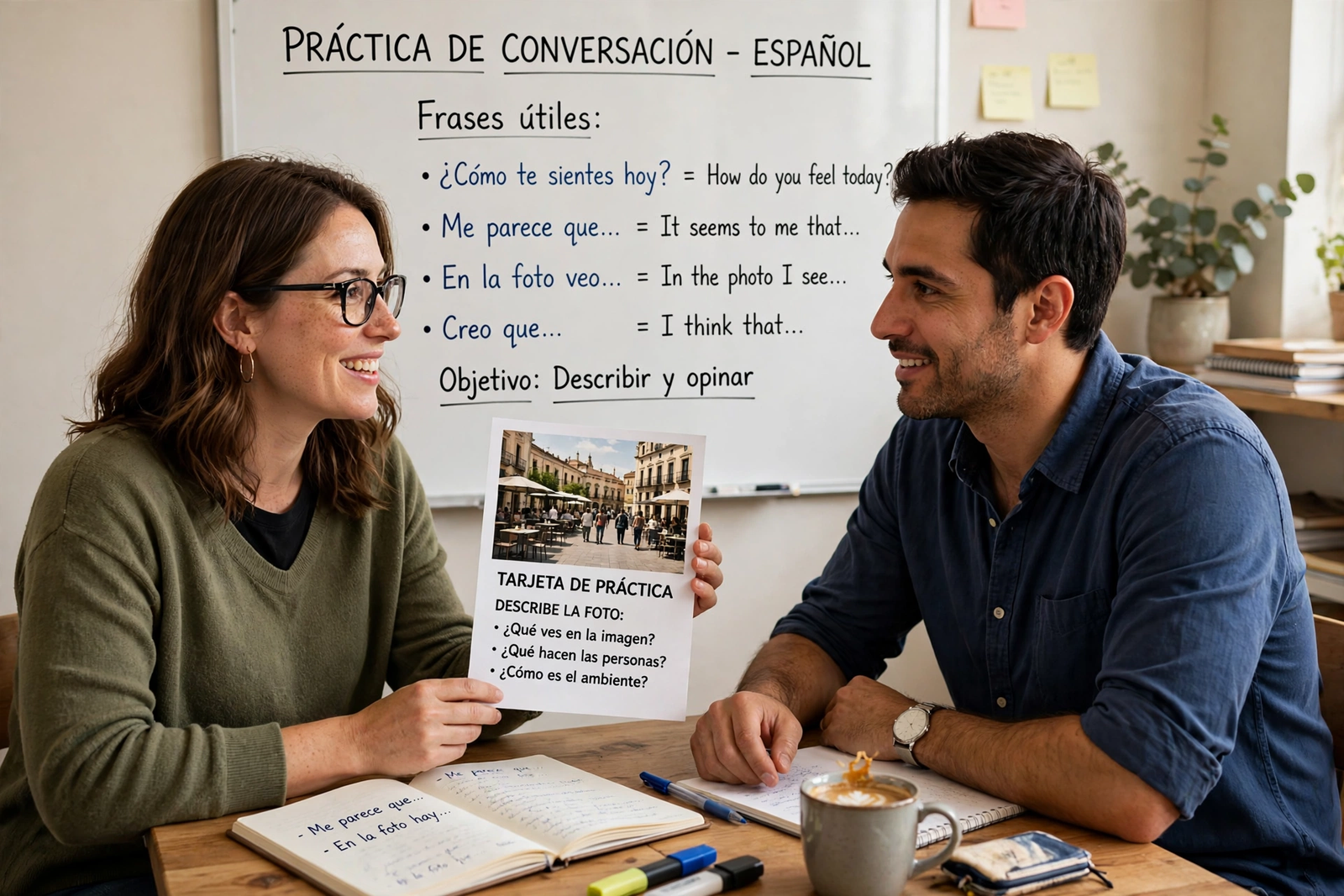
The speaking test asks you to describe, compare, and give your opinion, then defend it. Practise opinions out loud, even to an empty room, with phrases like “Me parece que…” and “En mi opinión…”.
Listen: "In the photo I see a plaza with lots of people. It seems to me that it is a sunny day and people are enjoying their coffee."
Three mistakes that cost people the diploma
1. Training only the easy skills. Reading feels safe, speaking feels scary, so speaking gets skipped. But each group must pass on its own — give your weakest skill the best hour of your day.
2. Studying grammar and never using it. Knowing the subjunctive is not the same as using it while you talk. Use every grammar point you revise in a sentence you say or write that same day.
3. Never practising under time pressure. You may write a beautiful essay in two hours, but the exam gives you eighty minutes for two texts. Start timing yourself from week four.
Your exam-week checklist
Tick it off in the week before the exam:
☐ Did one full timed mock exam and reviewed every mistake
☐ Practised describing three photos out loud, two minutes each
☐ Wrote two timed texts and checked the word count on both
☐ Listened to thirty minutes of Spanish every day this week
☐ Reviewed my connectors: en primer lugar, sin embargo
☐ Checked my exam centre, my ID, and my route there
Listen: "On exam day, I arrive early, I read the instructions calmly and I write with confidence."
Quick answers about the DELE B2 study plan
How long does it take to prepare for DELE B2?
From a solid B1, twelve weeks at about an hour a day, five days a week, is realistic — that is what this schedule is built for. From A2, give yourself six months. The honest test is a mock exam: close to the pass mark in both groups means you are ready.
Can I pass if my speaking is much weaker than my reading?
Only if you close the gap before exam day. Speaking sits in Group 2 with listening, and that group needs 30 out of 50 on its own. Strong reading cannot cover weak speaking, so make it your first session of the week.
Do I need a course, or can I self-study for DELE B2?
Many learners pass by self-study, especially with the official model exams from the Instituto Cervantes. A course or tutor helps most with writing and speaking, the two skills that need feedback. Even one conversation session a week helps.
Ready to start your twelve weeks? Our Spanish programme takes you from your first words all the way to exam day, with lessons, practice, and real conversations along the way. Pick your start date and begin with week one.
Quick quiz: how well do you know the DELE B2?
Tap an answer and see right away if you have got it.
Question 1. What score do you need in each group to pass the DELE B2?
Question 2. Which two tests form Group 1 of the DELE B2?
Question 3. What does the result APTO mean?
Question 4. How long is the DELE B2 listening test?
Question 5. On the CEFR scale, B2 means you are…