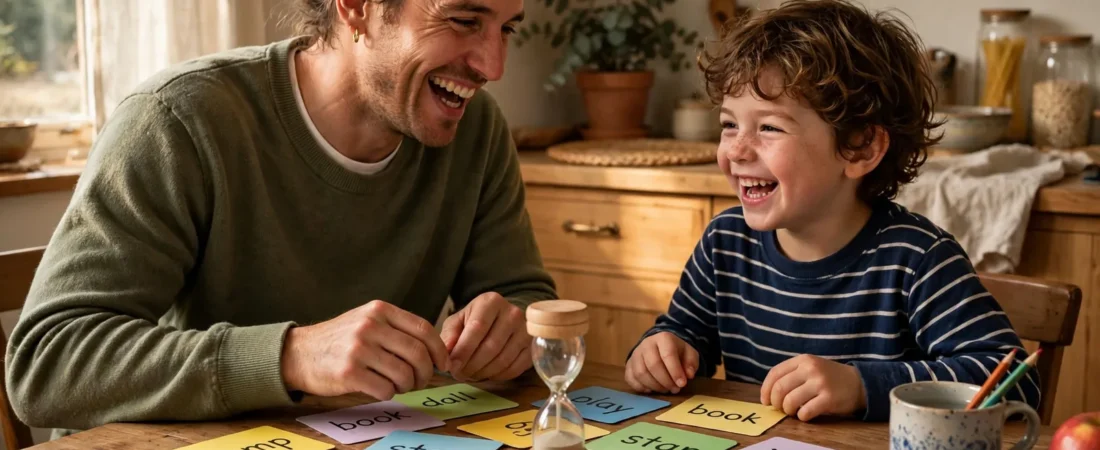
It is 5:30 in the evening. The English worksheet is on the table, your child is sliding slowly off the chair, and somebody is about to cry — possibly you. If that scene feels familiar, here is some good news: the problem is almost never your child, and it is almost never English. It is the format. The best English homework games for kids take ten minutes, need almost nothing, and turn the same words on that worksheet into something a child actually wants to do again tomorrow.
Children learn language by using it, not by staring at it. A game gives them a reason to say the word, hear it back, and say it again — three or four times in a minute, without anyone calling it “practice.” That is why the games below work. Each one targets a real skill: vocabulary, speaking, spelling, or listening. And each one fits into the gap between dinner and bath time.
Why games beat worksheets for young learners
A worksheet asks a child to sit still and be correct. A game asks a child to move, guess, and win — and correctness sneaks in through the back door. When your daughter shouts “cat!” to win a card, she has produced the word, heard herself say it, and connected it to a picture, all in two seconds. That beats copying the word ten times in a row, because her brain was awake for it.
Games also lower the stakes. In a game, a wrong answer is just a lost turn, not a red mark. Children who freeze on worksheets will happily guess and self-correct during a game, because the point is playing, not performing. And for parents, there is a quiet bonus: you do not need perfect English to play. You just need to be the player across the table.
Seven English homework games for kids, in ten minutes each
1. Word snap
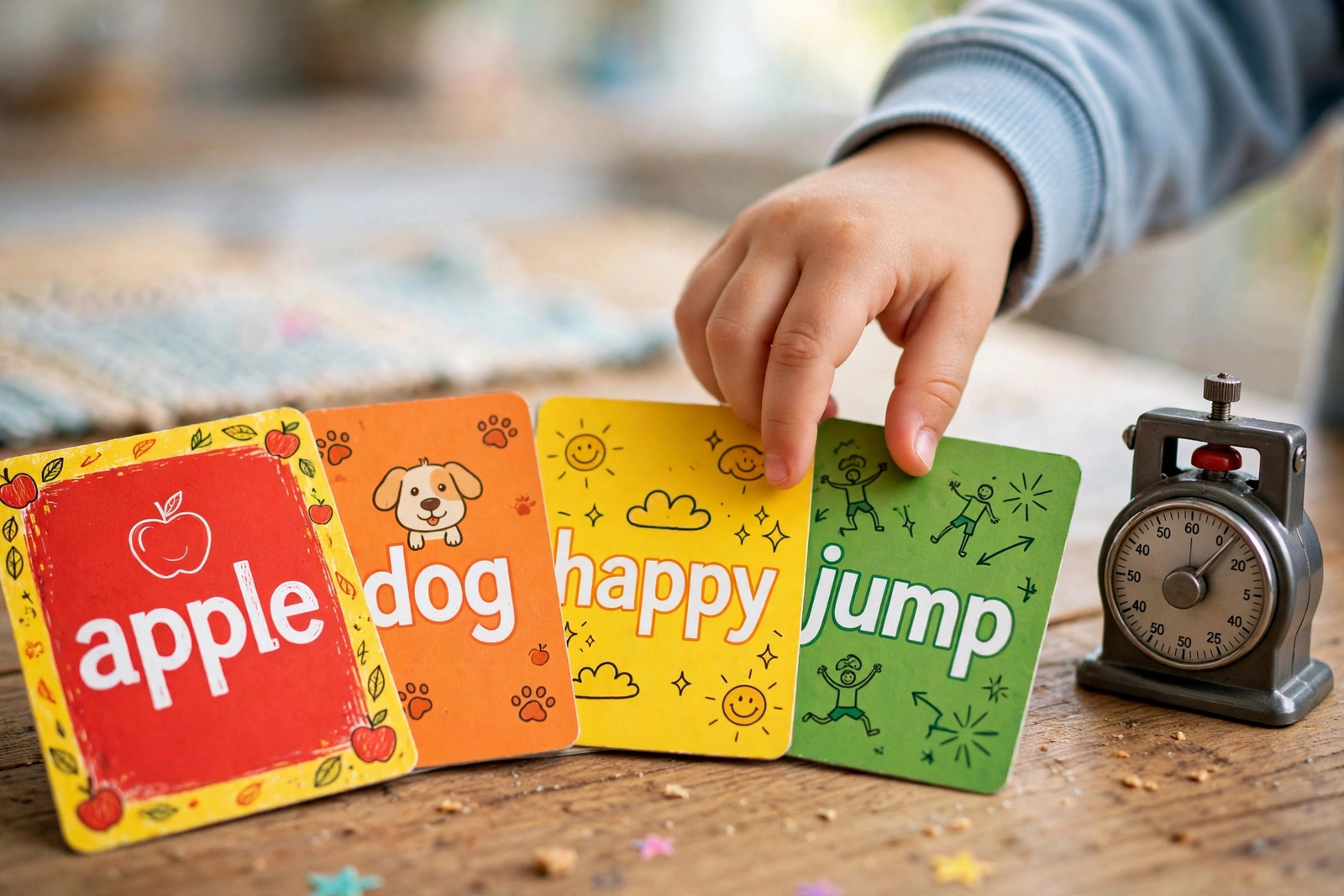
Make a set of word cards — simple words your child is learning this week, two copies of each. Deal them out, take turns flipping one over, and shout “snap!” when two match. The twist: you have to say the word before you can claim the pair. Every word gets said aloud half a dozen times.
2. Beat the timer
Set a kitchen timer for one minute. How many words can your child name from a picture — animals, food, things in the room? Write the number down and try to beat it tomorrow. Children love beating their own score — and quick recall is exactly what speaking fluency is made of.
3. The mystery bag
Put five everyday objects in a bag — a spoon, a sock, a toy car. Your child reaches in, feels one without looking, and describes it in English: “It is soft. It is small. I wear it on my foot.” Then swap roles. It is magic for adjectives and full sentences, because the child needs the words to win.
4. Story chain
Start a story with one sentence: “One morning, a cat found a red ball.” Your child adds the next sentence. You add the next. Keep going for two minutes and see where the story lands. It does not need to make sense — nonsense is better, because it keeps them talking.
5. Simon says, English edition
The classic, with a language twist: give every instruction in English, using action words from this week’s homework. “Simon says jump! Simon says touch something blue!” Children listen hard because they want to catch you out — and that careful listening is exactly what their English ears need.
6. Spelling race
Call out a word. Your child writes it — on paper, on a whiteboard, or in the air with a finger. First to five correct wins. Keep the words short and familiar, and let your child be the caller sometimes.
7. Read and act
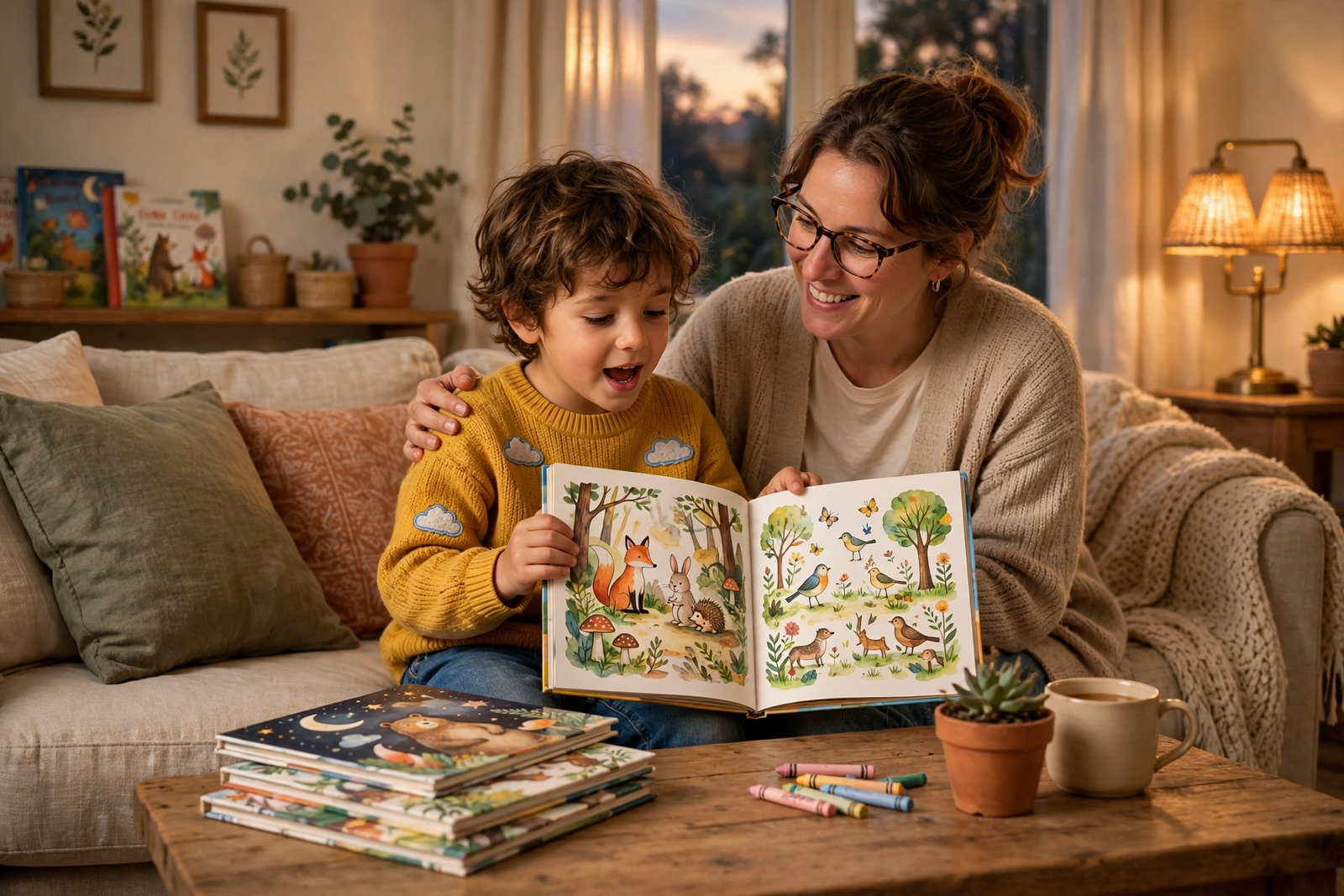
Pick one page from a picture book. Your child reads a sentence aloud, then acts it out. “The bear jumps!” means an actual jump, right there in the living room. Movement anchors memory — and reading aloud to a laughing parent is the opposite of reading aloud in front of a class.
A one-week plan you can actually keep
You do not need to play all seven games every day. Pick one a day, ten minutes, same time each evening:
| Day | Game | What it practises |
|---|---|---|
| Monday | Word snap | Vocabulary + saying words aloud |
| Tuesday | Beat the timer | Quick recall of words |
| Wednesday | Mystery bag | Describing + full sentences |
| Thursday | Story chain | Speaking + imagination |
| Friday | Simon says | Listening + action words |
| Saturday | Spelling race | Spelling + writing |
| Sunday | Read and act | Reading aloud + confidence |
After a week, ask your child which game was their favourite — and keep that one in the rotation. A game your child asks for is worth ten games you have to suggest.
Three mistakes that quietly kill the fun
First, correcting every error. If your child says “the cat runned,” resist the urge to stop the game and fix it. Just answer with the correct form — “Yes, the cat ran so fast!” — and keep playing. Children absorb the correction without the sting.
Second, playing too long. Ten minutes is the sweet spot — stop while it is still fun, while your child is still laughing. Ending early is what makes them ask to play again tomorrow.
Third, using words that are too hard. A game should use words your child mostly knows, with one or two new ones mixed in. If every card is a struggle, the game becomes a test — and tests are what you were trying to escape.
Quick Quiz
Test yourself on English homework games for kids. Click an answer to see if you are right — your score is at the top.
Score: 0/5
1. How long does each game on the list take?
2. In Word Snap, what must you do before you can claim a matching pair?
3. Which game practises describing things and full sentences?
4. What should you do when your child says the cat runned during a game?
5. According to the one-week plan, which game is played on Friday?
Quick answers
Do these games work if my English is not strong?
Yes. You do not need to be fluent — you need to be the other player. Use the words from your child’s school book, keep sentences short, and learn alongside them.
How long should English homework games last?
About ten minutes a day is enough for most children aged 5 to 10. Short, daily play beats one long weekend session, because language sticks through repetition across days.
My child hates English homework. Will games really help?
Often, yes — because the resistance is usually to the format, not the language. A child who refuses a worksheet will frequently play a game using the same words happily. Start with the silliest game on the list.
Homework does not have to be the hardest part of the evening. Ten minutes, one game, and a child who is laughing while saying English words out loud — that is a routine worth keeping. And when the games start working, you will know, because your child will be the one asking, “Can we play again?” For more ideas, our English programme has friendly lessons, songs and read-aloud stories designed for young learners and the parents cheering them on.