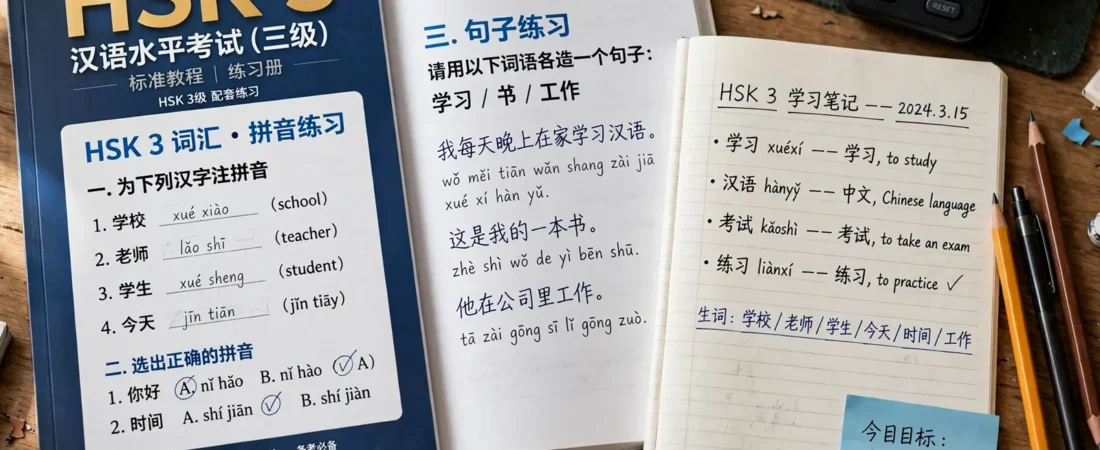
Ask any Chinese teacher which level jump causes the most groans and you will get the same answer: the hsk 2 to hsk 3 difficulty jump. Students arrive feeling confident — they can chat about their day, order food, and read short dialogues — and then HSK 3 hands them a paragraph, a longer conversation, and a blank box for characters from memory. It feels like a different exam. But it is very passable once you train for what changes instead of just studying “more Chinese”.
Why the hsk 2 to hsk 3 difficulty jump feels so big
At HSK 2, the language is short and concrete: simple sentences, brief dialogues, one idea at a time. HSK 3 asks you to hold several ideas at once. Listening passages get longer and faster, with no polite pause after every sentence. Reading moves to short paragraphs, where the answer often depends on a detail buried in the middle. And the writing section stops giving you everything: you must produce characters yourself, not just recognise them.
The vocabulary step-up tells the same story. On the older HSK 2.0 scale most courses still use, HSK 2 covers roughly 300 words and HSK 3 roughly 600 — so you are roughly doubling what you know, and the new words are more abstract: from 苹果 píngguǒ (apple) and 学校 xuéxiào (school) to 机会 jīhuì (opportunity), 决定 juédìng (to decide), and 环境 huánjìng (environment). These are words for opinions, plans, and explanations — the language of an adult life, not just a phrasebook. (The newer HSK 3.0 bands count vocabulary differently, but the step-up feels the same.)
The four changes to train for
1. Longer listening: learn to listen for the whole story
HSK 2 listening is one person telling you one thing. HSK 3 listening is closer to overhearing a real conversation: two people, a small story, a change of mind midway. The fix is to practise with passages, not just sentences: listen once for the general idea — who, where, what happened — then again for the details. And get comfortable with not catching every word: strong listeners catch the structure and fill in the rest; weak listeners freeze on one unknown word and miss the next three.
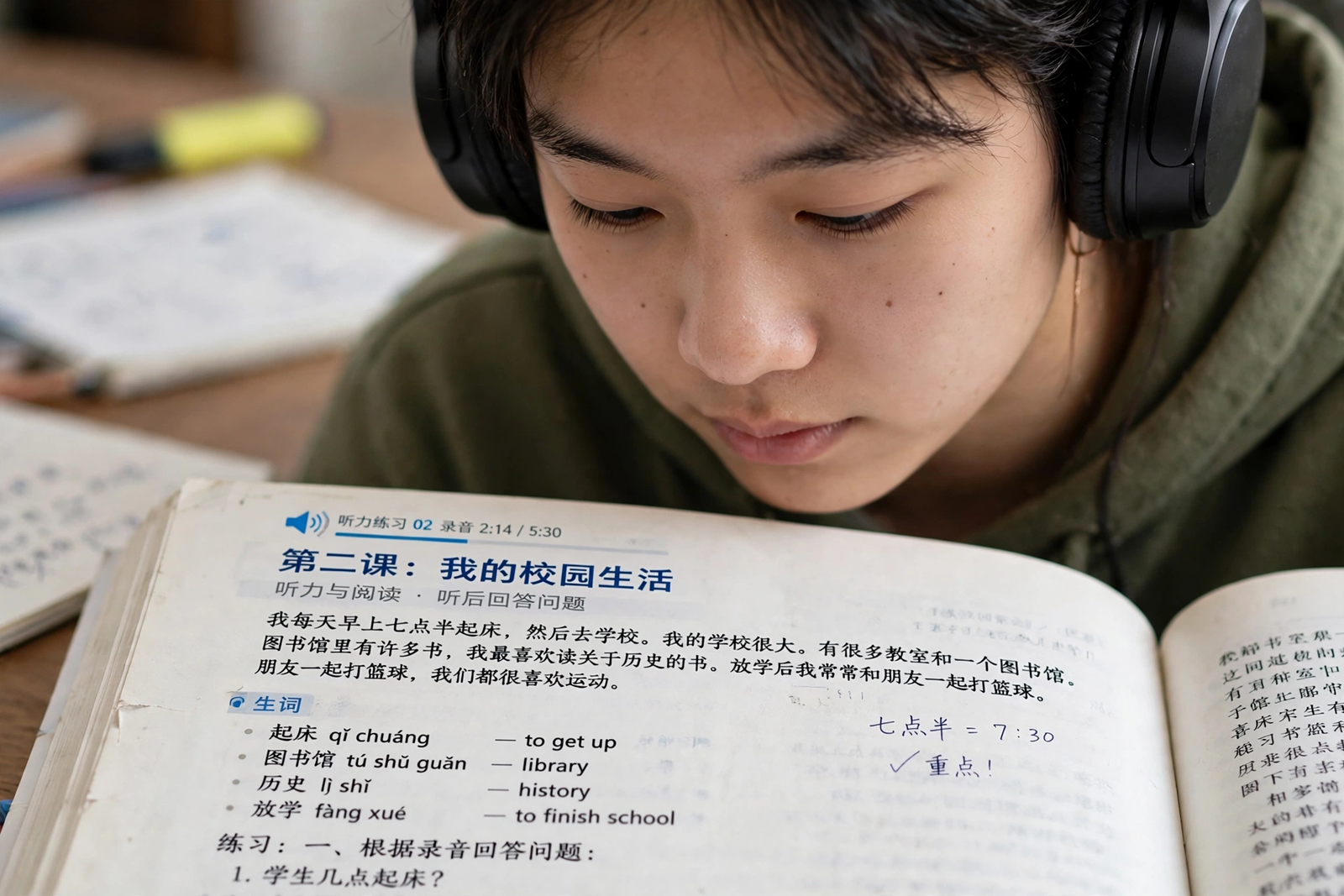
2. Paragraph reading: read for structure, not word by word
Many students fail HSK 3 reading not because their vocabulary is too small, but because they still read word by word, translating as they go. By the end of a paragraph they have forgotten the beginning. Read every paragraph twice: first pass, what is it about in one sentence? Second pass, find the detail asked about. Underline time words, contrast words, and names — they are usually where the answer hides.
3. Grammar that connects ideas
HSK 3 grammar is where Chinese starts expressing real thought. You will meet patterns that link ideas together: the 把 bǎ construction for moving things, as in 我把书放在桌子上 wǒ bǎ shū fàng zài zhuōzi shang (I put the book on the table); comparisons with 比 bǐ, as in 他比我高 tā bǐ wǒ gāo (he is taller than me); 越来越 yuè lái yuè for things that keep changing, as in 天气越来越冷了 tiānqì yuè lái yuè lěng le (the weather is getting colder and colder); and 虽然…但是 suīrán…dànshì (although…but), as in 虽然很忙,但是我每天都学习中文 suīrán hěn máng, dànshì wǒ měitiān dōu xuéxí Zhōngwén (although busy, I study Chinese every day). Learn each pattern with one example sentence you can say.
4. Writing characters from memory
This shocks people most. At HSK 2 you could lean on pinyin and recognition; at HSK 3, part of the writing section asks you to write characters yourself, and a character you can only recognise is worth nothing there. The remedy is unglamorous but reliable: write a little, often, from memory — cover, write, check. Five characters a day on a spaced schedule beats a panicked weekend of copying whole pages.

Your 8-week bridge plan
At around thirty minutes a day, eight to twelve weeks of focused bridge work after HSK 2 is realistic — longer if your schedule is tight, shorter if you read characters comfortably. Here is the shape of a bridge week:
| Day | Bridge task (30 minutes) |
|---|---|
| Monday | 15 new HSK 3 words, each written from memory once |
| Tuesday | One longer listening passage, heard twice, with questions |
| Wednesday | Two short paragraphs: gist first, then detail |
| Thursday | One grammar pattern in five of your own sentences |
| Friday | Review: this week’s words from memory, plus last week’s |
| Saturday | Timed mini-test: one listening set, one reading set |
| Sunday | Rest, or ten minutes of fun Chinese reading |
Two habits make this plan work. First, keep a “mistake notebook”: every time a question or character trips you, note what went wrong in one line. Patterns emerge fast — missed time expressions, forgotten second characters — and can be fixed. Second, do one timed practice weekly from week three onward: HSK 3 is also a time-management test, and students who never practise against the clock leave questions blank.
What to stop doing at HSK 3
Some HSK 2 habits quietly become liabilities. Reading pinyin instead of characters is the biggest: if your textbook prints pinyin above every word, cover it. Translating every sentence into English is another — at paragraph length, translation is simply too slow. And stop collecting vocabulary lists you never review: 600 words seen once are worth less than 300 you can use without thinking.
None of this means HSK 2 was wasted time: the tones, basic patterns, and first few hundred characters are the foundation HSK 3 stands on. The jump feels big precisely because you are moving from handling the language to using it: following stories, expressing opinions, writing your own thoughts. That is when Chinese starts feeling like yours.
Quick Quiz
Test yourself on the jump from HSK 2 to HSK 3. Click an answer to see if you are right — your score is at the top.
Score: 0/5
1. Roughly how many words does HSK 3 cover on the HSK 2.0 scale?
2. What is new about the HSK 3 writing section?
3. How should you read an HSK 3 paragraph?
4. How long is the bridge plan at 30 minutes a day?
5. Which pattern means ‘although… but’?
Quick answers about the HSK 3 jump
How much harder is HSK 3 than HSK 2, really?
Noticeably harder, but in predictable ways: longer listening, paragraph reading, connecting grammar, writing from memory. Each can be trained separately — which is why a bridge plan beats general studying.
How many words do I need for HSK 3?
On the widely used HSK 2.0 scale, roughly 600 words in total — about double HSK 2. Learn them in sentences, not isolated lists.
Do I have to write characters by hand for HSK 3?
Yes, in part: the writing section asks you to produce characters yourself. Short daily handwriting-from-memory practice is the most reliable preparation.
How long should I prepare before taking HSK 3?
After HSK 2, most learners need eight to twelve weeks of bridge study at thirty minutes a day — less if you read characters comfortably, more if writing is new.
The jump from HSK 2 to HSK 3 is real, but it is not a wall — it is a staircase, and every step has a name: longer listening, paragraph reading, connecting grammar, writing from memory. Train each one on purpose. Our Chinese programme walks you through the HSK levels in order, with listening, reading, and handwriting in every lesson — and you can try the free HSK 1 trial lessons to see how it teaches from the first step.